Rugby: Is it being played wrong?

Posted By on March 26, 2006

Taylor Rugby
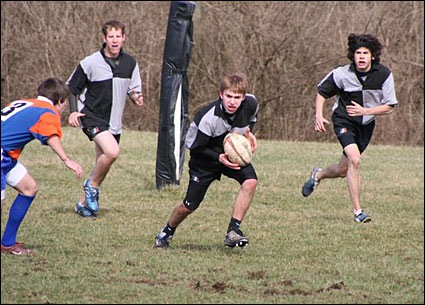
I’ve waited a week to post my concerns about the sport of rugby which is growing quickly in the United States. (far more popular in other countries) My son is a sophomore and this is his first year on the team which is comprised of students from a couple different local high schools. Rugby is a physical game requiring an array of skills from endurance, physical ‘beastliness’ and as well as practice and conditioning — which may not be sufficient. After the first two matches, the three teams involved has had, ‘in my opinion’ too many severe injuries: 4 broken legs, a broken arm, 17 stitch cut along with the usual bruises, sprains, strains, small cuts and bloodied noses. All of this in two matches mind you, so I’m not the only parent showing concern.

I decided to talk to internet friends and search statistics on Rugby. It was sort of a fishing expedition into what is normal and abnormal, yet I still couldn’t find numbers to quantify participation and injuries like I wanted. In talking to college age intermural rugby players, the first thing I found out was that there was an immediate concern from all I talked to with the number of broken bones in our first two matches. A 3rd year medical student who played rugby 3 of his undergrad years indicated that concern for his health when he was finally accepted into med school was a reason to sit out his senior year — he had too much to risk. Others had played throughout their college years and couldn’t recall anyone with a broken leg or having to call the rescue squad. Interestingly last week, the rescue squad came 3 times — the final time they sent the ladder firetruck since the rescue squads were still returning from the prior calls.

In the same vein, the players that I talked to overseas indicated a very similar story. One English ‘chap’ had played a six years without seeing this kind of carnage. He was quick to point out that the game is physical, but that sportmanship, coaching and attentive referees usually maintain game control and they should stop illegal play and dangerous hits. He pointed out that the physical conditioning of our teams might not be as tailored to rugby as it needs to be.

The biggest concern for players of rugby are for injuries to the head, particularly for those not wearing head protection. Statistics state 25% of serious rugby injuries are to the head (1). (only two out of 60 players had head protection last week) According to the Department of Physical Medicine and Rehabilitation, Indiana University Medical Center, “rugby players should be encouraged to use the limited protective gear that is allowed: wraps, tape, joint sleeves, scrum caps, and facial grease to prevent lacerations. Mouthguards are strongly recommended at any level of play and should be mandated.” Another concern is that of proper coach preparation that stresses the conditioning of players. “Coaches should be experienced and attend clinics or complete video courses on medical emergencies and safe techniques of the game. Injury frequency and severity can be decreased by adequate preseason training and conditioning, proper tackling and falling techniques, strengthening of neck muscles, and allowing only experienced, fit athletes to play in the front row.”

The concern is enough that The United States Rugby Football Foundation on January 9, 2006 granted $14,000 to study safety in high school rugby. An immediate concern to me as a parent is that the Rugby Foundation’s earlier finding was that “5% of the injuries sustained in matches were attributed directly to action that was ruled illegal activity/foul play by a referee or disciplinary committee. While referees are responsible for penalizing foul play on the field, a commitment should be made by coaches, parents, and athletes to eliminate this avoidable injury risk from the game.”

After the number and severity of injuries in the first two games, I was particularly attentive to both teams this week. Frankly, from a spectators perspective, I was not able to see anything that looked unsportsmanlike in this weekend’s match. Both teams played hard although not necessarily well. (we lost but the match was without major injury) Nevertheless, I’ve made my parenting rounds and noted concerns from other parents as well since two of the broken legs were on our team. One player continues to be on pain medicine and is still in the hospital a week after his snapped leg.

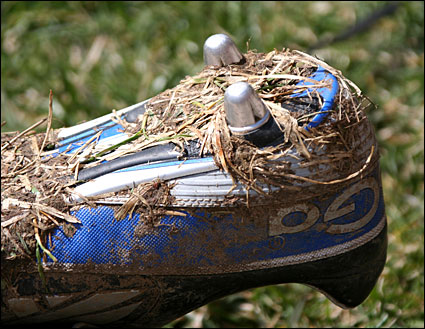
There was a time I enjoyed watching my son compete in sports … win or lose … it was fun. Now I find myself more concerned that there will be another serious injury. Thankfully so far for Taylor, he generally just comes home caked in mud (and blood, most from his own nose) and complaining only that he is sore, bruised or was stepped on with those metal cleats (2)! (also I’m going to start covering my car seats in plastic.)
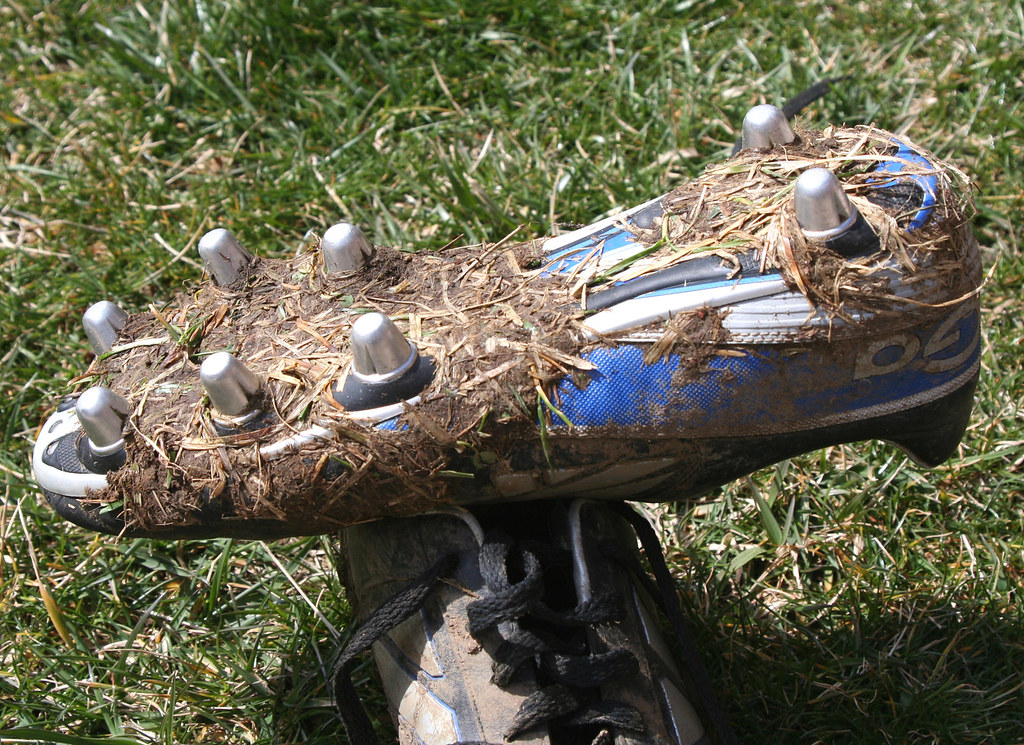
Rugby Cleat
On a side note, in the US, American style football has put an extraordinary focus on safety and improving the gear in protecting players. As a comparison I would be curious as to what kind of thought is giving to high school and college rugby safety by those administrators who oversee safety of student athletes?

Comments

  • Kyle

    American rugby inevitably draws from American football. I’ve played at the high school and college level, and have found that ex-football players populate a large portion of both teams. Football is a head-to-head collision game. It has a larger percentage of injuries at the collegiate level because of its style of play. Football is a game of yards, and so tackling with your head in front of the man, and driving him back with every muscle in your body is critical to your success. Rugby is a not a game of yards, but of possession. You need only tie up a man’s legs and let him fall forward. A tackler is actually more effective if he puts his head behind the man (near the back of the hip). Naturally, ex-football players will tend to tackle too aggressively, and usually injure themselves, their teammates, and opposing team members. In college, this problem is not as prevalent because the high stakes are instantly realized (much like in your story). In other countries , this problem is non-existent because the American football influence isn’t there.

    Tackling is just one example of how rugby takes an injurious influence from football in the states, but the entire mindset of rugby should be separated from that of football. A high degree of intensity is required to be successful in football. Short plays, quick tackles, and all out sprints make this a critical component of the game. Padding supports excessive amounts of intensity and sometimes anger by limiting a realization of consequence. In rugby, one must maintain a consistent level of intensity throughout a 80min match. Getting angry, sprinting everywhere, and tackling with maximum ferocity would only last most players about 10 minutes. Also, there is a major focus on sportsmanship in rugby with the post-game parties, and hosting visiting teams. However, this overly aggressive type of play still occurs in rugby, and injuries result. The bottom line is that Americans have a tendency to play “thugby” while they’re learning the game of rugby. Accordingly, most kids don’t ever get to play the great game of rugby. In short, I would suggest that there needs to be a focus on good coaching to alleviate the problem in this case.

  • Kyle

    American rugby inevitably draws from American football. I’ve played at the high school and college level, and have found that ex-football players populate a large portion of both teams. Football is a head-to-head collision game. It has a larger percentage of injuries at the collegiate level because of its style of play. Football is a game of yards, and so tackling with your head in front of the man, and driving him back with every muscle in your body is critical to your success. Rugby is a not a game of yards, but of possession. You need only tie up a man’s legs and let him fall forward. A tackler is actually more effective if he puts his head behind the man (near the back of the hip). Naturally, ex-football players will tend to tackle too aggressively, and usually injure themselves, their teammates, and opposing team members. In college, this problem is not as prevalent because the high stakes are instantly realized (much like in your story). In other countries , this problem is non-existent because the American football influence isn’t there.

    Tackling is just one example of how rugby takes an injurious influence from football in the states, but the entire mindset of rugby should be separated from that of football. A high degree of intensity is required to be successful in football. Short plays, quick tackles, and all out sprints make this a critical component of the game. Padding supports excessive amounts of intensity and sometimes anger by limiting a realization of consequence. In rugby, one must maintain a consistent level of intensity throughout a 80min match. Getting angry, sprinting everywhere, and tackling with maximum ferocity would only last most players about 10 minutes. Also, there is a major focus on sportsmanship in rugby with the post-game parties, and hosting visiting teams. However, this overly aggressive type of play still occurs in rugby, and injuries result. The bottom line is that Americans have a tendency to play “thugby” while they’re learning the game of rugby. Accordingly, most kids don’t ever get to play the great game of rugby. In short, I would suggest that there needs to be a focus on good coaching to alleviate the problem in this case.

  • RJ

    I am also worried about the injuries you mentioned in your post. I played for three years in college D-III and I am a current C-3 referee.

    At the high-school level and U-19, safety is the biggest concern. Players, especially in the US, are just learning the game and as the previous reply stated, are breaking some bad habits learned from football. Although injuries are bound to happen in any contact sport, the ones you are describing are most likely caused by a combination of poor technique being taught by the coaches, poor game management (by the referee) and over-enthusiasm by the players.

    If your local coach does not seem to want to address these issues (and if your son really likes the game) I would look up your local rugby union. In Ohio the high school/youth development person is chrishopps@yahoo.com (according to the Ohio rugby union website).

    If you are located in western OH, you might want to plan to attend the Cooper’s Lake tournament (near Slippery Rock, PA). Many DII and DIII collegiate teams will be there on March 29. The tournament is sponsored by Pittsburgh Rugby Club.

  • RJ

    I am also worried about the injuries you mentioned in your post. I played for three years in college D-III and I am a current C-3 referee.

    At the high-school level and U-19, safety is the biggest concern. Players, especially in the US, are just learning the game and as the previous reply stated, are breaking some bad habits learned from football. Although injuries are bound to happen in any contact sport, the ones you are describing are most likely caused by a combination of poor technique being taught by the coaches, poor game management (by the referee) and over-enthusiasm by the players.

    If your local coach does not seem to want to address these issues (and if your son really likes the game) I would look up your local rugby union. In Ohio the high school/youth development person is chrishopps@yahoo.com (according to the Ohio rugby union website).

    If you are located in western OH, you might want to plan to attend the Cooper’s Lake tournament (near Slippery Rock, PA). Many DII and DIII collegiate teams will be there on March 29. The tournament is sponsored by Pittsburgh Rugby Club.

  • http://www.myarchive.us RichC

    RJ,

    Thanks for your comments and since this particular game I’ve seen an improvement in ‘how the game is played’ in our area. I believe your comment referencing “just learning to play the game” had something to do with the number of injuries.

    Things are improving. Thanks again.

  • http://www.myarchive.us RichC

    RJ,

    Thanks for your comments and since this particular game I’ve seen an improvement in ‘how the game is played’ in our area. I believe your comment referencing “just learning to play the game” had something to do with the number of injuries.

    Things are improving. Thanks again.

  • http://www.Hotmail.com GETZ

    Uhm, hi.
    I play Highschool rugby, and it is starting tomorrow.
    But I’ve also played it for the last 3 years, and I haven’t heard of that many injuries in only 2 games, that barely happened in the whole 3 years that I’ve played. I think that that is just quite a bit insane.

  • http://www.Hotmail.com GETZ

    Uhm, hi.
    I play Highschool rugby, and it is starting tomorrow.
    But I’ve also played it for the last 3 years, and I haven’t heard of that many injuries in only 2 games, that barely happened in the whole 3 years that I’ve played. I think that that is just quite a bit insane.

  • http://www.myarchive.us RichC

    GETZ,
    Well this post was from a couple seasons ago and things have improved since then. I can’t say that I’ve noticed anything close to those injuries since. (and quite a few games have passed) Hopefully we’ve seen improvements in conditioning, coaching (not encouraging illegal contact) and officiating. All in all last season was much more enjoyable.
    http://blog.myarchive.us/?p=751

  • http://www.myarchive.us RichC

    GETZ,
    Well this post was from a couple seasons ago and things have improved since then. I can’t say that I’ve noticed anything close to those injuries since. (and quite a few games have passed) Hopefully we’ve seen improvements in conditioning, coaching (not encouraging illegal contact) and officiating. All in all last season was much more enjoyable.
    http://blog.myarchive.us/?p=751

  • Steven Paz

    If there are that many injuries in a game, maybe the kids arent being taught proper techniques to tackle. Or some if these kids take the game as being a barbaric sport and purposely tried to injure opposing players. Those are usually the football players, because they are still getting used to playing with out pads. I have played 4 yrs of rugby. I have only seen two broken bones in my entire career. I am 19 yrs old and I have played two yrs of high school and two yrs of men. Practices should be half technique work and drills, while the other half consists of full team work outs or running through some phases or breakdowns.

  • Steven Paz

    If there are that many injuries in a game, maybe the kids arent being taught proper techniques to tackle. Or some if these kids take the game as being a barbaric sport and purposely tried to injure opposing players. Those are usually the football players, because they are still getting used to playing with out pads. I have played 4 yrs of rugby. I have only seen two broken bones in my entire career. I am 19 yrs old and I have played two yrs of high school and two yrs of men. Practices should be half technique work and drills, while the other half consists of full team work outs or running through some phases or breakdowns.

  • Ted Clemens

    I have played rugby 4 years now, I’ve also played football from age 7-18 and I am just beginning my college education. 3 years I played for a high school levelm rugby team. 1 year at Men’s level, and under-20 Minnesota Selectside level (traveling all-star team).

    I have never witnessed a broken leg, i have only broken my right big toe, but that is unavoidable even in football. I’ve had my share of bloody noses also. The key to have less injuries, is fit players with proper coaching and conditioning. Rugby is an honorable game that should be played accordingly, injuries have happened where people do not wrap when they are attempting to tackle, they just fly in with a shoulder or a head or elbow. That is illegal, but it did result to a broken cheek bone and jaw of a teammate of mine, who is also a great multi-sport athlete.

    As long as the game is played by conditioned, well coached players, who play by the rules ,and such rules are enforced, the game of rugby is a great sport with little injury.

  • Ted Clemens

    I have played rugby 4 years now, I’ve also played football from age 7-18 and I am just beginning my college education. 3 years I played for a high school levelm rugby team. 1 year at Men’s level, and under-20 Minnesota Selectside level (traveling all-star team).

    I have never witnessed a broken leg, i have only broken my right big toe, but that is unavoidable even in football. I’ve had my share of bloody noses also. The key to have less injuries, is fit players with proper coaching and conditioning. Rugby is an honorable game that should be played accordingly, injuries have happened where people do not wrap when they are attempting to tackle, they just fly in with a shoulder or a head or elbow. That is illegal, but it did result to a broken cheek bone and jaw of a teammate of mine, who is also a great multi-sport athlete.

    As long as the game is played by conditioned, well coached players, who play by the rules ,and such rules are enforced, the game of rugby is a great sport with little injury.

  • http://www.myarchive.us RichC

    Thanks guys for the informative ‘first hand’ accounts — I’ve been getting a few of those over the past few years since these early Rugby posts. I’m guessing that the renewed interest means that the U.S. Rugby season is upon us once again? (FYI … my son is at practice as I write this … a new more experienced team for him this year.)

  • http://www.myarchive.us RichC

    Thanks guys for the informative ‘first hand’ accounts — I’ve been getting a few of those over the past few years since these early Rugby posts. I’m guessing that the renewed interest means that the U.S. Rugby season is upon us once again? (FYI … my son is at practice as I write this … a new more experienced team for him this year.)

  • Sean

    Hey just wanted to put some input. I use to play rugby back home in England during secondary school. The worse i ever had was a few broken fingers and some stiches but that was over 4 years of rugby not a few matches on the pitch. Truthfuly yes it is a brutal sport but to have so many things happin in two matches something is not going down the way it should be on the pitch(feild). I’ve seen a few matches here in the states and the way they go about it is not traditional rugby its more americanized rugby. Specialy in there take down and tackling. The main thing is if you have a coach trying to teach rugby that dosnt know how to teach proper tackling or is teaching american football style take downs then they are going to be more brute force then tactical like you have to do in rugby. Taking down a runner in Rugby is all about manipulating there weight to them take them down to the ground where as in american foot ball its brute force just hit the bloody hell out them till they hit the ground. Which is all peachy when you have pads out the ying yang like they do in american football. You might want to bring up these conserns with the school and find out what experince in rugby the coach has. Also what tools and techniques is he using to teach the lads how to tackle.

  • Sean

    Hey just wanted to put some input. I use to play rugby back home in England during secondary school. The worse i ever had was a few broken fingers and some stiches but that was over 4 years of rugby not a few matches on the pitch. Truthfuly yes it is a brutal sport but to have so many things happin in two matches something is not going down the way it should be on the pitch(feild). I’ve seen a few matches here in the states and the way they go about it is not traditional rugby its more americanized rugby. Specialy in there take down and tackling. The main thing is if you have a coach trying to teach rugby that dosnt know how to teach proper tackling or is teaching american football style take downs then they are going to be more brute force then tactical like you have to do in rugby. Taking down a runner in Rugby is all about manipulating there weight to them take them down to the ground where as in american foot ball its brute force just hit the bloody hell out them till they hit the ground. Which is all peachy when you have pads out the ying yang like they do in american football. You might want to bring up these conserns with the school and find out what experince in rugby the coach has. Also what tools and techniques is he using to teach the lads how to tackle.

Desultory - des-uhl-tawr-ee, -tohr-ee

  1. lacking in consistency, constancy, or visible order, disconnected; fitful: desultory conversation.
  2. digressing from or unconnected with the main subject; random: a desultory remark.