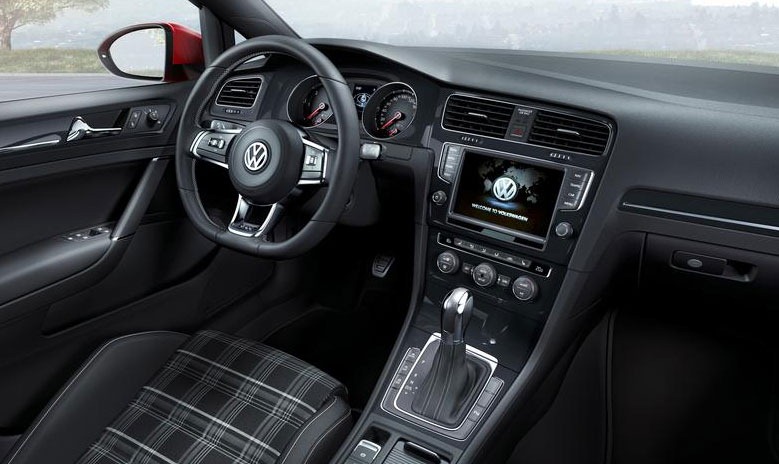
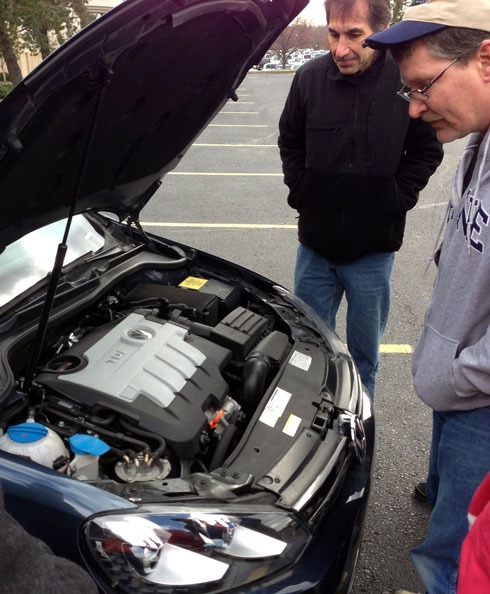
According to Car and Driver, American VW buyers have a shot at getting the 2014 turbocharged 2.0 liter diesel powered Volkswagen Golf GTD. The new performance model will resemble the gas GTI, but offer a 184 horsepower and 280 lb-ft of torque diesel. Revs for this performance are incredibly low at not much above an idle — 1750 RPMs. Transmission choices should be what is offered in Europe — the six-speed manual and a six-speed dual-clutch automatic transmission — but who knows .
Really … something has to change in Washington DC. We’re borrowing TRILLIONS, yet the President jets around playing golf while the first lady and family heads to Colorado on vacation. Sure it only MILLIONS …
In the another branch of our govenment, they pass reams of laws, bicker about raising more revenue (taxing us), pretend to discuss cutting spending (only slowing the rate of “growing government”) and haven’t even manage to pay for their own haircuts without the Senate barbershop running a deficit.
Most people probably don’t even know that the Senate Hair Care shop exists, but since 1997 it has been running deficits of about $340,000 annually. For the fiscal year 2012 taxpayers picked up the $401,000 difference. We are paying for senators’ haircuts, even though their annual salary is $174,000.
The Senate Hair Care shop only makes up a small part of the $4.3 billion budget to run the legislative branch, but what’s maddening is the fact that no one has considered cutting it. “While trimming the Senate salon will do little to balance the budget, allowing it to run such a large deficit indicates a lack of seriousness at best, and immorality at worst …” MORE
It makes the email being forwarded around all that more thought provoking!
A driver was stuck in a traffic jam on the highway outside Washington, DC. Nothing was moving. Suddenly, a man knocks on the window. The driver rolls down the window and asks, "What’s going on?"
"Terrorists have kidnapped the entire US Congress, and they’re asking for a $100 million dollar ransom. Otherwise, they are going to douse them all in gasoline and set them on fire. We are going from car to car, collecting donations."
"How much is everyone giving, on an average?" the driver asks.
The man replies, "Roughly a gallon."
Hmm … even at the uncomfortable $3.79 (I paid today), I’d probably be willing to donate a least a couple gallons.
I arrived home tonight to progress in repairing our finished basement. It was great to see such a speedy response from both my insurance company (Liberty Mutual) and the re-construction company (Paul Davis). Who knows, at this speed we may be back to normal by March?
I forgot to add a couple of photos from Katelyn and Drew’s visit this weekend in order to finish up their wedding invitations … of course we all forgot that the Post Office was close Monday — Presidents’ Day. I suppose one more day won’t hurt?
Also noticed the new bulbs are popping up already in mid-February; it seems a bit early considering it is still winter!
Although I’ve only used Posterous to update MyDesultoryBlog by email, I’m going to miss having a place to quickly send text, photos and video for personal archiving. It was a great product while it lasted … an all the coded shortcuts very cool.
So tonight I’m doing the “back-up” of data … and will figure out if I really want to bother with including anything in my WordPress blog (a few photos perhaps?) … probably not.
Posterous launched in 2008. Our mission was to make it easier to share photos and connect with your social networks. Since joining Twitter almost one year ago, we’ve been able to continue that journey, building features to help you discover and share what’s happening in the world – on an even larger scale.
On April 30th, we will turn off posterous.com and our mobile apps in order to focus 100% of our efforts on Twitter. This means that as of April 30, Posterous Spaces will no longer be available either to view or to edit.
Right now and over the next couple months until April 30th, you can download all of your Posterous Spaces including your photos, videos, and documents.
When we were first married, we had an old hand-me-down clothes dryer from my in-laws … along with an electric “Maytag ringer washer” that came with our first house. The dryer was about 20 years old when we first started using it and lasted another 15 years or so and could be easily self-repaired.
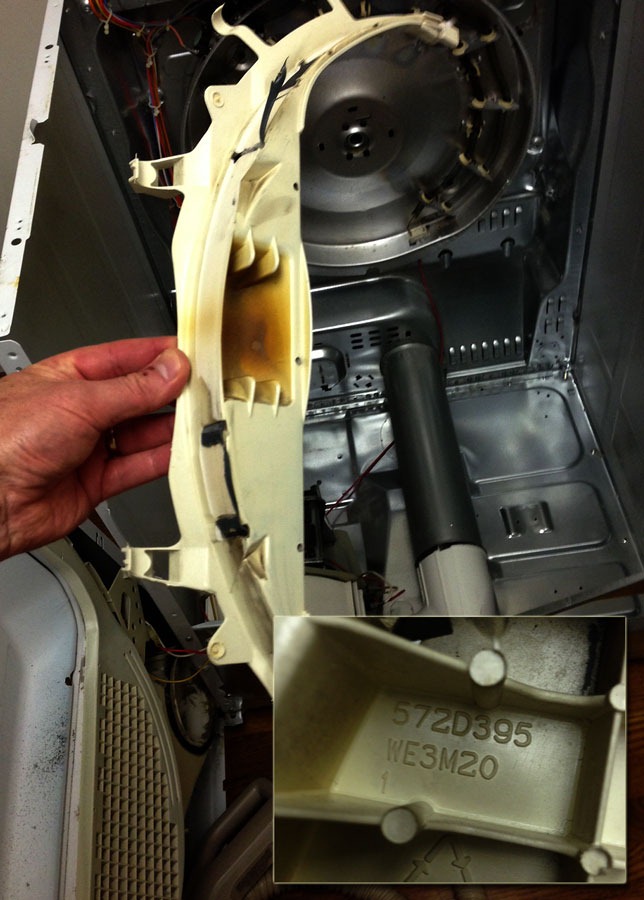
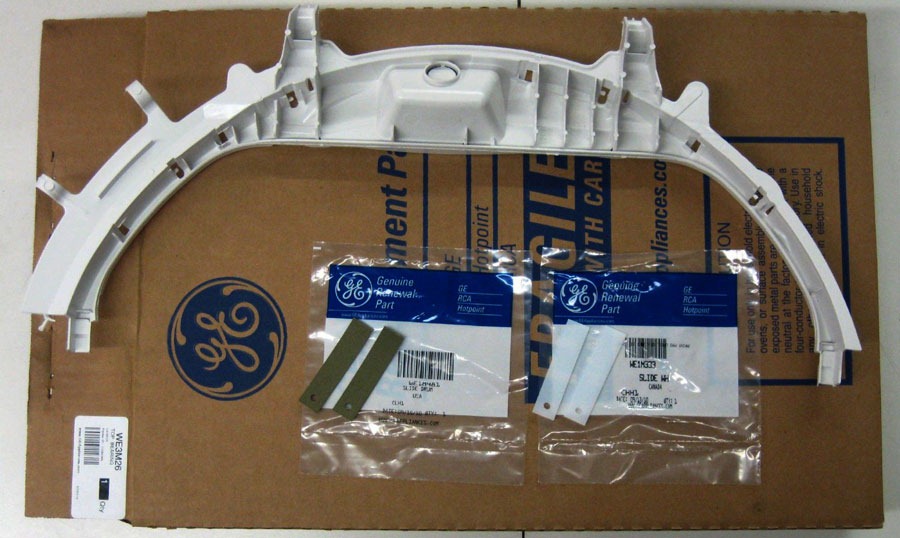
When we moved to Cincinnati, we bought a new matching GE washer and dryer with cheapened knobs and a variety of less durable molded plastic parts – some that I’ve complained about before. The ease of access in order to diagnosis is also an issue … as I found out while tracking down a dryer squeak. The photo to the left shows the “fail” … the Teflon slide bearings wear and eventually the drum grinds down the plastic housing. I suspect buying a new dryer would have been much easier than tearing apart the dryer (what a pain) as well as the hassle in shipping when ordering a new surround and bearing kit – it still isn’t here! ($21.75+sh)
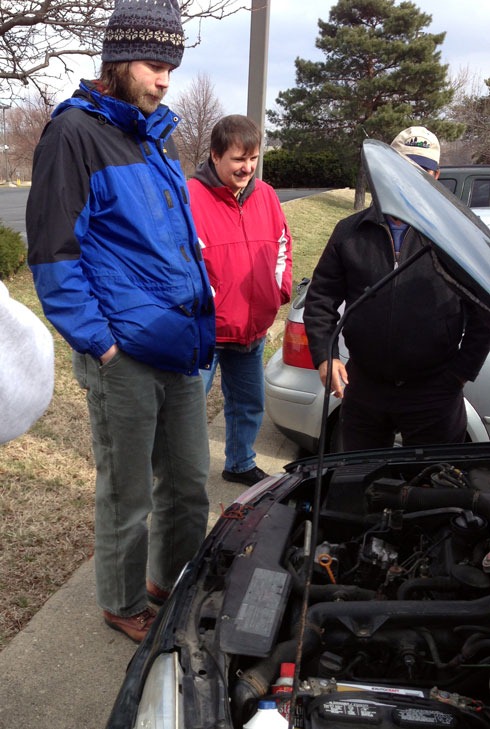
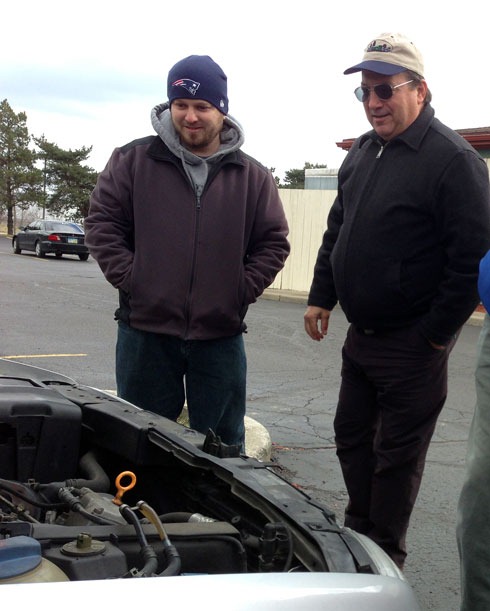
A handful of CinciTDI friends gathered on Saturday at Roosters in Fairfield Ohio with our Volkswagen TDIs and stayed warm inside most of the time for just a social get together (GTG). That’s not to say a few cars didn’t need a bit of "wrenching," but the temperature and wind chill would not have have made that a pleasant task – besides we only intended to talk and eat. (a few more photos below)
Shared per Emily Stewart of Online MBA blog … Thanks.
Global economists are keeping their eyes glued to the Asia-Pacific region, where a bitter feud is brewing between two of the world’s most powerful nations over a small collectivity of islands in the East China Sea. The Chinese government argues that a treaty signed during the first Sino-Japanese War (1894-95) conferred ownership of the islands to China. Japan has long disputed these claims, and today argues that the islands are integral to its national identity.
The argument came to a head last September, when a boycott of Japanese products led Chinese demonstrators to target fellow citizens who owned Japanese cars. Three months later, the situation escalated when when Japanese jets confronted a Chinese plane flying over the islands; no shots were fired, but the act of antagonism has set a troubling precedent between the military forces of both nations.
The conflict between China and Japan has put the United States in a precarious position: if a full-scale war were to erupt, the U.S. would be forced to choose between a long-time ally (Japan) and its largest economic lender (China). Last year, China’s holdings in U.S. securities reached $1.73 trillion and goods exported from the U.S. to China exceeded $100 billion. The two countries also share strong economic ties due to the large number of American companies that outsource jobs to China.
However, the U.S. government may be legally obligated to defend Japan. In November, the U.S. Senate added an amendment to the National Defense Authorization Act that officially recognizes Japan’s claims to the disputed islands; the U.S. and Japan are also committed to a mutual defense treaty that requires either country to step in and defend the other when international disputes occur. Not honoring this treaty could very easily tarnish America’s diplomatic image.
The countries of the Asia-Pacific region are collectively responsible for 55 percent of the global GDP and 44 percent of the world’s trade. A major conflict between the region’s two largest economies would not only impose a harsh dilemma on U.S. diplomats, but also have a significant impact on the entire global economy. It is in every nation’s best interest that the Chinese and Japanese settle their territorial dispute peacefully.
Video Transcript
Whispers of the unthinkable are wafting throughout the Asian-Pacific Region: war between China and Japan over a small cluster of resource rich islands in the East China Sea claimed by China (Diaoyu) and Japan (Senkaku).
In September, the dispute quickly came to a boil. Fueled by nationalism and the memory of Japan’s brutal occupation of China during World War II, enraged Chinese crowds filled the streets. They targeted owners of Japanese cars and launched a massive boycott of Japanese products, sending a debilitating gut punch to Japan’s still struggling economy. In November, the Wall Street Journal Live reported that the boycott had cost Japanese companies “billions of dollars.”
Since then, both nations have flexed their military muscle. In December, Japan scrambled jet fighters to respond to a Chinese plane flying over the islands. Although no shots have been fired yet, such dangerous confrontations are likely to continue.
Should the crisis worsen from its current status to, say, missiles launched and a ship sunk or an airplane knocked out of the sky, the United States will be forced to choose between backing a longtime ally (Japan) and supporting a nation more central to our economic health (China).
In terms of economics, China has the clear bottom-line edge, serving as America’s biggest lender. As of September, China’s holdings in US securities ($1.73 trillion) topped the global list of creditors.
In terms of trade, the most significant US relationship in the Asia-Pacific Region is with China – by far. According to the Office of the US Trade Representative, the export of US goods to China amounted to $104 billion in 2011, while exports to Japan over the same period were $66.2 billion.
Then there’s the extensive outsourcing by American companies, which ties the economies of China and the US even closer. A case in point is Apple, which designs its iPhone and other products in the US, but has them assembled at China’s massive Foxconn City facility.
All of this could be put at risk if the US sided with Japan in the current dispute – and the Chinese retaliated. A boycott would obviously harm American companies that ship agricultural products as well as cars and other finished goods to the Chinese market. Less clear is whether Chinese anger would extend to US firms such as Apple, which have deeper Chinese economic roots.
There’s also the possibility that China, to punish the US, could sell off its stash of US securities, a move that would devalue the dollar. It’s possible but not likely, at least according to a December report by the Congressional Research Service. Among other consequences, such a sale “could diminish the value of these securities” and “lead to large losses” for China.
In November, the US Senate unanimously approved an amendment to the National Defense Authorization Act recognizing Japan’s administration of the Senkakus and opposing the use of force. The Japanese cheered, and the Chinese howled. But the provocative sentiment expressed in the amendment should be no surprise.
In 2011, President Obama announced a major foreign policy shift. He declared that the Asia-Pacific Region – which generates “approximately 55 percent of world GDP and about 44 percent of world trade” – would be a top US security priority. The declaration was couched in normal and nuanced diplomatic niceties.
It could also prompt the Japanese to scrap their antiwar constitution – adopted after the US However, China and the other nations of the region weren’t fooled.
For the United States, China is a classic “frenemy” – an economic partner, a rival, and a potential enemy that has upgraded its military capacity and used it to reinforce its claim to other disputed islands in the South China Sea.
More importantly, the US and Japan – which is home to ships of the powerful US Seventh Fleet – are bound together by a mutual defense treaty, which commits the US to defend its longtime ally. US failure to support Japan would undermine US credibility not just in Japan but throughout this strategically important region. Firebombing of Japanese cities and the atomic devastation of Hiroshima and Nagasaki during World War II – and commit their deep pool of technological skills and talent to a single goal: a massive rearmament program that could include nuclear weapons. No one doubts that the Japanese, have the capacity to become a world-class military power – an outcome no rational person wants to see.
Should a shooting war erupt, the US will side with Japan despite the nightmarish economic scenarios that could follow. The challenge facing US officials and diplomats in 2013 is to help China and Japan find a face-saving way to keep the dispute from getting that far.
A friend of mine recommended adding the PrivacyFix plug-in to Mozilla Firefox and Google Chrome browsers. The install was simple on both and checks a variety of user adjustable privacy setting on Facebook and Google. After completing the 3 minute multi-step check, there is a option to install a small monitor icon on the browser header. Simple and hopefully clean enough not to slow down the browser or cause any issues. Check out the ReadWrite.com review.
Instantly check your privacy settings across Facebook, Google and the other websites and companies collecting your data. Get to the fix with one click. Know when policies change.