Posted By RichC on June 23, 2011
 Subject line stated in a Jerry Seinfeld voice …
Yes … I stopped in on my daughter this week while traveling and enjoyed seeing her new apartment a bit more organized that when she moved in. The new “orange” wall was bold for my taste but brightened her living room and kitchen up. We enjoyed a brunch together (I’m going to miss seeing her weekly for dinner) and both fixed the shelf and proceeded to break another part while reassembling. She probably suspected it was something I purposely did as an excuse to visit again?

Besides archiving a photo of her apartment, I’m going to include a recipe below that I’m hoping to eventually try …
How To Make Perfect Pulled Pork:
An Ideal Recipe for Serving a Crowd (and Cheap, too)
“Anything worth doing is worth doing slowly.” –Mae West
With smoke woven through shards of moist meat, potent bits of strongly seasoned crust mixed in, and a gentle splash of barbecue sauce. It is perfect for feeding large crowds, especially because it is cheap and you can do it well on any grill or smoker.
The best pulled pork is made from a hunk of meat that is woven with flavorful fat and connective tissue loaded and not much good for anything else. That’s the story of the origin of Southern barbecue. A cheap cut of meat that the slave owners didn’t want, that, as the slaves discovered, when cooked low and slow, when the fat and collagens melt the muscle fibers are mad tender, moist, and succulent. Like buttah. And the process, which can take 8 to 12 hours or more, is the quintessence of Southern smoke roasting. Lazy, slow, easy, fragrant. You set up a lawn chair, sip a cup of coffee as you put the meat on in the morning, as the sun gets high, you switch to cool refreshing beer, mid-day a mint julep refreshes the palate, and as the meat approaches doneness, with the sun setting, you switch to straight Bourbon (read on for more on “the stall”).
Pulled pork is a great place for the beginner to start experimenting with smoke cooking. A big clod of meat is a lot more forgiving than ribs. And you can do it right on practically any grill with a lid.
In North Carolina there is a controversy, to put it mildly, over what part of the hog to use for pork sandwiches. In the eastern part of the state, most joints cook the whole hog, chop the meat, and mix it all together. They feel that the unique textures and flavors of the different muscles makes the meat more interesting. They love going to “pig pickins”, meals where a hog is cooked, boned, chopped, doused with sauce, and displayed in its skin on a buffet so folks can pick the meat they want with tongs.
Inland and in the foothills of North Carolina, the preference is for shoulder meat. Frankly, I’m with them. Pork shoulder is the cut that is best for texture and flavor, and it has the added benefit of being inexpensive, often under $2 per pound. A full pork shoulder can weigh 8 to 20 pounds and has two halves, the “picnic ham” and the “Boston butt”. The picnic ham, runs from the shoulder socket through to the elbow. A picnic ham is not a true ham. Hams come from the rear legs only. The picnic usually weighs from 4 to 12 pounds.
The top half of the shoulder, from the the dorsal of the animal near the spine through the shoulder blade, has too many names: Boston butt, pork butt, butt, shoulder butt, shoulder roast, country roast, and the shoulder blade roast. Calling it a butt may seem ironic because it comes from the front of the hog. No ifs ands or butts, it makes the best sandwich meat on the hog.
Why is it called a butt? Some say that because, when trimmed, the butt is barrel shaped, and barrels were often called butts by English wine merchants. Others say that they are called butts because they were shipped in barrels. And one can only speculate why it is called the Boston butt, but my friends in New York have offered some unkind suggestions.
Butts can weigh from 4 to 14 pounds and they usually have shoulder blade bones in them although some butchers remove the bones and sell “boneless butts”. There is some evidence that the bone adds flavor, so I buy bone-in butts. Butts are often are tied with string because they fall apart easily. It is not unusual to find partial butts in the 4 to 5 pound range. These small cuts are especially nice because they cook quicker and there is a lot of the crispy, crusty surface, called bark, or Mrs. Brown by aficionados.
Perfect Pulled Pork Recipe
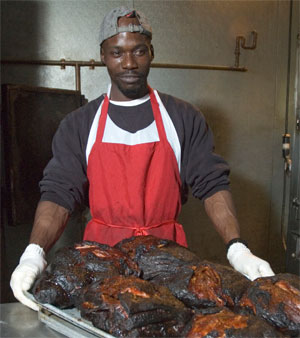 Yield. 3.5 pounds of meat, enough for 10 generous sandwiches. Leftovers freeze nicely.
Preparation time. 10 minutes to trim and rub the meat, and up to 24 hours to let it marinate in the rub.
Cooking time. Allow 8 to 12 hours or 1.5 to 2 hours per pound at 225F. If you kick the temp up to 280F, you can cut cooking time to about 1 hour per pound. Allow plenty of advance time and if necessary, use a beer cooler as a faux Cambro to hold the meat.
Pulling time. 30 minutes if you do it with your fingers, 10 minutes with Bear Paws.
Toolkit
1 grill or smoker with lots of fuel
1 digital meat thermometer, preferably with a probe and a cable
1 alarm clock
1 lawn chair
1 good book
6 pack of beer
1 pair of shades
plenty of food themed tunes
sun tan lotion
Ingredients
1 pork butt, about 5 pounds
3 tablespoons of vegetable oil
1/3 cup pork spice rub, click here for my recipe for Meathead’s Memphis Dust
2 cups wood for smoke
10 kaiser rolls or hamburger buns
1 cup of your favorite barbecue sauce (I prefer the South Carolina mustard sauces).
Skip the marinade, injections, and brines. Some folks like to inject butt with an internal marinade. Typically they will do something like mix about 4 tablespoons of their rub with 1 cup of warm apple juice and pump it deep into the meat. Some even use chicken stock. I don’t bother. I think this cut is moist enough on its own and injecting can mask the flavor of the pork. When I am judging, and the meat tastes more like apple juice than pork, I mark it down. Most competition cooks inject, but if you cook it properly, you don’t need to inject. Marinating will not penetrate a big hunk very far, so don’t bother. I love brining pork chops, but to penetrate such a large thick hunk of flesh, you would need to brine the meat for more than a day and even then the penetration would be shallow and uneven. Use a good rub, and let the smoke flavor it. Keep it simple.
For more crust. Purists will fall out of their lawn chairs when they read this, but a good shortcut is to buy large butts, about 10 pounds, and cut the meat into hunks of about 5 pounds. This will give you more surface area with more crunchy, tasty bark, more smoke penetration, and significantly speed the cooking. The tradeoff is that the meat will lose a little moisture.
Do this
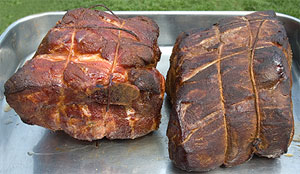 1. Trim most of the of fat from the exterior of the meat but not all of it. Leave no more than 1/8″. Some folks like to leave it all on hoping it will melt and baste the meat, but I want the seasonings on the meat, not on the fat, and I want the meat to get a crunchy flavorful, seasoned bark. Most of the butts I cook are 4 to 6 pounds, pretty well trimmed, and tied with butcher’s twine to keep them from falling apart. If yours is not held tied, hogtie it something like the picture at right. Don’t worry if it isn’t fancy, you’re going to throw it out, just rope it so it doesn’t fall apart.
2. Rinse and thoroughly dry the meat. Oil the meat with vegetable oil, coating all surfaces. This will help the rub adhere and also help dissolve the oil soluble flavors in the rub and carry it into the meat. Some folks like to slather it with yellow mustard first. I have tried it this way and I do not think it does anything noticeable. Besides, mustard does not contain oil, so oil soluble flavors don’t dissolve. Cover your butt (ahem) generously with rub. Use my recipe for Meathead’s Memphis Dust. Yes, it has sugar and salt in it, but they are helpful in forming the flavorful crust. Let it sit in the fridge for a few hours or, better still, overnight.
3. Insert a digital probe like the Maverick ET-73 and position the tip right in the center. Make sure it is not touching the bone or within 1/2″ of the bone. Fire up the grill or smoker to about 225F and set it up for 2-zone indirect smoke cooking (click here for gas grill setup, click here for charcoal grill setup, click here for Weber Smokey Mountain or bullet smoker setup, and click here for offset barrel smoker setup). Put the meat on, right on the grate, not in a pan, add 1/2 cup of wood chips, pellets, or chunks to the coals, and go drink a coffee. Go make your sauce, slaw, and beans. Go watch the game. Then cut the lawn. Wash the windows. Smoke a cigar. Make love to your spouse. Unfold the lawn chair and read a book with a beer. You’ve got plenty of time. Just check your cooker every hour or so to make sure the fuel is sufficient and you are holding at 225 to 250F. If it goes up to 300F, don’t worry. Butt is forgiving. But try to keep it down under 250F. Add additional doses of wood, 1/4 cup at a time, every 30 minutes for the first two hours. Don’t open the cooker to spritz or mop the meat (read my article on Basting, Spritzing, and Mopping). Opening the lid only screws up the temperature and humidity in the cooker so keep it to a minimum.
Allow 1.5 to 2 hours per pound but it might take more or less. Each hunk of meat is different, and rain, wind, ambient temp will impact cooking times. The temp will rise steadily to about 140 to 150F. and slow down for a looooonnnng while as moisture moves to the surface and the collagens turn to liquid. It might hold there for an hour or more. This is called “the stall” or “the zone”. Don’t panic and don’t crank the heat. Be patient. Magic is happening. Click here for more about meat science.
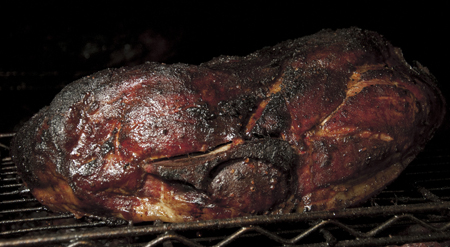 Option. Most competition cooks use a technique called the Texas Crutch. Some will wrap their butts tightly in a couple of layers of heavy duty foil when it hits about 170F or the color they like, add about 1 cup of apple juice or some other secret elixir to the package, and put it back in the cooker. Others put the meat in an aluminum pan on a roasting rack to keep it out of the liquid, add the apple juice, and cover it tightly with foil. The process allows the meat to cook in a high humidity environment and that seems to tenderize it a bit. Then, when the temp hits about 190F, they’ll take off the foil, put it back in to firm up the surface, and then it’s on to the next step. The Crutch is a nice touch, and it works, but most of the time, I don’t bother.
4. Is it ready? When it hits 190F, it may be ready, and it may not be ready. But it’s time to check. The exterior should be dark brown. Some rubs and cookers will make the meat look black like a meteorite, but it is not burnt and it doesn’t taste burnt. There may be glistening bits of melted fat. On a gas cooker it may have some pink. If there is a bone, use a glove or paper towel to protect your fingers and wiggle the bone. If it turns easily and comes out of the meat, the collagens have melted and you are done. If there is no bone, use the “stick a fork in it method”. Insert a fork and try to rotate it 90 degrees. If it turns with only a little torque, you’re done. If it’s not done, close the lid and go drink a mint julep for 30 minutes. If the internal temp hits 190F but the meat is still not tender, reduce the heat in your pit to about 190F and hold it there for as much as another hour. It should then be done. If not, you’ve just got a tough butt. Wrap tough butts in aluminum foil and let them go for another hour, but don’t take them above 200F or else the muscle fibers will start giving up moisture and toughen. If you can’t control the temp on your cooker, wrap the meat in heavy duty foil and move it indoors into a 190F oven.
 The fast method. After two hours of smoking at about 225F with lots of smoke, put the meat on a roasting rack in a roasting pan and pour a cup of water or apple juice into the pan. Cover the meat with foil and fasten the foil tightly to the edges of the pan so the meat is in a nice enclosed environment. Roast in the oven at 350F for another 2 to 3 hours or until the temp hits 190F and it passes the fork test, above.
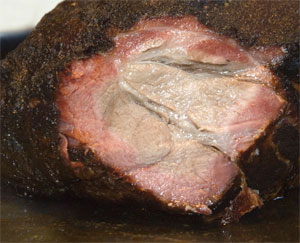
5. When it is finally ready, go ahead, take a taste. You should notice a thick flavorful crust, and right below you’ll see the telltale “smokering”, the bright pink color caused by smoke mixing with combustion gases and moisture. Let it rest for 30 to 60 minutes. If you are more than an hour from mealtime, you can leave the meat on the cooker with the heat off or put it in the indoor oven and hold it there by dialing the temp down to about 150F. If you are more than two hours from mealtime, wrap it in foil to keep it from drying out and hold it at 150F. If you are taking the meat to a party, use a faux cambro, which is nothing more than a tight plastic beer cooler in which you can hold the meat. Leave the probe in the meat, wrap the hunk tightly in foil, wrap the foil with more towels, and put it the whole thing in the cooler. Fill up the cooler with more towels, blankets, or newspaper to keep the meat insulated. Hang the thermometer cord over the lid of the cooler, and close it tightly. Plug the cord into the readout and make sure it never drops below 145F. Just know that this technique will soften the bark and change the texture of the meat very slightly.
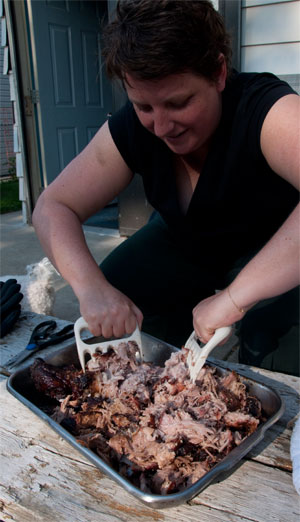 6. About 30 minutes before sit down, put the meat into a large pan to catch drippings. Pull the clod apart with Bear Paws, gloved hands, or forks. Discard big chunks of fat. If you wish you can slice it or chop it like they do in North Carolina, but I think you lose less moisture by pulling it apart by hand since the meat separates into bundles of muscle fibers, hence the name pulled pork. Try not to eat all the flavorful crusty bits when you are doing the pulling, and distribute them evenly throughout. Make sure you save any flavorful drippings and pour them over the meat.
For big parties I will smoke 3 or more butts, pull them, and then put them in a big pan. I add about 1/2 cup of water per 5 pounds, and about 1 tablespoon of butter per pound. I carry it to the party in a cold cooler. When I get to the party I heat it in a slow cooker. Occasionally I will add the sauce before I leave to make sure it is moist and easy to serve. Just don’t use so much sauce that you can’t taste the meat and the smoke.
Serving pulled pork
There are so many wonderful ways to serve pulled pork. It is marvelous just piled warm and steaming on a plate. So many people make the mistake of dumping a bottle of sauce over the meat. Please don’t. The taste unadorned and unadulterated, hot from the smoker, is the quintessence of porkdom. Serve it nekkid. Urge people to taste it nekkid. Then, if they wish, they can put a little sauce on the top.
Here are a few other suggestions
The classic pulled pork sammich. Mound it high on a nice bun. Top it with a small amount of your favorite sauce. This is where the Carolina vinegar and pepper sauces really shine. Here’s my recipe for Lexington Dip, and here’s my recipe for East Carolina Kiss & Vinegar. They soak in nicely and, if you go easy, really compliment the flavor. Try my Lexington Dip. I also love the mustard sauces like my South Carolina Mustard Sauce but my favorite is my herbaceous Grownup Mustard Sauce. I like my pulled pork with chopped raw onion mixed in. My wife likes her onion grilled and on top. Sometimes we chop up raw apple and mix it in, too. Sometimes I slice the roast rather than pull it and douse it with a classic Texas sauce, which is thin and more like a gravy. It lets the meat flavor come through without masking it. I know folks who like to garnish it with sliced tomato, pickle chips, and a raw onion slice.
Mound it on a bun with slaw, South Carolina style. In many places in the South folks often crown a pulled pork sandwich with slaw (use my Creamy Deli Slaw). Barbecue champ and instructor Jack Waiboer of Charleston tops his slaw with dill pickle chips and thin sliced Vidalia onions, and calls it the “Carolina Crusher.”
With melted cheese. My BBQ buddy Mark Stevens in NJ says he takes “A nice bit of pulled pork, a thin slice of onion, a slice of pepper jack cheese, a good glug of Hoboken Eddies Mean Green Roasted Pepper Sauce” and puts it all on buttered white bread. He then places the sandwich in pie iron, butter side out, and cooks it over a fire until golden brown and the cheese is melted.
Carnitas. Bill Martin, a friend in Texas, likes to cut smoked butt into 1/2″ pieces and fry them in a pan with some of the fat that dripped off. When crisp they make wonderful carnitas tacos, he says.
Rollups. Roll it in a tortilla with chopped onions, chopped tomatoes, jalapeno pepper, shredded cheese.
Leftovers
I always cook up more pulled pork than I’ll use. I mix the leftovers with a bit of barbecue sauce, and freeze it in two-serving portions in zipper bags. The sauce prevents freezer burn. Pop one in the microwave and you’ve got a great emergency meal for two. Pulled pork the following day can be heated in the microwave. But it will be a bit drier than the first day, so bring back some life with a splash of water, apple juice, or barbecue sauce.
- I love to make a killer app with pulled pork: jalapeno poppers. Split jalapeno peppers in half, scoop out the seeds and hot ribs with a spoon, and chop off the stems. Mix 1 part leftover pork with sauce and 2 parts fresh chevre or another cream cheese, and fill the peppers. Grill over a medium-low heat until the cheese is soft, and the peppers begin to char.
- Try adding pulled pork to nachos.
- In South Carolina, leftover pulled pork is often used in making “hash.” The recipe varies from place to place, but it is typically a stew of pulled pork, pork liver, onion, and mustard sauce, served over white rice. Sounds plebeian, but I think it’s ambrosia.
- Another nice dish is pulled pork in Louisiana Dirty Rice. Classic Dirty Rice is white rice mixed with cooked chicken livers and giblets and the “holy trinity”, which is sauteed green pepper, onion, and celery. But you can substitute or add pulled pork and amp it up.
- Here’s something fun: Plop some on top of a baked potato.
- Joe Wells in Arkansas says he puts the leftovers in “Brunswick stew, baked beans, mixed with scrambled eggs, hash, the list goes on and on.”
- Sandra Aylor of Memphis sez: “With the leftovers, I like BBQ spaghetti or BBQ pizza.”
- Buzz in Wisconsin sez: “leftovers are made into tacos and enchiladas.”
- Gerry Curry of Nova Scotia sez: “For leftovers I love it hashed for breakfast.”
- Bill Martin likes to make a hearty breakfast by frying chopped pulled pork, chopped onion, minced chili peppers, and Tater Tots. He then tops this with poached or sunny side up eggs.
Category: Archive, Audio, Personal, Photos |
2 Comments »
Tags: apartment, columbus, katelyn, mp3, pulled pork, recipe, seinfeld