Car and Driver reviews 2006 VW Jetta TDI
Posted By RichC on May 6, 2006

Car and Driver Magazine has a “Short Take Review” of the 2006 Volkswagen Jetta TDI written by Tony Quiroga this month which does a fair job of detailing VW’s only current US diesel. To be fair, the photos posted were taken by Nick Say and are also displayed in a slide show fashion in Car and Driver’s online article.
The article is ‘fair’ since is doesn’t gloss over the challenges facing VW diesels in the US. Mr. Quiroga was upfront when comparing the $52K Mercedes E320 CDI and the $23K Jetta in so far as clean diesel technology goes. “Mercedes has shown us its particulate filter equipped and 2007-compliant E320 BlueTec, but Volkswagen hasn’t revealed what it’s doing to comply with the stricter standards.” This concerns those of us wanting to see Volkswagen continue to capitalize on their diesel powered vehicles in the US and fearing they may not have a diesel capable vehicle ready for the 2007 models. It would be sad considering VW has been the only small diesel car available continually for many years. (Mercedes stop importing diesels to the US for a few years)
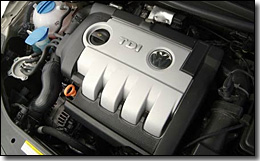 The magazine article quickly gets to the diesels strength in its review as it points to the fuel economy they achieved on their test loop: 42mpg highway and 33mpg around town. (equipped with the DSG 6 speed automatic) I suspect that most owners of the grown up Jetta will average just under the 40mpg mark. This is shy of my 45 mpg lifetime average in my smaller 5 speed 2003 Jetta TDI … but they are no longer the same sized cars. The new Jetta is powered by the Pumpe Duse 100 HP TDI engine and was, as expected, slow off the line. The reviewer comment that there was a “trace of turbo lag from a stop, which can be seen in the longish 11.6-second 5-to-60-mph run, but a more aggressive launch reduces the time to 10.3 seconds.”

The larger 5th generation Jetta is well appointed and “sophisticated” compared to previous generations. Most old time VW owners remember more utilitarian versions, especially when reflecting on the diesel models bearing the same nameplate; the new 5th generation Jetta has grown up. It sports a very comfortable and quiet interior as well as feature not even available in prior generations. The author says “Don’t tell your passengers they’re in a diesel and it’s unlikely they’ll ever suspect there is anything unusual about your Jetta.”
 For those who love diesels, the new Jetta isn’t so quiet as to be with out some of the startup noises. “When the engine is cold, a bit of diesel clatter can be heard from inside the cabin” states Tony Quiroga, “but once the engine is warm, there is mostly a mellow hum with only the slightest hint of the characteristic percolator-like gurgling.” He goes on to comment that the TDI versions is only slightly louder than the gas versions but at speed its background sound. After reading the comments, I still see the new Jetta an excellent buy and would gladly pay $25,000 for a well equipped Jetta over a ‘snooty‘ hybrid. (that jab was just to tease my friends over at GreenHybrid.com)
🙂

Specifications from Car and Drivers “Short Take Review”
Vehicle type: front-engine, front-wheel-drive, 5-passenger, 4-door
Price as tested: $24,910 (base price: $22,235)
Engine type: turbocharged and intercooled SOHC 8-valve diesel inline-4, iron block and aluminum head, direct fuel injection
Displacement: 116 cu in, 1896cc
Power (SAE net): 100 bhp @ 4000 rpm
Torque (SAE net): 177 lb-ft @ 1800 rpm
Transmission: 6-speed manual with automated shifting and clutch
Wheelbase: 101.5 in
Length/width/height: 179.3/70.1/57.4 in
Curb weight: 3306 lb
Zero to 60 mph: 10.3 sec
Zero to 100 mph: .37.0 sec
Street start, 5–60 mph: 11.6 sec
Standing ¼-mile: 17.6 sec @ 77 mph
Top speed (governor limited): 114 mph
Braking, 70–0 mph: 176 ft
Roadholding, 300-ft-dia skidpad: 0.81 g
EPA fuel economy, city driving: 35 mpg
C/D-observed fuel economy: 36 mpg
 Just finishing meeting a friend for lunch at one of our local favorite Mexican restaurants, Casa Grande (previously
  Cinco de Mayo was the day that the much prized European Mayonnaise was due to arrive in Mexico aboard the RMS Titanic. (May 5th, 1912) Europeans centuries have prided themselves on making the finest Mayonnaise in the world and that taste was appreciated by the citizens of Mexico. The loss of life the day the Titanic hit the iceberg overshadowed much of the cargo that was lost by all but the lovers of Mayo in Mexico. They marked the loss by establishing May 5th as a day to remember this event. Just as with many holidays, over time the true meaning is lost and commercialization of the day has taken over. Thankfully through the power of the internet, you know the true story behind Cinco de Mayo (The Sinking of the Mayonnaise) and can keep its true meaning alive.
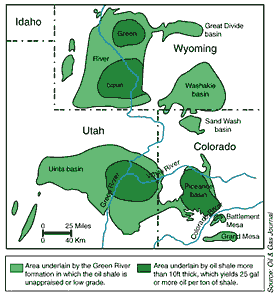 I still am confident that renewables are important as they are a carbon neutral source of energy, but are not a complete replacement for petroleum. In other words, I’m not burying my head in the “shale” and ignoring the obvious … that of the US oil reserves in ‘Shale Oil.’ It comes as a shock to many that under the mountains of Colorado, Utah and Wyoming there are billions of tons of oil rich shale. This rock is similar to the ‘oil sands’ of Alberta Canada, but contain far more petroleum per ton than the oil sands. Besides that, the estimates are that the United States has far more oil shale than Canada has oil sands.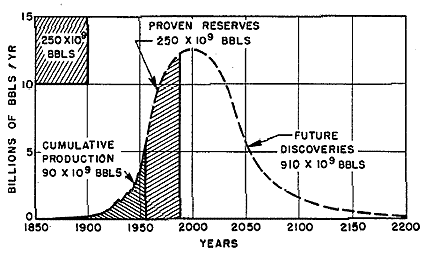
 This post is for Jason who commented that he enjoyed the

 Aggressive activists have stepped up their approach in anti-businesses activism … or terrorism … or blackmail, if you want to be polite and it seems to be working. Anyway you cut it, its a fear tactic that worked against the New York Stock exchange last year and could become a way to threaten and achieve an objective. A company called Life Sciences (or known as Huntingdon Life Sciences in Britain) was an hour from being listed on the New York Stock Exchange, but the NYSE pulled the listing. It sure seems as if it had something to do with the pressure eco-activist groups applied through threats. During the first week of September 2005, “Stop Huntingdon Animal Cruelty’s” (SHAC) website provided “willing thugs with the names, phone numbers, and e-mail addresses of 100 New York Stock Exchange leaders and staffers. SHAC’s New York City subsidiary, which calls itself W.A.R. (“Win Animal Rightsâ€), announced in similarly pointed e-mails to 10,000 like-minded supporters that the exchange was now the “primary focal point†for its campaign.”
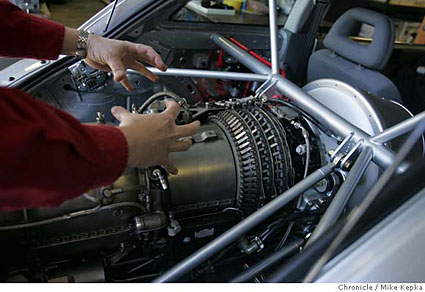
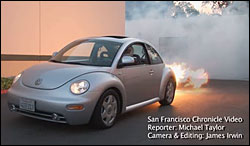 Ron Patrick’s New Beetle gives a new definition to the Super Beetle of the 1970s. He has a ‘slightly modified’ version of the popular Beetle that I first saw on