Maiden Flight for SubSonex from EAA News

Posted By on August 11, 2011

Great news for aviation experimenters — the personal jet experimental protype known as the SubSonex made its first flight. Way to go!

August 11, 2011 – A little yellow jet was spotted over Oshkosh Wednesday morning (August 10) and soon it was confirmed that John Monnett’s SubSonex had made its first flight. Jet sailplane pilot Bob Carlton, who wowed AirVenture crowds two weeks ago, was at the controls for the 14-minute flight. Thursday Bob took to the air for a 45-minute flight that included four landings and a climb to 5,000 feet, which Carlton joked took about two minutes.

The flights are the culmination of at least four years of development including an engine change and a design review to address controllability during takeoff and landing. It was a happy day for Sonex Founder John Monnett, who designed the SubSonex for the recreational pilot.

The first flight was exciting, but after watching repeated landings on Thursday the entire Sonex team was giddy and impressed with the jet’s performance.

“Awesome. Awesome,” John Monnett said as he listened to Bob Carlton describe how the plane performed on Thursday’s flight. Later Monnett talked about how far the project has come: “It’s a proof-of-concept. Hey, can we build a jet? Yes, I guess we can. I think I’ll call it the ‘Little Hornet,’” he mused, referencing the Hornet’s Nest, which is the official name of Sonex’s  research and development facility.

Carlton was selected to be the test pilot in part because his Super Salto jet-powered glider uses the same Czech-built PBS engine (První Brnenská Strojírna Velká Bíteš, a.s. TJ-100), which is capable of 240 pounds of thrust.

“It was great – flies like an airplane,” Carlton said after the first flight.  “The faster I went, the better it felt.”

Carlton kept the throttle at 70 percent during the first flight as he checked out the low-speed characteristics of the aircraft, including how it performed in a stall. On Thursday’s flight Carlton used 90 percent throttle as he worked on expanding the test envelope, staying mostly in the airport traffic pattern to establish performance at different airspeeds. The two flights will allow the SubSonex to expand the test area away from the airport.

“It’s an exciting day for Sonex,” Monnett said after Wednesday’s flight. “Usually I am in that seat, but especially with the trepidation we had with the other gear, we knew this would solve that problem.”

The aircraft originally sported a tandem landing gear with outrigger gear on each wing tip. Controllability became an issue in the “transitional phase approaching takeoff speeds,” Sonex said in a June 2010 press release announcing a design review of the aircraft following a taxi-testing incident that caused minor damage after it departed the runway.

The SubSonex emerged from the review with fixed tricycle landing gear and it did about eight high-speed taxi runs on Monday, raising up the nose a few times to test the new configuration. Monnett said the nose gear will eventually retract.

“It’s kind of a vindication more than anything,” Monnett said.  “Once we get a retractable gear on the nose at least, we’ll see where we go with the program. I probably envision this thing is going to end up with a folding wing like the Onex.”

While the SubSonex someday might be a kit, the project is still on the backburner in Sonex’s Hornet’s Nest facility while other kits in development – such as the Onex – are being finalized.

First flight:

Second flight:

————————-

Posted via email from RichC’s posterous

Have investors gone too pessimistic and oversold stocks?

Posted By on August 11, 2011

markets1108111217I listened and nodded in agreement to a little optimism this morning in a CNBC interview which paints a slightly different picture as it pertains to the financial health of consumers, US bank and companies. So far today (Dow about 11000 over the lunch hour) this might be making some sense to those who may have oversold U.S. stocks due to panic and fear?

Jim Paulsen of Wells Capital suggest that there is a “mania of pessimism.” Who knows what the market close will bring?

James Paulsen Mania of Pessimism (1 min 30 sec)– August 11, 2011

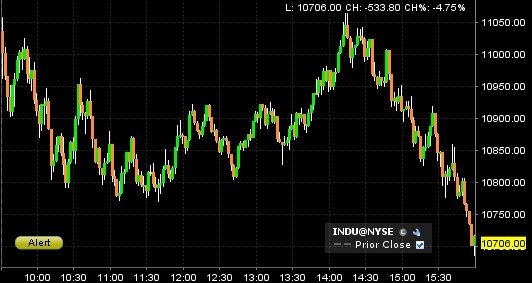
French banking concerns continue pessimistic view for markets

Posted By on August 10, 2011

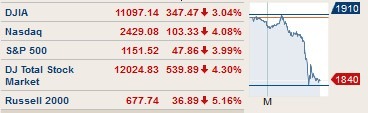
marketsdown110811

Maybe it just that we’re looking to point fingers or for a reason to remain pessimistic in our interconnected economies, but most reports I’ve been reading are now looking at the possible downgrade of French banks … and government. This spilled over to US markets (particularly banking) and started the day negatively.

After some regrouping mid-day buyers of stocks started picking up a few shares, but by late afternoon selling accelerated based on fear of what tomorrow and the future holds. For the day, the Dow Jones Industrial Average fell 520.29 points, or 4.6%, to 10719.48, while the Standard & Poor’s 500-stock index slid 51.83 points, or 4.4%, to 1120.70 and the Nasdaq Composite lost 101.47 points, or 4.1%, to 2381.05. All 30 of the Dow components and all 10 of the S&P 500 sectors were in negative territory.

Sea trials to begin for China’s first aircraft carrier

Posted By on August 10, 2011

chineseaircraftcarrier

Perhaps China adding their first aircraft carrier is just a sign of the times, but I see the modernization of China’s military as an unsettling long term move; call me distrustful considering their original statements and China’s questionable authoritarian government’s history. 

A Chinese company purchased the empty hull of a carrier called the Varyag from Ukraine in 1998 on the understanding that it would be used as a floating casino, but it was later towed to Dalian via the Black Sea, the Mediterranean and the Straits of Malacca.

China officially acknowledged only last month that it was refurbishing the vessel, and tried to ease regional concerns by saying it would be used for "research, experiments and training" and would take a long time to become fully operational.

That aside, experts have said that China is a long way from matching naval airpowers of the world when it comes to a threat to the US. They can use it or an eventual “operational carrier group” to better control the Asian waters where they have recently had disputes over territorial claims. For now their adding a first aircraft carrier may just be a symbolic step … but defense experts say that a shipyard in Shanghai already have other “indigenous carriers” under construction “which could be launched by 2015.”

Financial markets down after Fed, but up in the last hour

Posted By on August 9, 2011

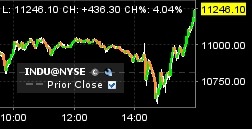
closingonahighnote110809Although I’m tiring of watching the fickle up and down action of the stock market … as are those who might stumble across my blog these couple of weeks … it is better to be able to say that the Dow Jones Industrial Average finished near session highs today. The 429.92 points – 3.98% gain wasn’t guaranteed even though many analysts saw the selling as “over done” … considering corporate balance sheets have been looking better (and frankly the US financial situation isn’t any different than anytime earlier this year). Still, it did feel better to to see the Dow close above 11,000 at  11239.77.

As for the day, the up and down action saw the index gained as much as 243 points at its morning then attempt to hold to the positive ahead of the Fed decision on interest rates. They signaled an “obvious” struggling US and world economy by saying they would hold to the existing low interest rate environment for “at least another two years.” This slow or no growth economy sent the markets instantly tumbling … but … as quickly as it went south, buyers may have had enough of the selling. The parking of capital at near zero was given a second thought and some may have decided that positioning in an over-sold equity was better than the yields available elsewhere.

Of course who knows what tomorrow will bring … we can only hope the jitters are enough to wake up those serving US in Washington DC?

U.S. Stocks Gyrate in Post-Fed Chaos – WSJ.com

Posted By on August 9, 2011

The Dow Jones Industrial Average recently rose 4 points, or 0.04%, to 10813 points. The index, which gained as much as 243 points at its morning high, saw its rally fade ahead of the Fed decision and then turned negative after the statement was released. It briefly recaptured some of the gains before falling sharply lower and then rising again. At one point the Dow fell as much as 206 points.

The Fed signaled it plans to keep its benchmark short-term interest rate close to zero for at least another two years as it sharply downgraded its view of the U.S. economy.

Posted via email from RichC’s posterous

U.S. Stock Futures Climb after a day of heavy selling

Posted By on August 9, 2011

Trying to be an optimist as equity markets near their 9:30 opening. Who knows how raucous the trading day will be after such a bit down day yesterday (see below).  According to “watchers,” we are the the most oversold in stocks in decades — odd considering the fundamentals for most companies and banks aren’t that bad when looking at the corporate balance sheets. Hanging on …

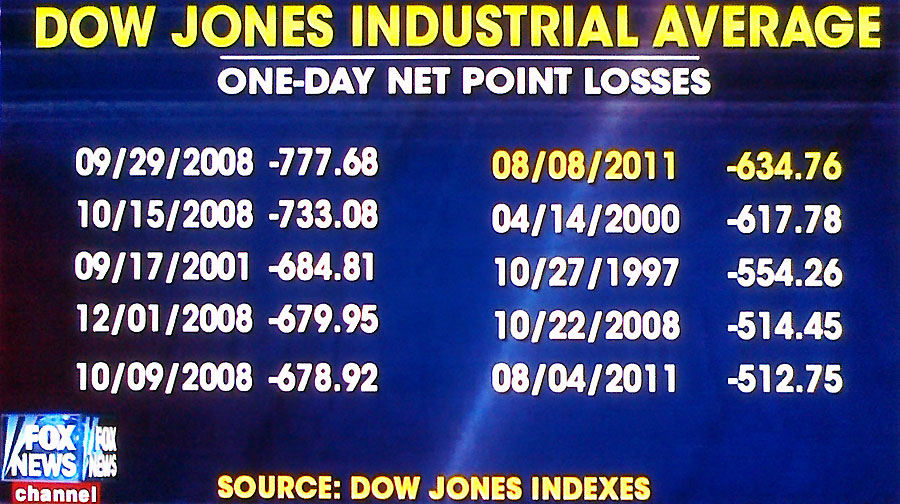
Dow Jones Industrial Average futures ran up 140 points, or 1.3%, to 10866, or more than 450 points above the lows seen in overnight electronic trading. The Dow fell 635 points on Monday, the sixth-biggest point drop in its history, to close at a 10-month low.

The blue-chip index fell beneath 11000 for the first time since November in the wake of Standard & Poor’s downgrade of the U.S. government’s credit rating, as investors continue to fret over government debt and the possibility that the economy slides into another recession.

Standard & Poor’s 500-stock index futures climbed 17 points, or 1.5%, to 1129 and Nasdaq 100 futures advanced 34 points, or 1.6% to 2071. Changes in stock futures don’t always accurately predict stock moves after the opening bell.

Posted via email from RichC’s posterous

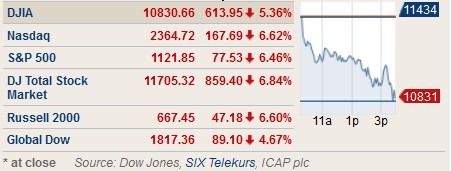
dow one-day downs

Dow closes down over 600 pts after S&P US credit downgrade

Posted By on August 8, 2011

gbwater110808

Oh to have had the wisdom of a Glenn Beck … and have listened to his analysis of how foolish it was to have believed in an economic recovery? He continued to recommend investing in gold as a safe haven from the upcoming financial meltdown. Of course one would think that as someone who watched his history lessons and nodded in agreement over his view that the borrowing and spending our government continued to do would eventually catch up with us. Today (and last week) it obviously did.

sandp500heatmap110808

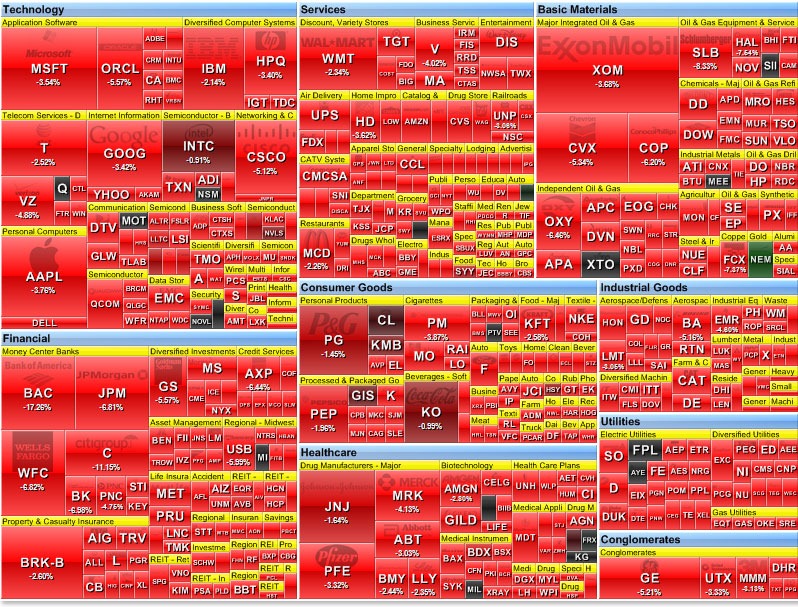
In looking at a sea of red heat map of the S&P 500, there weren’t many safe places to park money today … except gold (up over $1700 and futures even higher).

dowmarketclose110808

Is the economy heading down again or is it just panic selling?

Posted By on August 8, 2011

marketsdown350_110808Double dip or not? That is the question investors are facing, especially if they are holding stocks and bonds. After lunch today the markets are still seeing heavy selling … panic selling perhaps after the S&P downgrade this weekend. Realistically though, companies and even banks are much stronger than they were back in 2008 and therefore the selling may be over done, IMHO. On the other hand, perception is reality when it comes to those who would rather hold cash, purchase high rated low returning bonds or hide out in precious metals like gold (over $1720/ounce).

NEW YORK—U.S. stocks fell sharply Monday and gold surged as investors fled from risky assets in the first activity since Standard & Poor’s downgraded the federal government’s credit rating late Friday.

The Dow Jones Industrial Average dropped 370 points, or 3.2%, to 11073 shortly after 1 p.m. Eastern time, staging a selloff that added to last week’s losses. The blue-chip measure fell by as much as 385.12 points early in the session.

WSJ

What will the week after a credit downgrade bring?

Posted By on August 7, 2011

panicfingersPanic … it is going to be the big issue for financial markets come Monday morning. It won’t be pretty.

Is there really a difference between where we were last week (after the debt ceiling increase) and where we will be on Monday morning?  No, not really, but unfortunately Standard and Poor’s downgrade (PDF) of the United States is the perception which is going to be reality.

It is far too easy to point fingers at politicians who have borrowed and spent our way into a mess, but Americans as a whole have emulated the government with their own borrowing and spending and living beyond their means as well. Adjustments are going to require everyone to tighten their bootstraps to get spending and debt under control. The two points that came out of the “five pillars” S&P looks at when downgrading credit (politics, the actual economy, fiscal and monetary policy and externalities), was that politicians aren’t working together to address the problem and that the policy legislation passed doesn’t go far enough to address U.S. debt.

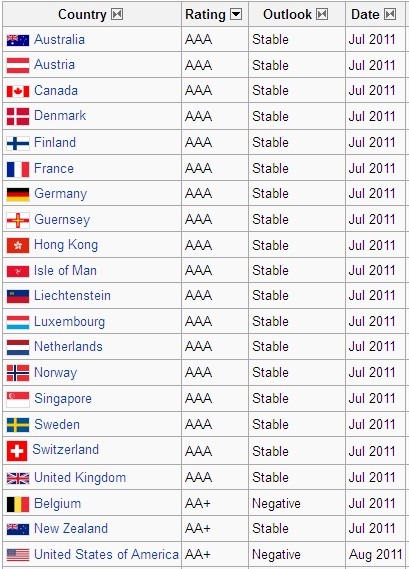
These things being said, panic is going to be the biggest issue with the US credit downgrade. The reality is that US Treasuries are still considered very safe, in fact in my judgment far safer than many on the list below which have triple-A ratings. As a post in the Weekend WSJ pointed out, do you really think a Luxemburg bond is safer than the United States? I think not. If the world economies collapse, I’d rather both be in the US and own US treasuries. As Mark Gongloff pointed out in a Q&A:

Q: What’s the difference between AAA and AA+? That doesn’t sound so bad.

A: It’s not so bad — and there’s not much difference. Technically, AA+ is considered “high grade” credit, while AAA is “prime.” The likelihood of getting paid back by a AA+ credit is considered “very strong,” while a AAA credit’s likelihood of paying you back is “extremely strong.” See the difference? Me neither. And the U.S. is a special case, given its status as the world’s largest economy and printer of the world’s reserve currency. If your personal credit score falls, then you will almost certainly have to pay more to borrow. The U.S. can get away with a slight credit-rating downgrade without having to pay more to borrow. In fact, many other large, developed economies, including Japan, Canada and Australia, have lost AAA ratings in the past and not had to pay more to borrow in the long run.

s&pdowngrade201108

Ratings by company

The S&P will monitor the U.S. for about six to 24 months to see whether its fiscal position deteriorates further or if political gridlock gets worse. John Chambers, the group’s managing director, said Sunday it would take stabilization of the debt as a share of the economy to determine the direction of S&P’s rating, and it’s no easy task to get it to rise.

"If history is a guide, it could take a while. We’ve had five governments that lost their AAA that got it back. The amount of time that it took for those five range from nine years to 18 years," he told ABC’s "This Week."

READ

Desultory - des-uhl-tawr-ee, -tohr-ee

  1. lacking in consistency, constancy, or visible order, disconnected; fitful: desultory conversation.
  2. digressing from or unconnected with the main subject; random: a desultory remark.
My Desultory Blog