Motorweek reviews the 2008 Volkswagen R32

Posted By on November 20, 2007

R32I’ve posted previously that I’ve ogled the limited edition Volkswagen R32, but haven’t had a chance to compare it to other small performance hatchbacks … including its close cousin the GTI. The gang over at the long running PBS automotive program Motorweek did, and they ran the R32 it through their consistent battery of road testing. Although the VW R32 is probably the most fun of the little VeeDubs to drive, it still doesn’t have the ‘stock’ performance that can be found in pricey European sports cars or their lower priced (and less respected) Asian rivals. The R32 seemed a bit slow (if you call a 0-60 six second time slow) in the straight line testing and stopped a few feet longer than what I would have expected. Although I do envy the all-wheel drive pocket rocket from VW, I’m just as happy zipping around in a chipped-TDI or our stock GTI. (11/17/2007 Motorweek Episode clip below)


Visiting family and the first taste of snow

Posted By on November 19, 2007

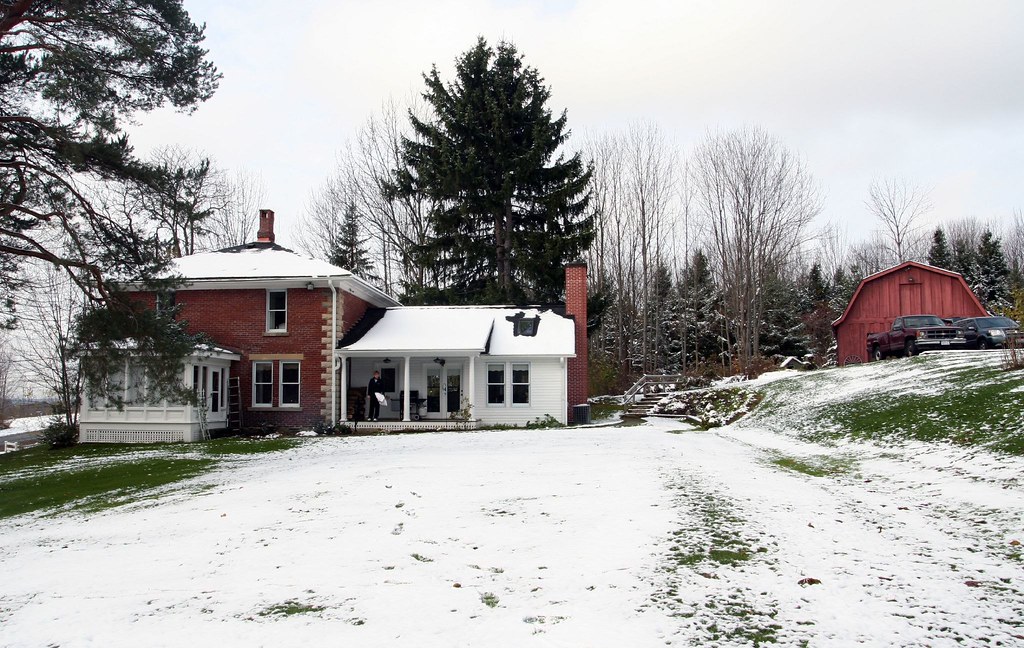
Farmhouse with wreathWe’ve been out of town the last couple of days and now it is catch up time for a short week of work before
Thanksgiving. It was an enjoyable visit in New York with my in-laws and a chance to give them a hand with a few home maintenance projects. Their beautifully restored 180 year old farmhouse always has a few touch up projects and when it is not your own they are enjoyable. (mine never seem to get done) Although the weather was slightly above freezing, we did get a little snow.

Farm House in NY
click for larger

From the fill in the missing date department

Posted By on November 18, 2007


I missed posting this weekend and figured why not add a Sunday entry on Monday? Here’s a great catamaran sailing video with some interesting onboard camera angles. Hmm … too bad winter is around the corner in my neck of the woods. (and in Ben Erikson’s too)
🙂

Back porch progress

Posted By on November 17, 2007


The stone masons (stone artists) continue to make slow progress on our new back porch fireplace. I’m finally giving up on having an evening fire before winter.

TDIFest OH-8 to be held in Cincinnati

Posted By on November 16, 2007

Fred Voglmaier founder of the TDIClub announced Thursday November 15th that Cincinnati was chosen as the site for the 2008 TDIFest to be held on Labor Day weekend — TDIFest OH-8. The CinciTDI group with help from the ColumbusTDIDrivers group are excited to host the annual gathering and believe our central location could make this the largest (and best) TDIFest ever.
More at the TDIClub Forum.

Mercedes S-Class 2010 S400 Bluetec diesel hybrid

Posted By on November 15, 2007

Mercedes S400
Those of you wanting a bit of luxury while sipping fuel might want to start saving your pennies. Mercedes Benz has announced their new S400 Bluetec Hybrid that will be available in 2010. The 265 HP/465 pound-feet of torque V6 diesel coupled to a high-torque electric motor will whisk this large luxury S-Class sedan to 60 mph in about 7.2 seconds while returning 40.5 mile per gallon on the highway. The vehicle doesn’t sport a price tag, was just another announcement at the LA Auto Show.

Biodiesel profits slim as sales rise

Posted By on November 15, 2007

Biodiesel sampleAn analysis article written my Timothy Gardner and published in Reuters summarizes the challenges of running a biodiesel business. Although fuel prices have risen significantly and demand for alternative have tripled sales of biodiesel to 250 million gallons last year, the oil feed crops have risen as well. Soyoil, the primary oil feed crop in the U.S., have risen to a 33 year high this past year as plants continue to come online processing the oil into fuel. The spike in feedstock has pinched margins for processors and is taking a toll on profits.

According to the article, the amount of U.S. produced soyoil being used for biodiesel “should be 20% this year, which is up 6%'” The concern is that even with record crude oil prices that some biodiesel producers are still facing negative margins.

“We’ve produced capacity well beyond the ability of the market to absorb it today,” Lapp told the Soya and Oilfeed Summit 2007 this week.

And any increase in soybean production may not help much because demand for soyoil for food keeps growing as the global population rises, experts said.

Even record oil prices above $90 a barrel are unlikely to boost demand for soy biodiesel as a substitute for diesel made from crude, because the food industry will always outbid the energy industry for soyoil, Lapp said.

“The food industry is always going to be willing to do what it takes to produce that food,” he said.

To end on a positive note, the alternative and biodiesel industry is even more serious about looking into new feedstocks — ones that are not a food-based oilstock. About the only problem is that North American based oil crops are grown on traditional farms, ones that are currently growing soybeans or canola. Perhaps this new demand for ‘grown oil’ will simulated the Algae to Oil research and development?

Earth Class Mail: Your postal mailbox online

Posted By on November 14, 2007

Earth Class MailWe are all familiar with an online mailbox, but do you know about Earth Class Mail “online” mail? Its not email in the traditional sense, but its your paper mail delivered on the Internet. Think of them as an electronic Post Office Box for your paper mail. Earth Class Mail receives, opens, scans and posts your mail online so that you can review it or trash it where ever you have Internet access. If the price was affordable, I’d be interested. (its the ‘modest fees‘ part that has me concerned as the junk mail begins to pile up)

Erie PA Community gifted $100 million

Posted By on November 13, 2007

ErieIf you live in the city of Erie Pennsylvania (pop 102,000), or the surrounding county (pop 280,000), you will soon be seeing a significant donation being put to use through community based charities. A recent anonymous donation will benefit some 46 charities distributed through the Erie Community Foundation. A wealthy Community Foundation ‘friend,’ who wants to remain anonymous, has donated a $100,000,000 (that’s 100 million dollars) to the Erie community; this should make a significant impact on the community and people in need of charitable services in the area. What an incredible gift to a community.

The director of the foundation Mike Batchelor has been delivering the news to each of the charities doing work in Erie and committing the one or two million a piece to each, like the homeless shelter, women’s center, food bank, group for the blind as well as universities. Although people in the community would like to know who has given such a generous gift, some believe prying to find out who the donor is would not be honoring the anonymous wishes.

About Erie Pennsylvania:
The city has a population of about 102,000 and the entire county is 280,000. It was once an iron and steel town located in the northwest corner of the state on Lake Erie between Cleveland, Ohio and Buffalo, New York. Industry develop from machinery, plastics, paper and furniture as with manufacturing in the U.S., many have moved overseas while other just try to survive. There was a large paper mill which employed 2,000 people for decades but it shut down in 2002 after more than 100 years in business. The city has a growing service industry and has tried to remake itself as a tourist destination with a new slots casino. But its poverty rate is about 19 percent, or twice the national average, median household income is $31,196, versus $48,451 nationally, and as of 2006, it had an estimated 400 homeless people.

Future Biodiesel: LiveFuels – algae-to-biocrude

Posted By on November 12, 2007

Algae to biocrudeLiveFuels Inc. is an alliance of scientists expecting to make algae ‘biocrude’ a viable biodiesel oil source by 2010. They believe if the Manhattan Project took only 3 years that their project can be done in 4 years. The alliance is being lead by Sandia National Laboratories, a U.S. Department of Energy Nation Laboratory and they expect to sponsor dozens of labs and hundreds of scientists. According to Lissa Morgenthaler-Jones, CEO of LiveFuels, she believes they have the “expertise in process engineering, bioscience and biotechnology” to create ‘biocrude’ from algae that will be able to be processed into biodiesel by the “millions of barrels of biocrude oil per day.” She states that “the initial focus of LiveFuels’ team will be algae-to-biocrude.”

Here’s a segment about “algae-to-biocrude” from their site:

Algal oil is similar to soybean oil but can be grown on marginal lands unsuitable for food crops. Thriving on sunlight and CO2, algae can be grown in fresh or brackish water. This makes algae an ideal solution for farmers dealing with issues of agricultural run-off. Moreover, a shortage of vegetable oil has been predicted within 3 to 5 years in the United States, and algal oil could fill the gap for non-edible uses like biofuels.
In order to make biocrude for less than $60 a barrel, algae must be high in fats or oils. Commercially-grown algae like Spirulina are high in protein and starch but low in fat. A few high-fat species of algae like Haematococcus are promising, but the fats — at prices around $1,200 a pound — are too expensive to fuel America’s vehicles today.
“Fat algae” doesn’t sound like a biocrude oil feedstock, but the petroleum we use today is derived from prehistoric biomass (including algae). Nature’s biomass decomposition process occurred over millions of years under conditions of enormous heat and pressure. Much of the petroleum we use today began some 200 million years ago in the Carboniferous Period. The deposits of oil pumped from the North Sea, for example, consist partly of decomposed haptophyte algae called coccolithophorids.
The challenge facing LiveFuels’ scientists will be growing and transforming algae cheaply into biocrude within days rather than millennia. The entire United States’ supply of imported oil could potentially be grown on 20 to 40 million acres of marginal land, leaving the 450 million acres of fertile American soil that are presently farmland still available to feed the nation.
“LiveFuels will enable American farmers to replace imported oil with home-grown biocrude and supply it to the United States,” said Morgenthaler-Jones. “Other countries are ahead of the U.S. in biocrude research, but other countries were once ahead of us in the space race too. America put a man on the moon in eight years, and America can make its own biocrude in four.”

CNET recently did an interview segment with Lissa Morgenthaler-Jones that I’ll include below:

Desultory - des-uhl-tawr-ee, -tohr-ee

  1. lacking in consistency, constancy, or visible order, disconnected; fitful: desultory conversation.
  2. digressing from or unconnected with the main subject; random: a desultory remark.
My Desultory Blog