Winter weather has just arrived, but I’m ready for spring

Posted By on January 9, 2010

It is good to be in a warm home after a challenging week. The weather has been less than perfect for driving and most of Ohio has received a little snow.

efe_snowy_night_100108
Click image for larger

In our house, the family Christmas cheer has given way to winter doldrums; one of my two children is back to school and the other will be on his way this weekend. My wife has taken the decorations down and I’ve done my part with ‘de-stringing’ lights and dragging tree  out to the bonfire. Ah … the house is almost as quiet and serene as the night view out my front door … and that’s a good thing.

Obituary: Catherine Eugenia “Jean” Finnegan Biden

Posted By on January 8, 2010

Condolences to Vice President Biden and his family.

January 8, 2010

Statement from Vice President Joe Biden

“My mother, Catherine Eugenia “Jean” Finnegan Biden, passed away peacefully today at our home in Wilmington, Delaware, surrounded by her children, her grandchildren, her great-grandchildren and many loved ones. At 92, she was the center of our family and taught all of her children that family is to be treasured, loyalty is paramount and faith will guide you through the tough times. She believed in us, and because of that, we believed in ourselves. Together with my father, her husband of 61 years who passed away in 2002, we learned the dignity of hard work and that you are defined by your sense of honor. Her strength, which was immeasurable, will live on in all of us.”

Catherine Eugenia “Jean” Finnegan Biden was born on July 17, 1917, the daughter of the late Ambrose J. Finnegan and the former Geraldine C. Blewitt of Scranton, Pennsylvania. In 1941, she married Joseph Robinette Biden. They were married for 61 years before Mr. Biden passed away in 2002.

Mrs. Biden is survived by her eldest son, Vice President Joseph R. Biden, Jr., his wife Jill Jacobs Biden and their three children, Joseph R. Biden, III, of Wilmington, Delaware, his wife Hallie Olivere Biden and their children, Natalie Paige Biden and Robert Hunter Biden, II; R. Hunter Biden of Washington, D.C., his wife Kathleen Buhle Biden and their children, Naomi King Biden, Finnegan James Biden and Roberta Mabel Biden; and Ashley Blazer Biden of Wilmington, Delaware; and by her daughter, Valerie Biden Owens of Kennett Square, Pennsylvania, her husband John T. Owens and their children Valerie James Owens, Cuffe Biden Owens and Catherine Eugenia Owens; and by her two younger sons, James Brian Biden of Merion Station, Pennsylvania, his wife Sara Jones Biden and their children, James Brian Biden, Jr., Caroline Nicole Biden and Nicholas Coleman Biden; and Francis W. Biden of Florida and his daughter, Alana Jaquet Biden.

Details on services for Mrs. Biden, 92, will be available in the coming days. On behalf of the Biden family, Valerie Biden Owens has requested that, in lieu of flowers, those wishing to make a contribution in memory of Mrs. Biden do so to a hospice, the Ministry of Caring in Wilmington, Delaware, or the Naomi Christina Biden Minority Scholarship Fund at Archmere Academy in Claymont, Delaware.

Posted via web from richc’s posterous

Flight 1549 Documentary Airs on TLC Sunday Night

Posted By on January 8, 2010

Added to Tivo recording schedule.

January 7, 2010Former EAA Young Eagles Chairman, actor Harrison Ford, provides the narration for a new documentary that features one of the new co-chairmen who succeeded him. Brace for Impact, scheduled to premiere January 10 at 9 p.m. EDT (8 p.m. Central) on The Learning Channel (TLC), examines the landing of US Airways Flight 1549 in New York’s Hudson River a year ago by Capt. Chesley B. “Sully” Sullenberger and First Officer Jeff Skiles. They safely ditched the Airbus A320 airliner on the river after a bird strike caused the plane to lose power in both engines on January 15, 2009.

The one-hour program features interviews with Sullenberger, passengers, air traffic controllers, and first responders who assisted in the extraordinary landing in which no fatalities occurred.

“I’m honored and gratified by the attention I’ve received as a result of this event. On January 15, we had a remarkably good day, and I’m proud that my crew and I were up to the task,” Sullenberger said. “I am sure that this documentary will convey the ongoing power of this story and its ability to touch and inspire people around the world.”

Posted via web from richc’s posterous

Will President Obama be held accountable for his promises?

Posted By on January 8, 2010

President Obama, for all the “hope and change” that was promised, seems to have no problem with the lack of openness and transparency being demostrated under his tenure. Obama’s promises of “openness” are empty … or perhaps only apply when concerning obamahealthcarepromiseRepublican leaders? For many, President Obama is a bigger disappointment than his predecessors  because he was so convincing with his rhetoric of “hope and change.”

— — —
“If a politicians’ lips are moving,
he/she is  probably lying.”

— — —

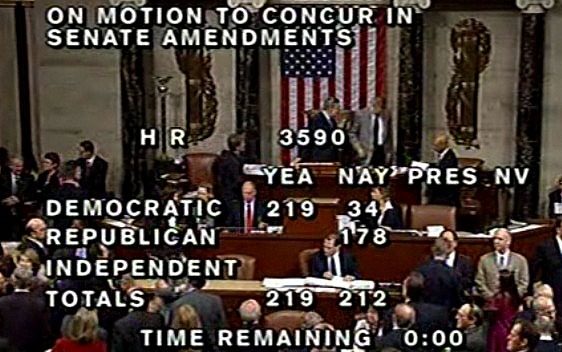
Much is being made of this campaign promise by even those who tend to be friendlier to the liberal health care agenda being “fast tracked” through congress. News and blogs are filled with repeated questions to Whitehouse Press Secretary Robert Gibbs (see video below) regarding the secrecy and backroom deals as it relates to health care reform. Out of touch House Speaker Nanci Pelosi has little problem with private backroom negotiations and commented that “the final health care reform bill behind closed doors according to an agreement by top Democrats,” while the Obama Administration dodges the questions related to the President’s promise of “openness and transparency.” Gibbs stressed that “the president wants to get a bill to his desk as quickly as possible.”

During the campaign,  then candidate Obama made at least eight public promises that when he arrived in Washington that negotiations would be open to public scrutiny and even be broadcast on C-SPAN. “The negotiations are obviously being done in secret and the American people really just want to know what they are trying to hide,” said Rep. Tom Price, R-Ga.

For those old enough to remember another President who once made a promise … “Read my lips, No new taxes” … one wonders if President Obama can survive reneging on his?

Video interview with rescued sailor Dennis Clements

Posted By on January 8, 2010

Posterous.com test post with video, but also a harrowing story from a sailor who was miraculously rescued from his boat of the coast of North Carolina.

Posted via web from richc’s posterous

Walmart, others make money on Oregon’s energy tax credits

Posted By on January 7, 2010

Playing the green energy tax credit game — the pitfalls of big government, powerful lobbyist and wealthy shrewd companies.

Walmart, others make money on Oregon’s energy tax credits

By Harry Esteve, The Oregonian
December 29, 2009, 7:00PM

When Oregon started handing out jumbo tax subsidies for renewable energy projects two years ago, one of the biggest beneficiaries was also one of the world’s richest corporations — Walmart.

No, the retail giant hasn’t branched to solar panels or wind turbines.

Instead, Walmart took advantage of a provision in Oregon’s Business Energy Tax Credit that allows third parties with no ties to the green power industry to buy the credits at a discount and reduce their state income tax bills.

State records show Walmart paid $22.6 million in cash last year for the right to claim $33.6 million in energy tax credits. The cash went to seven projects, including two eastern Oregon wind farms and SolarWorld’s manufacturing plant in Hillsboro. In return, Walmart profits $11 million on the deal because that’s the difference between what it paid for the tax credit and the amount of its tax reduction.

The loser in the transaction is Oregon’s general fund — which pays for public schools, prisons and health care programs — because the state is out the full $33.6 million in tax revenues.

Walmart isn’t alone. An analysis by The Oregonian shows Costco and U.S. Bank, which also rank among the nation’s top 200 wealthiest businesses, have made millions by buying up energy tax credits to cut their Oregon tax bills. Dozens of other companies and hundreds of individual Oregon taxpayers also have cut their tax bills by buying up the tax credits.

GS.41TAXX130.jpgView full size

The practice, known as “pass-through,” has become a popular, nearly risk-free way for profitable corporations and high wage-earners to avoid paying taxes in Oregon. But it also has become one more target for critics of the green energy subsidies, which spend state tax dollars to attract low-carbon industry and jobs to Oregon.

“It’s so convoluted,” says Eric Fruits, an adjunct economics professor at Portland State University who has studied Oregon’s energy incentives. “You’ve got all these dollars swirling around. Everyone is trying to grab them as fast as they can.”

The pass-through option “turns what would otherwise be an incentive to make energy investments into a windfall that may not have anything to do with energy,” Fruits says.

Program under fire

For years, Oregon has subsidized renewable energy and energy conservation projects by granting tax credits, which can be used as a dollar-for-dollar reduction on state income tax bills. The pass-through practice was put in place in 2001 as a way to allow government agencies and nonprofit organizations to take advantage of the subsidies. Since those groups don’t pay state taxes, the credits are worthless unless they can be sold to a third party.

The ability to sell the credits also allowed start-up companies with no Oregon tax liability to leverage upfront cash for their green energy projects.

The tax credits, known as BETC, or “Betsy,” have come under increasing fire this year because the cost to taxpayers skyrocketed. It went from about $10 million in 2007 to an estimated $167 million in the 2009-11 biennium at the same time the economic recession hammered other areas of the state budget.

A previous investigation by the newspaper showed state officials intentionally downplayed the estimated cost of the program before the 2007 Legislature voted for substantial increases to the maximum subsidies. The newspaper’s latest analysis also found:

Walmart, Costco and U.S. Bank, which top the list of energy credit buyers, shelled out a combined $67 million to avoid paying $97 million in Oregon income taxes.

Walmart and others are making money on projects that were closed, went belly up or never produced the energy or energy savings they initially claimed.

Out-of-state corporations and others looking for tax breaks are claiming an increasing share of the money that is supposed to pay for clean energy and conservation.

Weyerhaeuser/Walmart

The head-scratching nature of the subsidy program perhaps is best illustrated by a case study of what happened at the former Weyerhaeuser Paper Mill in Albany.

Weyerhaeuser, based in Federal Way, Wash., received $3.3 million in Oregon energy tax credits in 2008 for rejuvenating a biomass plant that burned wood waste for heat and steam, and for capturing much of the heat to dry paper. The company, which apparently didn’t need the tax offset, turned around and sold the credits to Walmart for $2.3 million in cash.

Walmart then gets to deduct the full $3.3 million from its Oregon income tax bill over five years for a payback of $1 million. But there’s a twist.

Last year, International Paper bought a number of Weyerhaeuser mills, including the one in Albany. And last week, I-P shut down production at the Albany mill as part of a corporate cost-saving plan.

The end result: The mill no longer produces nor saves the energy for which it got the tax credits. Walmart, however, retains the full benefit of the subsidy.

Walmart, which ranked second to Exxon this year on the Fortune 500 list, shouldn’t be cast as the bad guy, says Karianne Fallow, a spokeswoman for the Arkansas-based company. Oregon officials asked Walmart to become a “pass-through partner,” Fallow says.

“The state approached us with this investment offer and we participated in the opportunity,” Fallow says. The tax benefits were clear, she says, but bringing green jobs and companies to Oregon “is very much a goal that we support.”

Legislative overhaul

Similar examples abound.

FUSP, a Portland wood recycling company, garnered $2.6 million in tax credits last year and sold them to 17 individual investors for $1.9 million in cash. The money, according to a company official, was used to buy grinding equipment and other machinery that turns old wood into new lumber and pallets.

Shortly after the credits were issued, the housing market crashed. The equipment now sits idle in a lumberyard in Turner, outside Salem. The 17 investors, however, continue to receive the tax break.

“The problem is, we’re taking taxpayer money that is supposed to be accomplishing energy efficiency or power generation and instead we’re putting it into the financial market,” says Jody Wiser, who leads a watchdog group that wants changes to the energy subsidies. A better way, Wiser suggests, would be to give clean energy or energy conservation companies outright grants, thereby saving millions that wind up in the hands of investors.

Corporations doing business in Oregon took a keener interest in the tax credits after the 2007 expansion of the program, which upped the maximum incentives to $20 million for solar facilities and $10 million for wind farms. State records show the amount of tax credits bought by third parties shot up to $152 million — more than triple the amount of the previous year.

Gov. Ted Kulongoski and state energy officials say they recognize problems with the energy tax credits and are working to overhaul the program when state lawmakers convene for a short session in February. Among the targets of the overhaul is the pass-through option.

“The governor believes there’s been a public value to the program,” says Anna Richter Taylor, Kulongoski’s spokeswoman. “That said, he also is very supportive of efforts to align the rate better with other public investment portfolios.”

The current rules allow third parties to buy the tax credits at about 67 cents on the dollar and take the tax breaks over five years. For most, that means an annualized rate of return of about 10 percent – a rate that far exceeds what most people are getting on short term investments, such as bank CDs. Acting state Energy Department director Mark Long is pushing for a rate that would be more in line with other types of market investments — about 3.5 percent a year.

“That means more money goes to the actual project,” rather than to the investors who buy the tax credits, Long says.

— Harry Esteve

Posted via web from richc’s posterous

A crack is appearing on my webOS Palm Pre smartphone

Posted By on January 7, 2010

palmprecrack100107

A few weeks ago, I noticed what I thought was a ‘scratch’ on the side of my Palm Pre next to the USB door. The ‘scratch’ has since revealed itself as a ‘crack’ which is slowly working its way to the screen. So far, besides the cosmetic issue, the touch display works fine. Unfortunately I didn’t purchase the insurance for the phone since I’ve never had issues with previous Treo/Centro models, but after a call to Sprint they indicated that warranty coverage ‘may’ not be offered for this issue. Personally speaking, I haven’t dropped the Pre or been overly rough with it and wonder if this might be a design weakness? Cracks in your Palm Pre anyone??? (thread on PreCentral)

__

Effectiveness of Antidepressants

Posted By on January 6, 2010

Are antidepressants being over prescribed for patients with less severe depression AND are they ineffective? See JAMA Vol. 303 No. 1, January 6, 2010.

EDIT: Adding PDF of article (removed 1/16/2010) from Load2All.com.

JAMA Analysis of Antidepressants Suggests Effectiveness Varies Widely

Patients with severe depression benefit most from antidepressant medications while those with less-severe symptoms see little or no benefit, according to a new analysis released Tuesday. Wall Street Journal, page B12

Posted via web from richc’s posterous

Dreaming Up Textbooks on an Apple Tablet

Posted By on January 5, 2010

While I enjoyed reading on my daughter’s new “Nook” last week, it still leaves much to be desired. A well designed “tablet” might eventually be the best option. It will be interesting to see how Apple sees there up and coming device fitting in to the niche.

By Geoffrey A. Fowler

With Apple’s much-hyped tablet computer just months away, publishers are already beginning to have visions of how the device will change their business.

People attend the opening of the Apple Store on the Upper West Side in New York City.

The market is already filled with dedicated reading devices like Amazon’s Kindle, most of which feature black-and-white e-ink screens. But Coursesmart, a digital-publishing joint venture of five major textbook publishers, says many of those devices require too many concessions — like no color graphics, no consistent page numbers and no way to scribble notes — for students to adopt them widely in place of regular textbooks.

However, Coursesmart Executive Vice President Frank Lyman has a very different take on the potential of tablet computers for reading. Tablets could include the ability to look at color graphics and integrate other sources of information such as video and outside links, he said.

“The key is that with multifunction devices, you can do more than just read the textbook. You can interact with the content,” he said. “It is all about having your textbooks integrated with other tools and resources that you use for learning.”

To show the potential, he made the following video to share with folks in the industry at this week’s Consumer Electronics Show. While Coursesmart already has an app that makes its books available on the iPhone and iPod Touch, he said the schematic shown here was based on their own “imagination” of a tablet, not any specific information provided by Apple.

“Our objective is to make sure that people who are producing these devices are thinking about education,” said Lyman.

What do you think? Will all these bells and whistles help students learn — or just provide more distraction than an old-fashioned book?

Posted via web from richc’s posterous

One step closer to Apple mania … again

Posted By on January 4, 2010

News for tomorrow’s WSJ:
Apple to Ship Tablet Device in March

— Sent from my Palm Pre

Posted via email from richc’s posterous

EDIT:

Desultory - des-uhl-tawr-ee, -tohr-ee

  1. lacking in consistency, constancy, or visible order, disconnected; fitful: desultory conversation.
  2. digressing from or unconnected with the main subject; random: a desultory remark.
My Desultory Blog