The state of the biofuel industry in the U.S.
Posted By RichC on August 27, 2009
When oil prices doubled not too long ago, many along with our government saw expanding clean, renewable and domestic biofuels as one component that could help our nation become more self sufficient. Just as many pointed out that an agricultural based source would not provide real solutions to the problem in part due to the energy input needed to produce these biofuels compared to just pumping crude out of the ground. We were left with the debate between blaming the rise in crude oil prices on peak oil, significant increases in world wide demand, greedy oil companies or oil speculators.

August 2008 diesel and biofuel prices in Ohio
In hindsight, we can pretty much discount the “peak oil” as the cause (at least for a few more years), but can comfortably split the blame for $140/barrel oil on increases between worldwide demand, 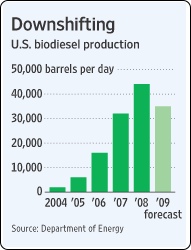 excessive profiteering by oil companies and run away speculation in the oil trading circles, not all that unlike tulip mania. Unfortunately for businessmen and investors in ‘green’ energy not recognizing risk that fuel prices could fall as quick as they rose are having a difficult time staying in business — even with tax credit incentives.
In the long run the idea of creating a renewable fuel is good, unfortunately one needs a long view and business model less dependent on both the oil crops currently being converted to fuels. I still see biodiesel from sources other than food based crops as a strong competitor to other alternatives. Using recycled oils and algae based oil crops provides an excellent addition to petroleum crude oil when producing, and reproducing, fuels for vehicles … and more of our own domestic energy.
That said, an article on the front page of today’s Wall Street Journal shows just how challenging the alternative fuel business is … particularly in a deep recession.
AUGUST 27, 2009
By ANN DAVIS and RUSSELL GOLD
The move towa The biofuels revolution that promised to reduce America’s dependence on foreign oil is fizzling out. Two-thirds of U.S. biodiesel production capacity now sits unused, reports the National Biodiesel Board. Biodiesel, a crucial part of government efforts to develop alternative fuels for trucks and factories, has been hit hard by the recession and falling oil prices. The global credit crisis, a glut of capacity, lower oil prices and delayed government rules changes on fuel mixes are threatening the viability of two of the three main biofuel sectors — biodiesel and next-generation fuels derived from feedstocks other than food. Ethanol, the largest biofuel sector, is also in financial trouble, although longstanding government support will likely protect it.
Earlier this year, GreenHunter Energy Inc., operator of the nation’s largest biodiesel refinery, stopped production and in June said it may have to sell its Houston plant, only a year after politicians presided over its opening. Dozens of other new biodiesel plants, which make a diesel substitute from vegetable oils and animal fats, have stopped operating because biodiesel production is no longer economical.
Producers of next-generation biofuels — those using nonfood renewable materials such as grasses, cornstalks and sugarcane stalks — are finding it tough to attract investment and ramp up production to an industrial scale. The sector suffered a major setback this summer after a federal jury ruled that Cello Energy of Alabama, a plant-fiber-based biofuel producer, had defrauded investors. Backed by venture capitalist Vinod Khosla, Cello was expected to supply 70% of the 100.7 million gallons of cellulosic biofuels that the Environmental Protection Agency planned to blend into the U.S. fuel supply next year. The alleged fraud will almost certainly prevent the EPA from meeting its targets next year, energy analysts say.
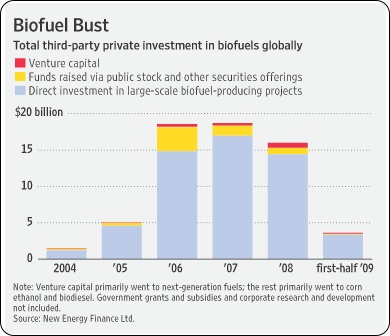
The wave of biodiesel failures and Cello’s inability to produce even a fraction of what it expected have spooked private investors, which could further delay technology breakthroughs and derail the government’s green energy objectives.
“If your investors are losing money in first-generation biofuels, I guarantee you they’ll be more reluctant to put money into more biofuels, including next-generation fuels,” says Tom Murray, global head of energy for German bank WestLB, one of the leading lenders to ethanol and biodiesel makers.
Domestically produced biofuels were supposed to be an answer to reducing America’s reliance on foreign oil. In 2007, Congress set targets for the U.S. to blend 36 billion gallons of biofuels a year into the U.S. fuel supply in 2022, from 11.1 billion gallons in 2009. That would increase biofuels’ share of the liquid-fuel mix to roughly 16% from 5%, based on U.S. Energy Information Administration fuel-demand projections.
Corn ethanol, which has been supported by government blending mandates and other subsidies for years, has come under fire for driving up the price of corn and other basic foodstuffs. While it will continue to be produced, corn ethanol’s dominant role in filling the biofuels’ blending mandate was set to shrink through 2022. Cellulosic ethanol, derived from the inedible portions of plants, and other advanced fuels were expected to surpass corn ethanol to fill close to half of all biofuel mandates in that time.
But the industry is already falling behind the targets. The EPA, which implements the congressional blending mandates, still hasn’t issued any regulations to allow biodiesel blending, though they were supposed to start in January. The mandate to blend next-generation fuels, which kicks in next year, is unlikely to be met because of a lack of enough viable production.
“I don’t believe there’s a man, woman or child who believes the industry can hit” the EPA’s 2010 biofuel blending targets, says Bill Wicker, spokesman for Sen. Jeff Bingaman of New Mexico, chairman of the Senate Energy Committee.
The business models for most biofuel companies were predicated on a much higher price of crude oil, making biofuels more attractive. A government-guaranteed market was also central to business plans.
But once blending mandates were postponed, oil prices plunged and the recession crushed fuel demand, many biodiesel companies started operating in the red. Even ethanol producers, which have enjoyed government subsidies and growing federal requirements to blend it into gasoline, have been operating at a loss over the past year. Numerous established producers have filed for Chapter 11 bankruptcy-court protection.
Critics of the biofuels boom say government support helped create the mess in the first place. In 2007, biofuels including ethanol received $3.25 billion in subsidies and support — more than nuclear, solar or any other energy source, according to the Energy Information Administration. With new stimulus funding, this figure is expected to jump. New Energy Finance Ltd., an alternative-energy research firm, estimates that blending mandates alone would provide over $33 billion in tax credits to the biofuels industry from 2009 through 2013.
Not all biofuels may be worth the investment because they divert land from food crops, are expensive to produce and may be eclipsed by the electric car. One fact cited against biofuels: If the entire U.S. supply of vegetable oils and animal fats were diverted to make biodiesel, production still would amount to at most 7% of U.S. diesel demand.
Producers and investors now are pushing for swift and aggressive government help. Biodiesel makers are lobbying to kick-start the delayed blending mandates immediately and extend biodiesel tax credits, which expire in December.
On Aug. 7 more than two dozen U.S. senators wrote to President Barack Obama to warn that “numerous bankruptcies loom” in the biodiesel sector. “If this situation is not addressed immediately, the domestic biodiesel industry expects to lose 29,000 jobs in 2009 alone,” the senators wrote, using estimates by the National Biodiesel Board.
Mr. Obama, who supported biofuels throughout his campaign, is working to roll out grants and loan guarantees for bio-refineries and green fuel projects, said Heather Zichal, a White House energy adviser. The pace of the disbursements should speed up this fall, administration officials say.
Obama officials defended the delay in biodiesel mandates. The EPA in May proposed rules that penalize soy-based diesel under the blending mandates, because deforestation from soybean cultivation is thought to offset the fuel’s environmental benefits. Obama officials say the EPA must perform a thorough environmental review before it can issue rules. The amount of biodiesel that was to have been blended in 2009 will be added to the amount required for 2010, so that no volume is lost, they add.
Any state help might be too late for GreenHunter Energy. In 2007, the company, led by energy exploration executive Gary Evans, acquired a Houston refinery that processed used motor oil and chemicals and retrofit it to make 105 million gallons of biodiesel a year from all manner of feedstocks, from soybean oil and beef tallow to, potentially, inedible plant matter. GreenHunter’s business model hinged on selling to a government-guaranteed buyer: GreenHunter has the capacity to make 20% of the 500 million gallons of biodiesel that Congress wanted to be blended into the 2009 fuel supply.
Until the mandate kicked in, GreenHunter and other biodiesel makers counted on exporting their output to Europe, a much bigger user of diesel.
GreenHunter opened in June 2008 as oil prices skyrocketed. By then, soybean oil prices were soaring, too, pinching refiners that had banked on using soy. Mr. Evans switched to inedible animal fats.
For about a month, when oil hovered above $120 a barrel and traditional diesel ran over $4 a gallon, GreenHunter says profit margins on turning animal fat into diesel rose as high as $1.25 a gallon. It wasn’t sustainable. The price of animal fat soared too, cutting margins again.
As the EPA continued to delay the blending mandates, the global downturn obliterated demand for regular diesel. Prices cratered. GreenHunter’s plant took a direct hit from Hurricane Ike in September. By the time the plant reopened in late November, the price of diesel had dropped by more than half, and GreenHunter was losing money on every gallon of fuel.
The European Union dealt the final blow this spring when it slapped a tariff on U.S. biodiesel, killing what had been the industry’s main sales outlet.
GreenHunter has since stopped producing biodiesel. The American Stock Exchange informed GreenHunter in May that the company was out of compliance with some listing requirements; the firm has submitted a plan to remain listed. Its stock has sunk to about $2 a share from a high of $24.75 in May 2008.
Bio-refinery carcasses are everywhere. GreenHunter’s lender, West LB, arranged $2 billion in ethanol and biodiesel loans, selling them to various investors beginning around 2006. Today, half of the $2 billion in loans have defaulted or are being restructured, according to people familiar with the portfolio. Publicly traded Nova Biosource Fuels Inc. filed for Chapter 11 bankruptcy reorganization in March.
Imperium Renewables, a biodiesel maker in Washington, is trying to hang on as a storage depot, its founder says. Evolution Fuels, an outfit that used to sell a biodiesel brand licensed by country singer Willie Nelson, has stopped production and said in a securities filing it may not be able to continue as a going concern. The company didn’t return calls for comment.
Some senators have introduced a bill to extend biodiesel tax credits. A provision passed in the House grandfathers soy-based biodiesel into the blending mandates for five years.
Second-generation biofuels have had their own setbacks.
When seeking investors for Cello Energy in 2007, Jack Boykin, an entrepreneur with a background in biochemistry, said Cello had made diesel economically in a four-million-gallon-a-year pilot plant from grass, hay and used tires. What’s more, he told investors he had successfully used the fuel in trucks, according to testimony in a federal court case in Mobile, Ala. He said he had invested $25 million of his own money. An Auburn University agronomy professor advising the Bush administration on green energy endorsed his technology.
Alabama paper-and-pulp executive George Landegger and Mr. Khosla, the venture capitalist, separately invested millions in seed money into Cello and had plans to invest or lend more.
A lawsuit disputing the ownership stakes of investors produced Mr. Boykin’s revelation, in a 2008 deposition, that he had never used inedible plant material such as wood chips or grass in his pilot plant, despite claims otherwise. Construction of his full-scale facility in rural Alabama moved forward anyway.
This year, Khosla representatives took samples of diesel produced at the new Cello plant and sent them off for testing. The results showed no evidence of plant-based fuel: Carbon in the diesel was at least 50,000 years old, marking it as traditional fossil fuel.
The EPA wasn’t told about the test, and continued to rely on Mr. Boykin’s original claims when it asserted in the Federal Register in May that Cello could produce 70% of the cellulosic fuel targets set by Congress that are due to take effect next year.
The jury returned a $10.4 million civil fraud and breach-of-contract verdict against the Alabama entrepreneur in favor of Mr. Landegger, one of the investors. Work on the plant has been suspended. Several weeks after the verdict was delivered, Mr. Boykin presented evidence that he had tested fuel from the plant and it did contain cellulosic material. He is seeking a new trial.
Mr. Boykin declined to comment, but his lawyer, Forest Latta, said his client denies committing fraud. The carbon testing, he said, reflected only an early stage quality-control test during startup trials. It would be premature to conclude, Mr. Latta said in an email, that Cello’s fuel-making process is a failure. “This is a first-of-its-kind plant in which there remain some mechanical issues still being ironed out,” he wrote.
Margo Oge, director of the EPA’s office on transportation and air quality, says the agency is “looking into the whole case of Cello.” Mr. Khosla declined to discuss Cello, but said he doubts the 2010 cellulosic fuel mandates can be met. “All projects, even traditional well-established technologies, are being delayed because of the financial crisis,” he said in an interview.





 The ballpark composts its grass clippings and convert all the cooking oil in the consession stands to biodiesel fuel according to a recent
 d more money is better, the idea of losing a couple hours in every workday seems … well … foreign.