A Nervous Bull and Healthcare thoughts

Posted By on August 13, 2009

Wall Street Bull in NYCAs U.S. Congressional representatives sweat over whether to have townhall meetings in their states to talk healthcare during the August recess, I sweat over how to plan financial security for my family’s future, of which health insurance is a part. Years ago it seemed logical to just keep plunking away a few dollars into a SEP, 401K and IRA and ‘let it ride’ for the long haul and keep the rose colored glasses on that medicare will cover me when I retire. Nowadays, the entire paradigm has been shaken and very few financial investment experts, mutual fund managers or traders have answers as to how to best protect one’s savings and plan for a secure retirement. The daily statistical numbers coming from the Fed and Wall Street don’t help much when deciding if equities are worth the risk again or if the economy is heading for a recovery from recession or if we’ll see more pain this autumn. On Wednesday the Fed offered an upbeat assessment and this morning retail sales numbers fell despite the government’s Cash for Clunkers program (PDF). Who knows, but I’ll remain a “nervous market bull” and continue to stay in equities for now.

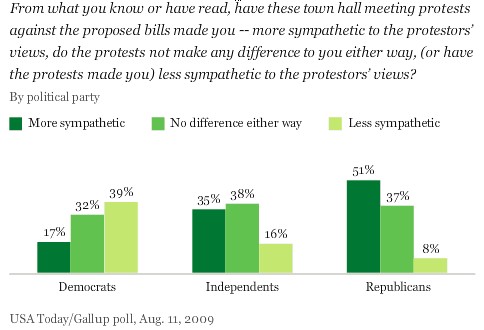
Although I’m not a supporter in the way government is currently getting  involved in healthcare, the inevitability is that our growing bureaucracy with be controlling it more and more … be Democrats or Republican be in control — get use to it. Both parties are talking about reform and most Americans are sick (pun intended) of rising heath insurance premiums, reduced care and the convoluted gamesmanship of managing coverage and the associated red-tape.
Healthcare

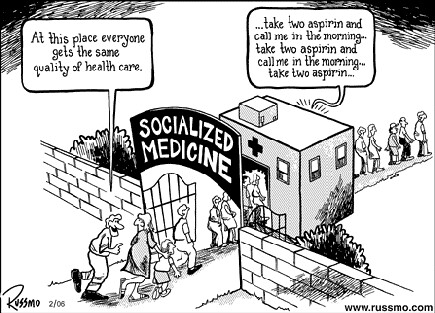
The key for me is to prevent socialized and rationed medicine that removes investment capital from the equation. These models have been tried in other developed countries are are not ‘the envy of the world.’ When profit is removed from healthcare, be it pay for smart high quality doctors, well maintained hospitals or ROI for biotech and pharmaceutical companies, to the point that it pays more to sue doctors, hospitals and big pharma (ie. no tort reform even being discussed), then we’ll find it challenging to advance medical care in this country. By removing the profit incentive for investment capital, we’ll reduce competition (fewer companies) under government control we are bound to see  overall quality of care to go down and will most definitely feel the inconvenience.

Currently, I’m in the waiting mode for a colonoscopy with “insurance company dictated” price controls (where there is at least some capital competition); how much longer do you suppose I’ll be waiting to get a colonoscopy when Washington dictates the price … or will they disallow my personal physician from even requesting it — that’s not to mention the quality of the procedure (paid by how many per day, not how well the scoping is done). Maybe its just me, but when someone probing ‘you know where,’ I don’t want an underpaid, under-incentified, less than qualified person doing as many colonoscopies in a day that they can when it comes to my colon.  I can’t find one government run bureaucracy that truly runs efficiently … but would run out of space listing the number of industries that improve both product and service when competition is increased and incentives for excellent products and service are there.
Cartoon

A final point: While we talk healthcare reform, and no doubt it is a ‘huge’ undertaking for our elected representatives, is it so immediate that it must be ‘rammed’ through without reading the bill or discussing it with constituents. To me it seems an important enough, and expensive enough, issue to work on it methodically. Let’s not make the the rash ‘bailout’ style decisions with healthcare that we did with banks and automotive. Let’s not rush into change for change sake without understanding the consequences and long term costs in both dollars and care. If there is one thing different about healthcare from the banking and auto crisis is that there’s time to read, discussion, improve and understand what is being voted on and demanding of our next generation … because in the end, I’m sure of only one thing … government run healthcare will end up costing us all more.

EDIT: For Sirius/XM radio listeners, there is a good relatively non-partisan program on Doctor Radio Thursdays call Health Care Connect hosted by Andrew Rubin. Besides offering Health insurance advice, they do a pretty good job of dissecting the current legislation being proposed. I’m including a short MP3 “How are we paying for it” question from a listener that should give and indication as to the work that needs to be done on this bill, along with an interesting MP3 segment with Steve Forbes.

I found this conversation interesting … and more of the kinds of discussion that people need to contemplate when trying to understand where biotech and investing fits into “healthcare.” (CNBC video from 8/13/2009 below)

But

230mpg: tAhe EPA needs to modify its calculations

Posted By on August 11, 2009

After reading and commenting on an article in the Wall Street Journal this morning regarding the upcoming Chevrolet Volt boasting 230 mpg, about all Chevy VoltI can say is we (the EPA) needs to create a new system of calculating fuel economy. It’s a bit misleading for a family sized sedan to be able to claim that it can beat a VW 1 liter1 liter vehicle designed for efficiency; its just plain deceptive to even repeat it. On the other hand, I do like the fact that GM is pulling out all the stops in order to compete with hybrid leaders like Toyota and Honda … and seriously wish them well in the gamble … one that I wish would have included diesel technology.

Here’s a snippet from one of my comments:

Call me a skeptic, but I’m more concerned with the total cost of ownership … initial investment + fuel + maintenance ‘minus’ retail value after say 5 to 10 years ‘divided by’ number of miles driven.

When that matches something like a Volkswagen TDI ‘clean diesel’ … then I be convinced that they are on the right path.

or …

Personally I think the old smaller hybrid ‘boost’ motor (or compressed air) linked to an efficient and clean diesel makes more sense. A small diesel is super efficient at highway cruise (American roads) and would be appreciably helped by boost when accelerator demand calls for it.

As for your ‘initial investment’ assumption … I’ll pit the diesel VWs against the Volt  and even the BMW 3 series diesel against it. Take a look at 60% of the vehicles in Europe as the initial investment is not “a lot higher” as on respondent suggests.

On the other hand, they are not wildly supported by companies other than the Europeans due to biased EPA measurements toward gasoline and about a 15% tax disadvantage (also US consumer still remember the old diesels — there is no comparison). Too bad memories and manufacturers still want to promote gasoline as the new diesel technology is more efficient … and CLEAN — do a Google search for the 2009 Green Car of the Year (hint: 2009 Volkswagen Jetta TDI) As for other U.S. vehicles besides light trucks … the list is currently mostly European: VW, Mercedes, BMW. Audi and Jeep.

The demand is strong for a moderately priced diesel too … take a look at VW sales and try to find a TDI or even negotiate on one. 🙂 June numbers for the VW Sportwagen TDI were 81% of all their wagon sales … I’m sure the 40 – 50 mpg doesn’t hurt. If you’ve got a clunker and want part of the Obama stimulus thinking one of these VWs would be perfect (and you would be right), don’t bother since nearly all the 2009 are gone and they are waiting for 2010 models in November – get on the list.

My point is still that a moderately price diesel (VW TDI $24,000) would make far more sense when stacked up against the Volt when we’re talking total cost of ownership (and resale is currently stronger than about any other daily driver).

Roz Savage nears 1 million oar strokes on another leg

Posted By on August 10, 2009

Roz Savage and her boat

Although I’m not going to refer to myself as a “Rozling” (followers of Roz Savage’s adventure), I do check on her progress and follow the blog of the ocean rowing British adventurer Roz Savage.Roz Savage She is currently 78 days into the second of three legs of a Pacific Ocean crossing after completing the first leg to Map of Roz SavageHawaii in 99 days in 2008. Her next stop is  Tuvalu and then on to Australia.  In recent day’s she’s been struggling to stay on coarse  although today has made up a significant amount of latitude (map of last month on left).

The purpose of the adventure, if there really needs to be one, is to draw attention to the environmental issues of plastic pollution, climate change and habitat destruction of which she is an excellent spokeswoman. She also is a good motivational speaker using the “one stroke at a time” mantra. When interviewed as to her reason why she goes to such an extreme, she recalls handwriting two obituaries — one with the life she ‘was’ living and one where she pursues a dream — “I had a big dream for a big adventure and decided to make it happen.”

Roz, more than most adventurers, seems to also embrace technology. As a writer, she is excellent at sharing with the written word through her blog, as well as audio and video (see youtube channel). She has done numerous interviews with the press and updates regularly through a satellite phone with tech notables like Leo Laporte.

As a dreamer of adventure on the ocean, I semi-envy her spirit and can-do attitude. Besides the extreme physical endurance, the risk of rowing the Pacific Ocean is substantial.

Catch up post: Driving by the Waco Field and Museum

Posted By on August 9, 2009

Ohio Historical Marker for Waco Aircraft CompanyLast week while trekking through Ohio I detoured off of I-75 in Troy, Ohio to swing by Waco Field (1WF) and the Waco Museum (pronounced “wah-co”). Fortunately the museum wasn’t open or my detour off the interstate would have been significantly longer. It was a nice day though to take a few minutes to walk around the grass strip and snap a couple photos of the museum and field. Having an interest in aviation and living in southwestern Ohio offers the benefit  of historic sites and ties to the development of powered flight, Waco Field from North Endas well as its many founders. With Dayton being the home town of the Wright Brothers, numerous companies expanded in and around this midwest manufacturing area in the early part of the 20th century and that included the Waco Aircraft Company. It’s founding started when two men businessmen Clayton J. Brukner and Elwood Junkin met barnstorming pilots Charley Meyers and George Weaver.

Waco sign

One such company was the Waco Aircraft Company which built airplanes in Troy, Ohio. The company was founded as the Weaver Aircraft Company in Lorain, Ohio and moved to Troy just north of Dayton in 1924 taking the name Advanced Aircraft Company. The kept the Weaver logo —  WACO  — and changed the name in 1929 to Waco Aircraft Company.

Waco History sign

Through its history as Weaver, Advanced and Waco, the company built 80 different models (see coding system) of aircraft  between 1919 and 1946 from the popular open cockpit bi-plane the UPF-7 to the WWII D-Day Normandy invasion and Operation Market Garden gliders. Waco Aircraft Company was the leading civilian aircraft company between 1924 and 1935 and sold airplanes to 37 different countries including the largest buyer Brazil.

Waco Museum

Currently there are several organizations working to preserve and enjoy those original WACO airplanes that are still being flown. The 3 popular clubs are the National Waco Club, American Waco Club and Western Waco Association. A company, Waco Classic Aircraft, in Battle Creek, Michigan which is unrelated to the original Waco company, has used the plans filed with the Library of Congress to build a classic looking but modern day YMF based Waco bi-plane.

Heading home
Heading Home after a long day

MyTether app for Palm Pre – a worthwhile ‘donated’ $10

Posted By on August 8, 2009

I’ve spent the morning finally getting around to tinkering beyond the norm with my Palm Pre. I’ve installed a couple functional ‘homebrew’ apps that really improves my ‘like’ for the smartphone device. First, I learned how to root and use developer mode on the Pre and installed a great little app that improves screen and keyboard lighting for night use — Brightness Unlinked. It is handy in that it offers a dimmer screen (read: longer battery life) and a brighter keyboard. BUT alas … it was only my test install for the more important apps to come.

My Tether Screen Shots

Enter MyTether— an app that returns the ability to access the Internet from a computer by quickly jumping on the web or  downloading email while on the road.  MyTether might have Palm and Sprint execs pondering what to do about over using a phone or excessive data use … and could eventually cost us another few bucks to use  Phone-As-Modem (PAM). At minimum they may stop the ability to use the Pre with a computer. For now it will really help me when I need a connection in an emergency … or while posting this and FTPing the screenshots.

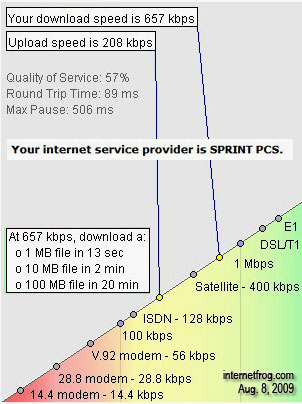
Speed at my home (see below) isn’t anything to write home about, but certainly is easily as good as a very busy hotel wifi connection or “no connection” while stopping for a quick lunch or in front of a clients office in the car.

A few pluses is that the Palm Pre can be set up to be used as a WiFi router (Wireless Access Point – WAP), and by enabling MyTether in this way several computers can be connect through its Adhoc network and access the Internet. Currently I’ve disabled my home network and have both my Mac and notebook PC running off the Pre — pretty nice if it doesn’t cost $60 more per month? Currently, the Pre is comfortably charging while its doing its duty and offering up some pretty solid 3G network connectivity. (I’ll test the speeds again when I get a better signal)

MyTether InternetFrog Speeds
SprintPCS Palm Pre connection 8/8/2009

It was past time for a new USB Flash/Thumbdrive

Posted By on August 6, 2009

ThumbDrive/FlashDrive

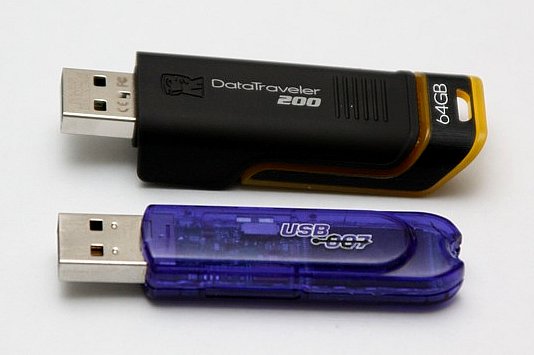
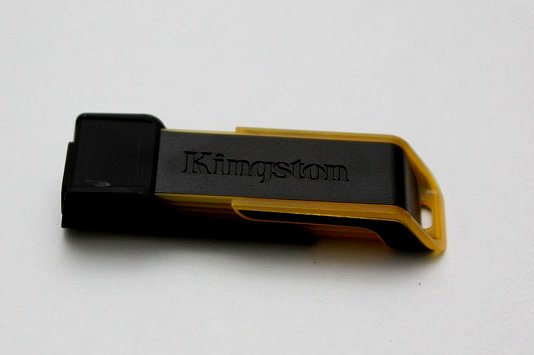
I’ve been thinking about buying a new USB ThumbDrive/FlashDrive for some time now, primarily for backups, transfer and storage when a  Buy.com email hit my inbox and triggered my impulse purchase — 64GB Kingston DataTraveler.

USB007A few years ago when I was traveling more often, I purchase my first and only ThumbDrive which has served me well (and my son in school too). At the time, a 1 GB USB ThumbDrive was unheard of … and I even had to order it direct from Hong Kong. Of course now a 1GB is laughable, but back then it cost me over $300! (I’m not laughing) Kingston DataTravelerFast forward to 2009 and memory is far less expensive, making small flash memory cards (took two 16GB SD cards on our recent trip) and USB drives give-a-way items, especially smaller ones. Of course I wanted a bigger ThumbDrive in order to transfer larger files, video or to back up more secure data with encryption (I’m storing a Truecrypt directory). The less than $130 price point made the memory drive attractive and considering my son heads back to college in a couple weeks with my USB007 drive, I figure it was a good time to upgrade.

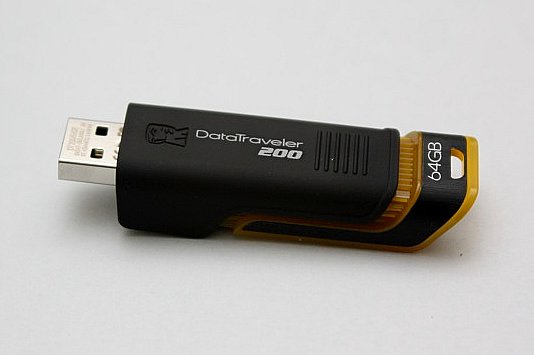
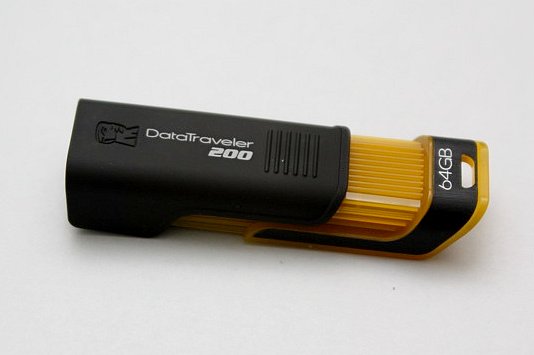
DataTraveler 64GB

Unfortunately the  Kingston 64GB FlashDrive can’t be used as Microsoft Windows “Readyboost” memory — but then that wasn’t the purpose. Real life transfer speeds seem a bit slow, but calculations show 29MB/secondKingston DataTraveler back moving files from the Kingston DataTraveler 200 ThumbDrive to my Window 7 RC notebooks computer’s hard drive and 13MB/sec transferring data from the computer to the ThumbDrive (the Apple Macintosh was about the same, although I didn’t time it). I’m sure I’ll be kicking myself in a few months as flash memory continues to drop, but then again hyper-inflation could make my purchase a deal? (listen to Peter Schiff speaking about  2009-2010 US Hyperinflation — MP3 audio)
😯

Apple iTunes and the Palm Pre with WebOS

Posted By on August 5, 2009

Palm AppleIn the business world, dominating a market has long been the practice of corporations. Some of it is justifiable since research, development and marketing cost companies a significant amount of money, but eventually most large corporations flirt with anti-trust laws. In the early 20th century and with hindsight it is easy to spot (ie. Standard Oil in 1911), but as the century drew to a close  the challenges of pinpointing what  behaviors are monopolistic and which are just smart business practices has blurred.

Microsoft in the 1990s … undisputed king of the personal computer operating system with MSDOS followed by Windows. To protect their turf, they spun their code in order to integrate Internet tools and services thwarting smaller browser companies bringing the eyes of anti-trust legislators upon them — too slow and too late for many struggling competitors. Other software companies like Adobe dominate by purchasing smaller rivals that threaten their products or preventing access to proprietary, but dominate file formats. In In keeping with the computer theme, Intel dominates when it comes to providing chipsets for PCs and devices … although monopolistic behavior is less noticed by the average consumer (direct competitors might suggest otherwise?). Then their is retail giant Walmart with rigid and frugal business practices that have work very well for this company: buying power, low prices and match or beat local competition has become difficult to beat when it comes to consumer value. Unfortunately for smaller retailers, it is nearly impossible to match the buying power of Walmart, difficult to sell at tiny margins and frustrating when a Grand Opening ‘ultra’ low price strategy can last long enough in small towns to put most ‘mom and pops’ out of business. Eventually competition in small town disappears, Walmart prices inch up, although remain respectably low enough to thwart competition upstarts. Unfortunately for residents of small towns, after a couple years of  Walmart matching or beating competitors, consumers are left with fewer retailers … especially smaller ones. Is this monopolistic behavior or just a shrewd business practice?

Currently, Palm and Palm Pre owners are facing Apple’s dominance in the recorded media and smartphone arena.  Apple claims to be defending their product when they block access to their  iTunes software (both Mac and PC computers) based on USB Vendor ID number (see PDF complaint letter). Some see this as controlling customer purchased music, audio and video and using methods counter to the openness being promoted by the USB-IF governing body. There is little doubt that Apple desires to prevent all external devices except theirs to access data that is controlled by iTunes. Is this monopolistic … maybe … but as a consumer it does slow progress and reduce competition.

Back to my initial comment about companies investing in research, development and marketing, I believe that needs to be protected long enough to be significantly profitable (ie. patents). We need this so that companies and individuals continue to risk capital on innovation. But when their is a move to protect and monopolize beyond the product, either by shear size and dominance , anti-trust oversight needs to prevail. In the case of using USB-IF interoperability ID numbers to block access to a computers organized data, its smells of Apple trying to control and dominate recorded media on  computers and the devices using this media.

An article in the NYTimes quotes Tim Wu, a professor at Columbia:

“There’s something very unseemly about what Apple is doing. It’s very counter to the ideals of openness, which is a concept Apple pioneered in computing.” In 2007, Steven P. Jobs, Apple’s chief executive, issued a call to the music industry for openness, titled “Thoughts on Music.”

As for Palm, Mr. Wu said, “It sounds like an uphill battle, in terms of trying to stop Apple from doing this.”

But Palm may have a shot. “The history suggests that openness wins,” said Mr. Wu.

_

WordPress 2.8.3 upgrade made easy

Posted By on August 4, 2009

Once again another incremental upgrade of WordPress moving my install to the 2.8.3 release … and thanks to Keith Dsouza‘s open source plug-in — WordPress incremental backup, it’s a painless and pretty easy step by step process (perhaps 5 minutes with database backups and all).

Speaking of open source, one of the other projects that Keith is working on is a simple Twitter information look up application called Twitlookup. Although there are several functions,  I expect that the dictionary and weather tools could get the most use. (The new app  is down as of this lunchtime posting)
😳

Michelle Malkin promoting her new book on “The View”

Posted By on August 3, 2009

I have a new found respect for Michelle Malkin as I watched her handle “The View” ladies and audience;Culture of Corrruption by Michelle Malkin she was better than most while promoting her book, in my opinion. (EDIT: thanks Scott)

For those into heavy political reading (right wing oriented), Culture of Corruption: Obama and His Team of Tax Cheats, Crooks, and Cronies, looks to be a very interesting read — although at 400 pages I may have to wait until the MP3 version is released???

Dictionary.com’s word of the day: desultory

Posted By on August 3, 2009

Dictionary.com Word of the Day A friend … and regular reader of my blog … sent me a message mentioning that the  “Word of the Day” over at Dictionary.com was none other than desultory.
:mrgreen:

Thanks Scott.

Desultory - des-uhl-tawr-ee, -tohr-ee

  1. lacking in consistency, constancy, or visible order, disconnected; fitful: desultory conversation.
  2. digressing from or unconnected with the main subject; random: a desultory remark.
My Desultory Blog