Posted By RichC on February 25, 2008
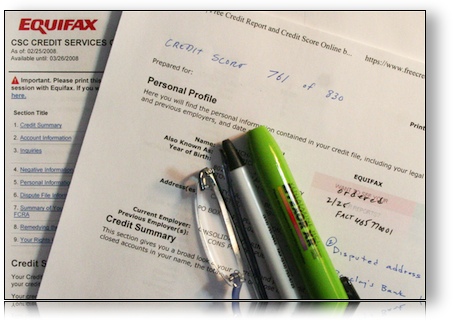
Having dealt with an identity theft issue about 5 years ago, I’ve been a bit more attentive to what is being reported on my credit report. Once a year around tax time I pull my own credit report and review the items being reported. (haven’t opted for a ‘pay for’ monitoring service just yet) This year I notice an incorrect out of state address and a credit card that I didn’t recognize — once again its time to clean up. Have you checked your credit report and score recently?

Suggestion: Pull your credit report from Equifax, Transunion and Experian. (or use a free credit reporting services to get a report)
 Then review each of the entries and confirm that the addresses being reported are yours. If there are legitimate concerns in regard to reporting from banks or credit sources, first contact the company to try and clear up the issue. You might also report the disputed information with the credit bureaus metioned above, although it is a convoluted process that in my case didn’t correct the issue. (except for the wrong address)
 Another frequently ‘talked about’ component of your credit report is the “credit score.” This maybe the single number that you are attempting to bolster, or correct.
 According to DebtGuru writer Michael Peterson, “a credit score is sort of like your adult version of a report card. It tracks your performance in incurring debt and paying your bills on time. You want a high score, because it shows that you are responsible about your finances and can be trusted to repay loans.” I see it more like a SAT or ACT score for admission in to college. It will either open or close the door to credit and is even being used to influence decisions like renting apartments or getting basic utility services!
How is my score calculated?
Your score may be different at each credit reporting agency, since the information they have on you may differ, or the statistical pool they are drawing from may be different. But they all use the same software to generate your score. You may hear your credit score referred to as a FICO score. That is because most scores are determined using software developed by Fair Isaac and Company.
What determines my score?
Your credit score is not concrete. It ebbs and flows like the tide, changing whenever you pay a bill on time or late, apply for new credit card or take out a loan. Your score is based on your credit history, and it attempts to predict what your credit behavior will be like in the future.
According to Peterson, the calculations for your credit score are based on statistical data and are objective evaluations. “You get points based on various credit factors. A creditor takes all of the information on your credit report, compares it to the statistics of people with similar profiles, and grants you points based on factors that predict creditworthiness such as outstanding debt, payment history, late payments, or the age of your accounts. Your total number of points reflects how reliable you are–how your past behavior suggests how likely you are to pay back a loan or pay your bills on time.”
I’m old enough to also have a bunch of items that might be smart to clean up and so decide to eliminate a few credit and store charge cards that were opened for one reason or another. For example, I had a bookstore credit card, a Brooks Brothers store card and an Old Navy revolving card that were only used for the initial discount. (ie. 10% off or something at the time of purchase) These were not being used and this was a good time to call and cancel them. Beside decreasing my exposure to fraudulent use, it should also help as it relates to credit score. Another suggestion from the experts is not to apply for additional new credit, especially unneeded credit or store cards. Reducing your balances is another way to improve your credit score, besides reducing credit debt is probably something that would be wise for all of us. Experts also recommend that you should try to reduce the number of credit cards you do use, and that keeping the ones you’ve had the longest tends to improve your credit score. And finally, have a long and clean credit history is a positive and does calculate into higher scores.
If you do go through the dispute process in an attempt to clear a negative item and it doesn’t go in your favor, you have the right to add a permanent statement to your credit reports which explains the nature of the inaccurate information. In this case the questionable information is not removed, but it is at least explained and must be included. (it is required by law)
What is the best score?
If you have a 760 or above, consider that an “A†on your credit report. You will get the best credit rates. Above 700, a “Bâ€. Between 600 and 700, a “Câ€. Below 600 is a big “D†or even an “F†and you will almost surely have to pay higher interest rates with a grade like that.
Category: Financial |
No Comments »
Tags: bureau, credit, idenity, report, score, theft

 Hillary Clinton, Barack Obama, John McCain and Mike Huckabee were or are speaking Monday and Tuesday in and around Cincinnati Ohio. I could barely contain myself watching the local news interviewing those showing up to
 While doing a few calculations, it might even save a few bucks to fly from Cincinnati to Orlando rather than drive … if you consider the cost of miles on an automobile. Here’s the
 LOw REsistance MObile
 While on a college visit with my son and short vacation this past weekend, I picked up a good book that offered a first hand look at today’s politically correct ‘college experience.’ I’m not sure that the author’s recount will comes as a shock, but I assure you that quite a bit has changed from my