Does the USA have 1.6 trillion barrels of oil?
Posted By RichC on May 5, 2006
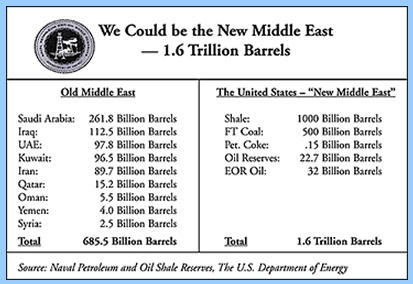
How much oil does the United States actually have? Its sort of a loaded question considering “what the definition of ‘oil’ is.” The estimates are all over the board when looking at traditional oil, but a recent read has me thinking the US might be far more oil rich that we think. Think Oil Shale.
Disclosure: I’ve spent the last several years learning about cleaner renewable energy in the form of biofuels, and have been promoting biodiesel as a way to offset some of the oil we currently import. It make sense from the standpoint of using something Americans grow, process and use. The fact that is clean, renewable and helps reduce our dependance on foriegn oil is a good thing for our national security as well. Biofuels are not the beat all to end all, but are alternatives that might ‘grow’ our way towards a smarter and cleaner energy future.
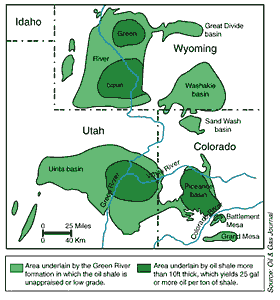 I still am confident that renewables are important as they are a carbon neutral source of energy, but are not a complete replacement for petroleum. In other words, I’m not burying my head in the “shale” and ignoring the obvious … that of the US oil reserves in ‘Shale Oil.’ It comes as a shock to many that under the mountains of Colorado, Utah and Wyoming there are billions of tons of oil rich shale. This rock is similar to the ‘oil sands’ of Alberta Canada, but contain far more petroleum per ton than the oil sands. Besides that, the estimates are that the United States has far more oil shale than Canada has oil sands.
According to a report in TheStreet.com, there are over 16,000 square miles of oil shale in the Green River Formation alone and that each are holds nearly 2 million barrels of oil — it’s the most concentrated energy source on earth, according to the Energy Department. Interestingly, since the 1930s, the federal government has protected this land from mining and actually owns 80% of this oil-rich land.
One of the old complaints about extracting oil from shale (or sand) was that it was too expensive to extract oil, but recently companies are coming up with innovative ways to extract the oil. The rule of thumb was that oil needed to be $30.00/barrel to be profitable to begin this kind of extraction — it has started to make sense. A company in Utah states that “it can extract the oil for as little as $10 a barrel.”
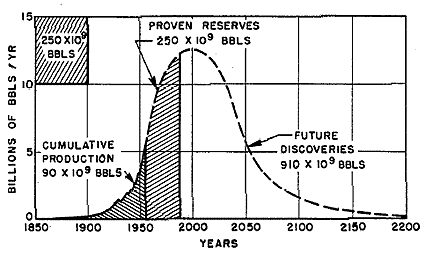
On August 8, 2005, President Bush signed into law, a mandate lifting the protective legislation on the Green River Formation which now allows companies to begin testing the shale formations. Then in January, the government gave six companies 160 acres each of the government’s oil-rich land to beginning tapping the petroleum rich rock. If they start to deliver on this shale oil, we could once again be awash in petroleum putting “Peak Oil” off another few decades or even centuries … depending on how wisely we use this domestic shale based oil. Perhaps the original Hubbert curve model of future oil, devised by M. King Hubbert, needs to be re-scaled, flattened or at minimum moved a bit toward the right? (see sketch below)
 This post is for Jason who commented that he enjoyed the

 Aggressive activists have stepped up their approach in anti-businesses activism … or terrorism … or blackmail, if you want to be polite and it seems to be working. Anyway you cut it, its a fear tactic that worked against the New York Stock exchange last year and could become a way to threaten and achieve an objective. A company called Life Sciences (or known as Huntingdon Life Sciences in Britain) was an hour from being listed on the New York Stock Exchange, but the NYSE pulled the listing. It sure seems as if it had something to do with the pressure eco-activist groups applied through threats. During the first week of September 2005, “Stop Huntingdon Animal Cruelty’s” (SHAC) website provided “willing thugs with the names, phone numbers, and e-mail addresses of 100 New York Stock Exchange leaders and staffers. SHAC’s New York City subsidiary, which calls itself W.A.R. (“Win Animal Rightsâ€), announced in similarly pointed e-mails to 10,000 like-minded supporters that the exchange was now the “primary focal point†for its campaign.”
 Ron Patrick’s New Beetle gives a new definition to the Super Beetle of the 1970s. He has a ‘slightly modified’ version of the popular Beetle that I first saw on
 Another day, another comment about diesel vehicles — let’s just say that I’ve been smelling diesel fumes lately. According to
  Americans really need to open their eyes to what the rest of the world already knows … new diesels are clean, quiet, powerful and fuel efficient. Hopefully its the ‘fuel efficient’ part that resonates as fuel prices top $3.00/gallon. As for the clean part, the the new Ultra Low Sulfur Diesel (ULSD) and biodiesel being implemented this year will help solve that concern. Currently American diesel fuel (D2) containing 30 times more polluting sulfur than European fuels but that is about to change come October of this year. Matt Vella in the auto section of