I say Ponzi Scheme, WSJ blog says “high-yield hara-kiri”

Posted By on July 15, 2012

A Ponzi scheme is a fraudulent investment operation that pays returns to its investors from their own money or the money paid by subsequent investors, rather than from profit earned by the individual or organization running the operation. The Ponzi scheme usually entices new investors by offering higher returns than other investments, in the form of short-term returns that are either abnormally high or unusually consistent. Perpetuation of the high returns requires an ever-increasing flow of money from new investors to keep the scheme going.

Wikipedia

If you are searching for a higher rate returns while investing,  or a “better than average” dividend” yield, be careful you aren’t purchasing a imageinvestordripfund that is returning investors principal as “distribution yields.” Last week I read an article which highlighted a family of closed end funds with higher than average yields. (way higher)  In today’s low rate environment, it doesn’t take a genius to know that something isn’t right.

The point is to be cautious when analyzing the dividends and distribution yields on funds with too good to be true yields, and read the prospectus carefully. High percentage returns in a low bond rate environment means one of two things: 1) very high risk, or 2) returning capital as a “distribution” … and likely a lot from new investor dollars. The big risk is that only so much principal can be return to investors before the house of cards gets shaky … “after the advisors have been paid” of course. Sooner or later investors will want their investments back and distribution yields will disappear.

High Rates? Are You Delirious?

Have today’s insanely low interest rates driven investors insane?

Three closed-end funds offered by Cornerstone Advisors of Asheville, N.C., show that some investors have come to believe the impossible: that high yields can persist in a world where central banks have squashed down bond rates to next to nothing.

These people have deluded themselves into believing they are earning fat yields. In reality, they merely are getting their own money back—and you can’t turn a fantasy into fact just by wishing it were so.

At Cornerstone, investors are receiving "distribution yields" of roughly 22% of net asset value, and the shares trade for much more than the value of their underlying assets. According to the WSJ Market Data Group, the Cornerstone funds are the three highest-yielding of the 657 closed-end funds in the U.S.

Most of the yield at Cornerstone, however, doesn’t come from its investments. In past years, it came from giving investors some of their original assets back. Now, it comes out of money the funds’ investors have just added.

In each of the past five years, the Cornerstone Progressive Return CFP +0.37% fund distributed more than 10 times as much in dividends and other payouts as it earned in net investment income.

In 2008 and 2009, for example, 93% of total distributions were return of capital—giving shareholders their own money back (after subtracting the manager’s fees, of course).

By the end of 2010, assets had shrunk to just $55 million from $132 million in 2007. At that rate, the fund would pay out its entire portfolio by 2014 or 2015—a kind of high-yield hara-kiri.

"If you keep throwing out more income than you can possibly make, someday your assets will go to zero," says Mariana Bush, a closed-end fund analyst at Wells Fargo Advisors. "And so will your management fees."

So, in 2011, the managers of Cornerstone Progressive Return raised $41 million in a "rights offering," a deal available only to existing investors that enabled them to buy one extra share for each three they already owned. That fresh capital injection helped the fund sustain its yield at more than 20%.

Last month, the fund raised $49 million in another rights offering. The prospectus says Cornerstone may turn around and pay much of that money back out to the same people who put it in.

Like a mutual fund, a closed-end fund is a pool of investments. But a closed end generally has a fixed number of shares, which trade on a stock exchange, where their prices can deviate from the underlying value of their holdings. Usually they trade below that value.

Most closed ends distribute varying amounts of dividends and capital gains. But roughly three dozen closed-end funds have "managed distributions" like Cornerstone’s, seeking to pay out a flat rate of income regardless of market returns.

None comes close to Cornerstone’s 20%-plus rates, which are "not reasonable or sustainable," according to Ms. Bush of Wells Fargo Advisors. And while rights offerings are fairly common, she says, they are "very unusual" among managed-distribution funds.

The magical payout machine at Cornerstone works roughly like this: Say you have $1,000 invested. You buy into the rights offering, shelling out another $250 or so to get extra shares. Cornerstone then pays out 20% or more in distributions, causing the value of each share to shrink accordingly.

The end result: You own more shares of a fund that is worth less, and most of the income you "earned" came from the money you put in yourself.

Cornerstone’s prospectuses disclose that much of its payouts "will not represent yield or investment return on the fund’s portfolio."

Still, Mike Taggart, an analyst at Morningstar, says he has received many emails from Cornerstone investors who believe that they are earning 20% yields and don’t understand that these funds are simply giving them their own money back.

"People see the ‘yields’ on these funds and they jump in," he says, "and it makes me sick."

Regarding such a switcheroo as "income" is like making an interest-free loan and then telling yourself, as the debtor pays back only your principal, that you are earning a generous return on your money.

Cornerstone’s portfolio manager, Ralph Bradshaw, didn’t respond to requests for comment.

Cornerstone Progressive Return has 93% of its assets in the shares of other closed ends, many trading below the value of their assets. The largest holding, at 4.9%, is the Eaton Vance Tax-Managed Global Diversified Equity Income fund.

But while you could buy the Eaton Vance EV +2.33% fund this week at a 14.3% discount to its net asset value, meaning that each $100 of its investments cost you less than $86, Cornerstone traded at a 10.3% premium. That means you had to pay $110 to get $100 in underlying assets.

That isn’t all. Because most of its portfolio is in other funds that charge their own expenses, the effective annual costs at Cornerstone reach 2.5%, according to its prospectus—roughly double those of the typical closed end.

Investing has sunk to this: People are willing to pay a big premium for the privilege of getting their own money back, after fat fees, without interest—apparently because it gives them the illusion of earning a high yield.

Desperate people do desperate things. Investors who are starved for yield do desperately stupid things.


intelligentinvestor@wsj.com; twitter.com/jasonzweigwsj

Looks like a 4-cylinder BMW diesel is coming to the U.S.

Posted By on July 14, 2012

Rumors have yet to be confirmed, but believe to be factual, that BMW will be adding a single or twin turbo 4-cylinder to their offering in North America next year. The 2.0L most likely will be offered in the 3-series which currently is available with a 6-cylinder diesel … a nice driving car by the way. The smaller engine should improve the current 36mpg U.S. diesel and put it right up there with the Volkswagen Jetta and Passat TDIs.

Photo

What it remains unknown is which variant of the 4-cylinder diesel will they use. Currently BMW offers 184 bhp and 380 Nm (280 lb ft) of torque, and also a twin-turbo variant of the same displacement but with 204 bhp and 400 Nm (295 lb ft) of torque.

Jason Cammisa of Automobile Mag says the engine is the single-turbo version. The engine currently powers the 320d model in Europe and is rated at 52 MPG. We believe BMW will use the 325d or 330d designation for U.S. models.

http://www.bmwblog.com/2012/07/13/rumor-2-0-liter-4-cylinder-diesel-engine-coming-to-u-s/

Posted via email from RichC’s posterous

Tech Friday: Surprising real data browser speed comparison

Posted By on July 13, 2012

mydesultoryblog_browserspd120711This comparison is not scientific since it only compares data pulled from Google Analytics and 25,000 MyDesultoryBlog visits, but it did surprise me. I expected to see Chrome a bit faster, but not Internet Explorer. Sadly the one time favored Mozilla Firefox is now a chubby porker and slow to load pages.

The music of Buffalo Springfield and triggered memories

Posted By on July 12, 2012

This content is restricted.

Google pulled firearms from their shopping search

Posted By on July 12, 2012

Google, an avid supporter of the 1st amendment, has decided they are NOT so supportive of the 2nd amendment … as I figured out after a few days of recent search failures for what Google classifies as “non-family safe” products — in this case, firearms.

Photo

After using a particular firearm a few months ago, I’ve been searching for availability using Google in hopes to find an M&P Shield (above). It was released by Smith and Wesson early this year and production hasn’t kept up with demand on this good quality and fair priced handgun. The “shopping” search worked fine in April, May and most of June and returned long list of stores selling the product (all out of stock). Then recently I noticed that I couldn’t pull the same searches??? A quick glance at the news page indicated Google had decided to censure items they deemed “non-family safe.” Shame on them for taking a restrictive stand against businesses marketing and a U.S. citizen’s Constitutional right to purchase and own a firearm … or in this case just searching availability and pricing. 

In its shopping service, Google “doesn’t allow the promotion of weapons or devices designed to cause serious harm or injury,” the website said, describing its advertising policies.

The ban includes “guns, gun parts or hardware, ammunition, bombs, knives, throwing stars, and brass knuckles,” it said.

Adsense listing to gun stores with an online business presence: http://support.google.com/adwordspolicy/bin/answer.py?hl=en&answer=176077

Posted via email from RichC’s posterous

A Short History of Congress’s Power to Tax

Posted By on July 11, 2012

For those wondering about the government’s Constitutional power to tax as it relates to “Obamacare,” here’s an excellent history lesson OpEd.
In 1935, Secretary of Labor Frances Perkins was fretting about finding a constitutional basis for the Social Security Act. Supreme Court Justice Harlan Fiske Stone advised her, “The taxing power, my dear, the taxing power. You can do anything under the taxing power.”Last week, in his ObamaCare opinion, NFIB v. Sebelius, Chief Justice John Roberts gave Congress the same advice—just enact regulatory legislation and tack on a financial penalty, as in failure to comply with the individual insurance mandate. So how did the power to tax under the Constitution become unbounded?

The first enumerated power that the Constitution grants to Congress is the “power to lay and collect taxes, duties, imposts, and excises, to pay the debts and provide for the common defense and general welfare of the United States.” The text indicates that the taxing power is not plenary, but can be used only for defined ends and objects—since a comma, not a semicolon, separated the clauses on means (taxes) and ends (debts, defense, welfare).

Entire Article

——

Mr. Moreno is a professor of history at Hillsdale College and the author of “The American State from the Civil War to the New Deal,” forthcoming from Cambridge University Press.

Texas takes the top spot for business in CNBC’s ranking

Posted By on July 10, 2012

A down day for the markets after slowing earning from big companies like Cummins and Alcoa … but it was the day CNBC announces the top states for business. Of course it is no surprise that Texas was the top state for the 3rd time in 6 years. The other states to make the top five are: Virginia, No. 3; North Carolina, No. 4; and North Dakota, No. 5.
Here are the categories that are used to rank the states.

Cost of Doing Business (350 Points)

Cost is a major consideration when a company chooses a state. We looked at the tax burden, including individual income and property taxes, as well as business taxes, particularly as they apply to new investments. Utility costs can add up to a huge expense for business, and they vary widely by state. We also looked at the cost of wages, as well as rental costs for office and industrial space (rental cost information furnished by CoStar Group).

Workforce (350 Points)

Many states point with great pride to the quality and availability of their workers, as well as government-sponsored programs to train them. We rated states based on the education level of their workforce, as well as the numbers of available workers. We also considered union membership. While organized labor contends that a union workforce is a quality workforce, that argument, more often than not, doesn’t resonate with business. We also looked at the relative success of each state’s worker training programs in placing their participants in jobs.

Quality of Life (350 Points)

The best places to do business are also the best places to live. We scored the states on several factors, including local attractions, the crime rate, health care, as well as air and water quality and pollution.

Infrastructure & Transportation (325 Points)

Access to transportation in all its modes is key to getting your products to market and your people on the move. We measured the vitality of each state’s transportation system by the value of goods shipped by air, land and water. We looked at the availability of air travel in each state, the quality of roads, and the time it takes to commute to work.

Economy (325 Points)

A solid economy is good for business. So is a diverse economy, with access to the biggest players in a variety of industries. We looked at basic indicators of economic activity, including growth, unemployment and the health of the real estate market. We measured each state’s fiscal health by looking at their credit ratings and outlook, as well as projected budget gaps (or surpluses) for the coming fiscal year. We also gave credit to states based on the number of major corporations located there.

Education (225 Points)

Education and business go hand in hand. Not only do companies want to draw from an educated pool of workers, they also want to offer their employees a great place to raise a family. Higher education institutions offer companies a source to recruit new talent, as well as a partner in research and development. We looked at traditional measures of K-12 education including test scores, class size and spending. We also considered the number of higher education institutions in each state and long-term trends for funding higher education.

Technology & Innovation (225 Points)

Succeeding in the new economy—or any economy—takes innovation. The top states for business prize innovation, nurture new ideas, and have the infrastructure to support them. We evaluated the states on their support for innovation, the number of patents issued to their residents, the deployment of broadband services, and the record of high tech business formation. We also considered federal health and science research grants to the states.

Business Friendliness (200 Points)

Regulation and litigation are the bane of business. Sure, some of each is inevitable. But we graded the states on the “friendliness” of their legal and regulatory frameworks to business.

Access to Capital (100 Points)

Companies go where the money is, and venture capital flows to some states more than others. We looked at the flow of capital to states in absolute terms as well as in proportion to the size of their economies.

Cost of Living (50 Points)

The cost of living helps drive the cost of doing business. From housing to food and energy, wages go further when the cost of living is low.

Blame our dysfunctional government in Washington DC

Posted By on July 10, 2012

Unless politicians “create an environment” that encourages risking capital and investing in American businesses, it will continue to be a struggle to grow our economy. I’m seeing more cities and counties running out of tax revenue and many more will be forced to declare bankruptcy unless thing change soon. emptypocketsOut of work and financially stressed taxpayers can’t continue to fund their public sector workers and from what we are seeing in Washington DC, it doesn’t look as if they are close to a solution that encourages growth and business investment. The unknown cost of Obamacare and the recent rhetoric of higher taxes discourages putting money at risk (investing in companies) and oppressive regulations in recent years make it restrictive to start new businesses or expanding old ones … in fact it encourages shutting them down. From what I can see, we’re not any closer to creating private sector jobs or accelerating the economy until we see change in Washington DC.

An article in the WSJ today highlights a growing concern as local governments are finding it impossible to meet payroll … let along fund pension plans for public employees.

SCRANTON, PA

Mayor Chris Doherty, a Democrat, temporarily cut the wages of police, firefighters and others to $7.25 an hour Friday, hours after a judge issued an injunction requested by three unions that represent most of the workers. A lawsuit filed July 2 in Lackawanna County Court on behalf of the unions argued that cutting the salaries unilaterally would violate the workers’ contracts under state laws governing public employees as well as federal law.

Meanwhile, Scranton’s business administrator said the city had just $5,000 in the bank last week after transferring enough money to cover the city’s payroll at $7.25 an hour, the state’s—and the nation’s—minimum wage. Mayor Doherty has said that once the immediate crisis is over, workers will be paid their deferred pay.

LINK

Great White Shark photos are always blog-worthy

Posted By on July 9, 2012

Sharksouthafrica_964x635

Shark photos trigger the most reposts on my blog and also the most hits … so with the heat of summer and the recent U.S. based “heat of the summer” beach sitings, it is only appropriate to include a great photo.

Erupting out of the sea with its jaws open the monstrous creature can be seen hurtling towards a Cape fur seal at a speed of almost 25mph.The dramatic moment was captured within a split second by famed wildlife photographer, Steve Bloom, who waited a painstaking 16 days for the incredible shot.

Posted via email from RichC’s posterous

Do teachers (and taxpayers) understand total compensation?

Posted By on July 9, 2012

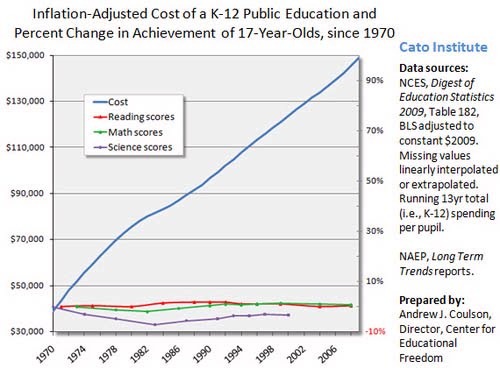
coulsonachievement

I’ve struggled with the “teachers are underpaid” debate arguing that we are often talking apples and oranges when comparing teachers, school district employees and management level administrators to the private sector. Those working in small businesses, corporations and the self-employed entrepreneurs make up the states private workforce and their taxes pay public sector and school salaries and they need to know there is some parity in pay and total compensation. Neither side of this debate has done a fair comparison … in my opinion … and each group, private sector, public sector and public education has a different structure for pay, job security, benefits, vacation time and most notably in recent years, retirement pensions.

The Heritage Foundation’s Jason Richwine discusses the issue of total compensation and benefits with Choice Media TV’s Bob Bowdon in this short clip … and has a couple suggestions that make sense (but will never happen) that increases a teachers pay (particularly in their early years) and suggests that we should structure their retirement pensions similar to the private sectors 401Ks.

As I see it, paying educators needs an overhaul. We no longer need to operate schools that operate 9 months a year and are only teaching students 6 hours per day. Our cost per student could be reduced if facilities were used all year and functioning two shifts each day. Teachers could initially be given the option to work more hours per year and their pay, vacation, sick time and benefits adjusted to match private industry. Performance should be measured just as with most other professionals; commonsense tells me that it is not that difficult to know when a teacher is drag on the school (as all those being honest when they graduate from high school can tell you) … maybe even use a varied teacher peer review scale to help weed out weak educators?

When it comes to factoring in retirement benefits, how about each state taking a broad cross section of their business retirement plans (a mix of small and large companies) and create a 401K retirement plan that gives teachers an incentive to contribute with a match tied to the state’s blend of businesses?

I’m amazed our nation moves so slow in making changes that keep our educational system competitive with other countries? With all the money being spent on education here in the United States, our numbers should be much better … this is shameful.

educationscoresbycountry200

Desultory - des-uhl-tawr-ee, -tohr-ee

  1. lacking in consistency, constancy, or visible order, disconnected; fitful: desultory conversation.
  2. digressing from or unconnected with the main subject; random: a desultory remark.
My Desultory Blog