Archive: Understanding retirement Part 1

Posted By on August 28, 2011

I’ve been thinking about the big entitlement (negatively charged word?) issue when it comes to how the U.S. structured our senior citizen’s healthcare seniormanand retirement living expenses. Having never really fully understood the cost … and inching closer towards that eventual day … I do recognize while looking at my own health and insurance costs that we face a really big problem when it comes to Medicare – it is difficult for me to see a way we can save it as it currently exists.

Social Security on the other hand may be more salvageable since costs can be better anticipated and amortized, but politically finding the will to address either problem is going to not only going to continue the political class warfare, but eventually make for a generational battle.

Below is an article I’m adding to the archive to better understand and contemplate how to deal with the the easier of the two issues (Social Security).Eventually we’ll all have the face the mounting cost and seek a solution not for Social Security, but the bigger problem – Medicare … but that will have to wait for Part 2.

Social Security: CNBC Explains – August 25, 2011

Born out of the Great Depression, Social Security is a) a socialist-styled government giveaway costing billions, or b) a well-thought-out retirement plan for aging citizens, paid mostly with their contributions.

Either way, the program has been a source of controversy since the beginning.

But what is the truth behind Social Security? What was it meant to do and how has it changed over the years? CNBC explains.

What is Social Security?

Social Security is a mandatory retirement system established in 1935 as part of President Franklin D. Roosevelt’s New Deal. It is run by the Social Security Administration, or SSA, based in Woodlawn, Maryland, just outside Baltimore.

The agency includes 10 regional offices, eight processing centers, some 1,300 field offices, and 37 Teleservice Centers. About 62,000 people work for the SSA.

The Social Security Act—as it is formally known—was created out of the devastating effects from the Great Depression. Millions of Americans lost their jobs, savings disappeared and the elderly were often left without a source of income.

The SSA provides benefits to retirees and disabled workers.

It is a “pay-as-you-go” program in which current workers fund benefits for current retirees and disabled Americans. In most cases, a worker must have 10 years of covered employment to be eligible for retirement benefits.

In 2011, there are an estimated 56 million people receiving Social Security benefits and 158 million workers paying into the system.

The act has expanded over the years, as we’ll see later. It also gives money to states to provide assistance to Aid to Families with Dependent Children, Maternal and Child Welfare, public health services, and the blind.

How is Social Security funded?

Workers and employers pay for Social Security—in fact, both are required to pay Social Security taxes.

In 1935, the amount employers and workers paid was a combined 2 percent payroll tax on the first $3,000 of a worker’s income.

As of 2011, workers paid 6.2 percent of their earnings into Social Security—up to an income of $106,800 a year. After workers hit that income level, taxes are no longer deducted.

Employers pay a matching amount, for a combined contribution of 12.4 percent of earnings.

Self-employed persons have to pay both the employee and employer share—for a total 12.4 percent.

Another source of funds comes from higher-income Social Security beneficiaries, who pay federal income taxes on their benefit income.

One important note: Social Security is not technically part of the federal budget. It never has been. In 1968, President Lyndon Johnson included Social Security for the first time in a "unified federal budget" as part of an effort to end confusion over budgetary procedures.

It was taken ‘off budget’ by 1986—meaning its balance sheet is not technically part of the overall federal budget.

However, those involved in federal budget matters often produce two sets of numbers, one without Social Security included in the budget totals and one with it included.

How are benefits calculated?

This is not the easiest of math problems to solve, as even the SSA admits.

Social Security benefits are based on a worker’s lifetime earnings. Out of entire earnings from age 22 to 62, the highest 35 years of indexed earnings are used in the computation.

Actual earnings are adjusted or "indexed" to account for changes in wages since the first year of work.

The purpose for indexing earnings is to make sure benefits reflect the rise in the standard of living that took place during a worker’s lifetime. Benefit increases are based on annual cost of living allowances—what’s referred to as a COLA.

The average monthly Social Security benefit for a retired worker was about $1,177 at the beginning of 2011, according to the SSA.

The SSA had send out by mail twice a year estimated benefits recipients would get. However, in a recent cost cutting move, that mailing has stopped.

The SSA has an online benefit calculator.

Are Social Security benefits taxed?

Yes. Until 1984, Social Security benefits were exempt from taxes. But in 1983, Congress made up to 50% of Social Security benefits taxable for higher-income beneficiaries; and in 1993, up to 85% was made taxable.

According to the Congressional Budget Office, about 40% of beneficiaries are impacted by the tax.

But the taxes collected are credited to the Social Security Trust Funds and the Medicare Hospital Insurance Trust Fund and not used for the Federal budget.

What is the Social Security Trust Fund?

Actually, there are two trust funds to handle surpluses in the program. Both were started in 1939.

The Social Security Trust Funds are: the Old-Age and Survivors Insurance (OASI) and the Disability Insurance (DI) Trust Funds. These funds are accounts managed by the Department of the Treasury.

They serve two purposes: they provide an accounting mechanism for tracking all income to and out of the trust funds—and most importantly, they hold the accumulated assets.

Social Security surpluses are, by law, invested in U.S. Treasury securities. When payroll taxes exceed benefits in a particular year, the surpluses are used to buy securities which are held by the Trust Funds.

The Trust Funds earn interest, which is set at the average market yield on long-term Treasury securities. Interest earnings on the invested assets of the combined OASI and DI Trust Funds were $2.6 trillion by 2010.

So far, there have been 11 years in which the Social Security program did not take in enough FICA taxes to pay the current year’s benefits. During that time, Trust Fund bonds in the amount of about $24 billion made up the difference.

Social Security’s costs will grow in coming years as the large Baby Boom generation those born between 1946 and 1964—move into their retirement years. The trust funds would then be exhausted by 2037 without changes to the system.

What age do you have to be to collect Social Security?

The first checks went to those who reached age 65, though early retirement at 62 would bring limited benefits, with a permanent reduction to 80 percent of the full benefit amount.

But the age has increased. In 2010, the full benefit age became 66 for people born in 1943-1954, and it will gradually rise to 67 for those born in 1960 or later.

Early retirement benefits will continue to be available at age 62, but they will be reduced more.

When the full-benefit age reaches 67, benefits taken at age 62 will be reduced to 70 percent of the full benefit and benefits first taken at age 65 will be reduced to 86.7 percent of the full benefit.

What are the origins of Social Security in the U.S.?

The U.S. created several pension plans for soldiers and sailors through its early history. But fast forward to the Civil War, and we find the first true government relief program that could be called a social security system, according to the SSA.

The Civil War Pension Program was signed into law in 1862 and provided funds to U.S. soldiers who were disabled in battle. Widows and orphans could receive pensions equal in amount to what would have been paid to a surviving veteran.

By 1890, the law changed so that any disability—from battle or not—would qualify a vet for funds. In 1906, old age was made a sufficient qualification for benefits. One note: pensioners did not have to pay into the system to receive funds.

Leaping into the 20th century and again to the Great Depression, we come to Social Security’s true start. What’s interesting to note is that several states at that time, such as New York and Massachusetts, passed limited pension plans for the elderly before the federal government did.

In June 1934, FDR announced his intention to provide a social security program. He created the Committee on Economic Security to come up with the exact plans for the system.

FDR submitted a bill with the recommendations, and it eventually passed both houses of Congress and was signed into law on Aug. 14, 1935.

How has Social Security expanded?

Initially, the SSA was charged with providing benefits only to retirees and some unemployed people.

The benefits for retirees was not supposed to be permanent. It was to be a temporary "relief" program that would eventually disappear as more people were able to obtain retirement income. And there were limits on the unemployed. Job categories not covered by the initial act included workers in agriculture, domestic service, government employees, and many teachers, nurses, hospital employees, librarians, and social workers.

A 1939 change in the law added survivors’ benefits and benefits for the retiree’s spouse and children.

By 1950, Social Security laws expanded coverage to all non-government workers, including the self-employed. It wasn’t until 1983 that civilian federal workers—such as the President of the United States—were eligible for Social Security benefits.

Another change to Social Security was the addition of Disability Insurance program in 1956. This provides monthly cash benefits for disabled workers and their dependents who have paid into the system, and met minimum work requirements.

An important note of change involves Medicare and Medicaid. Medicare is the nation’s health insurance program for people age 65 or older; Medicaid is a health and medical services program for low income individuals and families. Both were established in 1965 under a Social Security reform law.

But they are not a direct part of Social Security. Like Social Security, Medicare is financed by a portion of the payroll taxes paid by workers and their employers. But Medicare is also financed in part by monthly premiums deducted from Social Security checks.

What is the basis of your Social Security number?

Ever wonder why the Social Security numbers are the way they are? The numbers are designed to make sure benefits are accurate.

The first three digits are assigned by the geographical region in which the person was residing at the time they obtained a number.

Generally, numbers were assigned beginning in the northeast and moving westward. So people on the east coast have the lowest numbers and those on the west coast have the highest numbers.

The remaining six digits in the number are more or less randomly assigned and organized to ease bookkeeping procedures.

And by the way, no serial number 0000 has ever been assigned. Social Security numbers were first issued in November 1936. To date, 453.7 million different numbers have been send out.

When a Social Security card holder dies, that number is not reused.

What is the controversy surrounding Social Security?

Often called the “third rail” of American politics, Social Security has been attacked from both sides of the political spectrum.

Big business opposed Social Security from its beginning because it imposed new taxes, new bookkeeping requirements, and "undermined the absolute dependence of the employees on the company."

Many on the left said it didn’t go far enough to help citizens and was discriminatory—nearly two-thirds of all African Americans in the labor force and just over half of all women employed were not covered by Social Security at its inception.

There have been calls for many changes over the years: raise the retirement age, reduce benefits, and privatize the SSA by transferring the funds held by the government to Wall Street investment firms.

The impact of Social Security may be underlined by the fact that 8 percent of the elderly receiving Social Security benefits are poor, according to U.S. government standards. Meanwhile, forty-eight percent of Americans would be below the poverty line if they didn’t receive a monthly Social Security check, according to government statistics.

Come on in and grab onto my tail, “I don’t want to eat you!”

Posted By on August 27, 2011

comeonin_thewatersfine

Sort of reminds me of the of the 1875 St. Nicholas tale with the Gingerbread Man which ends like this:

… He ran till he came to a river. And next to the river was a fox. The fox said, "Hello little gingerbread man."Gingerbread_Man_1963_01a

The gingerbread man said, "HELLO! I ran away from the little old woman, I ran away from the little old man, and a pig, and some cows, and I can run away from you too!

Run, run, fast as you can!
Can’t catch me, I’m the gingerbread man!"

"But," said the fox, "I never run. And I don’t want to eat you!"
The gingerbread man said

Run, run, fast as you can!
Can’t catch me, I’m the gingerbread man!"

The fox said, "Run all you want, I’m not going to chase you. But– I would like to ask you a question."

The gingerbread man said, "What?"

The fox said, "How do figure you’re going to get across that stream without getting wet? I mean, if you get wet, you’ll get soggy, right?"

The gingerbread man didn’t say anything, but he looked very thoughtful.

The fox said, "I’ve got an idea."

The gingerbread man said, "What?"

The fox said, "I’m going to swim across, right now. If you want, you can hitch a ride on my tail."

The gingerbread man said, "OK," and grabbed the fox’s tail. The fox started to wade into the water.

After a few steps, the fox said, "Oh, little gingerbread man. The water is getting kind of deep. I’m afraid you might get wet. Why don’t you climb up onto my back?" The gingerbread man looked, and said, "Gee, the water is getting kind of deep, ok," and he climbed up onto the fox’s back.

After a few more steps, the fox said, "Oh, little gingerbread man, the water is getting even deeper, I’m afraid you might get wet. Why don’t you climb up onto my– neck?" The gingerbread man looked, and said, "Gee the water is getting kind of deep, ok," and he climbed up onto the fox’s neck.

After a few more steps, the fox said, "Oh, little gingerbread man, the water is getting even deeper, I’m afraid you might get wet. Why don’t you climb up onto my– head?" The gingerbread man looked, and said, "Gee the water is getting kind of deep, ok," and he climbed up onto the fox’s head.

After a few more steps, the fox said, "Oh, little gingerbread man, the water is getting even deeper, I’m afraid you might get wet. Why don’t you climb up onto my– nose?" The gingerbread man looked, and said, "Gee the water is getting kind of deep, ok," and he climbed up onto the fox’s nose.

And the fox went– SHLLLURP!– and that was the end of the gingerbread man.

The Gingerbread Man story

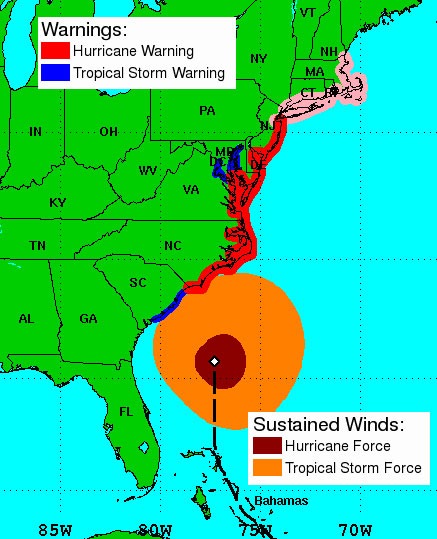
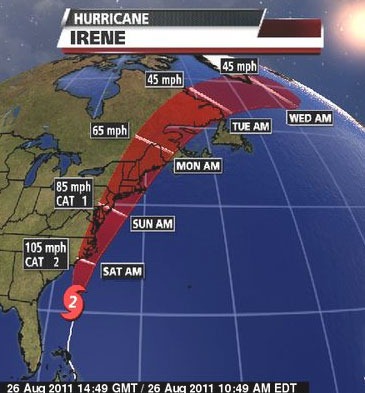
Hurricane Irene continues to track precisely as forecasted

Posted By on August 26, 2011

hurricaneirene_clouds hurricaneirene110826pm
Clouds from Hurricane Irene off the South Carolina beaches on Friday (click for larger)

While most living near the east coast of the U.S. prepare for Irene, the rest of us watch and hope early warnings are being heeded and that preparations are/have been made for the wind, rain and surge heading north. It’s going to be a tense weekend for many on the coast … let’s hope that its not anything like The Great Hurricane of 1938 (video below).

What will the economic cost of Hurricane Irene be?

Posted By on August 26, 2011

hurricaneirene11082611insurancehurricanecost
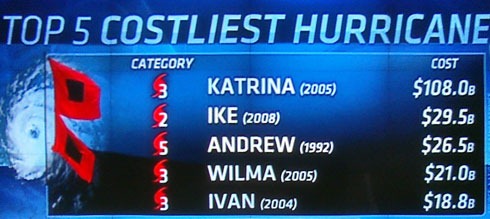
As the east coast waits for hurricane Irene to unleash its torrent of wind, rain and surge, the financial markets are analyzing the cost to insurance companies, taxpayers and eventually insurers (in higher premiums). Some suggest that Irene could make it into the top five list due to the forecasted impact of heavily populated east coast (and high priced) real estate and the long impact path.

Projections as of today are that the cost will be between $5 and $10 Billion dollars. The high end has estimates as high as $20 Billion.

Whether Irene wreaks the $15 billion damage mark that can turn the market depends to a great degree on where it hits.

LINK

Hurricane warnings up the east coast as Irene churns north

Posted By on August 25, 2011

Intense Hurricane IRENE (AL09) is forecast to strike land to the following likelihood(s) at the given lead time(s):

Red Alert Country(s) or Province(s)
    the Bahamas
        probability for CAT 1 or above is 100% currently
        probability for TS is 100% currently
    the United States
        probability for CAT 1 or above is 50% in about 45 hours
        probability for TS is 95% in about 45 hours
Red Alert City(s) and Town(s)
    Wilmington (34.2 N, 77.9 W)
        probability for CAT 1 or above is 50% in about 45 hours
        probability for TS is 90% in about 45 hours
    Norfolk (36.9 N, 76.2 W)
        probability for CAT 1 or above is 40% in about 69 hours
        probability for TS is 85% in about 45 hours

Yellow Alert City(s) and Town(s)
    Nassau (25.1 N, 77.4 W)
        probability for TS is 100% currently
    New York (40.7 N, 73.9 W)
        probability for CAT 1 or above is 25% in about 69 hours
        probability for TS is 80% in about 69 hours
    Philadelphia (39.9 N, 75.2 W)
        probability for CAT 1 or above is 25% in about 69 hours
        probability for TS is 75% in about 69 hours
    Richmond (37.5 N, 77.5 W)
        probability for CAT 1 or above is 15% in about 69 hours
        probability for TS is 65% in about 69 hours
    Raleigh (35.8 N, 78.6 W)
        probability for CAT 1 or above is 10% in about 45 hours
        probability for TS is 65% in about 45 hours
    Albany (42.7 N, 73.8 W)
        probability for TS is 65% in about 69 hours
    Providence (41.8 N, 71.4 W)
        probability for TS is 65% in about 69 hours
    Charleston (32.9 N, 80.0 W)
        probability for TS is 60% in about 33 hours
    Washington D.C. (38.9 N, 77.0 W)
        probability for CAT 1 or above is 15% in about 69 hours
        probability for TS is 60% in about 69 hours
    Concord (43.2 N, 71.5 W)
        probability for TS is 55% in about 93 hours
    Boston (42.3 N, 71.0 W)
        probability for TS is 55% in about 69 hours

August 25, 2011 at 5PM via tropicalstormrisk.com

Posted via email from RichC’s posterous

Mercedes puts a diesel in their roadster: the SLK250 CDI

Posted By on August 25, 2011

mercedesslk1dieselMy kind of diesel … well except for the 47,000 EUROs and “no word on U.S. availability or pricing” part.
Winking smile

Mercedes’ newest SLK roadster combines thrilling performance, classic sportscar proportions, and (most relevant from our purposes) incredible fuel economy figures:  try 47 miles for each gallon of diesel!

The SLK250 CDI is powered by Mercedes’ latest turbocharged, 4-cyl. diesel, which puts 204 hp and nearly 370 lb-ft of torque to the ground through a 7-speed automatic transmission.  That engine/transmission combination hurls the sporty roadster from a standstill to 60 mph in under 6.7 seconds, en route to a top speed of more than 150 mph – not bad, in other words, for a car that nearly matches the legendary Geo Metro‘s fuel economy!

Mercedes’ SLK250 CDI marks the first time the German carmaker has put one of its diesel engines to work in one of its roadsters.  Considering Mercedes’ history of building super-fast, diesel-powered prototypes and project cars, however, it may not be the last.

In addition to the high-mpg diesel, the new SLK250 CDI is available with Mercedes’ panoramic Magic Sky Control roof, as well as an available “Dynamic Handling Package” that includes the the company’s Direct-Steer system and Torque Vectoring Brakes, developed “for particularly agile and predictable handling characteristics.”

European pricing is set at just under 42,000 Euros.  No word yet on US availability and pricing.

Source: Gas 2.0 (http://s.tt/137e9)

Apple CEO Steve Jobs steps down, but remains positive

Posted By on August 25, 2011

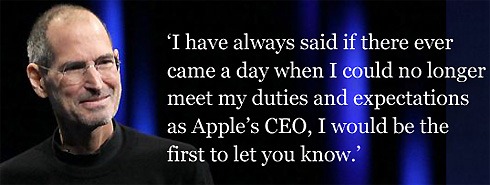
"I believe Apple’s brightest and most innovative days are ahead of it, and I look forward to watching and contributing to its success in a new role.”

— Steve Jobs (56), resigning CEO continuing Chairman of the Board

wsj_stevejobs

Although for the most part, my Apple loving days are probably in the past, I’m saddened to see one of America’s brightest and most innovative leaders handing over the reigns.

Apple said Mr. Jobs submitted his resignation to the board of directors on Wednesday and "strongly recommended" that the board name Mr. Cook as his successor. Mr. Jobs, 56 years old, has been elected chairman of the board and Mr. Cook will join the board, effective immediately, the company said.

"I have always said if there ever came a day when I could no longer meet my duties and expectations as Apple’s CEO, I would be the first to let you know," Mr. Jobs said in his resignation letter. "Unfortunately, that day has come."

LINK

My history with Apple stems back to the early 1980s when the only graphical personal computer at the time was the Apple Macintosh computer. It was “the only” fit for a start up printing and publishing company and it created an inroad for me and my new enterprise. No only was I able to set type without a dedicated “galley typesetting machine,” but the Macintosh enabled a user to actually set in position pages of text utilizing software. Soon we were setting type and graphics on a single paste-up sheet which could be quickly put to film, stripped with film halftones and burned to plate. What an innovation and leg up on the competition!

Of course it didn’t stop there … eventually the Mac enabled skilled graphic artists the ability to convert scanned sketches to refined press ready art in less than an hour … assemble catalogs in days not months … and eventually paginate and assemble full projects with color separations all on disk.

The Apple Macintosh eventually faced competition from Windows PC and has shared my industry with machines once again dedicated to prepress … but the revolution started with Apple and their “Xerox inspired” graphical interface. What a ride … thanks for dreaming and thinking out of the box Steve.

The big switch: Gold now down and stocks trading up?

Posted By on August 24, 2011

dowcloseshigh110824I sure would like it if I could accurately predict the volatile markets.

After opening down on the opening bell, the equity indices were up by the end of the day. This news is good for most long term investors and retirement plans, but not so good for those who have moved to precious metals in the last few days. For example, gold plunged below $1,800 and “gold futures ended the regular session down by $104, or 5.6%, at $1,757.30 an ounce for the most-active contract.”  According to WSJ reporting, the “rising stock market and sudden doubts about whether the Federal Reserve would signal any fresh stimulus measures on Friday were the principal drivers behind Wednesday’s selloff.”

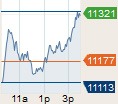
The Dow Jones Industrial Average gained 143.95 points, or 1.29%, to 11320.71. All but one of the Dow’s 30 components closed higher. The Standard & Poor’s 500-stock index gained 15.25 points, or 1.31%, to 1177.60. Financial and utility stocks registered the biggest gains in a broad rally. All 10 of the S&P 500’s sectors rose. The technology-heavy Nasdaq Composite rose 21.63 points, or 0.88%, to 2467.69.

The recent gains comes as investors hope Mr. Bernanke’s much-awaited speech on Friday will offer clues on how the central bank prepares to combat the slowing economy. That optimism may be fleeting, however, as the Fed hasn’t given signs that it’s ready to enact additional stimulative measures.

LINK

Sprint to Get Apple iPhone 5 – WSJ.com

Posted By on August 24, 2011

Married to Sprint but envious of the iPhone? Hold on … looks like it might finally be available.

Sprint Nextel Corp. will begin selling the new version of the Apple iPhone in mid-October, people familiar with the matter said, filling a huge hole in the No. 3 U.S. carrier’s lineup and giving Apple Inc. another sales channel for its popular gadget.

They should be offering both the iPhone 4 and the NEW iPhone 5 … but I’m curious if it will capitalize on Sprint’s 4G service?

The new iPhone is expected to be similar to the current iPhone 4, but thinner and lighter with an improved digital camera and a new more sophisticated operating system.


Posted via email from RichC’s posterous

Volkswagen challenging Toyota: The new Passat vs. new Camry?

Posted By on August 24, 2011

What is it going to take to make VW the “new people’s car?” With a larger size and lower price, the American built Passat could give domestics and the favored Toyota Camry a run for its money. While the current fuel saving hybrid is not in VW’s powertrain, the interstate frugal TDI diesel is sure to please those living where open road driving is commonplace.

VW doesn’t offer a gas-electric hybrid Passat model to compete with the Camry’s hybrid model or Ford Motor’s Fusion and Hyundai Sonota hybrids. Instead, it has a smooth-performing 2.0 liter diesel engine that’s rated at 43 miles per gallon on the highway. The new Passat gets an eye-popping highway range of up to 795 miles on a tank of gas. Take that, Nissan Leaf.

More important, the new Passat has a lower base price. The cheapest car starts at $19,995—less than the cheapest 2012 Camry.

Posted via email from RichC’s posterous

EDIT: The new audio system in the Toyota is a step forward tho…

Desultory - des-uhl-tawr-ee, -tohr-ee

  1. lacking in consistency, constancy, or visible order, disconnected; fitful: desultory conversation.
  2. digressing from or unconnected with the main subject; random: a desultory remark.
My Desultory Blog