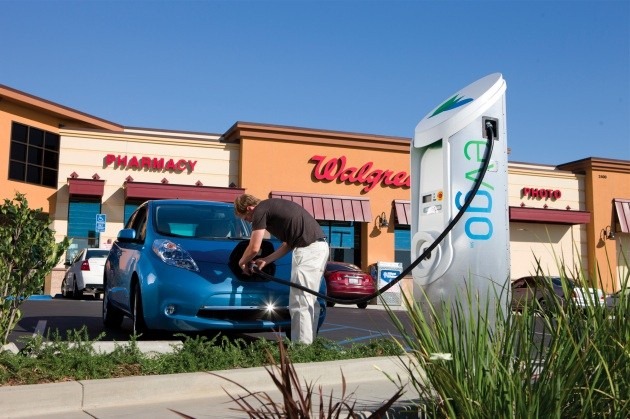
Walgreens will have EV charging station in 425 locations

Posted By on August 2, 2011

walgreens-ev-charger

Although EV only vehicles are the best fit for many of us, some might be a bit more comfortable if they knew where they could get a 20 minute charge. Personally don’t think we’ll see wide acceptance until universal wireless charging system are adopted widely available AND re-charging is offered as an incentive (discount). Perhaps EVs would gain a bit more widespread traction? Unfortunately the 350Green/Walgreens plug-in stations (rumored to cost $3-$4/charge) are a pretty expensive way to zip to the corner drugstore … although cheaper than a tow home due to running the battery flat.

I think the best way to promote EVs will be through “green minded” private companies who encourage their employees to buy cars with incentives; perks such as closer parking and free daily charging … maybe even a company wide “group discounted purchase” option financed through the company or its credit union? Maybe Google, Apple or other deep pocketed corporations are already doing this – if not, it will probably be right around the corner.

Press release regarding 350Green and Walgreens:

350Green and Walgreens to Bring Electric Vehicle Charging Stations to the New York Metropolitan Area

The agreement will help accelerate development of charging station network in America’s biggest city that has high adoption rate of electric vehicles and great need for fuel-efficient vehicles Los Angeles (July 21, 2011) – 350Green, a developer of electric vehicle (EV) charging station networks, today announced an agreement with Walgreens (NYSE, NASDAQ: WAG), the nation’s largest drugstore chain, to offer convenient access to EV charging stations. 350Green will install chargers at a total of 425 Walgreen locations, starting with the New York City metropolitan area. With the first phase of installations scheduled for up to as many as 60 charging stations, including 10 DC Fast stations in the New York City region, which will provide an ideal platform for creating infrastructure needed to support EVs as they roll off the production line.

"As a part of our comprehensive sustainably program – PlaNYC – we have been working to arm New Yorkers with the facts about electric vehicles and to green City government’s own vehicle fleet by adding electric cars," said Mayor Michael R. Bloomberg. "We have been working to increase the number of public charging stations in the City, but we need to see more locations for public recharging if we want to increase the number of electric vehicles on city streets. Walgreens and 350Green are making it easier for New Yorkers to choose electric cars over gas ones – an important step towards cleaning our air, fighting climate change, and reducing our dependence on oil."

Early focus on EV infrastructure has been on charging in home garages. However, the high number of residents in cities without access to a garage limits motorists’ participation in the EV revolution. By creating a network of public charging stations, widely and conveniently located near where residents live and work, EV ownership becomes a universal option.

"Now, as more Americans embrace environmentally sustainable technologies, our convenient locations make us uniquely positioned to help address the concern around accessibility or ‘range confidence’," said Walgreens President of Community Management and Operations Mark Wagner. "We look forward to becoming a destination for EV drivers looking to charge up." Depending on location and timing, 350Green will install either DC Fast Chargers, which can charge an EV in about 20 minutes, or Level 2 charging stations.

"To date the Department of Energy has invested $4.8 billion into the EV industry, laying the foundation for the free market to take over," said Mariana Gerzanych, CEO of 350Green. "We are excited to see private companies stepping in and investing as well. This project alone will create 54 jobs and will begin to generate jobs throughout the supply chain in other areas."

About 350Green
350Green is a project developer that designs, builds and operates a scalable, nationwide network of electric vehicle (EV) charging stations. The company partners with retailers, commercial property managers and developers, and municipalities to locate charging stations at places near where EV drivers live and work. Current projects are underway in Chicago, Pennsylvania and California. The company has signed partnerships with Walgreens and Simon Property Group, among others. For more information visit www.350green.com.

About Walgreens
Walgreens (www.walgreens.com) is the nation’s largest drugstore chain with fiscal 2010 sales of $67 billion. The company operates 7,733 drugstores in all 50 states, the District of Columbia and Puerto Rico. Each day, Walgreens provides nearly 6 million customers the most convenient, multichannel access to consumer goods and services and trusted, cost-effective pharmacy, health and wellness services and advice in communities across America. Walgreens scope of pharmacy services includes retail, specialty, infusion, medical facility and mail service, along with respiratory services. These services improve health outcomes and lower costs for payers including employers, managed care organizations, health systems, pharmacy benefit managers and the public sector. Take Care Health Systems is a Walgreens subsidiary that is the largest and most comprehensive manager of worksite health and wellness centers and in-store convenient care clinics, with more than 700 locations throughout the country.

Theatrics in Washington DC continues to wag Wall Street’s tail

Posted By on August 1, 2011

As I watch the talking heads on CNBC blabber back and forth, their premarket guest politicians covered their bases for the “lite” deal which in reality kicks the can down the road. It is expected that there will be enough votes to pass the small bill … enough to keep the government functioning and bills paid and give the President a debt ceiling increase.

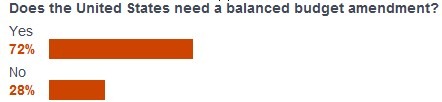
As far as savings over the long term, there really is little to cheer about. Realize that 2.1-2.4 Trillion in planned savings (the current small bill) hardly dents our nation’s debt. It also doesn’t balance our spending with our revenues (previous post and graphic). Voters like me are puzzled how representatives in congress refuse to listen to the public’s demand that they use this moment to spend only what we have. In fact poll after poll shows most Americans would even support a balanced budget amendment …  I’d go a step future and suggest we amend the constitution to include term limits for congress as well.

cnbcbalancebudgetamendpoll
CNBC Poll on Monday, Aug 1, 2011

Has the “safety net” grown into “middle class welfare?”

Posted By on August 1, 2011

arthurcbrooksYesterday I heard part of an interview with noted social scientist Arthur Brooks, President of the American Enterprise Institute, which I recorded on my Palm Pre Z-corder app – well at least part of it. He pointed out that our government has moved beyond the point of providing just the necessary “safety net” …

  Arthur Brooks The government safety net (mp3) | – July 31, 2011

Our problem: Government spending up; our revenues down

Posted By on July 31, 2011

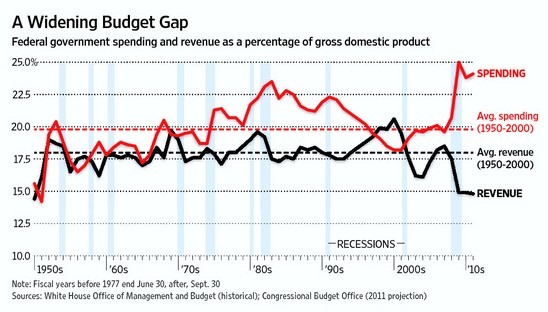
For many of us, getting a visual picture regarding the debate polarizing the country around the nation’s debt and deficit is helpful in understanding just how big the problem is. I found a WSJ graphic to be a clarifying example as to the gap between what we spend and what we take in as a percentage of GDP (the market value of what we produce). Economist, politicians and those who manage a business or family budget agree that our path is in no way sustainable … unfortunately not all agree on what we need to do in order to correct the problem.

wsjwideningbudgetgap

For the simple minded (no offense intended), we need to reduce our spending (tighten our belt) and work harder and smarter just as most families do when facing budget shortfalls. The first part is easy for all but an elected politician who is charged with cutting … the second part is a bit more difficult for those without a job or the skills needed to fill the positions that are available.

For the economist (depending on their school of thought), it is a bit more complicated. Most of them recognize the need to control spending, but they also for the most part agree that during a recession nations soften hard times with selective government spending and easing money supply in hopes to spur job creation. For the most part this has been the ‘tried’ strategy of the Obama administration for the past couple of years. The Federal Reserve has eased the money supply with lower interest rates (near zero percent) and the administration has implemented large stimulus packages in the hopes of creating jobs. Disappointingly, the policies have failed and in the opinion of many, it was due to how the stimulus was managed (costing nearly $400,000 per job created) … along with the administration’s additional regulation of banks, employers, entrepreneurs and investors – or the “unknowns” within these regulations.

It is my opinion that if we can somewhat agree with the brief explanation above in recognizing the problem, then we are halfway to a solution.

  1. Recognize that our nation spends too much of its GDP and that it is not sustainable … therefore reduce the size of the government and the cost to operate it by electing representatives who pledge to balance spending with revenue and will cut from every area of the budget (what’s wrong with a balanced budget amendment … even if we need a few tweaks for recessions, depressions and war?)
  2. Recognized that our nation needs to be business friendly and at we should at least be on an equal tax and regulation footing with the other countries we compete with – encourage companies to expand here by modifying the tax code to attract international corporations.
  3. Recognize that entrepreneurs and small business create the most jobs and offers the American dream to those willing to work hard and take risk. Remove the regulatory issues, tax complications and litigation fears  that has made starting and running a small business increasingly difficult.  (as someone who built a business and complained about government and tax paperwork in 1980s, I can tell you that it would be far more difficult and cost prohibitive today)
  4. Recognize that we live in a country that was founded on principles of freedom and liberty. Our government is far too over-reaching and now dictates decisions that should be made by the individual. Remove the newly enacted laws (e.g. Obamacare) and policies which takes away citizen’s independence and does not nurture personal responsibility.

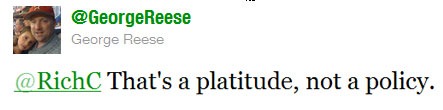
As I began writing this, I realized that I once again headed down theplatitude not policybeing argued by George Reese with me on Twitter yesterday. I guess I can’t help myself. Perhaps we all see clearly through the eyes of our political philosophy?

georeese_platitudnotpolicy

Ever been to Traverse City Michigan? This might inspire you.

Posted By on July 31, 2011

If you’ve ever enjoyed a summer (or fall, spring or winter) trip to Traverse City Michigan, you then know that it is a great All American town. I’ll bet you’ll love this  Traverse City LibDub 2011 video, at least I know Michigander Steve will, although some Buckeyes are pretty set in their ways?
Open-mouthed smile

Wright ‘B’ Flyer Silver Bird accident « EAA Chapter 284

Posted By on July 30, 2011

Our thoughts and prayers are with the friends and families of Mitchell Cary and Don Gum who devoted so much to aviation. It is a difficult day for those of us who support efforts to keep history flying and the Wright B Flyer Museum.

Crash kills 2 in plane based on Wright ‘B’ Flyer

GREEN TWP., Clark County — Two local pilots died Saturday morning during a test flight of the Wright ‘B’ Flyer’s Silver Bird.

The plane went down before 11 a.m. in a field about two miles west of 7391 Pitchin Road. Ohio State Patrol Sgt. Brian Cook of the Springfield Post said a call came in at 10:56 a.m. and troopers arrived at 11:39 a.m. He said all-terrain vehicles were needed to get authorities to the crash site. Media on the ground were not allowed on the property.

The president of Wright B. Flyer Inc. identified the pilots as Don Gum and Mitchell Cary. Phil Beaudoin said both men were volunteer pilots and members of the group’s board of trustees and that Cary was a former president of the organization.

“Wright B. Flyer Inc. and its members extend our deepest condolences to the families of Mitchell Cary and Don Gum,” Beaudoin said Saturday. “Mitch and Don were highly competent pilots with extensive experience flying Wright “B” Flyer airplanes and other experimental aircraft.

“They always observed the highest standards of safety. They made enormous contributions to our organization and to the aviation heritage community. They were good friends and we will miss them dearly.”

The coroner arrived at the scene at 1:45 p.m. and Cook said investigators from the Federal Aviation Administration were on the way. The plane had taken off from Springfield’s Beckley Municipal Airport, where Beaudoin said all test flights occurred for the Silver Bird.

A witness who lives nearby indicated that a small plane was sputtering and flying very low and then he heard the cracking of trees.

Beaudoin said the Silver Bird, call sign N453WB, is a slightly smaller version of the Brown Bird, the Model B replica Flyer that has been flying in shows for the past 25 years.

He said the plane had 25 hours of flight time before Saturday’s flight. Beaudoin said the aircraft received its FAA air worthiness certificate for test flights last fall.

Authorities did not address who was flying Saturday and Beaudoin said he did not know. Gum was quoted in a March 2010 article on Wright-Patterson Air Force Base’s website describing what it was like to fly a Model B replica.

“With other airplanes you have a reference out front, you have instruments,” Gum said during a show at Fort Sam Houston in San Antonio, Texas. “In (the Wright “B” Flyer) there is nothing around you, no cockpit; it’s beautiful, you can see directly below you.”

Beaudoin said the Silver Bird had been built during the past four years by volunteers and that it was constructed to modern standards. A third, non-flying Wright ‘B’ Flyer replica is housed at Hoffman Prairie.

Dayton Daily News

Posted via email from RichC’s posterous

How important is early boarding and securing carry on space?

Posted By on July 30, 2011

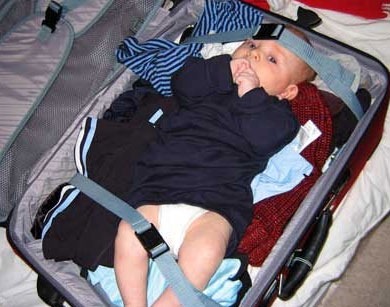
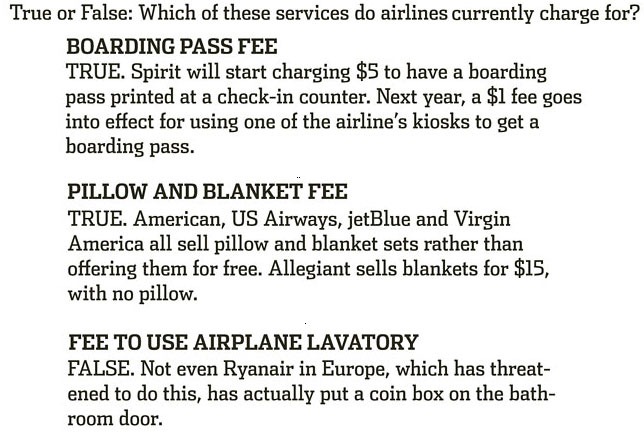
I read an aviation/travel article by Scott McCartney last week that reminded me of a post I made in June which dealt with booking flights and some of the changes we are all facing in air travel – childcarryonwell perhaps not elite travelers? From the sound of things, we’re in for a few more changes, and not all are going to be comfortable or convenient … at any rate it is going to feel like we’re being nickel and dimed.

Perhaps the most noticeable change long time flyers have huffed about (besides TSA screenings and heighten airport security) is the addition of a baggage fee for checked bags. This has changed the way many of us pack (sometimes for the positive) and also changes how much we attempt to carry on. Logic dictates that the more passengers carry on, the longer it takes to gets situated in a seat. So, according to McCartney, airlines have been studying the boarding process and trying out what they can do to speed up the process. Traditionally planes were boarded from back to front … except for those with elite status or paying for the privilege of boarding early. In studies, it takes on average 20-25 minutes to board a plane and some are looking for ways to shave a few minutes off of that time. In fact, “American Airlines undertook a two-year study to try and speed up boarding. The result: The airline has recently rolled out a new strategy—randomized boarding. Travelers without elite status get assigned randomly to boarding groups instead of filing onto planes from back to front.”

trueorfalseairlineswsj

For those flying different airlines semi-frequently — trying to shop by ticket price – will be the “do I or do I not” pay a premium to board early … who wants to be stuck in the last boarding zone searching for overhead storage? Because, if you do find overhead space, it will often be a distance from the ticketed seat creating an even bigger delay when deplaning. This new random boarding will put a person in jeopardy each time they fly if they’ll be the last one on. Even if it is the last “zone” who knows if a bag will even fit? Some think the pressure will be there to pay for the early boarding.

If I were designing the boarding process, I think I’d go with the United Continental suggestion of loading “window, middle and then aisle seat.” To me that should run smoother and makes those inside seats a little more attractive (knowing you’ll get overhead storage).

Alaska Airline goes one better and decided to board those who check their bag (and pay for the service) first. Now that’s adds another wrinkle … as does JetBlue’s and Virgin America’s boarding early if you pay for the “even more space” extra legroom seats.

How much would you pay to keep your carry on near your seat and have the privilege of boarding early? (currently $9 is American’s number, but I’m thinking it will go up as the usage rises)

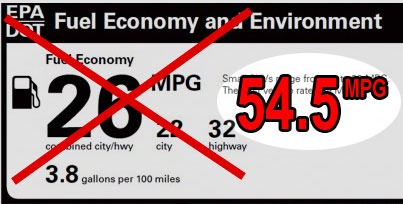
New fuel efficiency standards target is 54.5 mpg by 2025

Posted By on July 29, 2011

President Obama announces the new fuel efficiency standards with a few early jokes regarding his daughter and driving before stressing the pricesfuelefficstand110729 of fuel and the demand “worldwide” for oil.

His “fix” is to take steps to control prices through and energy strategy that 1) increase domestic production, 2) getting rid of tax subsidies to oil companies, 3) and producing more technically advanced engines and vehicles from auto manufacturers. The new standards he announced today will target the third point by increasing the fuel efficiency for cars and trucks, doubling what we see today to “almost 55 mpg.” President Obama commented that the business leaders believe this is “good for business and good for the nation.” He states that “in the next 15 years we will reduce the amount of foreign oil by 1/3 while improving the impact on the environment.” He also highlighted that improved bio-fuels and battery technology will also contribute to our oil needs. (audio below)

President Obama Fuel Efficiency Standards – July 29, 2011

While I can appreciate the direction and target, I wonder just what impact this will make on the performance? Hopefully as I mentioned in my 2012 VW Passat TDI post, we’ll see diesels paired with an electric motor which should offer solid efficiency and decent off the line and passing performance.

No debt deal yet. Markets head down on Friday morning

Posted By on July 29, 2011

As the financial markets in the US trade down this morning on lousy economic recovery news (little growth – 1.3% annual rate) and no compromise in Washington DC on the debt ceiling … I’m wondering why politicians can’t find a solution with a country as strong as ours. The far right can’t come together for a deal and not a single moderate Democrat will vote for the Boehner plan either. No matter what the end of the day brings on Wall Street, those trying to keep their heads above water are facing higher interest rates, few new jobs and continued pressure on housing – not to mention those trying to prepare for their kid’s college or their own retirement.

marketdown110729am
A week chart of the Dow Industrial – 9:30 open on far right.

I watched several interviews this morning with different congressmen and senators … few as hard hitting as the CNBC interview of Sen. Steny Hoyer by Becky Quick. If all are as obstinate as him, it is no wonder politicians can’t come to a compromise.

Sweating the summer heat, financial markets & debt ceiling vote

Posted By on July 28, 2011

In the Midwest we’re still sweating from the 90+ degree heat (12 days in a row for Cincinnati), although I’m getting use to it. We’re also sweating the debt ceiling and cost cutting measures being proposed in Washington DC by politicians. Like most of America, I watch the haggling and posturing between the extremes on both sides and those in the middle trying to come up with a compromise. In the meantime, job growth stalls due to very few wanting to invest in such an environment marketdown110728,jpg– at one time I thought “jobs” were the priority? Obviously neither side is suffering enough to work on the economy?

Job growth isn’t the only casualty from the stalemate and game of chicken being played in Washington … the financial markets are struggling for direction too even though corporate earning are turning positive. Companies are learning to manage their businesses with less as they lean down – a lesson for our federal government perhaps?

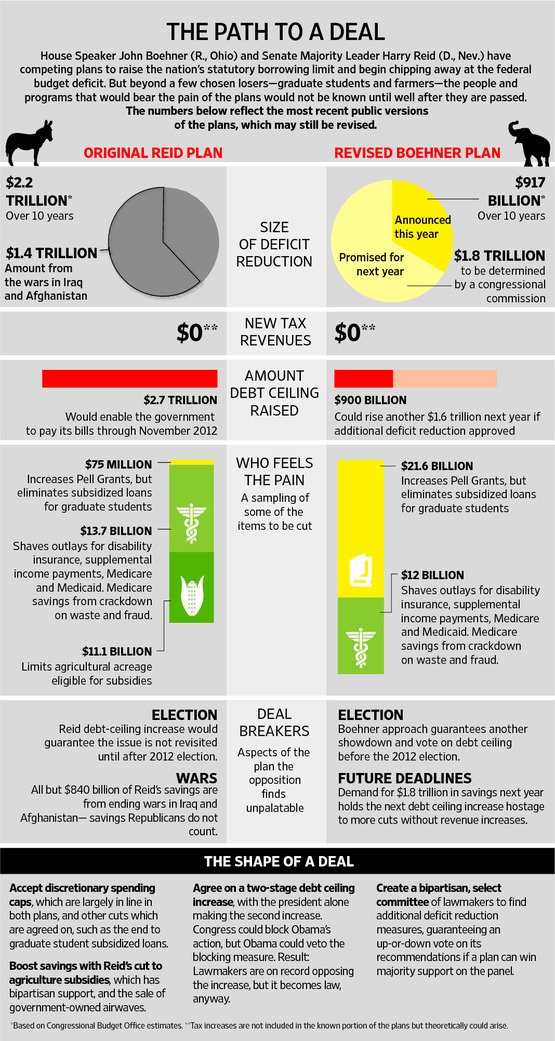
Saw this “Path to a Deal” this morning in the WSJ as we inch closer to “something.” (click for larger or link to story)

NA-BM596A_DEBT_G_20110727224204

Desultory - des-uhl-tawr-ee, -tohr-ee

  1. lacking in consistency, constancy, or visible order, disconnected; fitful: desultory conversation.
  2. digressing from or unconnected with the main subject; random: a desultory remark.
My Desultory Blog