Yesterday I heard part of an interview with noted social scientist Arthur Brooks, President of the American Enterprise Institute, which I recorded on my Palm Pre Z-corder app – well at least part of it. He pointed out that our government has moved beyond the point of providing just the necessary “safety net” …
Arthur Brooks The government safety net (mp3) | – July 31, 2011
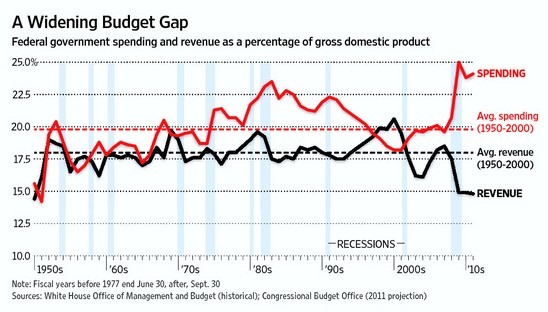
For many of us, getting a visual picture regarding the debate polarizing the country around the nation’s debt and deficit is helpful in understanding just how big the problem is. I found a WSJ graphic to be a clarifying example as to the gap between what we spend and what we take in as a percentage of GDP(the market value of what we produce). Economist, politicians and those who manage a business or family budget agree that our path is in no way sustainable … unfortunately not all agree on what we need to do in order to correct the problem.
For the simple minded (no offense intended), we need to reduce our spending (tighten our belt) and work harder and smarter just as most families do when facing budget shortfalls. The first part is easy for all but an elected politician who is charged with cutting … the second part is a bit more difficult for those without a job or the skills needed to fill the positions that are available.
For the economist (depending on their school of thought), it is a bit more complicated. Most of them recognize the need to control spending, but they also for the most part agree that during a recession nations soften hard times with selective government spending and easing money supply in hopes to spur job creation. For the most part this has been the ‘tried’ strategy of the Obama administration for the past couple of years. The Federal Reserve has eased the money supply with lower interest rates (near zero percent) and the administration has implemented large stimulus packages in the hopes of creating jobs. Disappointingly, the policies have failed and in the opinion of many, it was due to how the stimulus was managed (costing nearly $400,000 per job created) … along with the administration’s additional regulation of banks, employers, entrepreneurs and investors – or the “unknowns” within these regulations.
It is my opinion that if we can somewhat agree with the brief explanation above in recognizing the problem, then we are halfway to a solution.
Recognize that our nation spends too much of its GDP and that it is not sustainable … therefore reduce the size of the government and the cost to operate it by electing representatives who pledge to balance spending with revenue and will cut from every area of the budget (what’s wrong with a balanced budget amendment … even if we need a few tweaks for recessions, depressions and war?)
Recognized that our nation needs to be business friendly and at we should at least be on an equal tax and regulation footing with the other countries we compete with – encourage companies to expand here by modifying the tax code to attract international corporations.
Recognize that entrepreneurs and small business create the most jobs and offers the American dream to those willing to work hard and take risk. Remove the regulatory issues, tax complications and litigation fears that has made starting and running a small business increasingly difficult. (as someone who built a business and complained about government and tax paperwork in 1980s, I can tell you that it would be far more difficult and cost prohibitive today)
Recognize that we live in a country that was founded on principles of freedom and liberty. Our government is far too over-reaching and now dictates decisions that should be made by the individual. Remove the newly enacted laws (e.g. Obamacare) and policies which takes away citizen’s independence and does not nurture personal responsibility.
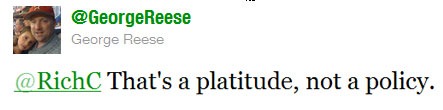
As I began writing this, I realized that I once again headed down the “platitude not policy” being argued by George Reese with me on Twitter yesterday. I guess I can’t help myself. Perhaps we all see clearly through the eyes of our political philosophy?
If you’ve ever enjoyed a summer (or fall, spring or winter) trip to Traverse City Michigan, you then know that it is a great All American town. I’ll bet you’ll love this Traverse City LibDub 2011 video, at least I know MichiganderSteve will, although some Buckeyes are pretty set in their ways?
Our thoughts and prayers are with the friends and families of Mitchell Cary and Don Gum who devoted so much to aviation. It is a difficult day for those of us who support efforts to keep history flying and the Wright B Flyer Museum.
GREEN TWP., Clark County — Two local pilots died Saturday morning during a test flight of the Wright ‘B’ Flyer’s Silver Bird.
The plane went down before 11 a.m. in a field about two miles west of 7391 Pitchin Road. Ohio State Patrol Sgt. Brian Cook of the Springfield Post said a call came in at 10:56 a.m. and troopers arrived at 11:39 a.m. He said all-terrain vehicles were needed to get authorities to the crash site. Media on the ground were not allowed on the property.
The president of Wright B. Flyer Inc. identified the pilots as Don Gum and Mitchell Cary. Phil Beaudoin said both men were volunteer pilots and members of the group’s board of trustees and that Cary was a former president of the organization.
“Wright B. Flyer Inc. and its members extend our deepest condolences to the families of Mitchell Cary and Don Gum,” Beaudoin said Saturday. “Mitch and Don were highly competent pilots with extensive experience flying Wright “B” Flyer airplanes and other experimental aircraft.
“They always observed the highest standards of safety. They made enormous contributions to our organization and to the aviation heritage community. They were good friends and we will miss them dearly.”
The coroner arrived at the scene at 1:45 p.m. and Cook said investigators from the Federal Aviation Administration were on the way. The plane had taken off from Springfield’s Beckley Municipal Airport, where Beaudoin said all test flights occurred for the Silver Bird.
A witness who lives nearby indicated that a small plane was sputtering and flying very low and then he heard the cracking of trees.
Beaudoin said the Silver Bird, call sign N453WB, is a slightly smaller version of the Brown Bird, the Model B replica Flyer that has been flying in shows for the past 25 years.
He said the plane had 25 hours of flight time before Saturday’s flight. Beaudoin said the aircraft received its FAA air worthiness certificate for test flights last fall.
Authorities did not address who was flying Saturday and Beaudoin said he did not know. Gum was quoted in a March 2010 article on Wright-Patterson Air Force Base’s website describing what it was like to fly a Model B replica.
“With other airplanes you have a reference out front, you have instruments,” Gum said during a show at Fort Sam Houston in San Antonio, Texas. “In (the Wright “B” Flyer) there is nothing around you, no cockpit; it’s beautiful, you can see directly below you.”
Beaudoin said the Silver Bird had been built during the past four years by volunteers and that it was constructed to modern standards. A third, non-flying Wright ‘B’ Flyer replica is housed at Hoffman Prairie.
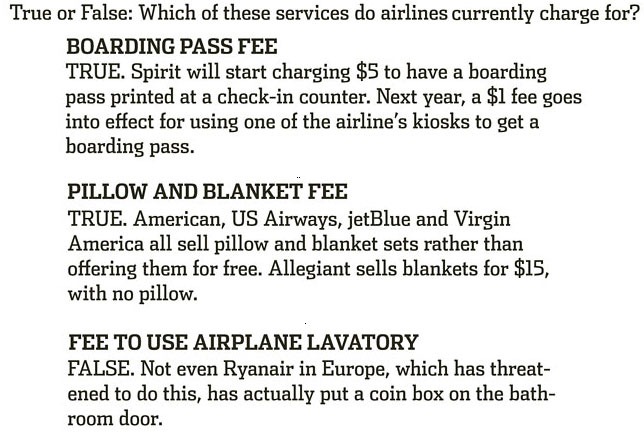
I read an aviation/travel article by Scott McCartney last week that reminded me of a post I made in June which dealt with booking flights and some of the changes we are all facing in air travel – well perhaps not elite travelers? From the sound of things, we’re in for a few more changes, and not all are going to be comfortable or convenient … at any rate it is going to feel like we’re being nickel and dimed.
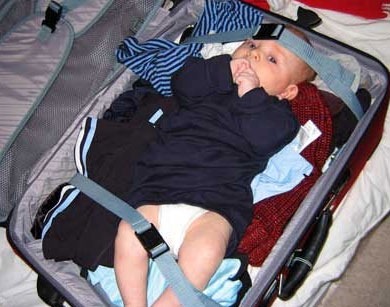
Perhaps the most noticeable change long time flyers have huffed about (besides TSA screenings and heighten airport security) is the addition of a baggage fee for checked bags. This has changed the way many of us pack (sometimes for the positive) and also changes how much we attempt to carry on. Logic dictates that the more passengers carry on, the longer it takes to gets situated in a seat. So, according to McCartney, airlines have been studying the boarding process and trying out what they can do to speed up the process. Traditionally planes were boarded from back to front … except for those with elite status or paying for the privilege of boarding early. In studies, it takes on average 20-25 minutes to board a plane and some are looking for ways to shave a few minutes off of that time. In fact, “American Airlines undertook a two-year study to try and speed up boarding. The result: The airline has recently rolled out a new strategy—randomized boarding. Travelers without elite status get assigned randomly to boarding groups instead of filing onto planes from back to front.”
For those flying different airlines semi-frequently — trying to shop by ticket price – will be the “do I or do I not” pay a premium to board early … who wants to be stuck in the last boarding zone searching for overhead storage? Because, if you do find overhead space, it will often be a distance from the ticketed seat creating an even bigger delay when deplaning. This new random boarding will put a person in jeopardy each time they fly if they’ll be the last one on. Even if it is the last “zone” who knows if a bag will even fit? Some think the pressure will be there to pay for the early boarding.
If I were designing the boarding process, I think I’d go with the United Continental suggestion of loading “window, middle and then aisle seat.” To me that should run smoother and makes those inside seats a little more attractive (knowing you’ll get overhead storage).
Alaska Airline goes one better and decided to board those who check their bag (and pay for the service) first. Now that’s adds another wrinkle … as does JetBlue’s and Virgin America’s boarding early if you pay for the “even more space” extra legroom seats.
How much would you pay to keep your carry on near your seat and have the privilege of boarding early? (currently $9 is American’s number, but I’m thinking it will go up as the usage rises)
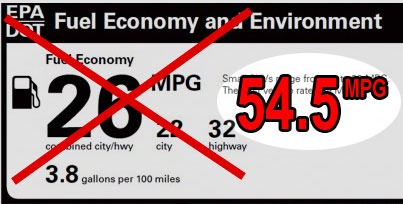
President Obama announces the new fuel efficiency standards with a few early jokes regarding his daughter and driving before stressing the prices of fuel and the demand “worldwide” for oil.
His “fix” is to take steps to control prices through and energy strategy that 1) increase domestic production, 2) getting rid of tax subsidies to oil companies, 3) and producing more technically advanced engines and vehicles from auto manufacturers. The new standards he announced today will target the third point by increasing the fuel efficiency for cars and trucks, doubling what we see today to “almost 55 mpg.” President Obama commented that the business leaders believe this is “good for business and good for the nation.” He states that “in the next 15 years we will reduce the amount of foreign oil by 1/3 while improving the impact on the environment.” He also highlighted that improved bio-fuels and battery technology will also contribute to our oil needs. (audio below)
President Obama Fuel Efficiency Standards – July 29, 2011
While I can appreciate the direction and target, I wonder just what impact this will make on the performance? Hopefully as I mentioned in my 2012 VW Passat TDI post, we’ll see diesels paired with an electric motor which should offer solid efficiency and decent off the line and passing performance.
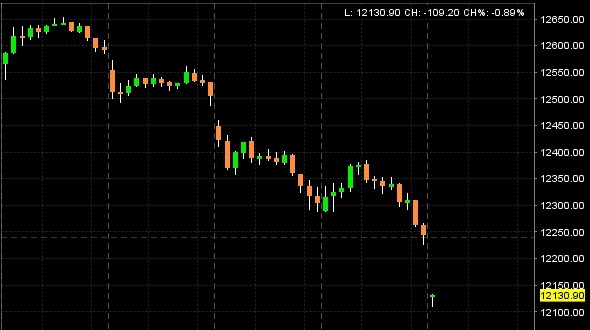
As the financial markets in the US trade down this morning on lousy economic recovery news (little growth – 1.3% annual rate) and no compromise in Washington DC on the debt ceiling … I’m wondering why politicians can’t find a solution with a country as strong as ours. The far right can’t come together for a deal and not a single moderate Democrat will vote for the Boehner plan either. No matter what the end of the day brings on Wall Street, those trying to keep their heads above water are facing higher interest rates, few new jobs and continued pressure on housing – not to mention those trying to prepare for their kid’s college or their own retirement.
A week chart of the Dow Industrial – 9:30 open on far right.
I watched several interviews this morning with different congressmen and senators … few as hard hitting as the CNBC interview of Sen. Steny Hoyer by Becky Quick. If all are as obstinate as him, it is no wonder politicians can’t come to a compromise.
In the Midwest we’re still sweating from the 90+ degree heat (12 days in a row for Cincinnati), although I’m getting use to it. We’re also sweating the debt ceiling and cost cutting measures being proposed in Washington DC by politicians. Like most of America, I watch the haggling and posturing between the extremes on both sides and those in the middle trying to come up with a compromise. In the meantime, job growth stalls due to very few wanting to invest in such an environment – at one time I thought “jobs” were the priority? Obviously neither side is suffering enough to work on the economy?
Job growth isn’t the only casualty from the stalemate and game of chicken being played in Washington … the financial markets are struggling for direction too even though corporate earning are turning positive. Companies are learning to manage their businesses with less as they lean down – a lesson for our federal government perhaps?
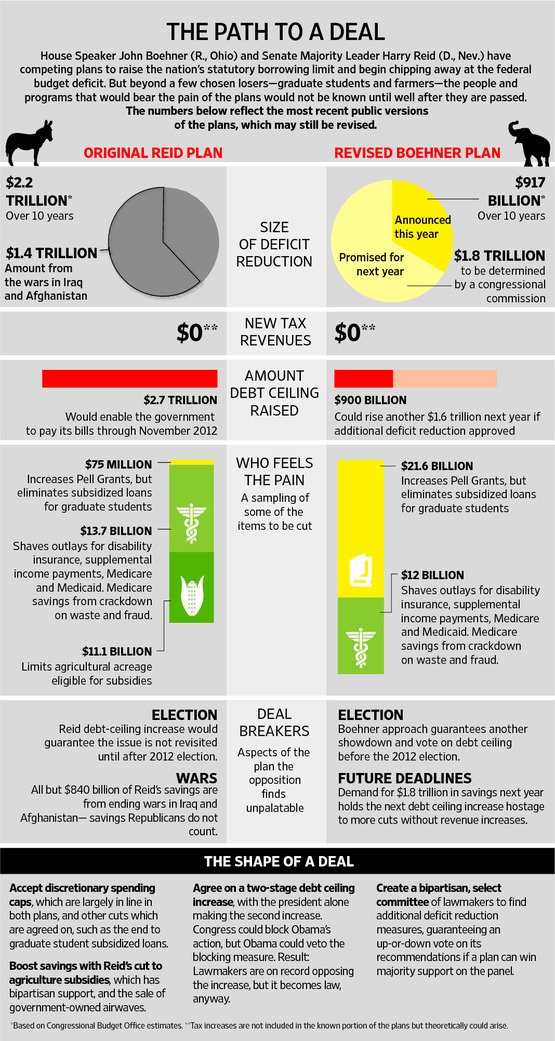
Saw this “Path to a Deal” this morning in the WSJ as we inch closer to “something.” (click for larger or link to story)
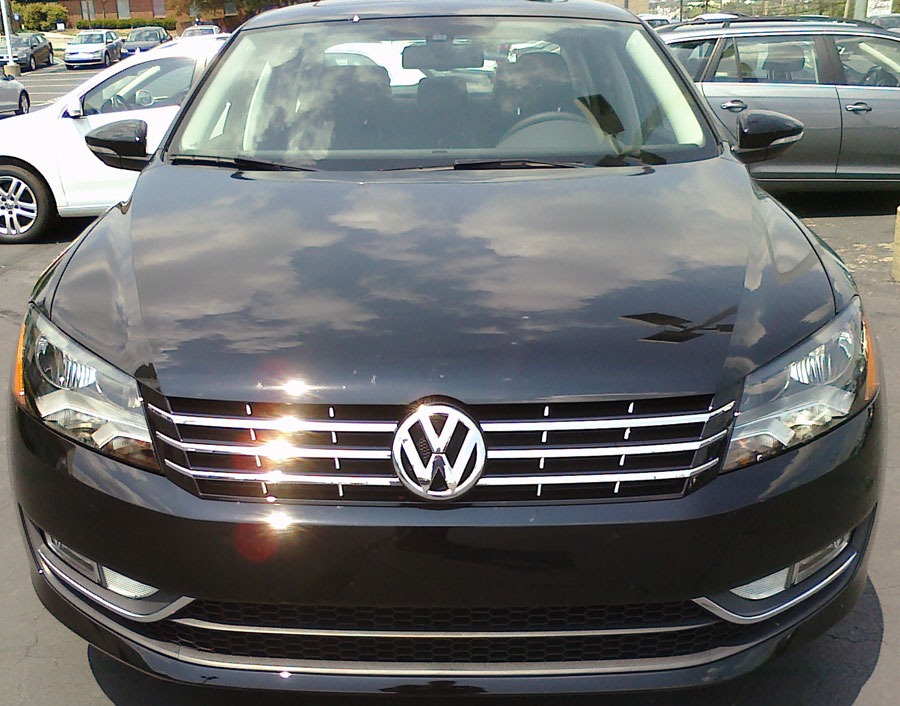
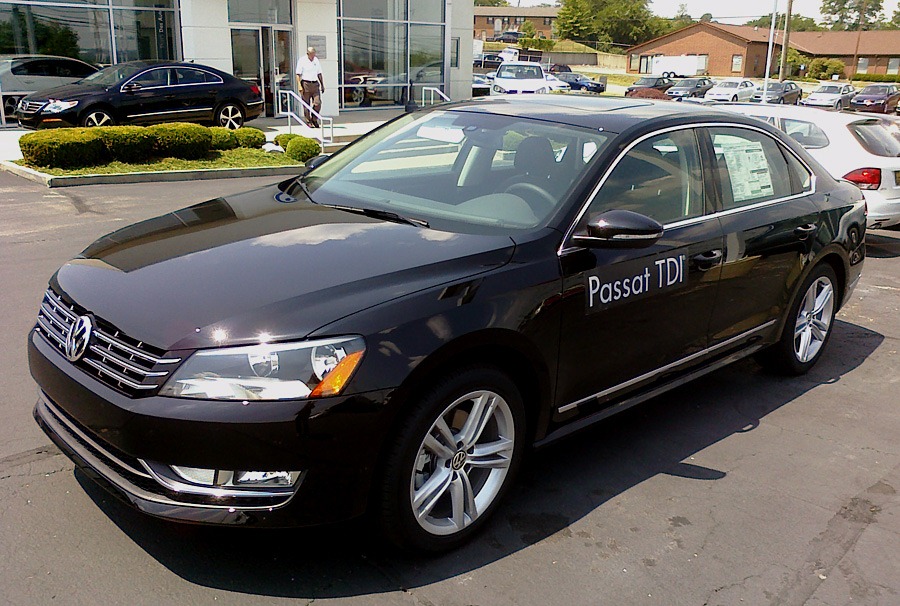
I had the chance to test drive the new 2012 Volkswagen Passat TDI diesel on Wednesday and was both surprised and impressed; it was not entirely what I expected. The SEL Premium package made this mid to large sized sedan seem more like the VW Phaeton than it did the previous Passat. Besides the larger size and substantial interior space, the cushier seats and new leather smell was simply luxurious. The premium package on this demo model even sported the remote start option (see video at end) along with a little square of soft touch suede leather insert where your tooshie touches the seats. Nice.
Besides the luxury feel, the real reason I’d be interested in the new Passat is the 40+ mpg 2.0L turbocharged TDI engine and DSG near instant shift transmission. Although I’m partial to a 6-speed manual gearbox, there aren’t many automatic shifters like the 6-speed dual clutch transmissions VW puts in several of their models. The combination of a high torque diesel and quick but smooth shifts of the DSL is terrific. You’d be hard pressed to know you were driving a “diesel” let along a 4-cylinder. My only complaint is the “tiny” lag when starting from a dead stop … which has me wondering what this combination would be like IF VW decides to add a small hybrid battery motor for idle and start-stop?
Behind the wheel the Passat felt much larger than any of the previous Volkswagens that I’ve owned or driven. It is definitely not a GTI or even a Jetta … more like my old Mercedes Benz 560 SEL. Right from the push button start up and finger tip power steering, the Passat felt much more like a domestic luxury car. Not that it was at all boaty, because it was far tighter in the corners than my dad’s Buick. I suspect the fact that the suspension is new makes a difference along with the 17” 18″ wheels and wide tires – it was obviously designed to corner rather than float and lean. This “softer ride” will appeal to a few of us middle age drivers who have shed the minivan and SUV, but appreciate a more comfortable ride. I’m not sure I can take 8 hours of bolstered seats and teeth rattling found in many of the sport sedans and hatchbacks. It’s a tough call for those still wanting the traditional European VW firmness but appreciating the long haul comfort in a larger sedan.
Cargo and passenger room is not a problem in the new Passat. The trunk is large (nearly 16 cu ft) and the rear seat leg and headroom is spacious. When flipping the rear seats down, the pass-thru from the trunk looked long enough to take nap … I didn’t measure the length, but it is substantial.
The controls are not quite as simple as the VWs models only a few years ago, but the instrumention is at least located exactly where you would want them. I had a difficult time while in fiddling with the odd operating powered side mirror joystick switches as well as the unusual sunroof knob, but assume they are instinctive for those under 40 and can be learned by a few of us over that age. I didn’t experiment with the navigation screen, but one push of the map button quickly located my position. Although I like gadgets, I’m not sure the ones being put on many new cars are ones “I would pay to add” (does that mean I’m getting old?) One unusual addition to all of modern instruments was the analog clock which took a prominent center position on the dash … from the first look, it looked a little out of place?
The biggest attraction for those considering the 2012 VW Passat TDI is probably the fuel efficiency numbers: EPA estimates are for 43 highway mpg and 795 miles on a single tank of fuel (sticker on this TDI was 40 mpg highway and 30 mpg city). The other important number isn’t quite as attractive – $33,185 … although really not all that high considering the level of luxury and other vehicles in its class, if there is another vehicle of this size getting 40+ mpg? (the base TDI Passat is just over $26,000).
All in all the new American made Passat TDI should be a near perfect car for those who spend time on the long stretches of US interstates. The diesel engine has proven to be powerful and long lasting. Driving a Passat TDI sedan is a way to drive/ride in comfort while getting the same fuel efficiency most are lucky to get while babying a hybrid or compact car. I’m sure you’ll see more VW TDIs in the coming years.
After an evening mowing the backyard grass on Tuesday night, a cooling dip in the pool was in order. The 90 degree water was a bit warm, but still felt refreshing.
Besides cooling off, I “launched” (chuckle, chuckle) our hard dinghy we call Trinka and “moored” it in the pool. It is out of place, but looked attractive enough as the sun set to take a cellphone photo (left).
I’d say we were enjoying the summer, but frankly with my wife working a few extra hours, my daughter hard at work as a first year resident intern (very few days off) and my son taking summer classes and working his summer job at a golf course … we really don’t have much free time. Perhaps we’ll get a chance to do something this fall … or escape to do a little more sailing next winter?
 Yesterday I heard part of an interview with noted social scientist Arthur Brooks, President of the American Enterprise Institute, which I recorded on my Palm Pre Z-corder app – well at least part of it. He pointed out that our government has moved beyond the point of providing just the necessary “safety net” …