For those citizens trying to follow the political goings on in Washington DC, it is irritating to trying to figure out just what is being debated and discussed by those we elect to “do the people’s business.” The current health care debate and varies bills being proposed in the House and Senate are prime example of “backroom politics” that could be (and should be) open to discussion, input and shared with the citizens it will impact.
“I’m going to have all the negotiations around a big table. We’ll have the negotiations televised on C-SPAN, so that people can see who is making arguments on behalf of their constituents and who are making arguments on behalf of the drug companies or the insurance companies.”
— Barack Obama, August, 2008
Some of us expected that President Obama and the Democrats, even if we disagreed with their philosophies, would at least offer open and fair discussions so citizens would know what was being debated. Naively, I even believed that opposing viewpoints would be included in the discussion and that there would be a semblance of bipartisanship. I was wrong … very wrong … there is even less transparency in this administration and congress while the billion and trillion dollar size of decisions are far larger than ever before.
Wake up America … no matter your political philosophy, at least expect — no … demand — that our elected representatives are forthright and truthful with those who they serve. If the majority in congress want more state control over more industries then they should have little problem convincing our citizens that what they propose is best for America — don’t do it in the shadows and ram changes through without vigorous debate, cautious contemplation or listening to what U.S. citizens have to say. Besides overhauling U.S. Healthcare through legislation, all of us should be concerned about the cost and how much of it will be past along to the next generation — something we should have learned from medicaid, medicare and social security (all yet to be correctly funded). The changes being proposed in health care are the largest in my lifetime — and the most expensive — therefore they deserve to be clearly considered and transparently understood.
_
(Graphics above from a Washington Post has a helpful interactive graphic projecting costs and coverage prior to Sen Reid’s recent addition to Senate Finance Healthcare bill).
Enjoyable to watch the patience of drivers … how long do you suspect this woman took to park her car? It’s no wonder automakers are building cars with automatic parallel parking features.
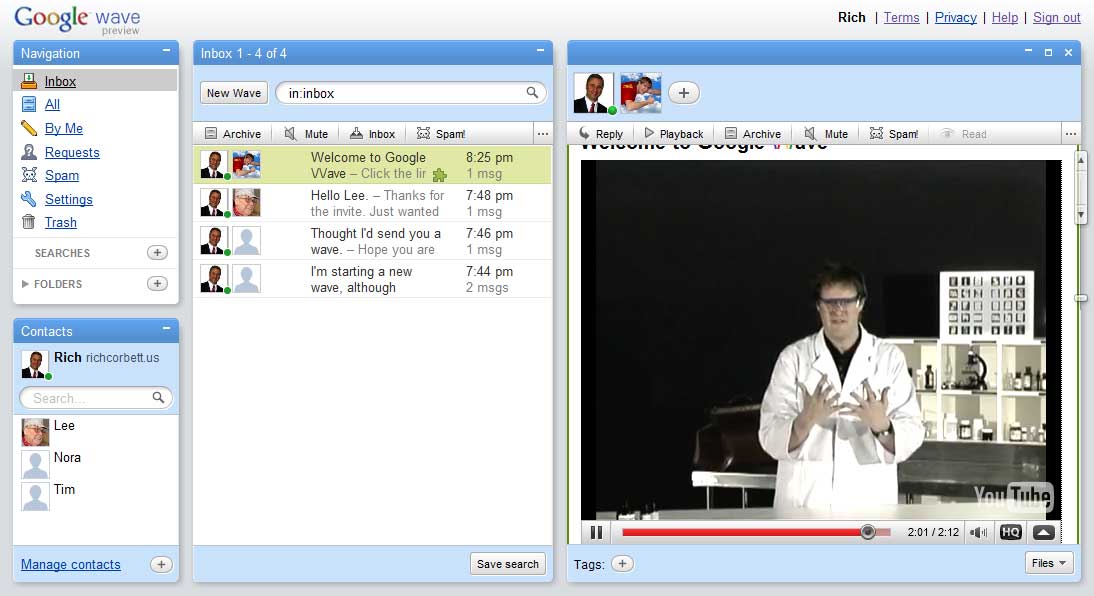
A quick thanks to Lee for expediting my Google Wave beta request, although I still feel a bit late to the game in getting a chance to play with this new Google app. Although I’ve talked to a few people about how they foresee using this new web based communications tool, I’m still struggling to figure out if it will really be adopted by my clients and co-workers — I sort of doubt it.
Basically, Google Wave out of the gate is a collaboration tool that integrates chat, email and online applications like Google Docs. The ‘realtime’ aspect (can watch each other type) of the web window interface gives collaborators in different locations the ability to work on projects without emailing copies back and forth or making conference calls. From what I can see, the real power will come from users who develop APIs interfacing for their clients online sites that will “go live” … literally. Imagine a newsroom updating a breaking story from several news bureaus and watching the written story develop for the mornings paper online …. or just an interactive conversational comment sections for active blogs? If you are a beta user and need to try it with someone, let me know.
Some of us have built some interesting things in our garages … but Anthony Toth in Redondo Beach California tops most of us — he’s built a vintage Pan Am World Airways 747 cabin from the 1970s and 80s. His cabin replica comes complete with Pan Am logo swizzle sticks, napkins and salted almonds sealed in Pan Am wrappers, although I don’t recall seeing any stewardesses?
Very nostalgic … and very eccentric (WSJ video below).
Color has indeed made it to the trees and leaves here in southwestern Ohio. The autumn sunshine and second Indian Summer has really brought out some spectacular color. I should be clicking away with my Canon Digital SLR, but a Palm Pre photo of the burning bush will have to suffice.
Did you know: The Euonymus alatus or the “burning bush” is an invasive species to the woodlands in eastern North America and that its importation and sale is prohibited in the states of Massachusetts and New Hampshire?
I’ve been happy with the overall cost of ownership of my 2006 Honda Pilot SUV … including the fuel efficiency. Besides oil and fluid changes, the only other expense of ownership over the past 87,000 miles to date has been a battery and of course gasoline.
After posting my latest fill-up to Fuelly.com, I was please to see that overall mileage was 21.0 MPG, which isn’t too bad for an 8-passenger 4-wheel drive vehicle. I would have preferred a diesel, but I doubt it would have been as cost competitive as the Honda (besides diesel prices have stayed a bit higher than regular unleaded gasoline for several years). For those needing or wanting a comfortable, relatively efficient and reliable 4WD eight passenger SUV, I think you’d be hard pressed to find one that has the track record of the Honda Pilot.
Although the Science Channel program “How It’s Made” isn’t one of the most exciting television programs, it does offer a glimpse as to what it takes to manufacture complex items. I happened to watch an episode on how Audi builds its 6-cylinder TDI diesel engine the other day and found it interesting (video clip below). Although I’m currently not a big fan of the recently imported behemoth Audi Q7 TDI seeing their price-point, performance and fuel economy still too low, I do believe their smaller A3 TDI diesels(above) will have some appeal … especially if they offer a manual transmission choice and quattro in the U.S. — yet to be seen.
The copies of Microsoft’s new computer OS Windows 7 arrived today! I’m not planning to update anytime soon as I’m currently running Win 7 RC on both of my PCs. (they should operate until 2010) I’m certainly not planning to ruin this weekend by stripping the computer and re-installing all my software (the scheduled colonoscopy sounds more appealing … well perhaps not?) Nevertheless, I did pre-order discounted copies after being completely satisfied with the recent Microsoft OS effort. Personally I still enjoy working on the Mac (and I’m not Snow Leopard yet) but am perfectly happy using Windows 7 as well.
For those pondering the upgrade, my advice is NOT upgrade immediately unless you are running Vista. I’d hold off and purchase and installed copy on a new PC if you are still using XP. (one caveat, if your PC is reasonably current and suffers from years of bloat and possible virus and spyware infections .. if so, do yourself a favor and wipe the HD clean and install Win 7 … or better yet, upgrade the HD with a bigger and faster one first!)
Since my balance and stability are no longer functional enougheven for a longboard, my only wave riding is going to come from the bodyboard or sponge. Here’s an encouraging — and well done — video demonstrating spongeboard surfing can still be quite the adrenaline rush!
😀
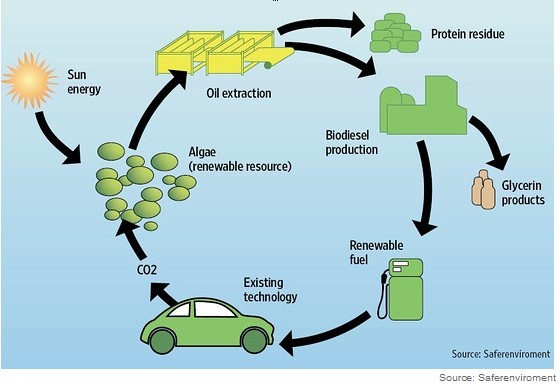
An article in yesterday’s Wall Street Journal highlighted algae based biodiesel as one of the “Five Technologies That Change Everything” recognizing that a new generation of biofuel made from nonfood crops is one of the more promising sources of energy.
Researchers are devising ways to turn lumber and crop wastes, garbage and inedible perennials like switchgrass into competitively priced fuels. But the most promising next-generation biofuel comes from algae.
Algae grow by taking in CO2, solar energy and other nutrients. They produce an oil that can be extracted and added into existing refining plants to make diesel, gasoline substitutes and other products.
Algae grow fast, consume carbon dioxide and can generate more than 5,000 gallons a year per acre of biofuel, compared with 350 gallons a year for corn-based ethanol. Algae-based fuel can be added directly into existing refining and distribution systems; in theory, the U.S. could produce enough of it to meet all of the nation’s transportation needs.
But it’s early. Dozens of companies have begun pilot projects and small-scale production. But producing algae biofuels in quantity means finding reliable sources of inexpensive nutrients and water, managing pathogens that could reduce yield, and developing and cultivating the most productive algae strains.
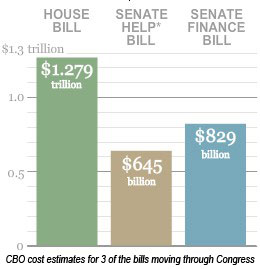 Naively, I even believed that opposing viewpoints would be included in the discussion and that there would be a semblance of bipartisanship. I was wrong … very wrong … there is even less transparency in this administration and congress while the billion and trillion dollar size of decisions are far larger than ever before.
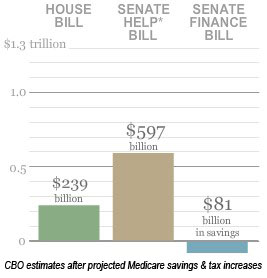 don’t do it in the shadows and ram changes through without vigorous debate, cautious contemplation or listening to what U.S. citizens have to say. Besides overhauling U.S. Healthcare through legislation, all of us should be concerned about the cost and how much of it will be past along to the next generation — something we should have learned from medicaid, medicare and social security (all yet to be correctly funded). The changes being proposed in health care are the largest in my lifetime — and the most expensive — therefore they deserve to be clearly considered and transparently understood.