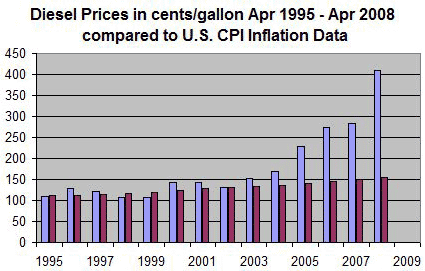
The fuel price discussions continue as I made small talk with clients throughout the week; Friday was no exception. Petroleum traded at an all time high to almost $127 per barrel in the morning on strong demand and there is very little evidence that we’ll see an additional supply come online this summer … or that demand will weaken. In fact, Goldman Sachs release a report that they believe crude will average $140 for the second half of 2008 and oil traders are betting that Chinese demand for diesel will push prices higher. (as are U.S. refiners — they see better margins in diesel) For most people, just looking at the diesel (or gasoline) verses CPI inflation graph from 1995 to 2008, it is obvious that we need to do some serious re-budgeting.
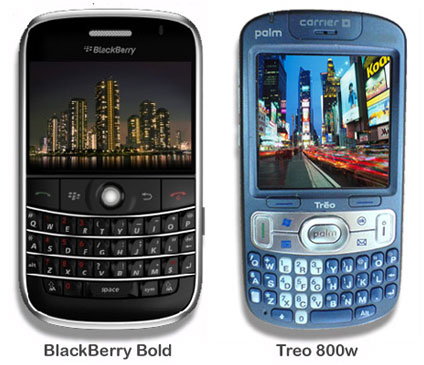
As someone who started with a Palm Pilot many years ago and who has been wondering what will replace my business oriented Palm Treo, I am disappointed at seeing the new Palm Treo 800w (at least displayed side by side with the new Blackberry Bold). I can’t imagine many new smartphone shoppers will select this Treo 800w when the new Blackberry, a gen-2 iPhone and many new slick look-a-likes are coming to market at the same time. Beauty and brains are equally important when competing for buyers.
For me, “form does still follows function” … and perhaps I should withhold judgment … BUT the humble styling of the 800w placed side by side with a rival smartphone doesn’t offer much hope — in fact it is kind of a turn-off. If Palm is planning to survive, they had better work on attracting new customers with at least the “look” consumers are expecting. Even existing Palm Treo ‘enthusiasts’ are going to have a hard time swallowing the antiquated design unless there is something on the horizon worth waiting for — at least this disappointed Treo enthusiast. (see Andrew’s first take over at Treonauts)
According to a recent article in the Wall Street Journal, U.S. refineries are trying to maximize output of the “more-profitable” diesel fuel even as the summer driving season kicks off. The article mentions that the “global hunger for diesel, coupled with tight refining capacity” offers better profits than gasoline. Last week diesel prices were up 18.2 cents to a record $4.33 per gallon which is a 56% rise over last year at this time. Couple this with an increase demand internationally and refiners see the profits better in diesel than gasoline. Gasoline prices have climbed in the past year too, but “less dramatically” than diesel, according to the article. (link)
One of the advantages of being on the road for business during the week is that I get a chance to see my daughter. Today was no exception … and the highlight was that it was her Birthday! She has been studying for a Neurology test tomorrow and brought along a stack of index cards 6 inches thick … of which we didn’t even look at over lunch. (I occasionally flash through her study cards with her) Anyway … it was nice that she made time for “dear ol’ dad” … and shared that tasty chocolate cake with ice cream with me!
🙂
BTW … here’s an economical and tasty lunch tip: The restaurant chain Bennigans has several terrific $4.99 lunch combos which includes a drink. Although I tipped a bit more than normal today (free Birthday desert), two people could comfortably have a nice sit-down lunch with table service for about the same as a McDonald’s combo and almost half of what I pay for the “pick two” at Panera Bread.
Search technology is improving daily and its a good thing considering the amount of information expanding on the web. A company called Powerset has recently launched their their first product which improves Wikipedia searching. Current search uses keywords to return results, but this isn’t always the easiest way to narrow and find answers. What Powerset does is to use “ordinary human language” in the form of phrases or simple questions to improve results. It doesn’t stop once a subject is found, but adds powerful tools which help surf through the article finding the exact content through an embedded “Article Outline” sidebar. Its quick and easy use either the “Outline” or “Factz” scanning of the Wikipedia article using this tool. I’ll use a “biodiesel” search question as my example below.
First, navigate to the Powerset.com page and enter in a question. Mine was an attempt to find the ASTM standards for bioidiesel so I asked a basic question which returned several results noting highlighted segments of Wikipedia’s database. Simple to see that the first result looks like it should work, I select it with a click. (I could also select the ‘down arrowhead’ to expand the article inline — nice touch) The Wikipedia information is then displayed along with several navigation and “Factz” adds in an embedded right sidebar. This is used to speedily navigate and find information in the article. In my search, I’m looking for the ASTM Technical Standard for biodiesel which you’ll note Powerset has highlighted in their “Article Outline” embedded sidebar. Simple enough, select the yellow highlighted “Technical Standards” and the article scrolls swiftly up or down to locate that information … which again is highlighted in the Wikipedia article. (below)
Although I haven’t used Powerset all that much yet, I’m bookmarking (and Tabbing on my tool bar in place of Wikipedia) for everyday use. Be sure to give it a try and check out the “Factz” feature too.
What are Factz?
Factz are concise representations of information extracted from sentences. They are represented in three parts: the subject, relation and object (e.g. Oswald shot JFK). Factz are one way that Powerset represents the meaning of a sentence. Of course, Factz do not always represent truth, but rather propositions that are asserted in the text of Wikipedia.
On the search results page, you will often see Factz for general topic queries. These Factz are collected from pages across Wikipedia. Click a word in one of the three columns to see the sentences that support the selected fact.
On a particular topic page, you can see the Factz extracted from the given page in the outline. Click on one to scroll directly to the sentence from which the fact was derived.
Palm better get their act together with a new high end Treo because Research In Motion introduced their new Blackberry Bold today. They seem to be catching up with Apple’s iPhone although some say Apple is prepping for the gen-2 iPhone … still they suffer from not having a dedicated tactual keyboard. There might still be a window for other high performance smartphone players since both the iPhone and new Blackberry Bold are only available on the AT&T networks.
Blackberry Bold specs:
* Size – Length: 114mm, Width: 66mm, Thickness: 14mm
* Weight (with battery) – 133g (same as the 88xx series. I can attest to it!)
* Memory – 1GB on-board (storage) and 128 MB Flash (applications)
* Battery – 1500mAhr lithium cell
* Est. Battery Life – Standby: 13 days, Talk Time: 5 hours
* Network Support – UMTS: 2100 / 1900 / 850MHz, GSM: 1900 / 1800 / 900 / 850 MHz, GPRS, EDGE and HDSPA networks
* Wi-Fi – 803.11a/b/g enabled
* Display – HVGA, 480 x 320 pixels, Transmissive TFT LCD, supports over 65k colors
* Media Player, Video Support – DivX 4, Div X 5 & 6 are partially supported, XviD is partially supported, H.263, H.264 and WMV3
* Media Player, Audio Support – .3gp, MP3, WMA9 (.wma/.asf), WMA9 Pro/WMA 10, MIDI, AMR-NB, Professional AAC/AAC+/eAAC+
* Media Player, Audio – BlackBerry Media Sync allows you to transfer your desktop iTunes music to your BlackBerry!!!
* Camera – 2.0MP, 5 x digital zoom (with flash of course)
* GPS – internal GPS with extended ephemeris, BB Maps is standard
* Bluetooth – Bluetooth v2.0, all the normal stuff and Bluetooth Stereo Audio via A2DP and AVCRP
* USB Port – Enables charging and high-speed data synchronizations via USB “A” to mini-USB “B” cable (I can personally say moving files back and forth is now lightning quick!)
* Browser – HTML browsing, View Movies/Clips from websites built for mobile streaming, RSS feed support
Here’s a good look at the “business” of RIMM and Apple … as well a a peek at the new Blackberry Bold. (CNBC video clip below)
Water cooler conversations around the country have been discussing fuel prices and what they (and our nation) can do to get a handle on the rapid change in fuel costs. Experts suggest that the reason for the run up have been four fold: a) increased worldwide demand, b) flat production of new crude and refined fuels, c) the weak U.S. dollar … and d) oil speculation due to lower returns in other investments (as well as speculation on other commodities affected by high oil). Currently there is a move to tighten up requirements for oil speculators as well as to conserve by tightening up fuel economy standards while the U.S. continues to work on ‘green’ alternatives, but most of this will take time — something our economy may not have.
In my opinion an immediate relief is needed, and for the U.S. it will require intervention that will permit American oil companies access to a few more currently off limit known oil reserve areas. It will also require trade talks with emerging countries (ie. China and India) and oil producing countries who currently subsidized their citizens fuels. (see CNBC video clip below) I believe that the act of approving additional U.S. capacity will send a signal to speculators, and in turn might prevent an additional run-up in crude pricing … even though the new U.S. oil production will be slow to come online. Trade talks with oil production nations who subsidized their citizens ‘below market priced fuels’ will also help to reduce worldwide demand and keep oil from doubling from here … and at least slow the appetite for gasoline and diesel to prevent threatening and ‘fuel price’ induced worldwide economic slowdown or worse.
CNBC had a good discussion Monday morning which discussed a couple of these points.
In a recent PBS Motorweek program, a selection of clean and efficient vehicles were compared to each other. They certainly were not equal for usability or price, but the comparison offered potential buyers insight on how the different ‘green’ technologies and most common fueling options compared to each other. The smaller Honda Civics were ideal for around town commuting and the Hybrid version was the cleaner and most efficient, but the Mercedes-Benz E320 CDI Bluetec impressed the reviewers as a highway vehicle for its torque and comfort traits. As for the reviewed offerings from GM, the Chevy Tahoe E85 or gasoline V8 4WD was tested against the hybrid version of the same … and although there was some improvement using E85 or the hybrid technology, its not exactly an econo-box when it comes to lean and green. (video clip below)
This might seem odd, but a new Royal Star Magnolia (Stellata Magnolia) is a gift that made my wife happy on Mother’s Day — photo and post from Palm Treo. (EDIT: tweaked post Sunday afternoon)
Happy Mother’s Day Brenda … and to all mothers reading this. (in fact I think I’ll give ‘my’ mother a call)

 According to a recent article in the
 Search technology is improving daily and its a good thing considering the amount of information expanding on the web. A company called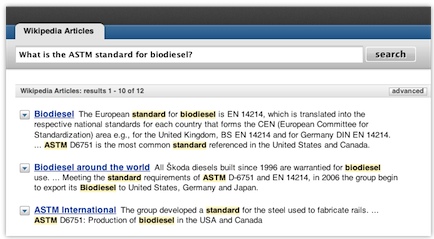
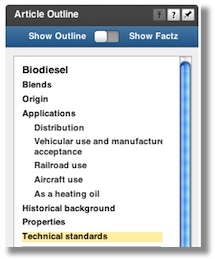 The Wikipedia information is then displayed along with several navigation and “Factz” adds in an embedded right sidebar. This is used to speedily navigate and find information in the article. In my search, I’m looking for the ASTM Technical Standard for biodiesel which you’ll note Powerset has highlighted in their “Article Outline” embedded sidebar. Simple enough, select the yellow highlighted “Technical Standards” and the article scrolls swiftly up or down to locate that information … which again is highlighted in the Wikipedia article. (below)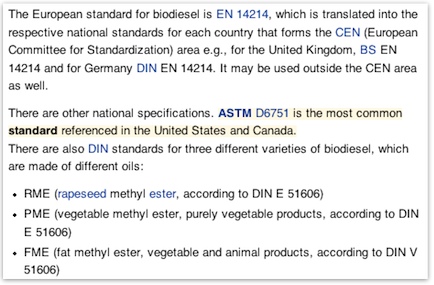


 In a recent PBS