Licensing problem for 3 wheel EVs in Ohio
Posted By RichC on May 5, 2008
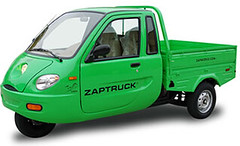 Back in 2006 I had a chance to test drive an all-electric “high performance” 3 wheel vehicle manufactured by Myers Motors in Tallmadge Ohio. I drove it on the public roads without a special endorsement, but the Cleveland Plain Dealer has reported that the Ohio DMV currently has a problem licensing them for Ohio road use. The issues is that the seats in the NMG (Myers Motors) and other three wheel electric vehicles (currently the Zap! Xebra pickup) do not meet the motorcycle requirements and therefore will not be issued registration. Another glitch is that if they are issued a motorcycle plate, owners of these electric vehicles would be required to have a motorcycle endorsement before they could legally drive such vehicles.
Josh Engel, chief legal counsel for the BMV mentioned that “It’s not the first time that the law hasn’t caught up with technology,” and that the state of Ohio is supportive of electric vehicles. Tom Hunter, communications director for the BMV, says that the law needs to change and he wants to see a new classification for vehicles which a motorcycle endorsement would not be required.
Three-wheeled electric vehicles don’t meet Ohio criteria to be on the road
Robert Schoenberger, Plain Dealer ReporterOhio’s governor and lawmakers talk about the need to support electric vehicles.
But the first person who tried to register the best-selling electric vehicle in the United States had his title and registration pulled without ever getting the vehicle on the road — all because of the shape of its seats.
“They say it’s not a motorcycle based on the Ohio definition,” said Alan Fuller, a 46-year-old father of two and a computer technician for the National Weather Service in Wilmington, about 50 miles northeast of Cincinnati.
Ohio’s ruling could threaten not only Fuller’s car but also electric three-wheelers made in Tallmadge and a handful of other gasoline and electric-powered vehicles that are growing more popular at a time of record fuel prices.
In February, Fuller received his Zap! Xebra pickup, a three-wheeled electric vehicle with a top speed of 40 mph and a 25-mile range. He paid $11,000 for it and quickly paid $773.99 in sales taxes. Title and registration fees cost him $31 more. A few days later, the motorcycle plate 43NQH sat on its back bumper.
It’s no powerhouse, but the Xebra fit Fuller’s needs.
“I live 3½ miles from work. My car doesn’t even get warm going one way,” he said.
Today, Fuller is trying to finalize the sale of the Xebra to a landscaper in Oregon, a state that will let her register the vehicle without incident.
About six weeks after he got his pickup from a dealer in Chicago, the Bureau of Motor Vehicles in Columbus sent Fuller a letter telling him to send the title back.
His Xebra wasn’t fit for Ohio roads.
Josh Engel, chief legal counsel for the BMV, said Ohio supports alternative fuels and advanced vehicles, but state law is clear.
“It’s not the first time that the law hasn’t caught up with technology,” Engel said.
The key issue was the Xebra’s motorcycle status. Federal regulators define a motorcycle as any motorized vehicle with three or fewer wheels and a saddle or a seat. Ohio law says a motorcycle has to have a saddle.
The BMV ruled that the Xebra, with a traditional car seat, wasn’t a motorcycle. It also wasn’t a car or anything else. It couldn’t be titled for use on Ohio roads. Winning motorcycle status is key for electric-vehicle manufacturers. Motorcycles don’t need airbags or other safety devices, and they can go faster. Four-wheeled neighborhood electric vehicles can go no faster than 25 mph.
Myers Motors of Tallmadge sells a three-wheel electric vehicle called the NmG (no more gas) that can go 76 mph. The single-passenger vehicle costs $36,000, but company owner Dana Myers said he’s working to get the cost down this year.
It is the only highway-legal electric vehicle on sale in the United States.
Tom Hunter, communications director for the BMV, said his agency is working with Myers and the governor’s office to come up with a short-term solution to the titling problem.
Simply changing the state’s interpretation of a saddle won’t solve the problem, Engel said. If the state allows Xebra and NmG owners to register vehicles as motorcycles, drivers would have to get motorcycle endorsements on their licenses.
“That means for the first year you’re driving, you’d be considered provisional and you’d have to wear a helmet inside the vehicle,” he said.
The ruling has already had a chilling effect on the sale of electric vehicles in Ohio.
Dick Staley, owner of electric-vehicle dealership North Central Zenn in New London, stopped selling Xebras this year. He still sells the Canadian-made Zenn four-wheel electric car.
He still sells Zap vehicles to people in other states, but he said he wouldn’t sell them to Ohio residents until he gets state assurances that people can get them titled.
“The people who are driving them now are the pioneers who are laying the groundwork for economically viable electric vehicles,” Staley said.
Zap Chairman Gary Starr said he has run into problems before with state definitions. California, where his company is based, also uses the “saddle” distinction for motorcycles. But in every other case, regulators have favored the environmental benefits of electric vehicles over narrow interpretations of state laws.
“The No. 1 definition of a saddle is a seat that you put on an animal that you straddle,” Starr said. “No motorcycle in the country could pass that definition.”
Engel said the best solution to the problem would be legislative action. Lawmakers could craft rules that would allow registration of three-wheeled electric vehicles and eliminate the need of a motorcycle helmet.
“It seems to make more sense to find a way to define what exactly these vehicles are,” he said.
Although he’s given up on the Xebra, Fuller said he isn’t ready to call it quits when it comes to getting an electric pickup. A kit to convert an old Chevrolet pickup into an electric vehicle costs about $9,500.
“The S10 would be a regular licensed vehicle that the state could not whine about,” Fuller said.
To reach this Plain Dealer reporter: rschoenb@plaind.com, 216-999-4059


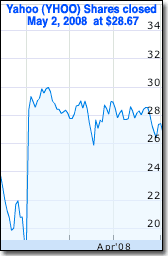 Microsoft released a letter from Chief Executive Steve Ballmer on Saturday that he sent to Yahoo CEO Jerry Yang saying that Microsoft was willing to raise its offer to $33 a share for Yahoo, but Yahoo demanded at least $4 per share more; $37/share. (the Monday share price for Yahoo will be interesting) “Despite our best efforts, including raising our bid by roughly $5 billion, Yahoo has not moved toward accepting our offer,” Mr. Ballmer said in a Microsoft press release. The WSJ reported that Microsoft has withdrawn its bid for Yahoo and has speculated is that Microsoft may be considering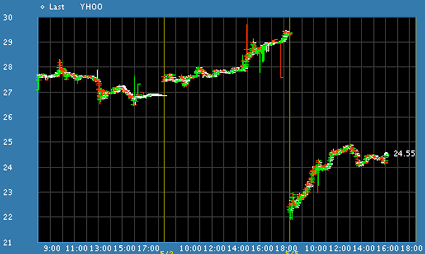
 I’ve been waiting to watch the movie
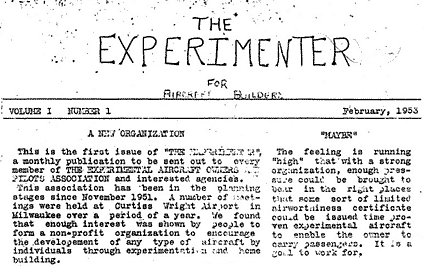
 That’s 59,000 pages from 1953 to 2006 for those counting! Interestingly the original newsletter was typed at the home of Paul Poberezny and brings back


 I’ve been focused on multiple home repair and improvement projects this spring and am always looking for a quick way to make a repair and keep the mess to a minimum. I generally use the “empty box” under the repair technique when cutting or drilling drywall, but Dean Johnson from