Dead Grandmother/Exam Syndrome
Posted By RichC on January 12, 2008
 A friend of mine who knows I have a daughter in college and a son on the way, sent me an email with an interesting “Dead Grandmother/Exam Syndrome and the Potential Downfall Of American Society” study by Mike Adams. The original was from some years ago, but is probably still accurate and an enjoyable read. I couldn’t find the originating author’s site, so I’ll include the study below.
It has long been theorized that the week prior to an exam is an extremely dangerous time for the relatives of college students. Ever since I began my teaching career, I heard vague comments, incomplete references and unfinished remarks, all alluding to the “Dead Grandmother Problem.” Few colleagues would ever be explicit in their description of what they knew, but I quickly discovered that anyone who was involved in teaching at the college level would react to any mention of the concept. In my travels I found that a similar phenomenon is known in other countries. In England it is called the “Graveyard Grannies” problem, in France the “Chere Grand’mere,” while in Bulgaria it is inexplicably known as “The Toadstool Waxing Plan” (I may have had some problems here with the translation. Since the revolution this may have changed anyway.) Although the problem may be international in scope it is here in the USA that it reaches its culmination, so it is only fitting that the first warnings emanate here also.
The basic problem can be stated very simply: A student’s grandmother is far more likely to die suddenly just before the student takes an exam, than at any other time of year.
While this idea has long been a matter of conjecture or merely a part of the folklore of college teaching, I can now confirm that the phenomenon is real. For over twenty years I have collected data on this supposed relationship, and have not only confirmed what most faculty had suspected, but also found some additional aspects of this process that are of potential importance to the future of the country. The results presented in this report provide a chilling picture and should waken the profession and the general public to a serious health and sociological problem before it is too late.
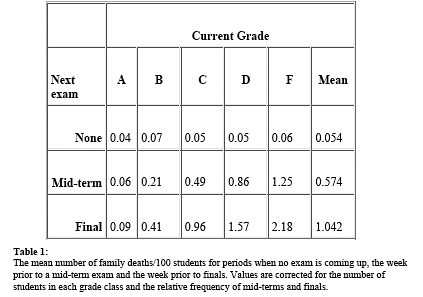
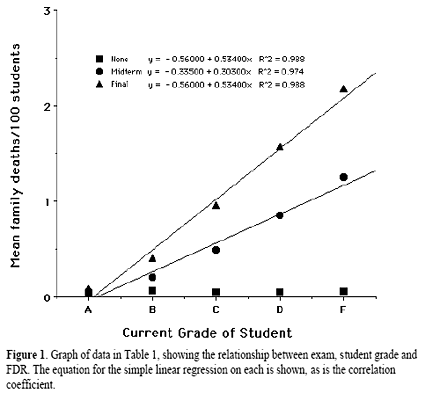
As can be seen in Table 1, when no exam is imminent the family death rate per 100 students (FDR) is low and is not related to the student’s grade in the class. The effect of an upcoming exam is unambiguous. The mean FDR jumps from 0.054 with no exam, to 0.574 with a mid-term, and to 1.042 with a final, representing increases of 10 fold and 19 fold respectively. Figure 1 shows that the changes are strongly grade dependent, with correlation coefficients of 0.974 for mid-terms and 0.988 for finals. Overall, a student who is failing a class and has a final coming up is more than 50 times more likely to lose a family member than an A student not facing any exams.
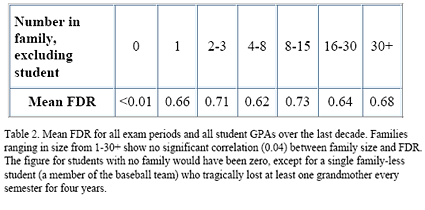
Only one conclusion can be drawn from these data. Family members literally worry themselves to death over the outcome of their relatives’ performance on each exam. Naturally, the worse the student’s record is, and the more important the exam, the more the family worries; and it is the ensuing tension that presumably causes premature death. Since such behavior is most likely to result in high blood pressure, leading to stroke and heart attacks, this would also explain why these deaths seem to occur so suddenly, with no warning and usually immediately prior to the exam. It might also explain the disproportionate number of grandmothers in the victim pool, since they are more likely to be susceptible to strokes. This explanation, however, does not explain why grandfathers are seldom affected, and clearly there are other factors involved that have not been identified. Nonetheless, there is considerable comfort to be had in realizing that these results indicate that the American family is obviously still close-knit and deeply concerned about the welfare of individual members, perhaps too much so. As some colleagues have expressed some degree of skepticism over my interpretation of these data, I have extended the scope of my research into the phenomenon. Using readily available sources (including the National Census Bureau and The National Enquirer ) have examined the relationship between education and family structure. Interestingly, there appears to be no correlation between FDR and the size of the extended family (Table 2). Either large families worry less on a per capita basis than do small families, or there is a single “designated worrier” in each family, who bears the brunt of the danger. The exceptionally high death rate among grandmothers (24 times greater than for grand fathers) suggests the latter explanation is correct. If not, then people from very small families would be well advised to discourage other family members from attending college, since the potential risk becomes excessive with so few members to share the danger.
The problem is clearly far more pervasive than most people realize. For example, if one examines the percentage of the population attending college and the mean divorce rate on a country by country basis, there is a very strong positive correlation between the two. The United States has the highest percentage of its population attending college and also the world’s highest divorce rate, while South Yemen is last in both categories. Although this study is still in progress and will form the basis for a future CSU grant proposal, it seems results already are becoming clear. As more people go to college, their families find that, for safety reasons, it is wise to increase the number of grandmothers per family. Since there is currently no biological way of doing so (though another grant proposal in preparation will ask for funds to look into the prospect of cloning grandmothers, using modern genetic engineering techniques), the families must resort to in creasing the pool by divorce and remarriage. Sociologists may wish to use these data to examine the effect of education on family structure from a new perspective.
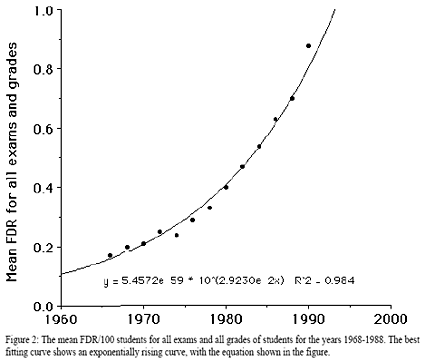
While the general facts of this problem have been known, if not widely discussed, I have recently become aware of a potentially far more dangerous aspect of the whole process. This trend came to light when a student reported two family members dying prior to an exam. Examination of the numbers of deaths over the last two decades clearly showed a “death inflation” When the figures for all students and all exams are pooled for each year, a disturbing outcome is seen (see Figure 2).
The FDR is climbing at an accelerating rate. Extrapolation of this curve suggests that 100 years from now the FDR will stand at 644/100 students/exam. At that rate only the largest families would survive even the first semester of a student’s college career. Clearly something will have to be done to reverse this trend before the entire country is depopulated. Three possible solutions come to mind:
1. Stop giving exams. At first glance, this seems to be the simplest answer to the problem. Like many simplistic solutions, however, it fails to consider the full ramifications of such a course. Without exam results, all medical schools would be forced to close their doors, having no way of distinguishing worthy students. The resultant dearth of physicians in the next generation would throw so many other professionals (tax accountants, malpractice attorneys, golf pros, etc.) out of work that the economy would go into a nosedive. Regretfully, this solution must be abandoned since it is more dangerous than the original problem.
2. Allow only orphans to enroll at universities. This is an extremely attractive idea, except for the shortage of orphans. More could be created of course, but this would be morally wrong, and in any case would replicate the very problem we are trying to avoid i.e. excessive family deaths.
3. Have students lie to their families. Students must never let any of their relatives know that they are at university. (Initial field tests show that keeping just the grandmother ignorant is neither feasible nor safe for the rest of the family.) It is not enough merely to lie about exams; if the family doesn’t know when the exams are, they may then worry constantly and this may lead to even higher death rates. The only solution is that the family must never be aware that the student is even enrolled at a university. Students must pretend they are in the armed forces, have joined some religious cult, or have been kidnapped by aliens. All of these alternate explanations for their long absences will keep the family ignorant of the true, dangerous, fact. Although it might be argued that such large-scale deceptions could not be maintained for long periods, the success of many politicians suggests otherwise.
It will take time to discover whether any of these solutions are feasible. In the interim, the problem is clearly far too important to be ignored. Following the government’s lead on so many similar, potentially catastrophic problems (global warming, the ozone layer, and ocean pollution), I propose that a commission be established to study the problem in more depth. While the state is deciding on the make-up of such a committee and what its charge should be, I would urge all members of the academic community to start keeping their own records. If faculty throughout the country were to send me summaries of their own knowledge about this matter, I could compile a follow-up report for publication in a year or two.


 Here’s a favorite extension known as
  The primary turnout in New Hampshire was extremely high and big numbers helped
 As halftime winds down, the Ohio State Buckeyes return to the field after an outstanding performance by the OSU Marching Band in the BCS National Championship game in New Orleans. I’m struggling to gain a bit of confidence back after LSU scored 24 unanswered points to lead 24 to 10. The LSU Tigers take the first possession in the 3rd quarter and they are looking almost as strong as when they ended the first half. Its actually shocking considering LSU is playing against the 2007 number one defense in college football?
 Although southwestern Ohio isn’t the only area of the country feeling the heat … I can’t let today pass without mentioning that its tee-shirt weather! Wow … its hard to believe that it is January.

 I’m reluctant to post on a subject touching close to home and too soon after the loss of life, but in hopes someone reads this and takes note I’ll included it. First my condolences go out to the Ferraro
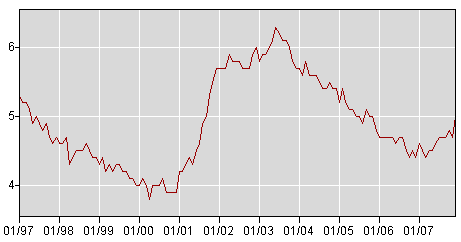
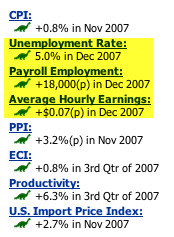 Recently I’ve been paying a bit more attention to the health of our U.S. economy and the trend is raises concern. In my opinion, the continued higher energy and commodity costs are taking a toll on our country and the ability to fend off a recession. While increases in productivity continue to help our nation produce goods efficiently, the addiction to imports, weaker buying power and debt financing of lifestyle will soon be a mountain too steep for us to climb. Today’s release of the rising unemployment number (up to a ‘moderate’ 5%) is disconcerting, especially if inflationary numbers continue an upward trend. November 2007 saw a .8% rise, the largest since September of 2005 and if December’s number are down a bit, I fear we will face both higher inflation and higher unemployment (today’s indication) even as the Fed pumps liquidity into the economy.