Does the US need more Natural Gas powered cars?

Posted By on February 9, 2006

NGV America, formerly Natural Gas Vehicle Coalition, ran an ad in several major newspapers across the country yesterday. The ad encourages the President and federal policy makers to include natural gas fuels and vehicles in our nation’s energy security planning.

I’ll be interested to find out who else feels left out. I’m not sure where I personally stand on natural gas as a vehicle fuel since we use just about every cubic foot for heating, etc? It is a far cleaner fuel for the fleet vehicles in cities and is being used now, yet its not renewable; it also has the disadvantage of adding to the already high demand on natural gas reserves causing prices to soar. Maybe its not the best alternative available today?

The full ad (in PDF format) is available here.
NGVAmerica Ad

GlobalFlyer and Fossett takeoff

Posted By on February 8, 2006

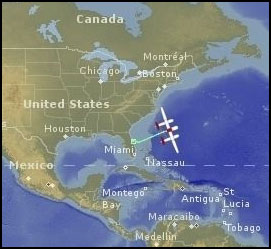
Global Flyer DepartsSteve Fossett took off in an experimental plane today at 7:20 a.m. on an 80-hour flight. He hopes to set a nonstop distance record in the GlobalFlyer aircraft sponsored by Richard Branson’s Virgin Atlantic Airways.

Steve Fossett, is a 61 year old excentric millionaire who has “ballooned” (pun intended) his way to fame in a variety of ways including flying and sailing, is out to break the record by some 700 odd miles set by Dick Rutan and Jeana Yeager, a 26,366-mile nonstop distance record set in 1986. After taking off from Florida, he will fly over the Atlantic, cross Africa, Saudi Arabia, India, China, Japan, the Pacific Ocean, Mexico, and the United States and then back over the Atlantic before landing at Kent International Airport outside London.
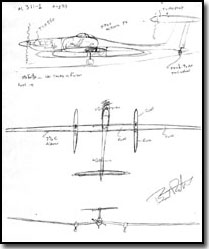
Global Flyer Original Napkin SketchThe GlobalFlyer, which is built by Scaled Composites need to climb to an altitude of about 45,000 feet to take advantage of the naturally occurring high-speed jet stream flowing from the west to the east over the Northern Hemisphere. The GlobalFlyer has a single engine and must have cool temperatures at takeoff in order to get the plane’s weight of more than 11 ton off the runway. Success at least the takeoff. (Check out Burt Rutan’s original napkin sketch prior to designing the GlobalFlyer to the left) 🙂

Interested internet watchers can track the flight on the Virgin Atlantic mission control site during the 80 hour trip. Below is a photo I took this past summer while in Oshkosh Wisconsin for Airventure. (the wingspan was enormous!)

Global Flyer in Oshkosh

EDIT: 2006-02-08 – 16:05est
Updated as a reader asked me a few question about the Global Flyer. (see below) In the meantime, Steve Fossett is over the Canary Island just off the coast of Africa. He is experiencing mild turbulance at 40,000 feet and traveling at 300 knots.

Info on the Global Flyer:
Scaled’s ‘Model 311’ aircraft is a single engine turbofan aircraft specifically designed for non-stop global circumnavigation by a solo pilot with no passengers. The ‘Voyager’ aircraft which took Dick Rutan and Jeanna Yeager around the world non-stop could well be considered 311’s ‘big sister’, but evolution and invention on the part of Burt himself and Jon Karkow has certainly played its part in making this aircraft unique.

Aerodynamics are key to this aircraft, and its configuration is optimised for range and fuel efficiency. The aircraft’s aerodynamics have been designed using extremely sophisticated computing technology that uses computational fluid dynamics to predict how the aircraft’s surfaces will behave in flight. The aircraft is so aerodynamically perfect, that the only practical way to descend is using drag parachutes, like the ones in the picture above. As the aircraft is only required to land once, these won’t be detachable and will take time to reset.The wing structure revealed during the construction phase.

The aircraft is a trimaran-like construction with two huge external ‘booms’ which hold the landing gear, and 5,454 pounds of fuel on either side of the pilot’s cockpit in the centre on top of which is the single Williams turbofan jet engine. The construction materials used for the structure of this aircraft are all graphite/epoxy. The stiffest carbon fibers are used in the construction of the wings, and the skin is a sandwich of graphite/epoxy and Aramid honeycomb.

The aircraft doesn’t have what is known as ‘deicing’ or ‘anti-ice’ measures. This means that it will be unable to fly in ‘icing’ conditions. In addition, it won’t cope with turbulence very well in the early part of the flight when the aircraft is heavy and structural margins low; so weather will be an important factor in choosing when and where to take off from.

The pilot, Steve, will sit in the main fuselage, the centre pod, just behind the nose landing gear and below the engine. He’ll also be sitting in front of the main fuel header tank which feeds the engine.

Advanced aerodynamic design accounts for the engine’s outstanding fuel economy at altitude, which makes the Williams FJ44 the ideal engine for the GlobalFlyer. In fact, it is the only engine with sufficient thrust-to-weight ratio and fuel economy to enable GlobalFlyer’s record-setting flights. Although remarkably quiet by jet engine standards, the engine is located so close to the pilot that sound deadening had to be added to the cockpit.

Steve will also be sitting in a pressurised cabin because of the altitude he will be flying at, which will give him a ‘cabin altitude’ of 10,000 feet at the 45,000 feet he’ll actually be flying at.

One mean machine!The cockpit itself is a mere 7 feet long. It is equipped with a reclining carbon fiber seat. However, to get a good enough view for take off and landing, Steve will need to sit on cushions as the seat isn’t high enough.

There are thirteen fuel tanks all in all, and on take-off, it is expected that this aircraft will be 83% fuel by weight. Which must be a world record surely? Getting fuel to where it’s needed whilst maintaining the balance and stability of the aircraft is a feat that will require constant supervision and monitoring. The fuel itself will be a special fuel that has a much lower freezing point that regular aviation fuel.

Some facts and figures:

– Wing Span: 114ft

– Wing Area: 400ft squared

– Length: 44.1ft

– Height: 13.3ft

– Gross Weight: 22,000 lbs

– Empty Weight: 3,350 lbs

Hybrid Myths

Posted By on February 8, 2006

Hybrid MythsNow just because it was printed in Business Week doesn’t make it ‘fact,’ but the January 31st article, “The Top Ten Hybrid Myths” by Brad Berman gives a pretty good primer on what hybrid technology is and isn’t. For those interested in cars and paying attention to automobiles, most of this isn’t new, but a good reminder as to the differences between makers and models in how they intergrate the technology in their vehicles. Just because the word “Hybrid” is stuck on the back of the vehicle doesn’t automatically make it a green, hyper-miler anymore. (nor has it necessarily been true even for those marketed that way — see USAToday article.)

Berman’s Top Ten Hybrid Myths:
1. You need to plug in a hybrid car.
2. Hybrid batteries need to be replaced.
3. Hybrids are a new phenomenon.
4. People buy hybrids only to save money on gas.
5. Hybrids are expensive.
6. Hybrids are small and underpowered.
7. Only liberals buy hybrids.
8. Hybrids pose a threat to first responders.
9. Hybrids will solve all our transportation, energy, and environmental problems.
10. Hybrid technology is only a fad.

As a proponent of clean, renewable, American produced biofuels, I’ve often stated that biodiesel and ethanol are solutions that we can implement today. I am hopeful that technology and innovation will continue to solve the problems related to dependency on fossil fuels … I believe that the hydrogen fuel cells are in our future, but a long way off?

I also see hybrids playing a role too. Biofuels and hybrid techology will carry us a long way while improving our emissions and reducing our dependance on foriegn oil. I believe hybrids might also be part of the final solution and be intergrated into hydrogen powered vehicles … anyway you look at it, they help our vehicles improve how they use energy. Regenerative braking and engine cycling offer definite improvements and most likely will be in future vehicles. Consider that the International Energy Agency (IEA) concluded that even under the most favorable conditions, hydrogen vehicles will most likely represent only 30% of the global fleet by 2050, future of automotive technology will most likely refine and continue to use hybrid/gas/diesel/biofuel/electric vehicles for a long time. Jim Press, president of Toyota Motor Sales USA is quoted in the article, and his comment parallels my conclusion: “I think everything will be a hybrid, eventually. It will either be a gas hybrid, a diesel hybrid, or a fuel-cell hybrid.”

Discovered! A red faced, wattled honeyeater

Posted By on February 7, 2006

New Guinea MapYes, discovered –a red faced, wattled honeyeater — its a bird.

🙂
An area high in the rainforest of New Guinea is being described as the “lost world.” I read through an article published yesterday in “The Independent” that details the unknown and rare animals that have been discovered by a team of international scientists. Bruce Beehler, of the American group Conservative International, led the expedition that recorded several new species of birds, frogs, butterflies and palms. The expedition explored this “Garden of Eden” in November and December of 2005 in this area untouched by man.

The teams jungle camp site was surrounded by giant flowers and unknown plants. The scientists watched rare birds, strange mammals, tree kangaroos and spiny anteaters. Interestingly these animals “appeared totally unafraid, suggesting no previous contact with humans.”

Bruce Beehler explained that “We found dozens, if not hundreds, of new species in what is probably the most pristine ecosystem in the whole Asian-Pacific region. There were so many new things it was almost overwhelming. And we have only scratched the surface of what is there.”

According to the interesting article, the scientists hope to return this year.

Superbowl XL and commercials

Posted By on February 6, 2006

John Madden and Al MichaelsI’m at a quandary as to comment on the actual game between the Pittsburgh Steelers and the Seattle Seahawks? Do I opine on the performances, or lack there of, from either team — or just focus on the individual achievements? I suppose I could eulogize about Seattle or reflect on the mediocre performance of the superstar status players? Maybe neither team really has superstar players? Seeing the emotional Bill Cowher with his family and their exuberance was perhaps a highlight of this game, but in my opinion the 21 – 10 Steeler victory was less than stellar. The game wasn’t a standout Superbowl and the slow pace wasn’t helped by the several required referee booth reviews. At time I even felt that the ABC announcers Al Michaels and John Madden were stumbling for call analysis as close decisions were decided at a painfully slow pace. (Congratulation to John Madden; he was just voted into the Pro Football Hall of Fame) All in all, it was a tepid end to a long NFL season.

Although the game is why most of us watch the Superbowl, the halftime show and commercials are becoming as important for some as the game itself. (they are a marketer’s delight) I found myself checking out each commercial, wondering which would capture the conversation around the watercooler on Monday morning?

Early results suggest that the winner might have been the “pre-hysterical” (as Professor Bill Ward states) FedEx spot featuring a caveman crushed by a dinosaur.

FedEx Caveman should have used FedEx
Anheuser-Busch who generally spends the most on Superbowl ads came close with its “secret” spinning wall refrigerator and the Bud Light spot with men on their roofs excaping their wive’s was also near the top. Since I was watching with a couple of teenagers, the Clydesdale football game with a “streaking” sheep seemed to rate pretty high as well.

Bud Light and the ‘Magic Fridge’

Husbands excape to the Rooftop for a Beer

Budweiser’s Clydesdales and the streaking sheep

My wife appreciated Unilever’s Dove ad, where young girls struggle with self-image issues, but her favorite product Diet Pespi, IMHO had a couple of the ‘loser’ ads as did Burger King. I’m not too convince the marketing for Ameriquest was poignant as I kept trying to figure out what there ads had to do with their business, but I did get a charge out of the mother and daughter in a hospital room visiting dear old dad as the buzzing fly was zapped.
Ameriquest Bug Zapper Ad

Dotcom’s still bought a few ads — I think most liked the Careerbuilder.com chimp ads. GoDaddy.com probably did the most ‘risque’ ad of the bunch when it produced a spoof on the Janet Jackson Superbowl fiasco. I’m not sure what it has to do with their product, the oxygen mask for an aging executive was a great touch.
GoDaddy.com – Aging board member needs oxygen

Gillette could have done something more creative to introduce their new five-bladed razor; it is basically a rework of a two, three and four bladed razor ads of the past — whoopee. Motorola stumbled as well in my opinion in marketing their PEBL phone … what’s with the meteor becoming a pebble? Celebrities were used in a few ads, including one for the nonsteroidal anti-inflammatory drug Aleve which used Star Trek’s Leonard Nimoy. It was so-so.
Aleve with Star Trek’s Leonard Nimoy

The motor city did their part as the Detroit, auto companies, General Motors Corp. and Ford Motor Corp., had pretty good ads. Ford promoted their ‘green’ ad with “Kermit thee Frog,”while GM went creative with a baby Hummer H3. Honda and Toyota were there, but were lukewarm as I know they had ads but can’t hardly recall them. (Ridgeline and Civic I think???)
But the winner is … according to me 🙂 … drumroll please …. the Sprint ad demostrating the crime deterrent of its phones. I thought it was hilarious.
Sprint/Nextel crime deterrent

All in all … Superbowl XL could have been better … but then that would have required the Bengals to have won a couple of more big games. Congratulations Pittsburgh.

Cat Herding – a Google Video Test

Posted By on February 6, 2006

I know … this internet video encoding is getting old, but there is a reason for my tinkering. I’m getting ready to publish a VW TDI Intake Manifold CleaningHow To” clip and trying to decide if there is a way to offer Google Video downloads and still not damage the DVD donations. I’m embedding a Cat Herding clip that is kind of funny as a test of this ‘Google Video’ method.

Cat Herding Commercial

Video Clip for bird lovers

Posted By on February 5, 2006

I’m guessing that across the pond there don’t worry about political correctness in their advertising? This Ford Sportka ad is rather disturbing. “Here kitty – kitty – kitty.” 😉

Motorweek turns 25

Posted By on February 4, 2006

PBS’s Motorweek celebrated 25 years of reporting on the auto world this past weekend and after taking a look back, also looked ahead to what is in our automotive future. Since I’ve been tinkering with video and encoding this weekend, I’ll include the tail end clip that mentions of diesel making a comeback and visions of diesel hybrids in our future; they even look under the hood clip of a VW TDI.


Motorweek Banner

Take a look.

Video: Just for fun …

Posted By on February 4, 2006

Redneck Water TubingI’ve been wanting to be able to incorporate a series of short video clips in my blog. Some clips have most likely been spotted on the internet before, others might be new and a few I’ve recently encoded. Instead of ‘forwarding’ to friends I thought I would share them here.

Without further ado I’ll put up a 20 second clip showing a couple geniuses ‘across the pond’ jury-rigging their car in order to do some tubing. (I would have used a term that Jeff Foxworthy coined for this situation — but it might be thought of as offensive … although I would have meant it in the most ‘creative country boy sort of way’) Unfortunately the beta plug-in that a handful of us WordPress guys are testing does not support H.264/mp4 AVC. (I prefer this kind of high quality/small size video file)
For the automotive types reading … “Name that Car!” 🙂 (maybe for the next GTG???)

Biofuels: Where are we going?

Posted By on February 3, 2006

BiofuelsAs we move forward with alternative energy and ways to displace petroleum as a primary fuel, I believe it is important to encourage industry and the country to explore a variety of option. The old adage of “placing all your eggs in one basket” apply to the predicament of what energy source we should consider. Personally, I believe we’ll eventually move towards hydrogen as a portable energy source, but see the road long and complicated. Even if we eventually adopt hydrogen fuel cells, I believe there will be combinations of petroleum and biofuels for many years to come. On my blog, I try not to overly focus on politics, but since the last two posts detail politicians (President Bush, Majority Leader Rep. John Boehner) who both are supportive of farm based renewable fuels … and are regularly promoting biofuels as a way to overcome our “petroleum addiction,” I wanted to stress a few key points because unlike hydrogen … it is something we can do today.

    Key facts about biodiesel and ethanol

*There are more than 4 million FFVs (Flexable Fuel Vehicles) that can run E85 (85% ethanol) currently on America’s roadways.

* Biodiesel works in any diesel engine and is much cleaner burning than petroleum diesel. It can be blended with petroleum at any percentage and can be made from any fat or vegetable oil. About 90 percent of U.S. biodiesel is made from soybean oil. It takes roughly 7 pounds (about 3.2 kg) of soybean oil to make one gallon (about 3.8 liters) of diesel.

* Ethanol, an alcohol most often made from grains and sugar cane, is blended with gasoline to reduce tailpipe emissions in cars and trucks. One acre of corn can produce 300 gallons of ethanol — enough to fuel four cars for one year with a 10% ethanol-blend.

* Biodiesel production capacity in Europe, mainly in Germany and France, has risen sharply as countries try to reduce carbon dioxide emissions and cut the bloc’s dependence on fuel imports. The EU in 2004 set a target that fuels should contain 5.75 percent of biofuels in 2010.

* Brazil is the world’s leading producer and exporter of ethanol, derived from the country’s huge sugarcane crop. It already blends its domestic gasoline with 25 percent ethanol and is looking to U.S., Japanese and Indian markets to boost exports.

* In the United States, the second largest biofuel producer after Brazil, hundreds of major truck fleets use biodiesel including all branches of the U.S. military, NASA, several state departments of transportation and public utility fleets.

* China, the world’s second largest energy consumer, is also the third largest ethanol producer. The Philippines encourages use of coconut oil for biodiesel.

* The International Energy Agency estimates that under the most optimistic scenario ethanol could make up 10 percent of world gasoline by 2025.

Source: Reuters and International Energy Agency.

Testing the Google Video link:

GM’s Go Yellow Commercial’http://video.google.com/googleplayer.swf?videoUrl=http%3A%2F%2Fvp.video.google.com%2Fvideodownload%3Fversion%3D0%26secureurl%3DkQAAALrZ7Kw2hIp3Hfa6LvCDeXltLMar4l8Hk4zVvcQPRo4HO9_t2xv5D_VxAzcgsQbpsg33PGmYPGX9lpnfCwVZke0M1J2i9EMkcVk3UHaDrnagx6GFFDwntmCl2agGcaYcrCYTp8CQxBEnu0A_bq_FqV07UNev_lkoaoItIYexNuJWVYlRi_7odGxQNxhaRKUBdOX8Bsk4kVKeo55wKvxU3ps%26sigh%3DUH5yee1PE0bJSByZOmRlrl1iQ8w%26begin%3D0%26len%3D30496%26docid%3D8631642079881718613&thumbnailUrl=http%3A%2F%2Fvideo.google.com%2FThumbnailServer%3Fcontentid%3D2eb1c3050c6c266a%26second%3D5%26itag%3Dw320%26urlcreated%3D1139244985%26sigh%3D65JXFJcQhyofgUqcQwulA5RcP0I&playerId=8631642079881718613&playerMode=embedded

Ford Hybrid and Kermit Commercial

Desultory - des-uhl-tawr-ee, -tohr-ee

  1. lacking in consistency, constancy, or visible order, disconnected; fitful: desultory conversation.
  2. digressing from or unconnected with the main subject; random: a desultory remark.
My Desultory Blog