Senator Ted Kennedy succumbs to brain cancer at age 77

Posted By on August 26, 2009

Sen Ted KennedySenator Ted Kennedy, the “liberal lion” of the Senate as he has been described, passed away at the age of 77 after a a battle with brain cancer in his home. He was an icon for many favoring liberal politics in the U.S. and served the state of Massachusetts for 9 terms after being elected in 1962 to fill the seat of his brother President John F. Kennedy. His tenure in the Senate placed him as the second in seniority behind West Virginia’s Senator Robert Byrd.

Although I did not admire Kennedy’s personal life or his politics, my respects go out to his family and many years of service to our country. His stature and strong voice will leave a void for many that see his accomplishments out weighing his flaws. RIP Senator Ted Kennedy (February 22, 1932 – August 25, 2009).

Samoa drivers order to drive on left instead of right

Posted By on August 24, 2009

An odd article today in the Wall Street Journal that has drivers of the island nation of Samoa ordered to switch from driving on the right  to the left.  The prime minister, Tuilaepa Sailele Malielegaoi, has pushed for the change and is refusing to back down even with a significant push from resident, including a well organized group called PASS who say “the switch will turn many of Samoa’s already-dangerous roads into disaster zones. Roads wind through mountainous jungle terrain with sharp turns, few traffic lights and pedestrians and dogs sharing the lanes.” Advocates say that one of the reasons is that “by aligning with Australia and New Zealand, the prime minister says, it will be easier for poor Samoans to get cheap hand-me-down cars from the 170,000 or so Samoans who live in those two countries.”

Perhaps a few “cash for clunker vehicles” could have been shipped to Samoa and have solved their problem?

The comments of David William Hedrick need to be heard

Posted By on August 23, 2009

As the August recess for our congressional representatives draws to a close, the concerns of many Americans have been clearly and forcefully expressed in townhall meeting across the country. One such American expressed the growing opinion of many citizens regarding the change in government happening in our country.  David William Hedrick, a USMC veteran, expressed this concern succinctly.

Mr. Hedrick — thank you, your voice was heard, at least by me  and it clearly
resonates with many in America. (thanks for the video link Eric  R.)

Evening clouds photo using Palm Pre camera

Posted By on August 22, 2009

Evening Sky photo with Palm Pre

While buzzing around Liberty Township, the evening sky was pretty dramatic so I poke my Palm Pre phone out the window on Butler-Warren County road and included it. (Panoramio Location)

Intellichoice survey reviews 2009 hybrid and diesel cars

Posted By on August 21, 2009

TDI QuestionA 2009 Intellichoice survey compared the cost of ownership beyond the sticker price by factoring in depreciation, financing, fuel, Insurance, maintenance, repairs and state fees. By doing this, consumers should have a better idea of what a vehicle’s long-term ownership costs might be and better be able to decide which vehicle is a better overall value.

This year they reviewed 51 different hybrid and diesel model cars and have concluded ‘surprisingly’ that the maintenance cost of both the diesel and hybrid vehicles were on par with their gasoline only counterparts in a 5 year comparison*. They also describe ‘clean diesel’ vehicles as a “game changer” and the PDF charts show the Volkswagen Jetta TDI as the best return for the dollar (even in 5 years) when comparing its MSRP premium, fuel cost saving, maintenance and resale value.

* What it doesn’t show, and should be pointed out by those of us that drive hundreds of thousands of miles and keep their cars for more than 5 years, is that diesel cars and trucks have significantly higher resale values AND have traditionally had a lower cost of maintenance per mile as a vehicle ages. At this time, one can only  spectulate that a hybrid owner will eventually face the high cost of a new battery on top of its internal combusion engine, which will most certainly impact long term values and the cost of owning a hybrid vehicle compared to both gasoline only and diesel vehicles.

Smart ForTwo looks good in roof-strength crash test

Posted By on August 20, 2009

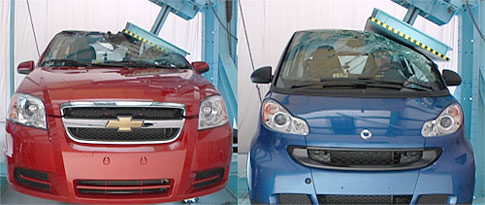
Chevy Aveo and Smartfortwo

One has to think twice before grimacing  when seeing those tiny Smart ForTwo car(t)s rolling down the highway … especially if you’re in a bow-tied import like the Chevrolet Aveo (Daewoo Korean built Chevrolet). A recent report issued by the Insurance Institute for Highway Safety (IIHS) found that the Smart ForTwo performed the best in tests designed to compare rollover occupant protection, where the Aveo received only a “marginal” rating.

News Release | August 20, 2009


Smart Fortwo rates good for roof strength; test is designed
to assess & compare occupant protection in rollover crashes

The Smart Fortwo has the strongest roof and the Chevrolet Aveo has the weakest among 2009 micro and minicars recently tested by the Insurance Institute for Highway Safety. The Smart earns the highest rating of good compared with acceptable for the Honda Fit, Hyundai Accent, Mini Cooper, and Toyota Yaris. The Aveo is rated marginal.

The rating system is based on Institute research showing that occupants in rollover crashes benefit from stronger roofs. Vehicles rated good must have roofs that are more than twice as strong as the current minimum federal safety standard requires. The ratings, products of the Institute’s new roof strength testing program, add to consumer information tests that rate vehicles for front, side, and rear crashworthiness. The roof test is designed to help consumers pick vehicles that will help protect them in rollover crashes.

“We anticipate that our roof strength test will drive improved rollover crash protection the same way our frontal offset and side tests have led to better occupant protection in these kinds of crashes,” says Institute president Adrian Lund.

Roofs have gotten stronger during the past few years, Institute research shows. Part of the reason is that automakers have made structural improvements to earn better front and side ratings in Institute tests. Strong A and B pillars help prevent intrusion in these types of crashes. They also help hold up the roof.

“Small cars should have an easier time with the roof strength test,” Lund explains. “Their light weight means their roofs don’t have to work as hard to keep the structure around the occupants intact in a rollover.”

About 10,000 people a year are killed in rollovers. When vehicles roll, their roofs hit the ground, deform, and crush. Stronger roofs crush less, reducing the risk of injury from contact with the roof itself. Stronger roofs also can prevent people, especially those who aren’t using safety belts, from being ejected through windows, windshields, or doors that have broken or opened because the roof deformed. Roofs that don’t collapse help keep people inside vehicles as they roll.

The best protection is to keep vehicles from rolling in the first place. Electronic stability control is significantly reducing rollovers, especially fatal single-vehicle ones. When vehicles do roll, side curtain airbags help protect people. Belt use is essential.

How roofs are evaluated: In the Institute’s test, a metal plate is pushed against 1 side of a roof at a constant speed. To earn a good rating, a roof must withstand a force of 4 times the vehicle’s weight before reaching 5 inches of crush. This is called a strength-to-weight ratio. For an acceptable rating, the minimum required ratio is 3.25. A marginal rating value is 2.5. Anything lower than that is poor.

“Compared with the current federal standard of 1.5, a strength-to-weight ratio of 4 reflects an estimated 50 percent reduction in the risk of serious or fatal injury in single-vehicle rollover crashes,” Lund explains.

The Smart withstood a force of 5.4 times its weight. The Aveo withstood a force of just over 3 times its weight.

Cars have been built to meet the same roof crush standard, Federal Motor Vehicle Safety Standard 216, since 1973. The rule was extended in 1994 to include all passenger vehicles up to a gross weight rating of 6,000 pounds. Many SUVs and pickup trucks are heavier, so they’re exempt.

New federal requirements: In April the National Highway Traffic Safety Administration ended numerous delays by unveiling a new rule that doubles the current roof strength requirement (strength-to-weight ratio of 1.5) for vehicles with weight ratings up to 6,000 pounds. Roofs on vehicles with weight ratings 6,000 to 10,000 pounds will be required to withstand a force equal to 1.5 times their unloaded weight. Another requirement is that roofs maintain sufficient headroom during testing. For the first time, the government also will require the same performance on both sides of the roof when tested sequentially. Phase-in begins in September 2012, and all vehicles must comply by September 2016.

“The federal government’s leisurely phase-in of the new standard means roofs won’t have to get stronger right away,” Lund says, “so we plan to continue rating vehicle roof strength for the foreseeable future. We want to reward manufacturers who are ahead of their competition when it comes to providing protection in rollover crashes. We want to help consumers identify the safest vehicle choices.”

Roof ratings added to award criteria: A good roof strength rating will be a new requirement to earn the Institute’s Top Safety Pick award for 2010. This is the second time criteria for this award have been tightened since the first winners were announced in 2005. Availability of electronic stability control became a requirement starting with 2007s.

“Adding roof strength to Top Safety Pick criteria means we’re going to see fewer winners in 2010,” Lund points out. A record 84 vehicles have qualified for the 2009 award so far.

Earthrace and Pete Bethune thinking Antarctica

Posted By on August 19, 2009

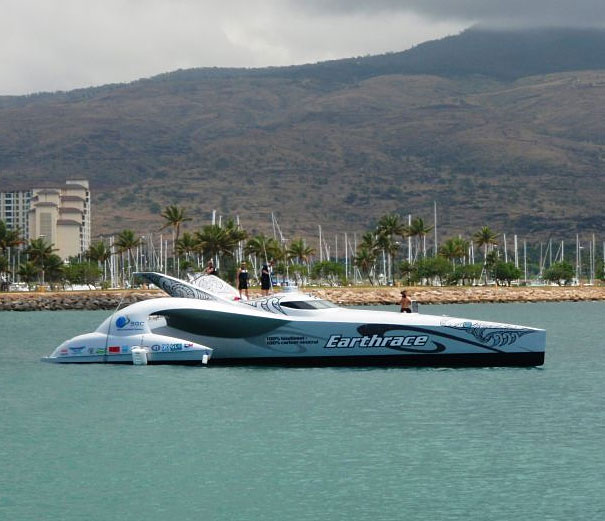
August must be the month for reminiscing, as I recently posted on what I remember 40 years ago (Woodstock festival) and I also just clicked a ‘Years ago on this date’ link from 2006. I had a good smile remembering what it was like to be at 13,796 feet on Earthrace in HawaiiMt. Mauna Kea in Hawaii; it was enjoyable to remember these good times.

I also enjoyed connecting with another ‘blog post friend’ from the past, Pete Bethune from Earthrace. Besides setting him up with a Twitter name previously reserved for him (@earthrace), I had a chance to discuss what was in store for him and Earthrace. As an activist for admirable causes (previous was the alternative fuel ‘biodiesel’), Pete and his radical boat are planning to head for Antarctica where they hope to draw attention to the barbaric practice of high-tech whaling. There have been others, most notably Greenpeace, that are concerned over these factory ship operations and systematic slaughter of one of the Ocean’s most magnificent creatures.

I wish him well in this endeavor and hope to post more as his plans come together. Stay tuned.

The Great American Ballpark and Biodiesel

Posted By on August 18, 2009

Not only has the Cincinnati been a pioneer in using biodiesel in their city buses (PDF), but the Great American Ballpark is being praised as one of the greenest Major League Baseball facilities in the nation. Chris DickersonThe ballpark composts its grass clippings and convert all the cooking oil in the consession stands to biodiesel fuel according to a recent article.  Reds outfielder Chris Dickerson, cofounder and CEO of “WePlayGreen.org,” says there has been great support in Cincinnati from Rumpke dispersing recycling bins to fans participating in efforts to use resources more carefully. Dickerson’s goal is to try and “instill consciousness” among Reds fans.

LINK

Pondering the value of a Spanish Siesta

Posted By on August 17, 2009

hammock at sunsetWhile visiting Spain last month I was surprised that even in the 21th century that there were towns along the Mediterranean coast (tourist area) who still enjoy a mid-day ‘siesta’ and have little problem with the loss of business  For American who have grown accustomed to workplace praise for productivity or have been cultured in hard work,  ambition angone fishind more money is better, the idea of losing a couple hours in every workday seems … well … foreign.

On the other hand, there are days like Sunday and Monday (today) when the temperatures inch into the mid-90s that I’m ready to put out the Gone Fishin’ shingle … or at least take an afternoon off to clean the pool. FYI … the water was cool and relaxing.
😀

Enjoying a hot summer weekend at the pool

Posted By on August 15, 2009

Just in case you’re enjoying a weekend at the pool, here’s something to think about …
:mrgreen:

video removed

Desultory - des-uhl-tawr-ee, -tohr-ee

  1. lacking in consistency, constancy, or visible order, disconnected; fitful: desultory conversation.
  2. digressing from or unconnected with the main subject; random: a desultory remark.
My Desultory Blog