New Speed record for a VW TDI in New Zealand

Posted By on August 1, 2006

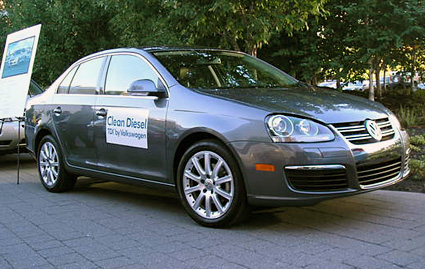
Oreilly's TDIHere’s an update on Maurice O’Reilly’s high speed record attempts with a Volkwagen Jetta 1.9 liter TDI diesel. On Saturday and Sunday (July 29 & 30th) he set four records at Goudies Road in Rerewhakaitu New Zealand according to reports. The previous diesel record for this run was topped by 40km/h and is now Mr. O’Reilly’s at 232.1245km/h. (144.5416mph) Although I don’t know specifics in regard to what it takes to set a “Diesel Speed Record for the flying kilometre,” the new record is impressive and obviously requires a correctly tuned TDI and the right fuels? (I’ll await a reply from the club secretary in hopes of an explanation)

Congratulations to the team and driver Maurice O’Reilly for showing the world exactly what a 1.9 liter turbocharged DIESEL can do. For more on this run, see cars.co.nz.

Vacation book choice: Talking Right

Posted By on July 31, 2006

Talking RightI’m looking for a light reading book for my upcoming vacation. Geoffrey Nunberg’s book, Talking Right, might just be the ticket. It looks humorous enough to keep the reading light, but topical enough to hold my interest. I’m open for opinions and will offer a few tidbits if they are worthy after our family vacation.

I’ll include a video segment below with the author and a link to an interview Mr. Nunberg had with NPR’s Terry Gross … host of the program Fresh Error.

🙂 Ok that was nasty …. I mean Fresh Air.

Talking Right by Geoffrey Nunberg


Introduction from Geoffrey Nunberg’s book


Signs and symbols, language, are the means of communication by which a fraternally shared experience is ushered in and sustained. But conversation has a vital import lacking in the fixed and frozen words of written speech. . . . That and only that gives reality to public opinion. —John Dewey, The Public and Its Problems, 1927

Are the Democrats simply tone deaf? That impression was hard to escape when the party floated a new slogan in the fall of 2005 that was aimed at the 2006 midterm elections: “Together, America can do better.” Or more accurately, a newly augmented slogan—in 2004, John Kerry had used “America can do better,” without the “together” part. According to the congressional newspaper The Hill, Democrats had chosen the slogan to address the party’s “messaging problems” after testing it in focus groups along with a number of alternatives. “We know the majority of people agree with us on the issues,” one Democrat was quoted as saying, “but this effort is an acknowledgment that we need to communicate better.”

The response to the slogan was, to put it mildly, tepid. The Washington Post reported that Democratic governors were scoffing at it, and the liberal commentators excoriated it. “Pathetic,” said Hendrik Hertzberg in the New Yorker. And the Los Angeles Times’s Rosa Brooks concurred: “‘You can do better’ is what you say to a dim child whose grades were even worse than expected. Is this really the Democrats’ message to the nation: that we don’t need to be quite as pathetic as we now are?” The blogger Wonkette was characteristically caustic: “Now we know where the Democrats stand,” she said. “They stand for betterness.” And indeed, the slogan seemed to epitomize Democrats’ inability to come up with an overarching theme other than “Listen, anybody would be an improvement over this bunch of bozos.” (Wonkette mused that the rejected slogans probably included “You Could Do Worse,” “It’s Not Like There’s a Third Party,” and “Sorry About That Kerry Thing.”)

Given the slogan’s resounding vacuity, it might seem like piling on to point out that it’s ungrammatical in the bargain, with the together sitting uncomfortably with the singular America. Saying “Together, America can do better” is a bit like saying “Together, the North won the Civil War”— you know what it’s supposed to mean, but you have to do a little mental stutter-step to get there. It’s clearly a sentence written by a committee: you can tell that one faction wanted to go with “America can do better” while another favored “Together, we can do better” to get the unity theme in there, so they decided to split the difference. Of course, faulty syntax by itself has never been an impediment to successful advertising. But the slogan could stand in, only a little unfairly, for the Democrats’ general failure to get their communicative act together, right down to an inability to get their adverbs and subjects to agree.

What makes the party’s choice of slogan ironic—or not to mince words, downright depressing—is that the Democrats have been struggling with their “messaging problem” for some time now. I first became involved in those efforts in the spring of 2003, when Senator Byron Dorgan invited three linguists, George Lakoff, Deborah Tannen, and me, to make a panel presentation to the Democratic Senate caucus on “Framing Policy Issues to Enhance Public Understanding,” with the aim of helping the Democrats counter the Republicans’ success in using language to advance and often obscure their agenda. We talked about “issue framing” and linguistic stereotyping, and the senators seemed receptive and clearly concerned about the problems. And despite that lame slogan, it’s clear the Democrats have been trying in their hugger-mugger fashion to respond to Republican rhetoric more assertively.

But as I was reflecting afterward on those discussions, it struck me that the Democrats haven’t fully grasped how deep their linguistic problems go, or how they directly reflect the Democrats’ inability to tell a coherent story about themselves (I mean over and above observing tautologically that they aren’t Republicans). This book shows how that failure has had consequences that go beyond anything that improved framing or better slogans could remedy. The right’s most notable linguistic achievement isn’t its skill in coining distracting catchphrases, but its success in capturing the language of everyday political discussion.

Talk to most people about “political language” and they’re likely to think of the language that politicians and pundits use when they’re trying to rouse public support for particular candidates and policies. Most of the books and articles on political rhetoric concentrate on the language of speeches and public pronouncements, rather than the language that ordinary people use when they are talking about political topics—not surprising, since until recently those were the only records of political language available, and scholars naturally congregate where the light is. But while the language of politicians and pundits is ultimately aimed at persuading people to act in certain ways, it can only get there by first persuading them to talk in certain ways. As John Dewey observed, it’s only in private conversation that political opinion crystallizes, as people absorb the words they read or hear from on high and incorporate the ideas they stand for into the stories they tell about politics and their lives. Language is a kind of informal plebiscite: when we adopt a new word or alter the usage of an old one, we’re casting a voice vote for a particular point of view.

Until a few years ago, you could only observe those shifts in language use in an anecdotal, Andy Rooney sort of way—”Have you noticed how everybody seems to be talking about values these days?” Or what’s only slightly better, you could listen to the way a handful of people talked about politics in focus groups, without any real sense of how typical their language was. Now it’s possible to date and measure those shifts in language, thanks to the Web, the online discussion groups, and all the databases of press stories and broadcast transcripts. It’s true that those tools weren’t designed with the aim of gauging public opinion, the way political polls and surveys are. As scientific instruments go, they’re highly imperfect: they ignore distinctions of meaning, their counts can be inaccurate, and they’re not necessarily representative of the language that people use when they’re kicking around political issues with their co-workers or at the breakfast table.

But whatever their limitations, the tools allow us to examine how words are being used by both the press and the general population, and to measure changes in their popularity and shifts in their meaning. Needless to say, these methods have transformed the way we word wonks come at our subject. In the Victorian age, it took a small army of volunteer readers twenty years to amass the 3.5 million citation slips illustrating the usage of all the words in the English vocabulary that were used to prepare the first edition of the Oxford English Dictionary. These days it takes Google just half a second to report that it gets 6.8 million hits for the single phrase liberal media (though you’re best off taking the exact figure a bit cautiously).

And it doesn’t take much longer than that to track the way class warfare waxes and wanes in the press and the online discussion groups according to the political climate, or to determine whether conservative or liberal writers are more likely to use the word redneck. As a window on public opinion, language can hardly take the place of polls and surveys. Language comes at the world from a different angle, more oblique but in its own way just as telling, if you read it right. The appearance of new phrases like “the liberal mindset” and “hidden agenda”; the shifting meanings of elite, liberal, government, or patriot; or even the fact that conservatives tend to say “you liberals” a lot more than liberals say “you conservatives”—all these things testify to the way political attitudes are embedded in the words that people use to express them.

It’s only when you look at those patterns of usage that you discover how deep the Democrats’ linguistic problems go. Over recent decades, the left has lost the battle for the language itself. When we talk about politics nowadays—and by “we” I mean progressives and liberals as well as conservatives and people in the center—we can’t help using language that embodies the worldview of the right.

The challenge facing liberals and Democrats is to recapture that ordinary language. That’s what this book is about.

From Talking Right by Geoffrey Nunberg. All rights reserved.

Is middle east peace even possible?

Posted By on July 30, 2006

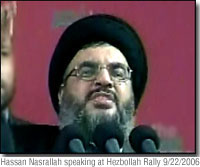
Hezbollah Rocket at night 7/22/2006Its about as tense as it has been since the start of this conflict between Hezbollah and Israel. Sunday was a most brutal day for people still in Qana, a city in southern Lebanon, as a building was struck by Israeli air forces which was suspected of being a launch or storage area for Hezbollah rockets. (Update: 57 28 killed, 9 of them children – confirmed by International Red Cross 8/2/2006) Israel provided evidence that rockets were being launched from this area and stated that they did target ‘a building’ suspected of being a Hezbollah site. More than likely, the rockets were launched from right behind or next to the 3 story house that was hit. (BTW … Hezbollah launched over 100 rockets at Israeli cities on Sunday alone — purposely targeting civilians) Unfortunately after 19 days of fighting and continual launches of rockets from within border towns by Hezbollah, civilians have remained or are unable to evacuate these targeted areas. Regretably Hezbollah chooses to hide among these civilians, as well as launch their rockets ‘at Israeli civilians’ from areas where Lebanese women and children are living. There are also some analysts questioning whether or not Hezbollah and Hamas purposely are setting up ‘pawns’ in order to damage Israel politically — although no evidence of such a claim as been presented as of yet.

Another concerning issue for the US was the meeting of Venezuela’s President Hugo Chavez (see previous comments) and Iranian President Mahmoud Ahmadinejad. Ahmadinejad presented the highest state medal on Sunday to Hugo Chavez for supporting Tehran in its nuclear standoff. What does this mean to have the number 4 and number 5 oil producer ‘chumming’ up while the permanent members of the U.N. Security Council draft proposals that gives Iran until the end of August to suspend uranium enrichment or face the threat of economic and diplomatic sanctions.

With Americans once again either being called upon to assist in the peace process or choosing to assist in being a peace broker, we once again look like the world police force. Its a no-win situation as opinion is split as to what the US should and shouldn’t do whenever violence erupts around the world. Personally I see validity to both positions … on one hand I don’t want our troops dying in every continent every time arms are drawn between countries or renegade forces … on the other, disengagement in foreign affairs permits rise of thug and rogue nations desiring to use force in implementing their evil desires or permitting terrorists free reign in
Newt Gingrichtargeting nations’ citizens. With Secretary Rice returning prematurely before even attempting to work on a peace, it looks as if war will continue to rage unless the UN can come up with some palatable solution where a peacekeeping force can intercede. While watching some of the experts, I recorded a man I respect for his knowledge of history and pulse of current world affairs: Newt Gingrich.

FoxNews with Newt Gingrich

Motorweek confirms Jeep Liberty CRD demise

Posted By on July 30, 2006

jeep crdAs mentioned in previous posts (a, b, c), the diesel powered Jeep Liberty CRD will not be offered in 2007 and according to the PBS program Motorweek, production at the Toledo, Ohio plant as already ceased. For those of us that are ‘pro-diesel’ (and biodiesel) this development has bee disappointing. On the plus side, Jeep should be producing the new diesel powered Grand Cherokee, but most likely its power, luxury and price (and unimpressive economy) will keep many traditional diesel advocates from running to their local Jeep dealer.

In addition to the Jeep Liberty CRD’s elimination for 2007, Volkswagen, the current dominate diesel ‘car’ importer to the US, has indicated that they to are unable to meet new emission standard with their current TDI technology. (see May 2006 post) Volkswagen representatives have indicated that US dealers will continue to sell 2006 TDI models well into the 2007 model year, or at least while they last. Hopefully their new common rail engine will get emissions approval for 2008.

Motorweek Reports Jeep Liberty CRD demise

Larger ‘Car Sized’ Lithium batteries

Posted By on July 29, 2006

Valence LogoI read several articles today highlighting a Texas company called Valence Technology who has come up with a way to “throttle the explosive properties” of charging and discharging batteries. This technology makes the lithium ion batteries that are used in notebook computers and cellphone available in larger sizes.

My first thought is to use bigger batteries to power hybrid and electric powered vehicles and that exactly what Valence is doing. One of the problems last month that I mentioned when interviewing Dana Myers of Myers Motors was low tech batteries and motors. (they are working on this) For their NmG all electric car they selected traditional gel-cell Optima batteries to keep down cost, achieve many more charges and decrease the danger of charging and discharging batteries rapidly. (unfortunately that leaves their little one seater car with a 30 mile per charge range) But things are changing as according to CNET, there is a least one all electric car company, Tesla Motors, who recently unveiled an all-electric sports car that uses the new lithium ion battery pack.

Valence has a technique using its “U-Charge Power System lithium ion batteries” that uses a different cathode material inside a battery; it has patented this technology as Saphion®. Where most lithium ion batteries have a cobalt oxide cathode Valance Technology used one made of metal phosphate. The downside is that batteries with the metal phosphate can store only about 75 percent of the energy a traditional lithium ion battery can hold but, the phosphate won’t burn. In traditional lithium ion batteries, heat inside the battery can cause the cobalt oxide cathode to decompose.

As I mention earlier, devices with larger batteries are most interested in this technology. Valance sees the biggest potential market where current hybrid vehicles want to also offer plug in power. There are companies that convert hybrid cars into plug-in hybrids, which offer the advantage of running significally farther under battery power. Several other potential markets for these larger lithium batteries are wheelchairs, scooters and as replacement for marine deep cycle batteries.

Mozilla Firefox Critical update

Posted By on July 28, 2006

FireFox Critical update

For those of you using Mozilla Firefox, you will want to check your browser version and be sure to update it to the latest 1.5.0.5 version. There have been a couple of security issues with previous versions and those running the Firefox browser would be advised to update as soon as possible.

According to HD Moore, the researcher who heads up MOBB (Month of Browser Bugs), there is a “vulnerability in the Firefox browser allows a so-called “race condition” in JavaScript’s garbage collector, which lets an attacker execute arbitrary code and ultimately load adware and malware, or destroy the hard disk.” Mr. Moore agreed to hold off on reporting the bug until after Mozilla had released the updates to its browser due to criticism that they have published bugs before vendors have patched the problems.

Mozilla released the new Firefox 1.5.0.5 version patches the JavaScript bug as well as 12 other vulnerabilities, 7 of those which Mozilla categorized as “critical,.”

Cummins to produce light-duty diesel engine

Posted By on July 27, 2006

Cummins diesel engineCummins has indicated that they will begin producing a light-duty diesel engine in a press release today. They will be working with “a major automotive manufacturer serving the North American market.” They will not announce the partner, but indicated that the high performance light-duty diesel will be used in vehicles under 8,500 pounds. Most assume this new Cummins diesel will fit standard pickup trucks and SUVs from a domestic manufacturer. (my guess would be a Chrysler product due to their current relationship with heavy duty Dodge pickups)

Don’t look for these new diesel to arrive quickly as the press release also indicates that it is targeted for the ‘end of the decade.’ They stated that “this diesel engine will provide an average of 30 percent fuel savings,” something Americans could use right now! A significant factor in developing this diesel was due to the “result of a nine-year partnership between Cummins and the US Department of Energy.” No site as been selected by Cummins management but they did indicated expecting to hire an additional 600 employees. All in all, it is positive news for diesel engines in the US. (unfortunately we are still way behind Europe in diesel technology and production of efficient diesel vehicles)

CinciTDI DieselGeek Panzer Skidplate

Posted By on July 26, 2006

Bruce with Panzer PlateI’m posting this particular Volkswagen TDI “How To” video clip here before I send it to Jim at DieselGeek or post to the CinciTDI website in hopes to have a couple extra eyeballs checking it out. I’m not all that concerned about filmmaking criticism (my ego can’t take that), but I want to make sure that the H.264 Quicktime plugin runs on a variety of systems. The compression and streaming of the H.264 video gives slightly better quality than previous video clips, but also requires a little computer processor power to uncompress. (slower machines might look choppy???) Let me know if there is a problem … otherwise I’ll post it over at the CinciTDI video pages on Friday and send Jim a copy. Thanks.

Dieselgeek Panzer Skidplate Video Clip


Oxymoron: Biodiesel powered Hummer

Posted By on July 25, 2006

Biodiesel Hummer on Flickr
ox·y·mo·ron
n. pl. ox·y·mo·ra or ox·y·mo·rons A rhetorical figure in which incongruous or contradictory terms are combined.

Ok so its a stretch to call this and ‘oxymoron, nevertheless I saw this photo that AutoblogGreen posted from Flickr images and chucked as I thought of the internal conflict some environmental groups might have when supporting biodiesel, while advocating the efficient use of resources. It is reflective of most of America … while we support causes that favor a cleaner environment and conservative use of resources, our actions often speak louder than our affiliations and our words. I’m the perfect example: I live in a bigger house than I need, run the AC when I could open a window, drive way too much, purchase food and consumer items in excess and yet still talk “conservation” as something that ‘we’ Americans should volutarily do. Such hypocrisy — yes another word worth a definition.

hy·poc·ri·sy
n. The practice of professing beliefs, feelings, or virtues that one does not hold or possess; falseness.

AirVenture: World’s Greatest Aviation Celebration

Posted By on July 24, 2006

Oshkosh 2006
I’ve considered a protest pout today in refusing to write a post announcing the first day of AirVenture 2006 since I am not able to join the gang from my EAA Chapter 284 … but that would be childish. Monday July 24 kicks off the aviation week as the Experimental Aviation Association (EAA) marks the 54th annual EAA event. Thankfully my son and I were able to go last year … we had a great time. (see last years post and photos)

This week will bring more than 10,000 aircraft from around the world together and will represent both military and general aviation. The gathering will represent 60 nations and over 800 exhibitors as visitors in-person and via the internet participate. As Tom Poberezny, EAA’s president, states, “EAA AirVenture is not only aviation’s family reunion, but also the place where nearly every facet of flight is on display, as Oshkosh is the international crossroads where people enjoy and celebrate the freedom of flight.”

Visitors this year will see everything from a rare British Lancaster bomber to a US B-24, B-17s and B-25s — which are just a sampling of the 300 warbirds expected to be in Oshkosh. Current military planes like the B1B bomber, C-17 transport, A-10, F-16 and F/A-18 fighters will make an appearance along with the Navy’s Blue Angels making a flyby on Friday.

Camping is probably one of the highlights for experienced visitors as the camaraderie only enhances the trip to AirVenture. Who doesn’t enjoy sharing their passion with others who love the same thing? The Ford Motor company and Eclipse Aviation will be showing classic aviation movies each night on a five story inflatable screen for those staying at the campground. There will also be appearances by celebrities in aviation and Hollywood … including Harrison Ford and Cliff Robertson. One particular movie sort of stands out since Oshkosh and AirVenture will be its worldwide premiere — Flyboys. Not only does AirVenture offer entertainment from the silver screen, but tonight’s (Monday) live entertainment will be from a timeless California band starting the ‘fun, fun, fun’ — The Beach Boys.

Its not all fun and entertainment since what would Oshkosh AirVenture be like without workshops and lectures. Marion Blakley, FAA Administrator, will have two days of meetings with different groups and if he listens will be sure to get plenty of feedback from aviation enthusiasts.

The biggest name in general aviation, Cessna, also celebrates an anniversary this year … the big five-O. Almost every pilot has flown a Cessna at one time in their lives … and most likely a 172, which is the “most produced airplane model in history.” Probably Cessna’s biggest news is that they will introduce an entry into the Sport Aircraft arena.

For me, Homebuilders make up the core of the EAA faithful, and there will be tons for them to do. From checking out new plans to the latest in electronics … every homebuilder will be like a kid in a candy shop. Innovation is something that comes with ‘experimental aircraft’ and there of that there will be no shortage. Those appreciating where we’ve been will enjoy looking back at aviation’s innovative 100 year history and those wanting to know where aviation is going will get just that glimpse as NASA displays a full scale silhouette of what the next generation astronauts may take to the moon, mars adn beyond.

If you love aviation, best place to be this week is Oshkosh Wisconsin … if not, just do the best you can to block off the week next year and ‘try’ to enjoAirVenturere via the internet. (hey guys … send me some photos!)

Desultory - des-uhl-tawr-ee, -tohr-ee

  1. lacking in consistency, constancy, or visible order, disconnected; fitful: desultory conversation.
  2. digressing from or unconnected with the main subject; random: a desultory remark.
My Desultory Blog