Posted By RichC on March 21, 2006
 Volkswagen is one of those companies that seems to get a tad ‘edgy’ in it advertising campaigns. From the “Vee-Dub” and “German Engineering, ya-man” ads mentioned a couple weeks ago, to the latest Hispanic targeting ads featuring the cartoon mouse ‘Speedy Gonzalez.’ I posted a comment a week or so ago on the CinciTDI group list, but only today have I had an opportunity to see any actual commercials designed to target Hispanics with Volkswagen’s new GTI Golf. One of them, that I’ll include below, has our little Speedy Gonzalez mouse ‘mooning’ a bunch of cats. If that’s not bold enough, then check out the hub-bub some Spanish translation is having with the some VW GTI billboards in Miami, New York and Los Angeles. (they have removed the billboards due to complaints)
It seems, according to the Houston Chronicle that certain words didn’t translate from English to Spanish as VW advertising executives had planned. “The ad for the new GTI 2006 had a photo of the sports car accompanied by the words “Turbo-Cojones.” Cojones, which means testicles in Spanish, has become a casually used term for boldness or guts in English but has never lost its more vulgar connotations in its native language.”
For a little more detail, check out the posts on Carbuyersnotebook and Autoblog.
Category: Automotive, Video, Volkswagen |
2 Comments »
Tags: cats, commercial, gti, mp4, video, volkswagen, vw
Posted By RichC on March 20, 2006
 Tom and Ray Magliozzi host a radio program (and newspaper column) called CarTalk and it has been an entertainment mainstay for National Public Radio listeners for many years. Last month they inflamed a few biodiesel nuts (including myself) by making an incorrect comment regarding biodiesel by assuming it was the same thing as virgin or waste ‘unprocessed’ vegetable oil. (listen to the original ‘BOGUS’ comments: MP3 audio clip)
Needless to say a few of us made comments on their forum and by email, eventually receiving a comment first in email from their producer, second on their forum (attached below), and third on their radio program this past weekend. (listen to an even shorter MP3 correction) Nice work to all who pushed for a correction!
We gave out some incorrect info about biodiesel a few weeks ago on the show.
During a call with Ben from Oregon, we were asked about using biodiesel or vegetable oil in a diesel engine. We said they would both require an engine modification. We were wrong. And we’d like to thank the 600 biodiesel Nazis who wrote to us (14 times each) to scold and correct us. Thanks for having our backs, guys!
While using vegetable oil in a diesel engine WOULD require a prior modification, biodiesel fuel requires NO engine modification, and can be dumped directly into the diesel engine of your choice.
What, exactly, IS biodiesel fuel, anyway? It’s fuel that’s made from fat or plant oils, which have been processed through something called, “transesterification,” and removes the glycerin that cruds up your fuel lines. In case you were wondering.
So, biodiesel = no modification required. KFC cooking vats = modification required.
Got it?
We’ve posted updated information right here on our web site, in our eco area.
You can also read a plethora of posts on the topic, right in here in the (Boy, did those morons blow it!) Second Opinion bulletin board.
Sorry for the confusion and thanks to everyone who wrote to correct us.
Yours in fueling facts,
Tom and Ray
Category: Automotive |
5 Comments »
Tags: cartalk, npr
Posted By RichC on March 19, 2006
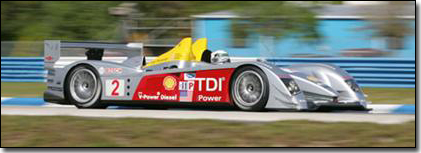
Not only does diesel reign supreme in efficiency when hauling loads down American highways and rails, but now looks to be able to dominate on American racetracks as well. (see “Backstretch Motorsports“)
The #02 Audi’s R10 TDI diesel ‘torqued’ to a top finish and a new track record yesterday at Sebring in Florida after the #01 Audi had to be retired after about 4 hours due to overheating. Tom Kristenssen, Allan NcNish and Rinaldo Capello won the Mobil 1 Twelve hour American LeMans style race by three laps besting teams from Intersport Racing, Aston Martin Racing, Corvette Racing and Penske Racing even after starting the race from 34th position.
This is reportedly the first time an oil-burner has claimed victory in a major American auto race. (see previous post on the Audi R10)
Category: Uncategorized |
No Comments »
Tags:
Posted By RichC on March 18, 2006

I’m an Engadget fan and a Treo cell phone admirer, but when Kirk Sutherland submitted his entry for his working Birthday Cake Treo 650 there was little competition. Nice job Kirk!
This past month the ‘gadget’ reporting website Engadget decided to give away presents for their 2nd birthday. Toward the end of the daily giveaways, they decided on a grand prize for the best ‘gadget’ oriented birthday cake. There were several terrific entries, but Kirk’s “took the cake,” don’t you agree?
Engadget’s Winning Birthday Cake
Category: Cellphone, Computer, Misc, Technology, Video |
No Comments »
Tags: birthday, engadget, palm, treo, video
Posted By RichC on March 17, 2006

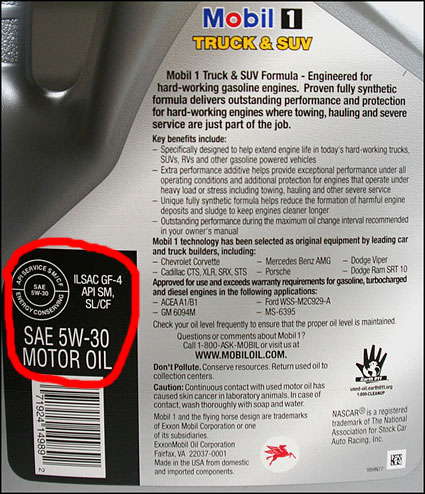
I took advantage of warm oil after a long drive tonight to do an oil extraction (change) in my Volkswagen Jetta TDI tonight. I thought I would included a photo of a couple of appropriate filters with the plastic oil dam inside since I happened to have both the OEM VW brand (from the dealership) and a Mahle brand from Jon Hamilton’s shop (RallyVW).
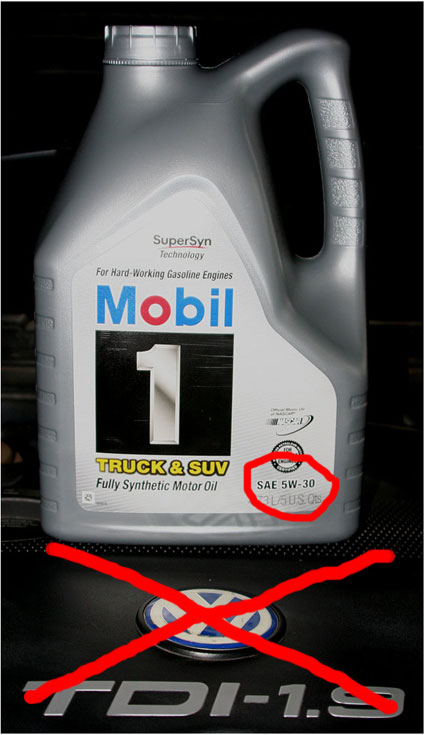
Unfortunately the oil that I’ve been using (see TDIClub Forums thread with photos) is not package as it usually is in my local Walmart. It seems that the repackaged diesel rated Mobil Delvac 1 oil for retail is being renamed from Mobil 1 Truck and SUV 5W40 oil to Mobil 1 Turbo Diesel Truck 5W40.
The 5W40 diesel motor oil is still available and will meet the API CI-4Plus requirement. It has been renamed to Mobil1 Turbo Diesel Truck 5W40 and all the same stores that carried the former product will have availability.
-Matt / Mobiloil Customer Service
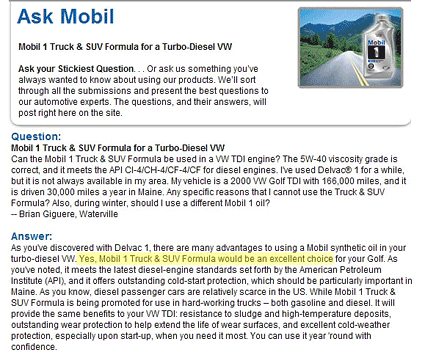
Unfortunately for me, I assumed seeing Mobil 1 Truck and SUV on the shelve was okay and didn’t realized that the oil was now different than in the past. The techs behind the service counter at the Walmart Auto Center were clueless … no surprise. After figuring out my error, I returned the wrong oil and asked when they would be stocking the new Mobil 1 Turbo Diesel Truck oil? They didn’t even see it in their system or know what I was talking about … note the above Mobiloil web site FAQ … its not update or showing the correct product either.
Lesson learned … read the label and pay attention to what you are buying; thankfully I caught things before draining my oil. (speaking of draining … have you tried a Pela ‘oil extraction?’)
Category: Automotive, Diesel, Volkswagen |
No Comments »
Tags: filter, oil, tdi, volkswagen
Posted By RichC on March 16, 2006
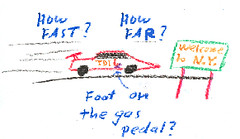 A fellow Volkwagen TDI driver emailed me a question about my fuel mileage, and in particular if I “noticed a change in MPG when I switched to the Sprint 520s? What about smoke?” He’s talking about the fuel injectors that I originally put in my Volkswagen Jetta TDI to increase performance.
I answered basically “No” and “No” to just the mild Sprint 520 or PP520 injectors. No noticable drop in fuel economy or increase in smoke …. even without adjusting the IQ (Injection Quantity) with the VAGcom interface and software.
My theory goes like this … if the fuel you add to the cylinder gets complete combustion (equal btu’s), the engine in your car (m) will provide an equal amount of work (W) sending you down the road with the same velocity (v). (v = speed with direction)

Of course there are a few other variables but I’m assuming you drive you car exactly the same …. equal acceleration and speeds. (hard to do when you have new found power!)
 Its when you change your driving habits (because you will with more ‘available’ power) that is you’ll notice a drop in your fuel mileage OR if you install overly large injectors that spray excessive fuel into the cylinders … noted by black smoke (incomplete combustion wasting fuel). Even with a chipped car, if done correctly, and the fuel and air balance is kept appropriate, the mileage will not drop, trusting you drive conservatively. I do notice that my mileage has drop just a little but then that’s because 1) I use the extra power too often, and 2) I ‘foolishly’ opted for even more aggressive injectors than the Sprints or PP520s and have a Rocketchip Euro III setup at a recent RallyVW Tuning session. My new setup over-fuels considerably anywhere past half throttle and the only way I see to correct this is to add more boost. (bigger turbo: VNT 17, 20 or 22) I can eliminate smoke by running biodiesel at near B100, but still am overfueling under hard acceleration and wasting fuel.
I still manage 46-47mpg on the highway at 75mph so long as I don’t drive aggressive … otherwise I’m going to be in the low 40s. But once you drive a TDI with more power there is no going back … the ‘torque pull’ is addictive. I maintain a pretty accurate lifetime cost of ownership … on a spreadsheet if you care to check it out.
Category: Volkswagen |
No Comments »
Tags: diesel, tdi, volkswagen
Posted By RichC on March 15, 2006

What’s wrong with this Mercedes Benz marketing video? (click here to view) Maybe its just me, but I’m not sure this was the best dressed choice for the national marketing of the brand new Mercedes Benz GL-class vehicle.
For as much as Mercedes Benz spends on marketing and developing a premium corporate image, I felt this clip was a little ‘too comfortable’ and could have used some ‘tailoring,’ in more ways than one. 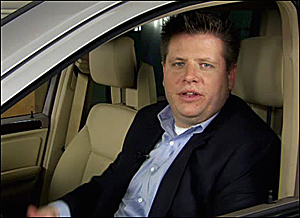 Perhaps a little more professionalism in both clothing and personnel selection would have made a big difference? I’m sure Rob Mueller is a bright guy, but when I see his white tee-shirt proudly displayed where his tie should have been, that just doesn’t fit with a brand new beautiful GL-Class Mercedes.
Other than the video walk-around, I look forward to test driving the GL450 when it arrives at my local dealer … especially when the diesel option arrives. (I don’t even want to think about what they’ll be asking for that.) What do you think? Was the portly, less than exquisitely tailored product manager the right choice for this product introduction and walk-around?
Category: Automotive, Mercedes |
2 Comments »
Tags:
Posted By RichC on March 14, 2006
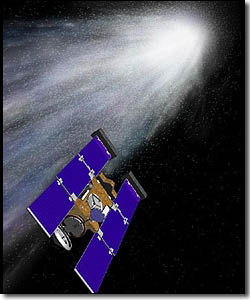
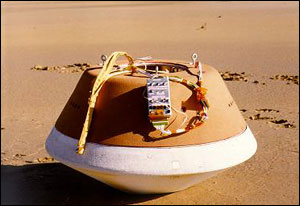 NASA’s Stardust space capsule returned to earth on January 15, 2006, after investigating the Comet Wild 2. It captured particles of dust from the comets tail in a special strong but lightweight gel. Most of us were taught that comets were ice, dust and gas, but scientists gathered at the Johnson Space Center in Houston discovered minerals formed by intense heat as well, which suggests to them that our comets may originally come from close to the sun.
 The comet ‘Wild 2’ is about 3 miles wide and passes nearest the earth while in its orbit closest to Mars. Its eliptical path then sends it zipping well out into our solar system before bringing it back around the sun again. When we visually see the comet, it is a bright streaking lump followed by a long gaseous tail that grows as it nears the sun and shrinks as it heads back off into space. Comets can have tails as long as 62 million miles, although Wild 2 is much smaller. They travel at speeds faster than a bullet travels, making intersection for Stardust, the space capsule, a critical calculation. The spacecraft had to travel at 13,000 mph to pass within 160 miles of the core of the comet which is traveling at 10,000 mph.
 As far as comets go, Wild 2 ellipse around the sun is shorter than most. It will be back again in 6.39 years unlike the famous Haleys comet which return every 100 years. Although the age of comet dust is debated, many believe that the dust is from 4.5 billion years ago and that comets may have delivered the water that led to life on Earth. Another interesting component in comets is that they are loaded with carbon, an element essential to life.
 Scientists chose to send Stardust to ‘Wild ‘ primarily because it has just recently entered an orbit that takes it close to the sun, which they indicate ‘bakes’ the surface of comets. Wild 2 is believed to have more of its material perserved because of this and therefore the dust more apt to offer better material in which to study. In 1974 Wild 2 neared the large mass of Jupiter which swung the comet through gravitational pull on a course taking it closer to the sun according to calculations, since it wasn’t actually discovered until 1978.
(Wild 2 was named for Paul Wild, a Swiss astronomer who first spotted the comet in January 1978.)
Category: Space |
No Comments »
Tags:
Posted By RichC on March 13, 2006
 The EAA284 chapter meeting was at Red Stewart Airfield yesterday, March 12th, after a drenching evening of rain, which continues today. The grass strip was absolutely soaked yet a T-craft and Cub successfully ‘rutted’ down the runway and sprayed their way into the air. (from the care of the runway perspective, I didn’t think it was such a good idea) Our time was well spent and the comradery enjoyable. Before the meeting, everyone had a chance to socialize a few minutes outside and meet the new airport guard dog. Perhaps she has some growing up to do?
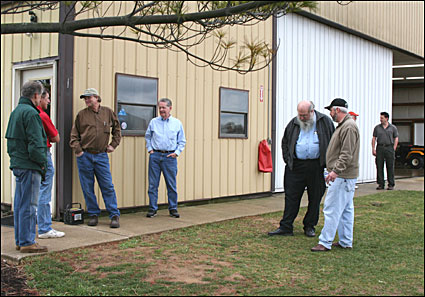 Our March meeting brought out a couple new faces, and although I didn’t get a chance to talk much to them, I’d like to welcome them to our chapter just the same. Ralph Wirth from Wirth Advertising and Marketing was our speaker and he gave an excellent presentation on vinyl graphics. Most of us doing any airplane building or restoration could see application (pun intended) for this kind of full color computer aided graphics on vinyl. As the assembly comes to completion one could really finish a project well using some of Ralph’s talents.
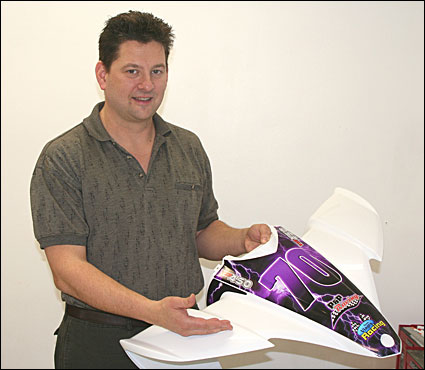
I enjoyed listening to Ralph Wirth openly discuss the changes in technology that enable such high quality imaging on vinyl; something that wasn’t even possible at any dollar amount a few years ago. His knowledge of the industry and investment in equipment is a good resource for our chapter and its members. Ralph can be reached at Wirth Advertising and Marketing, 1237 Cincinnati Ave., Xenia, Ohio 45385. (for an example of his work, see previous post for a photo of his VW Golf TDI)
Category: Aviation |
No Comments »
Tags: eaa284, flying, red stewart
Posted By RichC on March 11, 2006
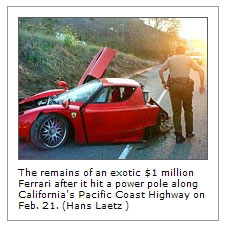 I’m sure by now everyone has heard the story about the Ferrari Enzo that crashed along the Pacific Coast Highway in late February, but thought I would include a rather amusing video clip of a European Ferrari crash at the end of this post.
The story that was told by the ‘alleged’ passenger and car owner, Stefan Erikson, is intriging. According to Mr. Erikson, ‘Dietrich’ [no last name] was the driver who ran from the scene and excaped into the Malibu California hills. (yeah right) Who is this crazy ‘Dietrich’ and was he really racing a 626 HP Mercedes SLR at an estimated 160+ mph?
It seems that investigators doubt both the race and Dietrich. Sgt. Philip Brooks of the Los Angeles County Sheriff’s Department was quote that they believe that Dietrich “no longer exists and that the Ferrari was racing by itself and there were no Mercedes.” Another clue is that only the driver’s side air bag had blood on it and Stefan Eriksson suffered a cut lip in the crash so DNA matching should assist in determining if Stefan Erikson was behind the wheel or not. This could twist this story one more time since Eriksson’s blood-alcohol level after the crash was .09, slightly more than the legal .08 limit. If you ask me, Mr. Eriksson should just be thankful to be alive.
Crackin’ up a Ferrari
Category: Misc |
No Comments »
Tags: