Posted By RichC on July 27, 2017
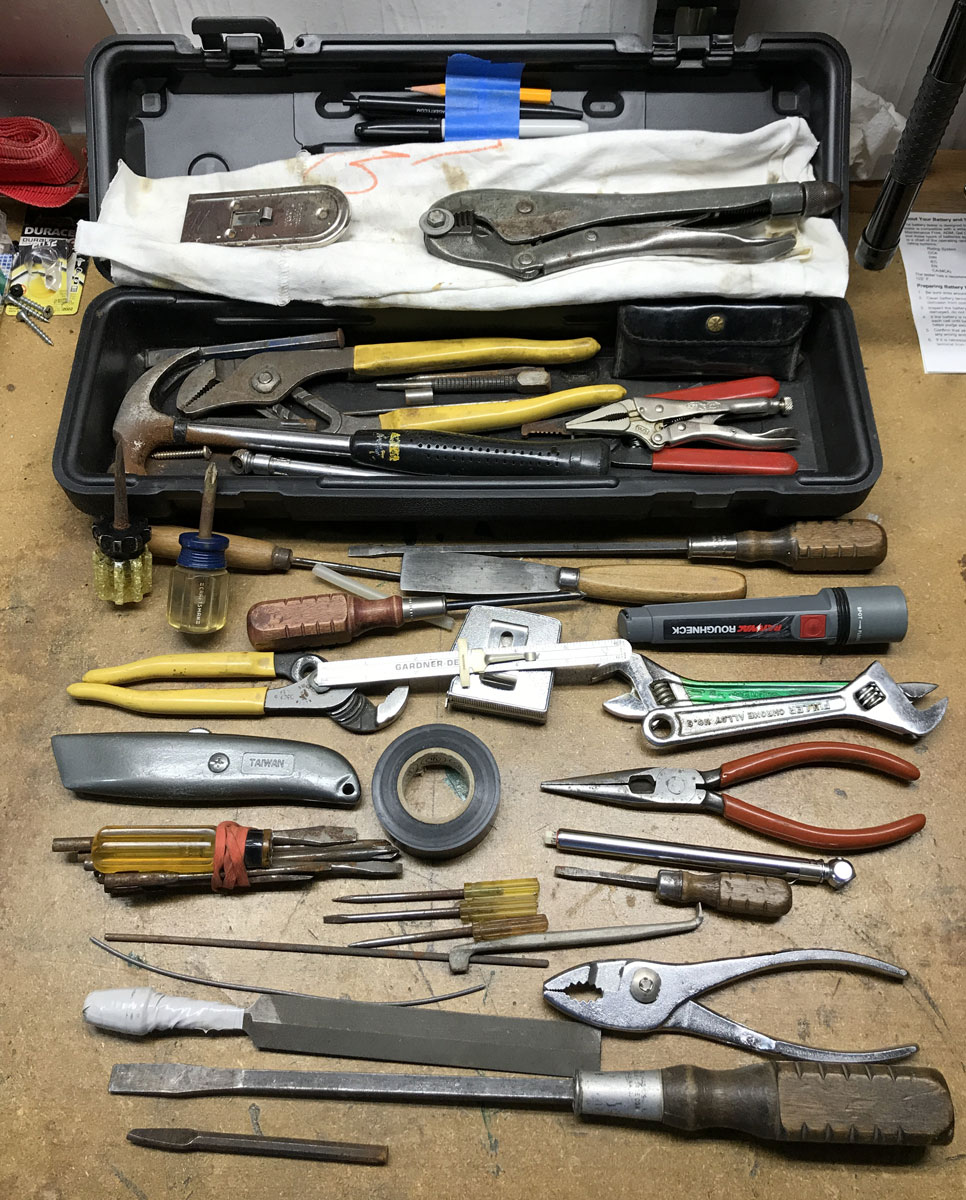
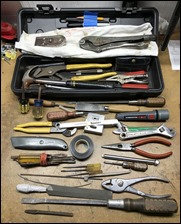 Hagerty (the classic car company) posted an article talking about essential tools to keep in your car that I wanted to archive. I’ve always kept tools in my car along with odds and ends and even fluids like antifreeze, oil and brake fluid. The problem I face is keeping the correct tool in the right box for the too many cars "in my fleet," as my son-in-law calls it.

I’ve hodgepodged together a couple toolboxes that fit in wheel well, spare tire well or under seats of each car, but most satisfied with a plastic toolbox from my dad which seems to hold just the right combination of screwdrivers, wrenches, etc … of course I’m always missing something.
Here’s the suggestion from Rob Siegel at Hagerty:
About a year ago, I bought a medium-sized plastic toolbox and filled it with a few redundant tools, the intent being to create a “go-to” toolbox that can be easily thrown into the trunk of whichever vintage car I’m about to drive. Now, there are limits to this. If I’m driving a car to an event a thousand miles away, I’ll always bring a lot more. But many of my needs involve 100-mile trips, as I keep four cars in a storage area 50 miles from my house. The go-to toolbox contains:
- A set of the most commonly-used box-end wrenches. As I said, for a vintage BMW, these are 8-, 10-, 13-, 17-, and 19-mm. I have spare sets of the Heyco wrenches that originally came with the cars, so those are the ones I throw into go-to toolbox. I make sure that I have two of the 10s and two of the 13s, as that’s what’s needed to easily loosen or tighten the distributor and the fan belt adjustment bolt on the alternator. And speaking of the fan belt, I recently drove one of the vintage cars while taking my wife to dinner, and the fan belt began slipping just a few miles after leaving the house. Thanks to the wrenches, I was able to fix it right then and there instead of squealing all the way home and taking a different car.
- Ratchets and sockets, both big and small. That is, I bring a 1/8-inch ratchet handle and a set of 1/8-inch metric sockets from 6 to 13 mm, and a 1/2-inch ratchet handle and 1/2-inch sockets from 10 to 22 mm. With these I find that I don’t need the more standard 1/4-inch sockets (although experience has taught me that if I have only the 1/4-inch set, I often want something larger or smaller). A single medium-length extension for each is usually adequate for quick jaunts.
- A slotted screwdriver and Phillips screwdriver.
- Regular pliers and needle-nosed pliers (vise grips are best).
- A battery terminal cleaner. With all the swapping of cars in and out of storage, and swapping batteries in and out of cars, this is a must-have item. Corrosion forms on the inside surfaces of the battery cable connectors, and if it isn’t cleaned off you can tighten down the terminals on the battery posts until the bolts practically strip, and still hear nothing but the dreaded “click” when you turn the key.
- A multimeter. One of those $5.99 specials is more than adequate to check battery voltage and verify that the alternator and regulator are charging the battery.
An inexpensive electrical kit with a crimping tool and an assortment of butt splices and spade connectors. For real electrical work, I prefer using higher-quality connectors, but this is a great item to have in a travel toolbox.
- A pair of wire cutters, since the wire cutters on crimping tools always stink.
- A pair of 6-foot lengths of 14-gauge wire, each with a battery charger-sized alligator clip on one end that can bite onto the battery terminal, so I can wire things directly to the battery (if needed).
- A 20-foot, 14-gauge lamp cord (two-conductor wire) than can be cut and spliced as needed.
- An inexpensive set of metric nuts and bolts. The number of times I wind up digging for one is surprising, even if it’s only to re-attach the front license plate to a car that’s been sitting in storage and has an expired inspection sticker (in Massachusetts, the front plate needs to be attached for a car to pass inspection).
- A pack of zip ties.
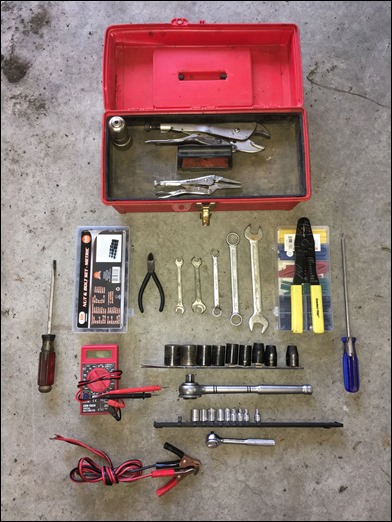
Contents of my throw-it-in-the-trunk tool box
When I swap cars in one of the storage spaces, I bring the tool box, plus either a set of jumper cables or a battery jump pack, and a cigarette-lighter-powered air compressor to inflate tires. It’s proven to be a winning combination.
For longer trips, I want to be prepared for mechanical problems far from home, so the tool volume and weight increases substantially. First, there’s the aluminum floor jack and aluminum jack stands. Even though these days I’m perfectly happy to call Hagerty Plus Roadside Assistance to change a flat on the interstate (I no longer have the stomach to crawl under a car while traffic whizzes by at 75 mph), the idea of traveling 1,000 miles without being able to jack up the car drives me crazy. So they come too.
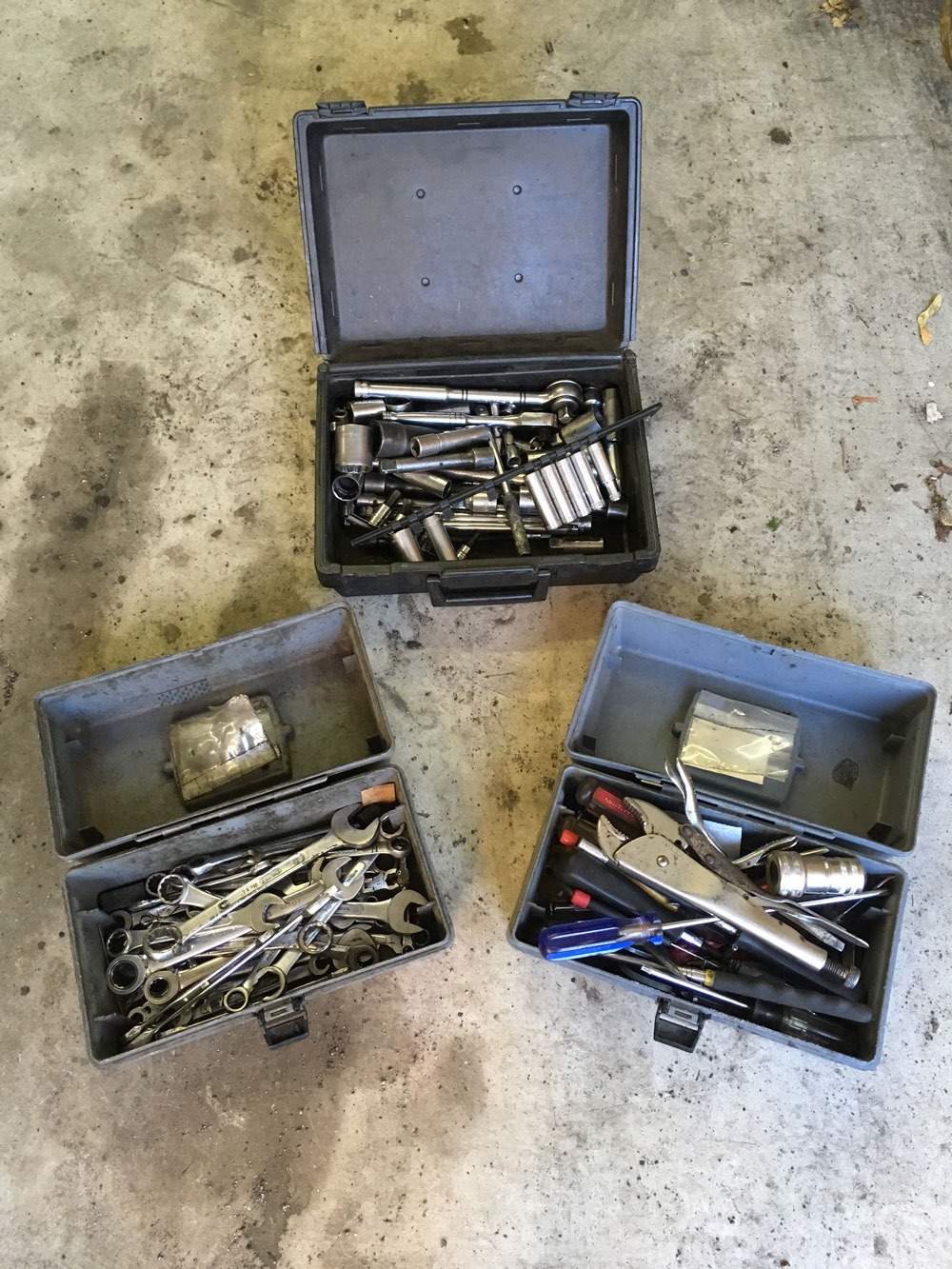
In my garage, I have the requisite big-ass, multi-level, multi-draw tool chest, but over time I’ve set up three small tool boxes: one with commonly-used wrenches; one with most of the ratchet handles, sockets, Allen key sockets, extensions, and universals; and a third with everything else—all the screwdrivers, pliers, picks, telescoping magnetic pick-ups, circlip pliers, files, flexible nut drivers (that are the bee’s knees to use on hose clamps), and more. I’ve basically given up on configuring a compact minimal set of tools for a big road trip, and instead simply throw these three toolboxes into the trunk.
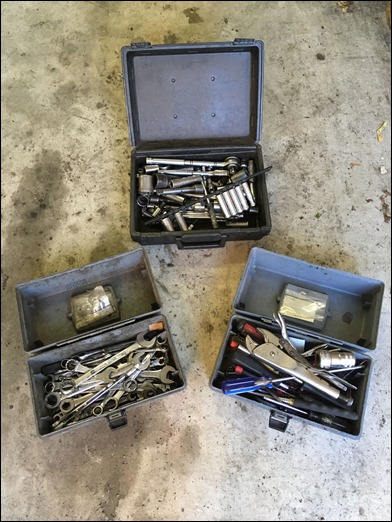
The three small toolboxes containing most of my tools that I take on longer trips
In addition, there are a few things too big to fit in a tool box, such as the breaker bar, the pipe extension for the breaker bar, the BFS (big freaking screwdriver), and the BFPs (big freaking pliers). Depending on my mood, I may or may not bring a 1/2-inch torque wrench. I always imagine having to change a head gasket on the road—although these days most of the head gaskets I’ve used call for angle-torqueing the head bolts, and while I do have the angle-torque jig, bringing it on a road trip strikes me as crossing some invisible line of sanity and rationality.
Of course, for a long trip, I’ll also take a timing light, dwell tach, fuel pressure gauge, and an old Heathkit portable exhaust gas analyzer. They have all been used on the road.
Even with all those tools, it is axiomatic that anything you don’t take, you’ll need, and anything you take, you won’t. Case in point: when I took a 1,000-mile trip to rescue Louie, the decade-dead 1972 BMW 2002tii that I bought in Louisville, I brought a roll of copper-nickel brake-line tubing and a flaring tool, and did not need to use it. Conversely, I did not bring a hacksaw or Dremel tool, and wished to high heaven that I had.
So there you go. Run out and buy some milk on Sunday morning. Bring two 13-mm wrenches for the fan belt and you’ll probably be fine. Unless the milk is two states over. Then I’d pack the brake flaring tool.
LINK
Category: Advice, Archive, Automotive, Tools, Travel |
No Comments »
Tags: car, hagarty, toolbox, tools, trunk











 Roto-Rooter’s