An excellent Civil War history lesson #video
Posted By RichC on August 27, 2017
Posted By RichC on August 27, 2017
Posted By RichC on August 26, 2017

A month or so ago I blogged that the small little chameleons that ran around the condo in Delray Beach, Florida have grown up and "moved next door" … BUT thankfully they are not the ones this homeowner in Australia deals with! Yikes!

Photo (above) from July 2017 at the Delray Beach, Florida condo — new residence this year!
Posted By RichC on August 25, 2017
 While listening to the early comments from the technology pages and news programs regarding Samsung (Galaxy Note 8) and Apple (iPhone 8 – ???)releasing their new smartphone models, I realized there are features I haven’t used much.
One of the camera upgrades coming to the new Samsung Note 8 phone is a portrait mode like my current Apple iPhone7 Plus. I’m including a "portrait mode" photo … although an attempt without a human model — just an insect. The blurred background is a selective focus feature those of us who enjoy "real photography" as a hobby have used for years. The technique is to use a longer lens, faster shutter and lower f-stop (open aperture). It is a great feature to put on smartphone IF users remember to use it. 
Posted By RichC on August 24, 2017
This content is restricted.
Posted By RichC on August 23, 2017

Posted By RichC on August 22, 2017

For the good photos check in with NASA (above) or a professional photographer who travels to the optimal locations and spends more than 5 minutes taping a welding filter to his camera … for a less than perfect “time-lapse” solar eclipse attempt, check my photos below. It was at least fun to mark the occasion; maybe I’ll give it another try in 2024?
Sun and moon eclipse photos aside, the real treat was a NASA photographer catching the International Space Station passing in front of the sun while in partial eclipse (below) … how cool is that?

Posted By RichC on August 21, 2017
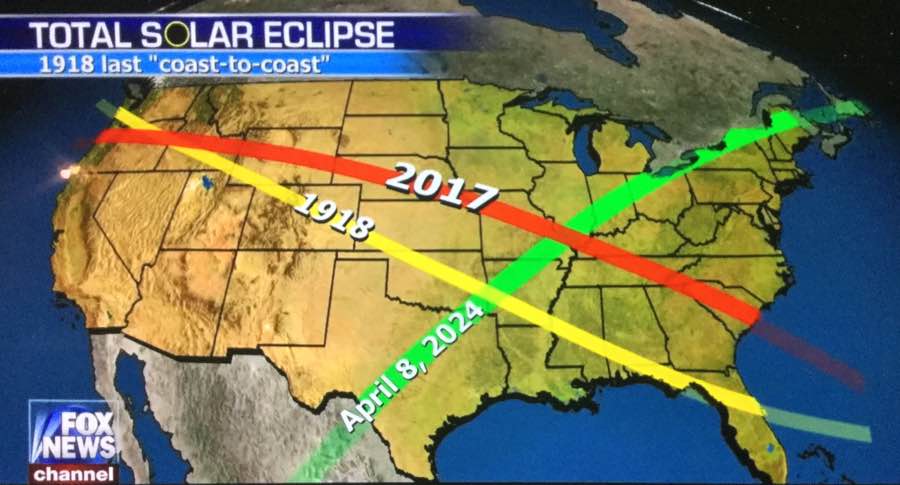
 The last time our continent had a total solar eclipse was 1991 and so getting a chance to view 2017’s is a rare opportunity. Not everybody will be traveling to the “belted area” across the country, but most will have a chance to see a partial eclipse.
According to NASA, “an estimated 500 million people will be able to observe the August 21, 2017 total solar eclipse, in partial or total form: 391 million in the U.S., 35 million in Canada, and 119 million in Mexico (plus Central America and parts of South America and northwestern Europe).”
For those of us in and around Cincinnati, but still on Eastern Standard Time, get ready to check out the sky in the mid-afternoon. Below is the NASA map projecting the Total Solar Eclipse as it passes from west to east — NOTE: Bowling Green KY and Nashville TN along I-65 look like pretty good spots.

If you end up with cloud cover or miss the opportunity to view, there is another total eclipse opportunity in the U.S. in 2024 depending on where you live.
Posted By RichC on August 20, 2017
This content is restricted.
Posted By RichC on August 20, 2017
Snipped parts and archived a TDAmeritrade educational article …
Americans used to count on a pension plus Social Security to get them through those “golden years.” These days, people change jobs more often, rely on dual incomes, and manage their own retirement funds through defined contribution plans. By most estimates, you’ll need between 60% and 100% of your final working years’ income to maintain your lifestyle after retiring.
Saving Is the Key Component of Retirement Income
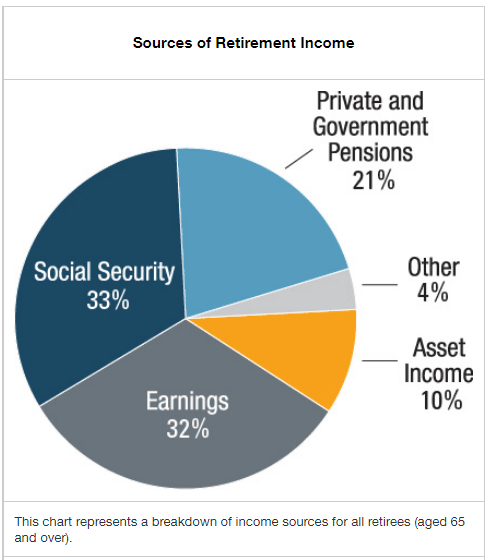
The accompanying pie chart shows the importance of saving now toward a retirement fund. Not only are Social Security benefits less significant, but also the sums are diminishing and the age at which you can begin to receive benefits is higher.
You can contact Social Security at 1-800-772-1213 to learn what you can expect in benefits and when to expect them. Benefits are calculated on your earnings, with certain variable factors.
Alas, the responsibility for the bulk of your nest egg rests with you. Social Security represents approximately 33% of the aggregate income of Americans aged 65 and older, according to the Social Security Administration.
Also, as you begin thinking about how much you’ll need for a comfortable retirement, you may be startled to learn the impact of inflation. At an average inflation rate of 3%, your cost of living would double in 24 years. Your annual income will need to increase each year even during retirement in order to keep up with the gradual rise in prices of everyday goods.
You’ll also have to consider the likelihood of increased medical costs and health insurance as you grow older. The median nursing home cost for a private room, for instance, now runs more than $92,000 a year and could rise to almost $140,000 per year by 2030, assuming an annual inflation rate of 3%.1
Meeting Your Goals
Now that you have an idea how much you’ll need to finance your retirement years, of which there can easily be 25 or more, you may better understand the urgency to build your assets.
How Much Do You Need to Retire in Style?
Financial experts estimate that most of us will need about 60%
to 100% of our annual preretirement income to live on each year
after we retire. Find out how close you are to meeting this goal by completing the exercise below.
- Estimate your last working year’s salary. Multiply your current
salary by the inflation factor from the table below, based on the
number of years you have until retirement. This represents the
future value of your salary, assuming 3% annual inflation.Example: If you are currently making
$40,000 and have 20 years until retirement, your formula is $40,000
x 1.81 = $72,400- Determine what percentage of your current income you expect to
need after retirement. If 100% seems high, consider that while you
may be able to stop paying some expenses, like mortgage payments,
other expenses will likely increase, such as health and travel
expenses. Multiply that percentage by the amount in #1.Example: $72,400 x .80 = $57,920
- Estimate your future Social Security and retirement benefits.
The best source for Social Security benefit projections is the
Retirement Estimator at www.ssa.gov/retire/estimator.html. (If you
cannot readily access the official calculator, you can also get a
very rough estimate of your benefit from Table 2 below.)
- If you are using the calculator, multiply the monthly amount
listed next to “at full retirement age” by 12, then multiply that
figure by the inflation factor from Table 1 below.Example: If the calculator shows an
estimated monthly benefit of $1,153, your formula is $1,153 x 12 x
1.81 = $25,043- If you are using Table 2, take the number corresponding to your
annual salary and years to retirement.Example: If you currently earn
$40,000 and have 20 years to retirement, your estimated benefit
would be $25,000- Subtract your Social Security benefits and other retirement
benefits from the annual amount calculated in #1. This will give
you an estimate of how much of your own savings you will have to
use each year in retirement.Example: $57,920 – $25,000 =
$32,920- Estimate the total amount that you will have to put aside in
retirement accounts, such as 401(k) plans, individual retirement
accounts (IRAs), and personal savings accounts. To determine how
much you will need to save, multiply 19.3 by the annual amount you
calculated in #3. This multiplier represents how much savings you
would need to last 28 years at 3% inflation and earning a 6% annual
return. A healthy, 65-year-old male has a 10% chance of living
longer than 28 years.Example: $32,920 x 19.3 =
$635,356- Enter the amount of your current savings and investments and
multiply it by the growth factor from the accompanying table. This
is what your savings would be worth by the time you reach
retirement, assuming an 8% return compounded annually.Example: $30,000 x 4.66 =
$139,800- If line 5 is larger than line 4, congratulations! You are on
your way to meeting your retirement goal. Keep saving! If line 4 is
larger than line 5, subtract line 5 from line 4. Enter that amount
here. This is the additional amount you’ll need.Example: $635,356 – $139,800 =
$495,556- Divide #6 by the multiplier in the table below for the number
of years until your retirement. The multiplier represents how large
your savings will grow based on your annual contribution, assuming
an 8% annual return. The result is the approximate amount you may
want to set aside each year.Example: $495,556 ÷ 49.42 =
$10,027
Table 1 — Factors* |
|||
| Years | Inflation | Growth | Multiplier |
| 5 | 1.16 | 1.47 | 6.34 |
| 10 | 1.34 | 2.16 | 15.65 |
| 15 | 1.56 | 3.17 | 29.32 |
| 20 | 1.81 | 4.66 | 49.42 |
| 25 | 2.09 | 6.85 | 78.95 |
| 30 | 2.43 | 10.06 | 122.35 |
| 35 | 2.81 | 14.79 | 186.10 |
| 40 | 3.26 | 21.72 | 279.78 |
Table 2 — Social Security Income |
||||||||
| Years to Retirement | ||||||||
| Current Salary | 40 | 35 | 30 | 25 | 20 | 15 | 10 | 5 |
| $20,000 | 29,500 | 27,000 | 25,000 | 22,500 | 20,500 | 19,000 | 17,500 | 16,000 |
| 30,000 | 32,500 | 30,000 | 27,500 | 25,000 | 22,500 | 21,000 | 19,000 | 17,500 |
| 40,000 | 35,500 | 32,500 | 30,000 | 27,000 | 25,000 | 23,000 | 21,000 | 19,000 |
| 50,000 | 38,500 | 35,500 | 32,500 | 29,500 | 27,000 | 25,000 | 22,500 | 21,000 |
| 60,000 | 41,500 | 38,000 | 35,000 | 32,000 | 29,000 | 26,500 | 24,500 | 22,500 |
| 70,000 | 44,500 | 41,000 | 37,500 | 34,000 | 31,000 | 28,500 | 26,000 | 24,000 |
| 80,000 | 47,500 | 43,500 | 40,000 | 36,500 | 33,500 | 30,500 | 28,000 | 25,500 |
| 90,000 | 50,500 | 46,500 | 42,500 | 39,000 | 35,500 | 32,500 | 29,500 | 27,500 |
| 97,500 + | 53,000 | 48,500 | 44,500 | 40,500 | 37,000 | 34,000 | 31,000 | 28,500 |
| *Assumes 3% annual inflation and a 5% annual return. |
Pensions, Social Security, and Other Allies
Traditional pensions (private and government) are estimated to
supply about 21% of the aggregate income of today’s retirees, while
Social Security is estimated to supply 33%, although nearly two
thirds of retirees rely on Social Security for 50% or more of their
income, according to the Social Security Administration. Still,
you’ll probably fall far short of your goal. A radically reduced
standard of living for a quarter century or more is hardly the
stuff “golden age” dreams are made of.Fortunately, you have some allies. First is the power of
compounding, which takes advantage of time. Tax deferral is another
ally. Using investment vehicles such as 401(k) plans or IRAs, you
can put off paying taxes on your earnings until you are retired and
potentially in a lower tax bracket. Meanwhile, your contributions
may be pretax or tax deductible, helping reduce current tax
bills.For example, an investment of $10,000 would grow to more than
$100,000 after 30 years at an annual return of 8% if all the
returns were reinvested and the account grew tax deferred. As with
all hypotheticals, this example does not represent the performance
of any specific investment, and the earnings would be subject to
taxation upon withdrawal at then-current rates and subject to
penalties for early withdrawal.The more time you have until retirement, the more fortunate you
may be. Delaying just months, never mind years, can significantly
reduce your results. Consider this example: Jane begins investing
$100 a month in her employer-sponsored 401(k) plan when she’s 25.
Mark invests the same amount — beginning when he’s 35. Assuming a
7.5% annual rate of return compounded monthly, when Mark retires at
65, he’ll have $135,587. Jane will have $304,272.While this is only hypothetical and there are no guarantees any
investment will provide the same results, you can see the
remarkable difference starting early can potentially make.By starting early, investing systematically, and benefiting from
the potential of compounding and tax deferral, you may pack a lot
more punch into your portfolio.Another advantage of today’s retirement planning options is that
you can control how your money is invested.Investment plans need to be customized because different people
have different degrees of risk they will accept as well as varying
time frames they intend to hold their investments. Keep in mind,
all investments involve risk, including the possible loss of
principal. A tailor-made portfolio can be diversified to take these
factors into account. It’s a wise idea to consult a professional
financial advisor for complete information.
1Sources: Genworth 2016 Cost of Care Survey; DST Systems, Inc., 2016.
Posted By RichC on August 19, 2017
Although the news of late on the political front has been challenging (Trump Admin, Barcelona, Charlottesville, North Korea) the savvy investor/trader can use these moments to put the "risk capital" part of their portfolio to good use. Most who trade have plenty of horror stories where their trades have gone terribly wrong, but usually the good trades keep them attentive to logical decision-making and winning trades.

Last week I was in and out of Ford ($F) since I’ve been focusing on dividend stocks in recent years. The company have been beaten up for good reason, but the brand is strong and the future in a growing economy 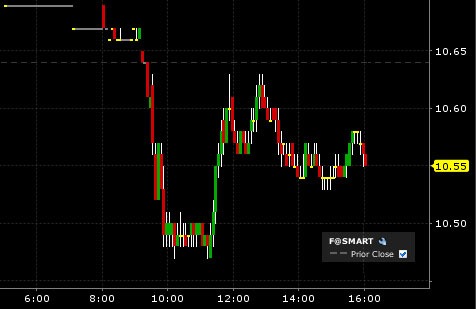 should be strong enough to keep above average dividends flowing. The question lives on is whether they can keep enough investors holding their declining stock? Personally I don’t mind holding a stock that has been beaten up so as long as the economy is strong and the company earning can pay the dividend … so picking up shares to hold, or to sell for a quick profit, makes for a logical trade.
Friday morning I added back the shares (at $10.50 this time) that I sold on Monday and will likely sell the extra shares again if $F quickly rebounds to $11 or beyond next week (I’m still holding long-term invested shares at a dollar-cost-average under $11 and expecting a better future for Ford … or waiting for something like the below).