Thinking about the world tread of Nationalism

Posted By on May 31, 2014

Gerald_F_Seib_78x78WSJRadio had a short segment with their Washington Bureau Chief Gerald Seibtalking about Nationalismand how it seems to be growing around the world. Usually Americans take pride in our national identity and “American Exceptionalism” … but taken too far history shows that this sentiment can be dangerous – think about the events which lead to World War II.

  WSJRadio with Gerald Seib on Nationalism (MP3)

Added 1100+ miles to the 32 year old Mercedes Benz 300D

Posted By on May 30, 2014

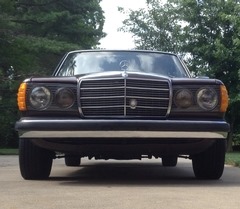
203222The weather was nice for driving this past week for a Memorial Day trip to Atlanta, so instead of taking the Honda Pilot, we opted to take the 1982 Mercedes Benz 300D Turbodiesel. I’ve been driving it regularly on trips to and from NE Ohio (500 miles rt) and to visit my daughter and her husband in300d Columbus (200 miles rt), but this was the first multi tank longer highway trip since driving to New York last year (1000 miles rt). I wasn’t overly concerned, just hesitant about a few aging items … no need to have been concerned as all was without incident.

As a “daily driver” the 300D isn’t the most comfortable of cars. Besides the lack of “off the line” acceleration, the car could really use an overdrive gear for highway cruising. I usually drive around 75mph and the 3300 RPMs is a little high for a 5-cylinder diesel which tends to be far more efficient at RPMs in the mid-2000s – quieter too. That aside, she didn’t miss a beat and offered that powerful sounding torquey growl when climbing through the mountains. I ran the AC much of the time and despite a nice cold stream of air, the seatbacks got sweaty due to the noticeable lack of insulation … particularly the door seals. (fixing the cruise control is still on my “to-do” list)

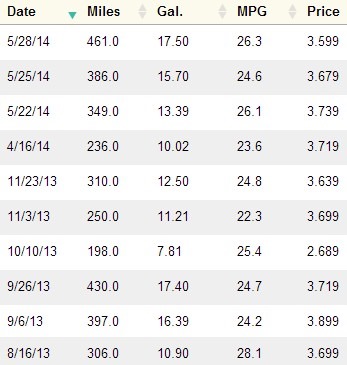
Diesel fuel prices were actually lower than gasoline this weekend which gave me another reason to take the Turbodiesel car; I even found $3.599 for diesel in Knoxville Tennessee just after logging 461 miles on the previous tank … still only 26.3 MPG. My only “stressful moment” was taking Brenda the 40 miles from her sister’s house, north of the traffic nightmare of a city, to the Atlanta Airport to catch a flight to Minneapolis during rush-hour … and then having to drive back though it again in order to head home to Cincinnati. Ugh!

fuellyfills_300D140526

AAA’s Top 10 Green Cars

Posted By on May 30, 2014

Q: What’s interesting about this list? A: Half are clean diesels!

1) 2013 Tesla S P85 (Electric)
2) 2012 Toyota RAV4 EV (Electric)
3) 2014 Audi A7 TDI Quattro (Clean Diesel)
4) 2013 Lexus GS 450h (Hybrid)
5) 2013 Nissan Leaf (Electric)
6) 2014 Honda Accord Hybrid (Hybrid)
7) 2014 Audi Q5 TDI Quattro Tiptronic (Clean Diesel)
8) 2014 Audi A8 L TDI Quattro Tiptronic (Clean Diesel)
9) 2014 Mercedes-Benz E250 BlueTEC (Clean Diesel)
10) 2014 Audi A6 TDI Quattro Tiptronic (Clean Diesel)

LINK

Global obesity rates for children are up 47% since 1980

Posted By on May 29, 2014

chinese_american

I notice short bit in the WSJ about He Liang and his “homemade suitcase vehicle in the streets of Changsha, China,” and about the only difference I can see is that the Chinese “scooter” is a little narrower when compared to our American-sized versions? (I would include a smiley below, but it is more shameful than humorous.)

It might make Americans feel a little bit better to know that we are not along in having an obese population:

More than half of the world’s obese are from just 10 countries: the United States, China, India, Russia, Brazil, Mexico, Egypt, Germany, Pakistan and Indonesia.

BUT … as with many statistics, we do a pretty good job in leading the world:

It is no surprise that the United States, whose eating habits and fast food chains have revolutionized the way much of the world now consumes, represented the biggest slice of the planet’s obese population – 13 percent – yet it has less than 5 percent of the world’s total population, which now tops 7 billion.

 LINK

Congratulations to Jessica on her high school graduation

Posted By on May 27, 2014

LambertHSGraduation140527

Brenda and I spent a few days with our niece (Brenda’s younger sister) and family in Atlanta, Georgia. What a great time to be with our family and celebrate Jessica’s high school graduation and time checking out the Georgia Tech and ducking cover from the heavy rains. What a great time with a great niece.

JessG_SarahJess140527 JessG_JessGmas140527
Sisters Sarah and Jessica  |   Gma Howard, Jess and Gma Gerber

JessG_AnnJess140527 JessGrad_JessBrenda140526 JessGrad_Jesscap140526
Ann and Jessica   |   Jess and Brenda   | Jessica and Sarah

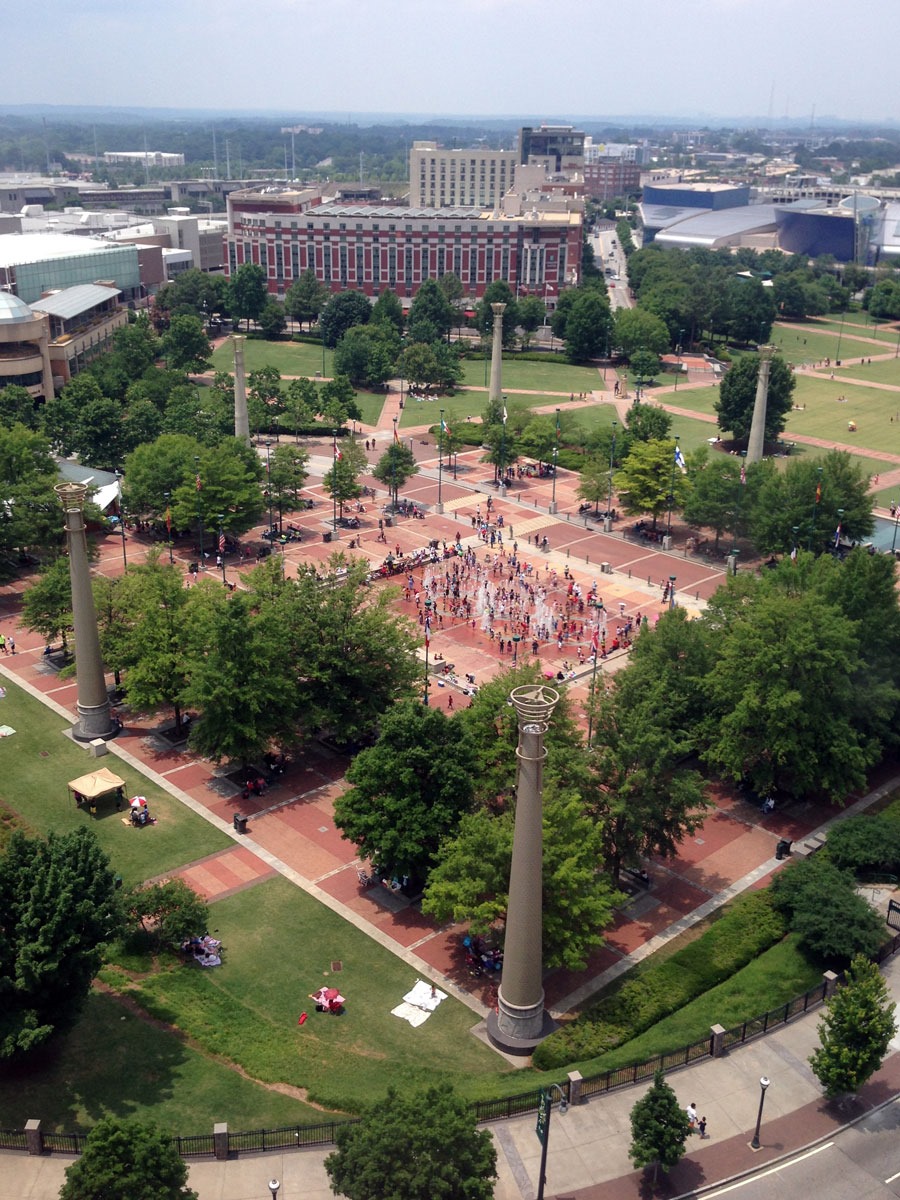
We spent a day downtown at Centennial Park.

JessGrad_CentenialPark14052 JessGrad_SarahPhotobombed14

JessGrad_Wheel1 JessGrad_CentenialWh140526

JessGrad_Atlanta140526

Reflecting on those we remember on Memorial Day

Posted By on May 26, 2014

Vets_tombofunknown_3199A few years ago I was a volunteer taking a group of “surviving” veterans on an Honor trip to Washington DC. It was indeed a privilege to be in their company.

Vets_KoreaMemorialField0063

One thing that was noticed by those of us who were there to serve as volunteers for these WWII and Korean War veterans was that, to the man, they were humbled when remembering those that didn’t return. This was particularly noticed when we were at Arlington National Cemetery realizing just how many brave Americans gave the ultimate sacrifice for our country.

arlingtoncem_modified

On this day, Memorial Day 2014, take a moment to remember those who fought and died for this nation … may they never be forgotten.

Books: Shadow Divers by Robert Kurson (2004)

Posted By on May 24, 2014

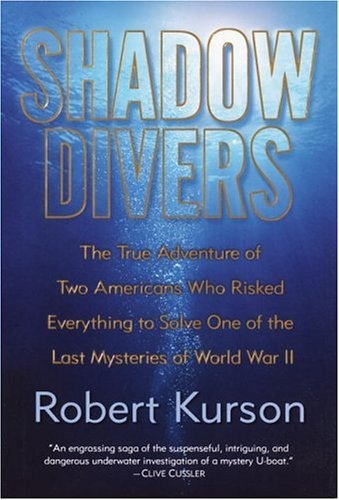
shadowdiversAfter seeing some book advice from a friend, I checked with Nooeo.com and downloaded a $5.00 ebook to my Kindle app on my iPad for an upcoming trip. Since Elizabeth Bernstein is also an avid reader, sailor and Scuba diver, her recommendations are usually spot on for me.  After reading the forward to Robert Kurson’s 2004 book Shadow Divers about a lost WWII German U-boat  off the coast of New Jersey, I was hooked.

The non-fictional story is written around a couple of polar opposite divers who learned to respect each other. Richie Kohlar and John Chatterton discovered an unknown World War II submarine eventually known as U-869. The dive team called the mysterious ship the “U-Who” until their research narrowed it down. The 1991 find spawned a 2000 PBS NOVA program called Hitler’s Lost Sub and a follow-up book challenging the facts presented in Shadow Divers

There is also a major motion picture in production based on the book, although the once 2013 release date has now been put on hold.  While waiting for what should be a blockbuster, check out the uploaded YouTube video narrated by John Chatterton.

Gas prices rise as Memorial Day kicks off summer driving season

Posted By on May 23, 2014

rbobgasoline140523I’m probably not the only one noticing the annual Memorial Day jump in retail gasoline prices kicking off the summer driving season. Yesterday most of the  stations locally (north of Cincinnati) bumped prices up to $3.85plus per gallon for regular grade fuel. Thankfully on the drive home, I fueled up the old Mercedes 300D for $3.73 per gallon – its first time I’ve seen diesel lower than gasoline for quite some time.

CincyGasPrices.comgasdieselprices45069_140523

It is time to test a homemade concoction for killing weeds

Posted By on May 22, 2014

homemade_weedbegonespray

Mixing up a batch to test on some fresh new growth and will report back. Have you tried this or any combination of homemade weed or vegetation killers similar to Round-Up or Weed-Be-Gone?

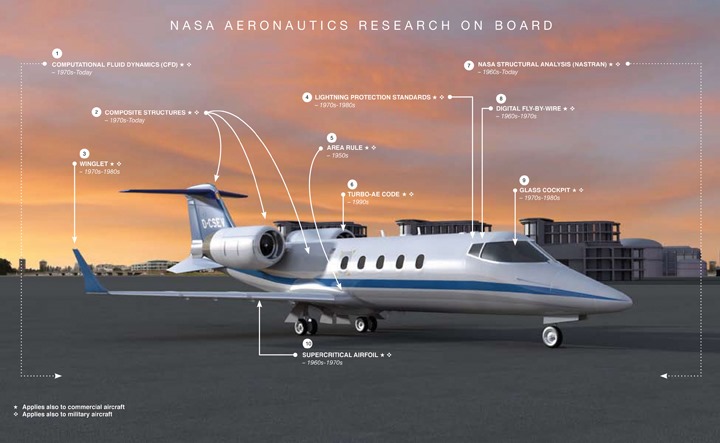
Ten aeronautical advancements thanks to NASA

Posted By on May 21, 2014

The Dryden Flight Research Center posted ten technology examples on their site that made a big impact on aviation. Most assume NASA has contributed to our science and engineering advancements, but the debate continues over the the high cost of the taxpayers through government funding the NASA research centers or if the private sector can achieve similar results more efficiently.

GenAviationlitho-1

1. Computational fluid dynamics – During the 1970s, NASA developed sophisticated computer codes that could accurately predict the flow of a fluid using complex simulations, such as air over an aircraft’s wing or fuel through a space shuttle’s main engine.
Those codes became computational fluid dynamics, or CFD, which today is considered a vital tool for the study of fluid dynamics. CFD greatly reduces the time required to test and manufacture nearly any type of aircraft.

2. Composite structures – NASA first partnered with private industry during the 1970s to conduct research on how to develop strong, nonmetallic materials that could replace heavier metals and aluminums on aircraft.
Composite materials have gradually replaced metallic materials on parts of an aircraft’s tail, wings, fuselage, engine cowlings, and landing gear doors. Using composite materials can reduce the overall weight of an aircraft and improve fuel efficiency.

3. Winglets – During the 1970s and 1980s, NASA studies led to the development of vertical endplates, or "winglets," that are now seen on many aircraft wings. This innovation is the first of three efforts on this list that were led by NASA Langley Research Center’s pioneering scientist Richard Whitcomb, who was chief of the Transonic Aerodynamics Branch at Langley in Hampton, Va.
Winglets reduce vortices and drag, thereby improving airflow and fuel efficiency. The first aircraft to adopt winglets were within the general aviation and business jet communities. In the mid-1980s, Boeing produced the 747-400 commercial jetliner, which used winglets to increase its range.
A winglet flight test program at the NASA Dryden Flight Research Center, Edwards, Calif., in 1979-80 first validated Whitcomb’s research when the test aircraft – a military version of the Boeing 707 jetliner – recorded an increased fuel mileage rate of 6.5 percent.

4. Lightning protection standards – During the 1970s and 1980s, NASA conducted extensive research and flight tests to identify the conditions that cause lightning strikes, the types of currents, and the levels of threat.
The research confirmed the data that were incorporated into design guidelines that are used in new aircraft and in flight operations to protect critical digital systems.

5. Area rule – In the 1950s, Whitcomb discovered one of the most revolutionary aeronautics technologies when he researched "area rule," a concept that helped aircraft designers avoid the disruption in airflow caused by the attachment of the wings to the fuselage.
Whitcomb deduced that removing the equivalent wing cross-sectional area from that of the fuselage cross-sectional area avoided the abrupt bump and improved the distribution of flow across the longitudinal area of the aircraft. By using the area rule, aircraft designers for decades have been able to allow aircraft to fly higher, faster, and farther.

6. Turbo AE code – During the 1990s, NASA developed a computer code that generates two-dimensional simulations of potential aeroelastic problems that can occur in jet engine blades. Such problems include flutter or fatigue that can eventually cause engine fan blades to stall or fail.
With TURBO-AE, engineers can more efficiently design thinner, lighter, faster rotating blades for today’s jet engines built for higher performance, lower emissions and lower noise.

7. NASA structural analysis (NASTRAN) – In the 1960s, NASA partnered with industry to develop a common generic software program that engineers could use to model and analyze different aerospace structures, including any kind of spacecraft or aircraft.
Today, NASTRAN is an industry-standard tool for computer-aided engineering of all types of structures.

8. Digital Fly-By-Wire – During the 1960s and 1970s, Dryden researchers developed and flight test the digital fly-by-wire system, which replaced heavier and less reliable hydraulics systems with a digital computer and electric wires to send signals from the pilot to the control surfaces of an aircraft.
The F-8 Digital Fly-By-Wire flight research project in 1972-73 validated the principal concepts of all-electric flight control systems now used on nearly all modern high-performance aircraft and on military and civilian transports. It was the forerunner of current fly-by-wire systems used in the space shuttles.

9. Glass cockpit – During the 1970s and 1980s, NASA created and tested the concept of an advanced cockpit display that would replace the growing number of dial and gauge instruments that were taking up space on an aircraft’s flight deck.
Called a "glass cockpit," the innovative approach uses flat panel digital displays to provide the flight deck crew with a more integrated, easily understood picture of the vehicle situation. Glass cockpits are in use on commercial, military, and general aviation aircraft, and on NASA’s space shuttle fleet.

10. Supercritical airfoil – During the 1960s and 1970s, Whitcomb led a team of researchers to develop and test a series of unique geometric shapes of airfoils, or wing designs, that could be applied to subsonic transport to improve lift and reduce drag.

LINK

Desultory - des-uhl-tawr-ee, -tohr-ee

  1. lacking in consistency, constancy, or visible order, disconnected; fitful: desultory conversation.
  2. digressing from or unconnected with the main subject; random: a desultory remark.
My Desultory Blog