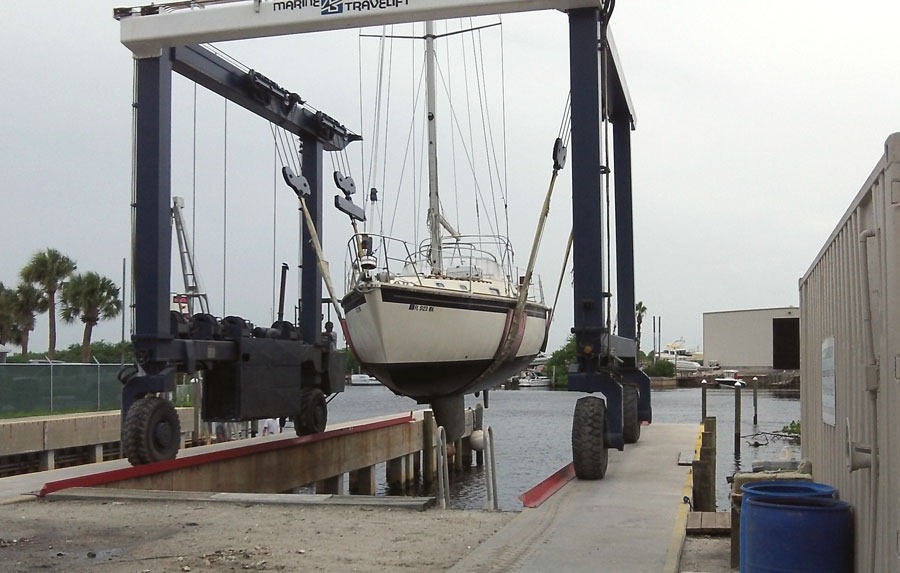
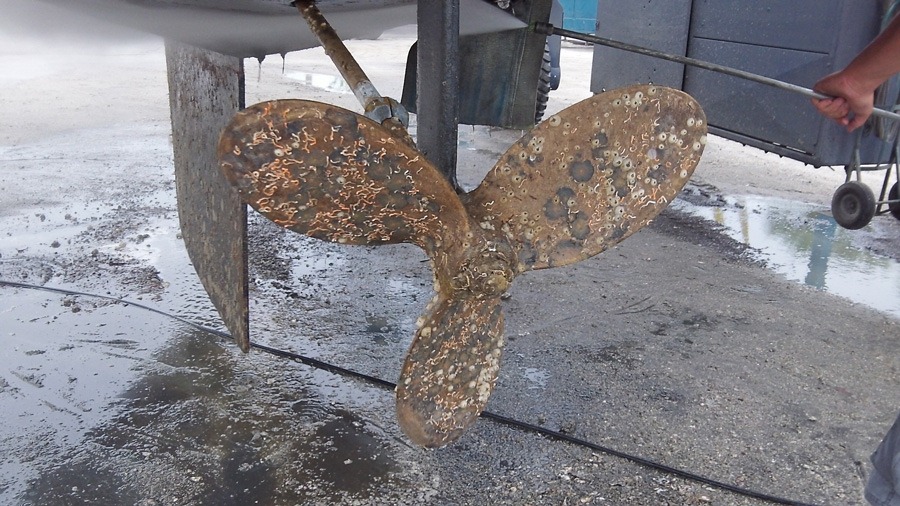
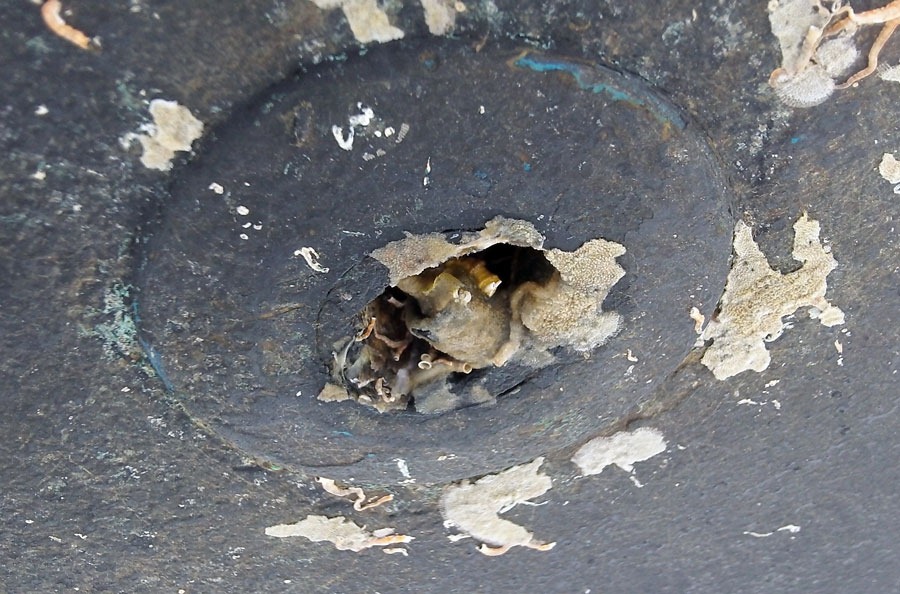
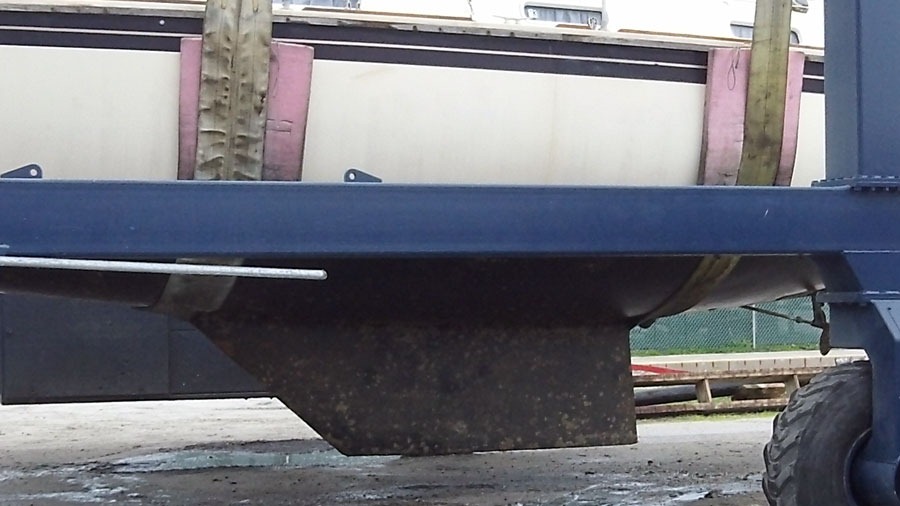
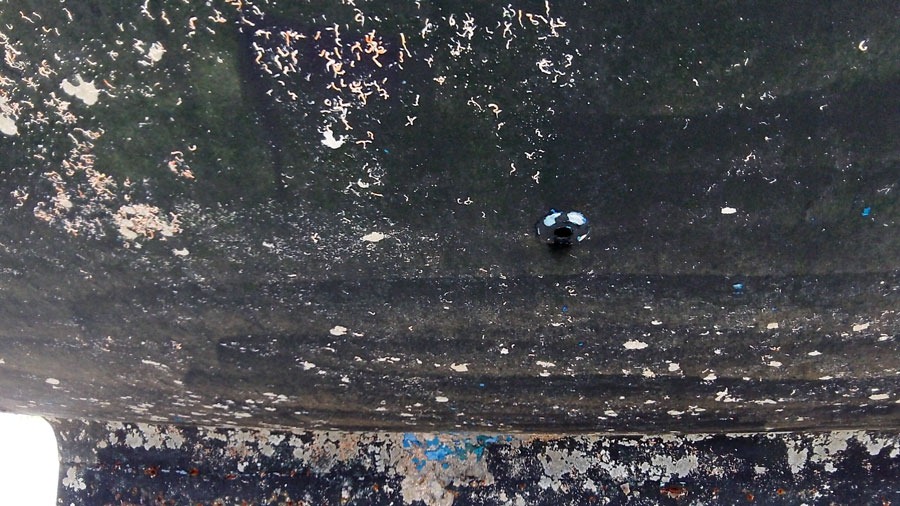
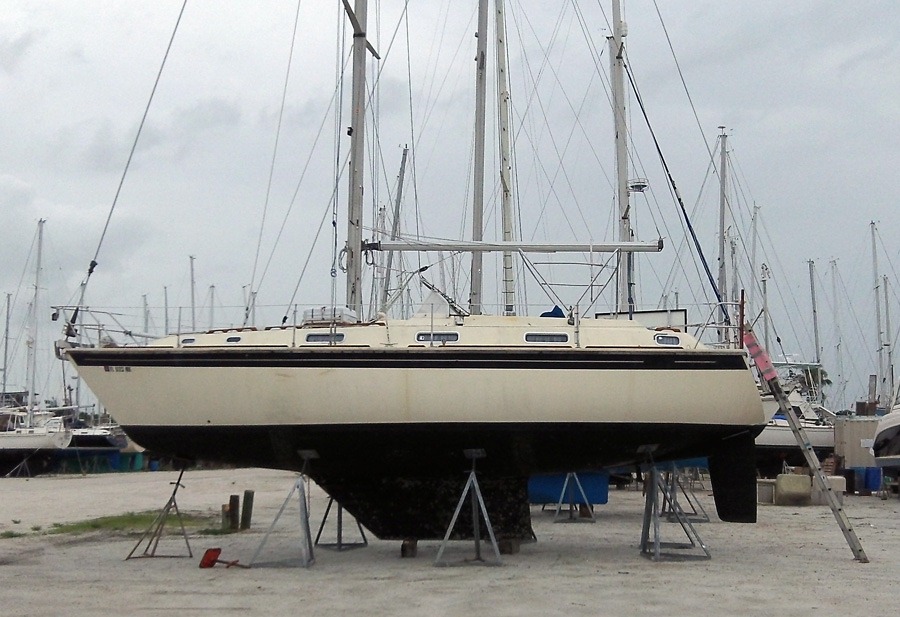
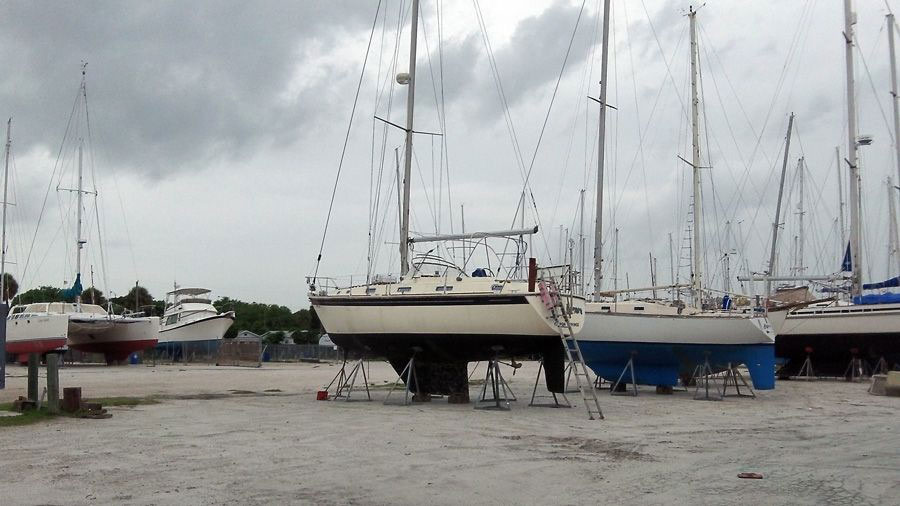
Let’s start with the good news … Encore is safely out of the water, block and safely in the boatyard. Her bottom ablative bottom paint sort of did its job, but was completely used up. A strong power washing took care of the slime and some of the growth and left a few barnacles glued to the hull and prop. Unfortunately the cleaning brought to light blistering … something all too common to aging fiberglass hulls (West System PDF). In Encore’s case, there are many … MANY … all small but too plentiful for the normal DIY West System patching technique. This brings me to my next dilemma –what do I do next?
The right way to go would be to hire a soda blaster and strip the below surface area so as to open all of the blisters so they can dry out (approx $2500). After this “heavy striping of the bottom,” a filler coat can be applied before laying up several barrier coats (four coats according to Joe Valenza at Whiticar Boat Works) … then apply both a hard antifouling bottom paint of one color and an second ablative antifouling coat of another color. Of course even all of this labor intensive work would not be enough since the iron keel needs to be treated differently as it is showing signs of rust (something I knew about). All I know is that the cash register will be ringing if the repair is done the right way.
There is always the “wrong way” and the questionable in between way to repair the bottom. I could move the boat to the do-it-yourself area (a charged of course) and just slap new ablative antifouling paint over everything and wait another year. Or I could sand and grind the bottom down myself, attempt to patch multiple 100s of small blisters and repaint the hull knowing this will not solve the problem long term but give me several seasons.
Hmm, something to sleep on and delicately talk with Brenda about in a year we are planning a wedding ($$$) … gulp!
Well at least my task for the weekend was accomplished. Sail and canvas stripped and Encore out of the water for the next few months.
Encore is out of the water, but not necessarily dry at the moment. No doubt I picked a lousy weekend and Monday morning to schedule for our haul-out. It has been a planned move since my failed attempt in May for coming out of the water for the 2012 hurricane season and much needed bottom work (but that’s another post!)
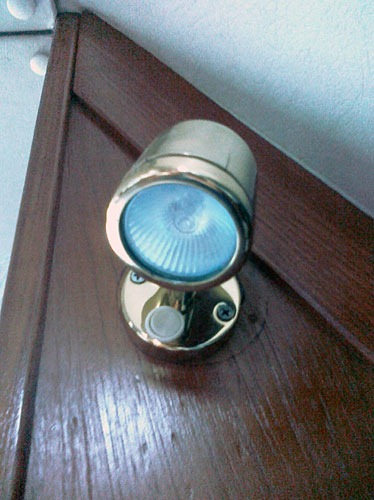
Archiving a few Encore “thinkering” photos so as to begin searching for upgrades. The four smaller reading lights are currently halogen and draw too many amps and create too much heat for the boat. I’m hoping to be able to replace them with warm-white LED bulbs as they improve and come down in price. ( LED Wholesale )
I would really prefer to purchase new fixtures from AlpenGlow but that would be costly; I do intend to replace the two lights above the table with one or two though(photo below). They are expensive others who have installed them are happy that they did.
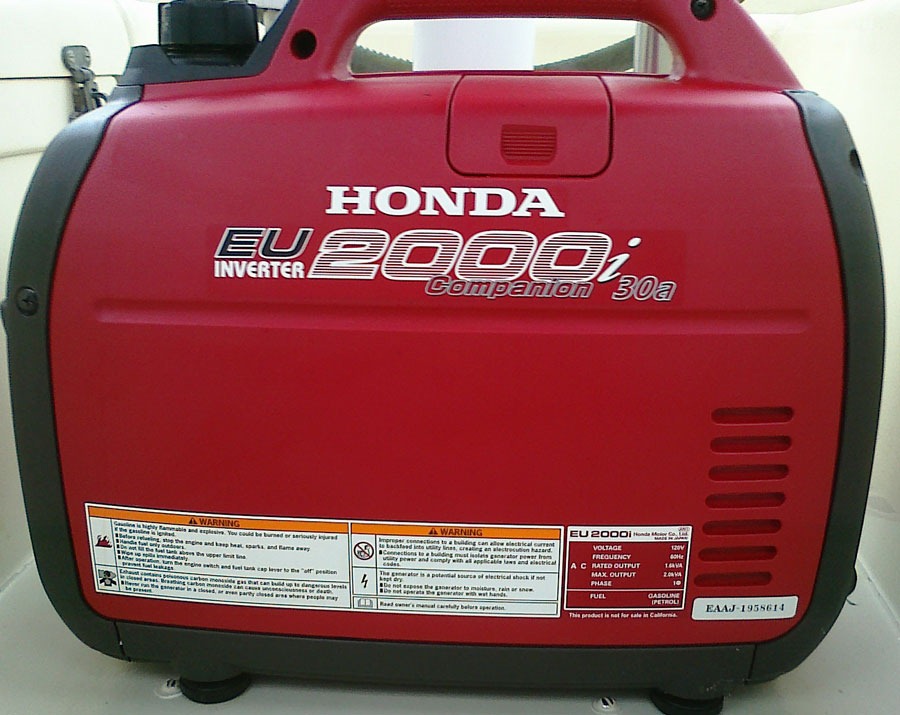
Since our trips have been minimal there hasn’t been a need to run the little Honda EU 2000i generator aboard just yet, but since I’m moving the boat ashore decided to take the little power plant to the storage locker for the season and take a photo for insurance purposes. (besides I’d like to run it a bit too)
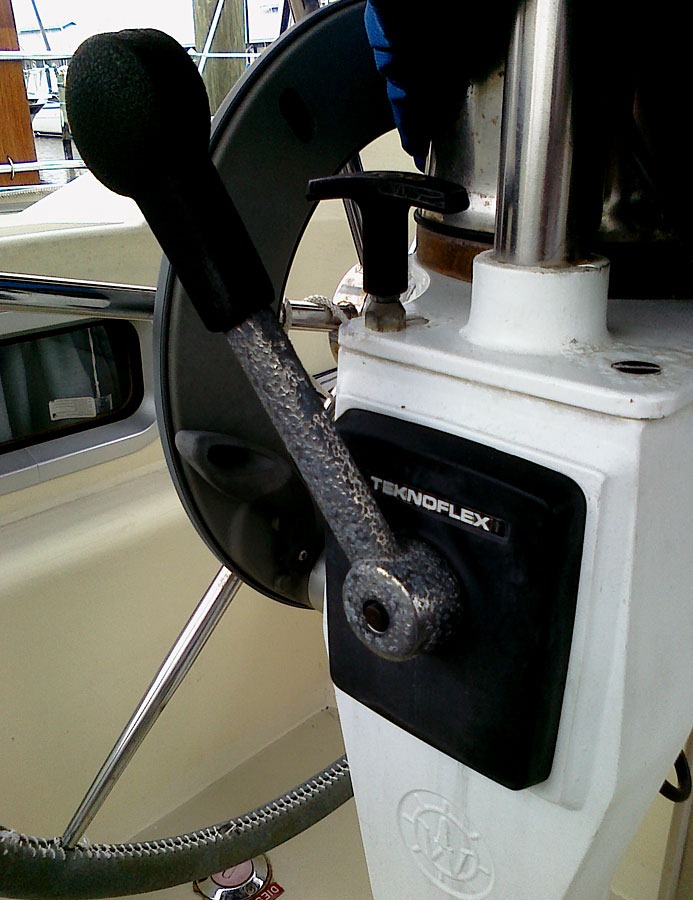
The list of boat related projects continues to grow. Just as I knock a couple off the list, a few more pop up. First the “stop engine” cut-off cable broke and although I can climb to the bilge and manually move the lever to choke of air, it is much more convenient to do it from the helm. That said, I was able to shorten the existing cable enough to get the old cable to work again, but it began the thinking process regarding the existing engine gear control lever and throttle. It is well pitted and the rubber is cracked. Yes it still works, but then so did the stop lever until I pull on it a little hard. Perhaps it is time to start looking around for replacements (cable too.) A quick Internet search pointed me to Teleflex/Morse controls looks like it might work since I couldn’t find Technoflex control parts on the web.
As for a few other project before putting Encore on the hard, I replaced the Spinlock line clutched that I repaired at home (previous post 1 and post 2). Besides that, a few electrical issue hard me rewiring the fuse that runs to the meter that measure output (it gets a little too hot???) and the manual switch and fuse for the electric bilge pump (and after fiddling down there, looks as if I’ll be doing a little bilge cleaning).
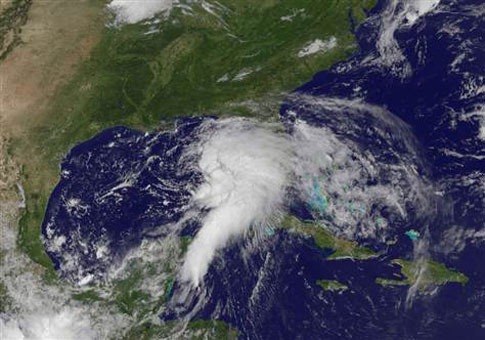
Since I’m hanging out at the boat this weekend getting Encore prepped for tropical weather/hurricane season, it is rather fitting that the chatter at the marina is about what is brewing in the Gulf of Mexico. A couple neighboring boat have added a couple extra dock lines and removed some canvas. I’ve taken down the sails and intend to remove the bimini … but all that was planned.
I’m not particularly concerned about ‘this particular storm’ except that I’m planning to move a boat with a friend on Monday morning and am wondering where the wind and rain will be?
One forecasting model has the slow-moving system heading west toward Texas by midweek, weather.com reported. A less reliable model has it swinging back east over Florida and then along the mid-Atlantic. A third model has it surging north into Louisiana-Mississippi.
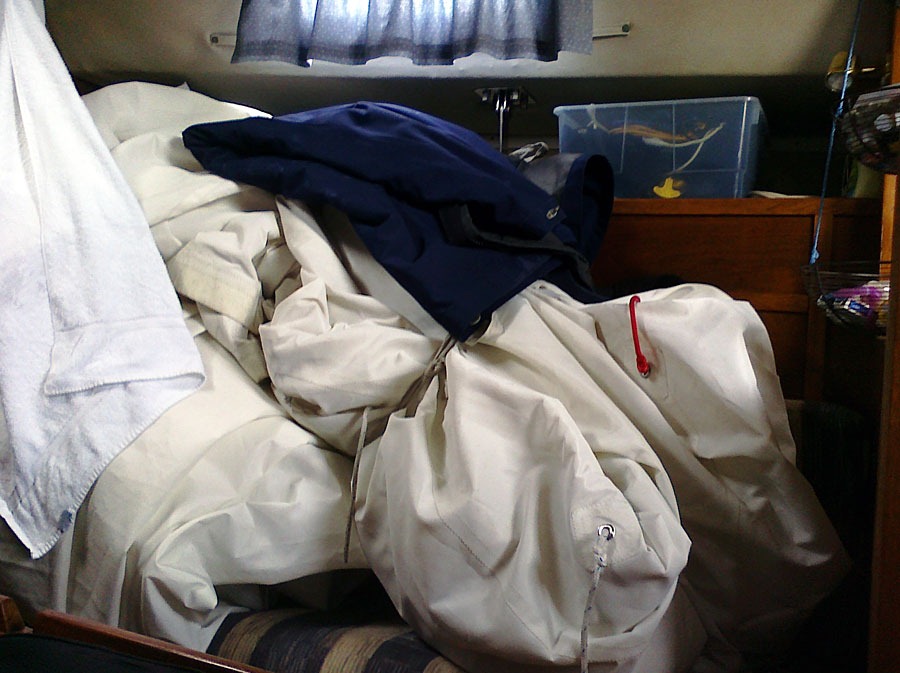
Not the optimum way to store sails below, but doing it alone is challenging. (I’d like to take them to a loft for some re-stitching but need a few references.)
WSJ graph showing how unemployment has impacted the nation’s mature workforce. This can’t be good since many are only a few short years away from not even being able to work.
Yes, according to a news release from Colombia, Maryland’s New Energy Technologies, Inc. Unfortunately I still think we are faced with the “it is a drop in the bucket” producer of electricity in comparison to what we Americans use … not to mention the cost of windows. Still, it is interesting to explore the advancements in solar power and energy efficiency.
New Energy Technologies Inc. and National Renewable Energy Laboratory Create Improved Process for Technology Capable of Generating Electricity on See-Through Glass
Columbia, MD – June 18, 2012 – New Energy Technologies, Inc., developer of see-through solar cells for generating electricity on glass, today announces an improvement in its manufacturing technique that should lead to higher speed, lower costs and greater durability.
Teaming with the US Department of Energy’s National Renewable Energy Laboratory, New Energy Technologies Inc. (OTCQB: NENE) has developed the use of low-cost materials and a special application technique that could help optimize the movement of electrons within the ultra-thin solar cells. This should increase the amount of electricity produced when New Energy’s see-through SolarWindow™ prototype is exposed to natural or artificial light.
Importantly, the improvement to the technology can be executed at ambient pressure and low temperatures, allowing researchers to avoid the use of materials that must otherwise be deposited using high temperature vacuum deposition. Vacuum deposition is both expensive and time-consuming and, thus, not practical for high speed and large-scale applications. Today’s innovation promotes low processing temperatures, enabling high-speed roll-to-roll (R2R) and sheet-to-sheet (S2S) manufacturing. This large-area, R2R and S2S fabrication capability and improved durability of SolarWindow™ technology are crucial for production of market-ready electricity-generating coatings on see-through glass and plastic.
Previously, New Energy, with assistance from University of South Florida and NREL, developed important improvements to New Energy’s SolarWindow™ technology, capable of generating electricity on see-through glass. These improvements include enhancements that address advancing durability, power performance, and cost-effective manufacturability – all important to the eventual commercial deployment of New Energy’s SolarWindow™ technology.
Today’s announcement marks the latest in a series of technical accomplishments that Company and NREL research teams have recently achieved.
“Over the past few months, our researchers have unveiled a virtually invisible conductive wiring system, which collects and transports electricity on SolarWindow™ prototypes, and have fabricated a large area working module, which is more than 14-times larger than previous organic photovoltaic devices fabricated at NREL,” stated Mr. John A. Conklin, President and CEO of New Energy Technologies, Inc. “Earlier, we developed our first-ever working SolarWindow™ prototype using a faster, rapid scale-up process for applying solution-based coatings.
“Together, these achievements have moved us closer to our manufacturing, scale-up, durability, and power production goals – all important factors to advancing our SolarWindow™ technology towards commercial launch,” Conklin added.
To generate electricity on SolarWindow™ prototypes, researchers creatively layer and arrange unique, ultra-thin see-through solar cells onto glass. Each of these cells is arranged in a network and interconnected by way of a virtually invisible grid-like wiring system.
Within these ultra-thin solar cells, the light-induced movement of electrons generates electricity. When SolarWindow™ prototypes are exposed to light, the light’s energy prompts electron movement through specific physical and chemical mechanisms leading to power generation.
Dr. Scott R. Hammond, Principal Scientist at New Energy Technologies, Inc., believes the discovery announced today could also favorably improve durability and shelf-life of the Company’s future SolarWindow™ products. “NREL scientists have previously published unrelated results that demonstrate dramatic improvements to the operational and shelf-life of unprotected (i.e., non-encapsulated) photovoltaic devices utilizing related materials when subjected to continuous illumination. No doubt, this is a promising and significant advancement.”
Currently under development for eventual commercial deployment in the estimated 85 million commercial buildings and homes in America, SolarWindow™ technology is the subject of ten patent filings and is the world’s first-of-its-kind technology capable of generating electricity on see-through glass windows.
I filled my tank on Tuesday in southwest Ohio for $3.59 which I thought was 10 cents cheaper than other stations, but noticed pricing dropping rapidly this week and even lower while fueling a rental car in Florida (which is usually higher than Ohio). In fact, I just noticed stations at $3.09 and had to do a double take.
Yes, I know the tension have eased in the middle east (questionable), and that OPEC decided not to cut production even though supplies are plentiful … and economies around the globe are slowing reducing the demand … but I’m still surprised to see the drop at the beginning of summer and during peak travel season. I suppose that is good news for vacationers and those earning their living on summer tourism. As for the economic slowdown, the U.S. is no exception and even the Fed admitted this week that we aren’t recovering from the long recession as quickly as expected. For those disagreeing with President Obama and the Democrats’ policies, we are not all that surprised, and unless some kind of change in Washington DC encourages business growth and public sector cost containment (ie. reducing deficit spending), I think the odds of a double dip recession are increasing. We can’t continue to grow government, tax, regulate and spend our way to prosperity.
2012 started with fears that gas prices could spike to $5 per gallon and beyond, but a new report suggests that gas price could actually dip below the $3 mark by year’s end.
Turmoil in the Middle East had many analysts calling for $5 gas by the summer driving season, but tensions have eased and so have fuel prices. Add in a world economy that isn’t recovering as fast as first hoped and we could see prices below $3 per gallon by this fall.
Across the country gas prices now average $3.47 per gallon, down $0.47 cents from this year’s high in April. In some parts of the country prices have fallen even farther, with a gallon of gas averaging $3.06 in South Carolina. Moreover, 30 percent of the state’s gas stations are charging less than $3 per gallon.
I’m probably not the only one who has “excessively” followed people on Twitter over the past few years … so I am trying to clean up my tweetstream with TwitCleaner. So far so good.
Twit Cleaner [web] (free)
If you follow a large number of people and are looking to clean up your timeline, Twit Cleaner can help you out. Twit Cleaner is a great web app that recommends people you should unfollow on Twitter based on a number of things such as how often they tweet, how often they post links, their follower/following ratio, etc.
I appreciate high profile Meniere’s Disease sufferers commenting on how debilitating it is to deal with abrupt attacks and ongoing balance/sickness issues, especially when they are as tough as UFC’s Dana White. He commented that he is “not a normal patient” while in an interview about his struggle – although I don’t think he exhibits any traits of “being patient” = capable of calmly awaiting an outcome or result; not hasty or impulsive. It will be interesting to follow what treatment path he eventually takes or how quickly he recovers from a Vestibular Nerve Section.