After hearing and seeing reports of an Australian man arrested for driving his beer cooler scooter, I wondered just how popular motorized coolers or cases of beer might be – they’re not as rare as you might think. A few years ago in Germany this cellphone video of this shirtless guy was uploaded to YouTube… crazy!
From the start, it wasn’t that hard to predict a slow go for HP in releasing their Touchpad. As a Palm Pre webOS user and sometimes enthusiast, the slow-motion releases in handset, webOS and tablet products have left existing users wanting and contemplating buyers asking “Why?” Couple that with the largest users base (Sprint) feeling ignored after HP acquired Palm … there isn’t even the built in first day release buzz to give HP’s new products free word of mouth advertising. I’m unsure who to blame for the Sprint/HP fallout, but the fact that original Pre webOS buyers don’t have a path or reason to buy a Touchpad “if a new webOS Palm Pre3 phone isn’t in their future.”
As an unhappy HPQ shareholder, heads should roll over the blunder that didn’t capitalized on the existing chunk of Sprint webOS users when releasing the Touchpad. Although I still like and use my first generation Palm Pre, I see little reason to be encouraged that HP management is currently on the right track with their webOS devices and carrier support. (perhaps I’m just a bitter Sprint Palm Pre user seeing a “roadway ends here” sign)
There’s an unsettling truth in the HP TouchPad price drop that we have to face: HP wouldn’t have dropped the price if the tablet was selling well as it was priced. A new report by Arik Hesseldahl of AllThingsD laid bare what we have long (for six weeks) suspected: the TouchPad isn’t selling as well as HP or any of their retail partners would have liked.
Staples saw a lot of success with their TouchPad $200-off sale, but it’s likely they only had a few in stock to begin with. A better barometer might be Best Buy, who has been selling the TouchPad at full price since launch. According to Hesseldahl’s report, Best Buy was sent 270,000 TouchPads by HP, and they’ve only managed to sell 25,000 of them (a number that another source said might be “charitable”). Does that seem like an unreasonable number? Recall the Woot sale of the TouchPad: they sold 612 at $120 off. Woot usually pushes thousands of any one item, HP computers included.
Best Buy is reportedly so livid about the sales of the TouchPad that they’re refusing to pay for all of them, instead insisting that HP take them back. A high-level HP executive is supposedly going to be meeting in person with these angered Best Buy executives to smooth things over, but when you’ve got masses of unsold inventory on hand, we can’t imagine that will be a very friendly chat.
HP reports their quarterly earnings tomorrow, and if these numbers are true, we expect that they will remain mum on the exact number of TouchPads actually sold.
Here’s a tip on paying attention when uploading photos from your smartphone:
“… smartphone pics are embedded with GPS data, making it so easy to determine your precise latitude and longitude that "a first grader could stalk someone," says cofounder Larry Pesce. For its part, Twitter’s image-hosting service strips geotagged data from phone-uploaded pics, but third-party services like TwitPic are still vulnerable.
Here’s a bit about “news reporting” on Twitter (probably obvious, but a good reminder when considering RT (retweeting) fast breaking news stories:
The death of Osama bin Laden was tweeted by Donald Rumsfeld’s chief of staff Keith Urbahn more than an hour before President Obama’s official address to the nation and before most news outlets had posted it on their Web pages. That tweet turned out to be true. But as more top stories get broken on Twitter, journalists using the site to try to keep up with a never-ending news cycle sometimes rush to report information that isn’t accurate. Thomson Reuters, for instance, was among several news outlets that erroneously tweeted Rep. Gabrielle Giffords was killed in the Arizona shooting in January. (A spokesperson for Reuters says the organization is now enforcing a stricter social-media policy.)
While listening for updates from the German Chancellor Angela Merkel and French President Nicolas Sarkozy in Paris today, a CNBC guest analyst made the observation that “If all countries were like Germany, Germany would not survive. Germany needs the weaker European countries to export to in order to prosper.” (paraphrased)
BTW, no news from the meeting as of lunch.
Preliminary figures from the statistics office said growth dropped to 0.1 percent in seasonally adjusted terms, dragged on by a negative trade balance, flagging consumption and weak construction investment.
The office also revised growth in the first three months of the year down to 1.3 percent, leading some economists to cut their 2011 and 2012 forecasts.
"The second quarter marks a turning point in the German business cycle," said Unicredit analyst Andreas Rees, lowering his 2011 forecast to 3 percent from 3.5 percent, and his 2012 forecast to 1.25 from 2 percent.
"The period of exuberant growth is now behind us," he said.
The sluggish German growth contributed to a sharp euro zone slowdown, raising fears that a longer-term dip could derail efforts to resolve the bloc’s debt crisis.
With the Obama administration failing to lead in the area we expect, liberal politicians (might as well say “all politicians”) have little problem taking a leadership role when it comes to telling the industry how to run their businesses.
The Department of Energy distributes our taxes as giftsgrants as a way to warp free market capitalism to achieve “their vision” – an EV in every garage (perhaps we should still be thankful “they” will still permit us individual car ownership?) If I sound a little cynical, it is because I’m not fond of the gamesmanship most businesses are forced to engaged in so they can compete. Let’s see, to stay completive business pays for political clout (lobbyist and campaign donations) in order to receive millions in federal grant dollars from the bloated taxpayer funded bureaucracy in Washington DC so they can sell their cars back to taxpayers at a profit.
If it were up to me, maybe the Department of Energy would be a good place to start when tackling our country’s addiction to taxing, borrowing and spending.
General Motors, Chrysler and Ford were among the three-dozen entities that received a combined $175 million in U.S. Department of Energy (DOE) grants to be used to further develop technology aimed at boosting light-duty vehicle fuel economy by more than 75 percent over the next 14 years.
Minnesota slugger Jim Thome become the eighth player in major league history to hit 600 home runs, connecting twice against the Detroit Tigers on Monday night.
We’ve started off the week in a more upbeat fashion as the expectations are high for some kind of deal on Tuesday from the Europeans. Hopefully they’ll be able to sooth the jitters many are having over banking and Eurozone’s socialist mentality. I’m not holding my breath that they’ll be able the make the social programs cuts over on that side of the pond any easier than we can hear. Eventually the borrow and deficit spend now will sink even the most productive countries.
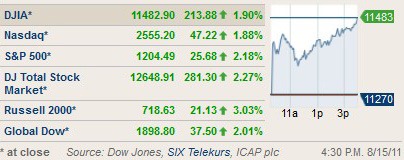
For now, stocks advanced leveling out last week’s losses. The Dow finished 213.88 points higher, or 1.9%, to 11482.90, which almost the high for the day. The Standard & Poor’s 500-stock index ended with a 25.68-point gain and the Nasdaq Composite wsa up 47.22 points. For those long, it did feel better than last weeks decline.
Can we continue with the optimism or are we facing such slow growth that companies will sit on their cash rather than invest and hire? Personally all the talk about investors chasing dividend stocks rather than growth has me think the latter.
Couldn’t resist dreaming of exotic ports of call and far away anchorages … this one is from the Chagos in the Indian Ocean (he archipelago has the largest expanse of undisturbed coral reefs in the Indian Ocean, as well as rare and endangered species of birds and other wildlife. There are strict conservation rules, which must be observed in order to preserve this unique sanctuary in its present state).
Another perfect day enjoying the cruising lifestyle in Chagos. This is our favorite picture of the boat in the place where we think ‘this must be as close to paradise as it gets’.
I’m archiving a bit from Jackalyne Pfannenstiel’sletter to the WSJ editorthat was in the paper this past weekend which reflects my point of view when it comes to alternatives and efficiency in the U.S. military. Most of us know that all branches of the armed forces are making strides to lessen their dependency on oil, but not everyone has fully thought through the impact on implication if we aren’t efficient or independent from foreign source of fuel. Although I’m a supporter of having the best defense possible, I don’t believe we need to do it “at all costs,” or better put … while wasting money. I’m partial to the sentiment of Pfannenstiel’s letter, but her titlein my opinion demonstrates that we are top heavy in Washington DC administrative staff and should have no problem trimming the militaries budget along with 90% of the federal budget – her title is: Assistant Secretary of the Navy for Energy, Installations and Equipment.
The Marine Corps, for example, is deploying Marine-tested, combat-ready renewable energy technologies in Afghanistan resulting in two patrol bases being operated entirely on renewable energy. Marine patrols that normally require a battery resupply every two to three days can now go three weeks between resupplies, extending their operational reach. For the Navy, new hull and propeller coatings, stern flaps and future engine modifications are going to save five million barrels per year at sea by 2020, again returning mission capability to our warfighters.
Alternative fuels are critically important as a hedge against the risk to a single source of energy, as well as a way to assure that we can continue to perform our mission. Domestically sourced, advanced drop-in biofuels that do not adversely impact food, water, or land use provide a significant opportunity for the department to reduce its dependence on foreign sources of fuel. Today, solutions exist, are being scaled and further driven toward economic parity that have substantially different implications than past generations of biofuels.
Energy efficiency, alternative fuels and energy technologies significantly enhance our combat capabilities. Having a unified position across the Department of the Navy, we can lead the nation toward a more independent, more secure energy future.
I’ve been reading a few of the ideas being toss around by congress as a way to stimulate the economy and “create jobs” (as I recall that was job #1 about three years ago?) The school of thought for most Republicans (at least the last couple years) is to lower tax rates and cut both the size and excessive spending in Washington … as well as their borrowing. The conservatives at least believe lower taxes, reducing regulations and shrinking government is a the way to encourage the private sector to hire and companies to both locate and expand in the United States. Democrats have leaned to the Keynesian approach believing the government and Fed needs to take a more active approach in stimulating the economy. They also desire to advanced social programs as well as implemented and mandated new legislation requiring higher taxes in order to fund this philosophy. Unfortunately for all of us the last 3 years are proving that the later has not effectively pulled us out of our recession, created many “private sector” jobs, or stimulated the economy; it most definitely has not reduced our debt. Democrats say that the government didn’t simulate enough and need to raise more taxes in order to try more of the same.
I also notice that a few surprisingly liberal Democrats are actually suggesting selectively cutting tax rates … sort of a surprise … but one which would offer a “tax holiday” to U.S. corporations in order to repatriate overseas profits. New York Democratic Senator Chuck Schumer recommends that companies pay a lower rate that the current 35%, probably in the range of 5.25% for a year – hence the “gimmickry” hinted at in the subject line.The downsides is that while this may bring some cash back to the U.S., it isn’t an incentive for corporations to do anything with it … except perhaps increase their dividends? On the upside, the cash does come back to the United States. Job problem solved? I think not.
One flaw in the “if we bring cash back to U.S. we’ll create jobs” plan, is that corporations are already “sitting” on hoards of cash but have no reason to expand their U.S. operations due to 1) low demand in a slow economy, 2) uncertain taxes and regulations (think Obamacare) and 3) a workforce that is far costlier than their operations overseas. o, unless some longer term changes are made, just offering a tax incentive for global corporations is not going to be the change we need to create jobs and a robust world leading economy.
If congress is going to do something, they need to tackle this with some big changes … like restructuring and simplifying he tax code, reducing the excessive regulation saddling businesses large and small and dealing with the size and spending in Washington DC even if it means modifying entitlement programs (Dems) and making some cuts that impact our military (Repubs).