It was a rough day on Wall Street, but nothing like it will be if they aren’t able to pass a bill to keep money flowing in the U.S. When paychecks are no long being cashed and layoffs start occurring in full force, their will be blood. For most, the losses are currently just on paper as the DJIA closes at 10,365.45, down 777.68 points 7% drop. The Nasdaq and S&P 500 were even worse, down about 9% at the close … big numbers for those of us funding, or planning to fund, our children’s education and trying to be responsible about retirement.
The Republican minority in congress who thought they had enough votes to pass the rescue/bailout bill today, said that it was a “poisoned” partisan speech from House Leader Nancy Pelosi delivered before the vote that sabotaged the distasteful $700 Billion bill — nobody actually likes it, but most fear the outcome if one isn’t passed. The vote was 228-205 against the measure, with one member not voting. There was broad bipartisan opposition, so neither side can really complain, even though they will. More than 90 Democrats and 130 Republicans voted against the bill. (NYTime article)
John Boehner (R – OH) voices frustration and
blames today’s bill failure on Nancy Pelosi
Money lending … this wouldn’t be the first time society gets carried away with borrowing more than realistically we can pay back under the terms of a contract — what started it and is there a solution? Was it the Fannie and Freddie backed loans to those without the incomes to borrow during the 1990s? Was it the ‘market driven’ unrealistic price increases for homes and property seen over the past 10+ years? What about the excessive borrowing encouraged by lenders, either with or without enough collateral leveraging the value of a home. Some see much of the blame can be tied to these creative “pay-option” ARMs and forward looking lending based on continuing increases in home values?
I doubt it is as simple as “what ONE thing started it” or easy to point the finger at one group. Banking is certainly at fault, but then so are those of us who borrow too much and trust those we elect to oversee the banking and mortgage industry. We are where we are and the three groups need to come together and find a band-aid in hope to avert a national panic and give the banking industry time in order to restructure and get their house back in order. Going forward, even with a bailout, most homebuyers and businesses will find capital much more challenging.
Here’s an interesting look from the mortgage industry and valuation collapse in one of the hardest hit areas — California real estate. David Faber of CNBC talks with 20 year mortgage veteran Mark Hanson (his blog) from Oakland California; he offers a look into the practices that moved toward this inevitable situation.
Like many investors, I’ve been watching the reaction to the bank melting down on Wall Street. All who are invested in America (and rippling overseas) are going to be impacted in real estate value, stock value, bond security and the ability of our government to remain sound. This devaluation will no doubt slow our economy and threaten jobs, not just those jobs in the non-competitive industries (ie. Auto, etc). As all 30 DOW Industrials open Monday morning, they do it to a down side even as a $700 billion dollar rescue package seems to be inevitable; some suggest taxpayers will be required to pay even more.
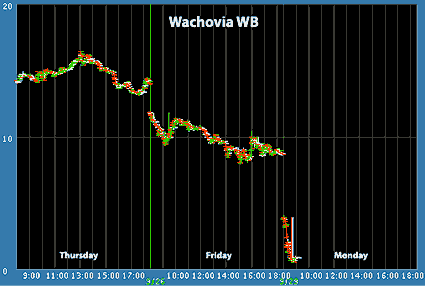
Perhaps the biggest news of the morning is that Citigroup will buy Wachovia Bank for about $2.16 billion, or $1 per share, for its banking operations — Friday WB was trading for $10/share and last year it was $50/share. Wachovia will retain its wealth management and brokerage operations according to stories.
Although there is enough blame to go around, here’s a partisan CSPAN video that at least shows that a couple legislators were trying to get a handle on the business practices and corruptions going on over at Fannie Mae and Freddie Mac back in 2004. When people “ask where the oversight and regulators” during these practices … I look at this and say, “because we weren’t paying attention.”
I’m reading the latest document from Capital Hill on the government’s rescue effort from my congressman John Boehner. (PDF – September 28, 2008 | 6:31 pm) Also, here is the letter from the Office of Management and Budget on Rescue to Boehner’s office (see below).
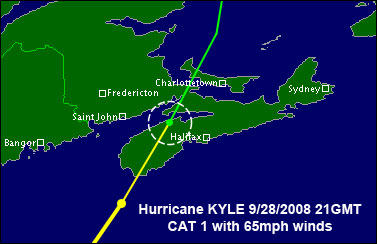
Hurricane Kyle is heading just west of Halifax Nova Scotia today and could leave many without power and create more than just a disruption along thia pristine coastline. Each inlet, which already experiences significant tides, could have additional water along with wind and rain heading their way. Most of us don’t think of hurricanes affecting Canadians, but this 65 mph storm will be onshore this evening.
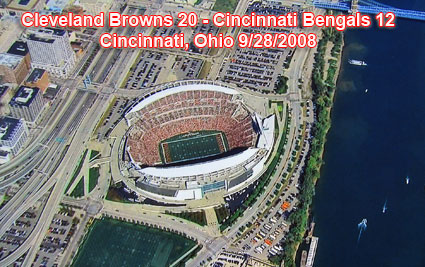
Not that it matters, but the Cincinnati starting quarterback Carson Palmer is just sitting on the sideline today as he watches his 0-3 Bengals take on the equally struggling Cleveland Browns. According to reports, he is capable of playing, but his elbow is sore after receiving beatings in the first three game. The franchise quarterback has been durable since the 2005 playoff injury against Pittsburgh, but one can take only so many sacks and remain healthy. So far in today’s game (2nd quarter), the Bengals haven’t missed their veteran as back up Ryan Fitzpatrick is keeping things close (Cin 3 – Cle 3 @ 2PM). Some of us would love to see #5 get a few snaps — Carson Palmer’s brother Jordan Palmer.
— EDIT 4PM:
Sour ending to the game if you are a Cincinnati Bengals fan as not only do they go 0-4 losing to Cleveland today, but their defense looks questionable and offense is missing their starting quarterback. Neither team looked all that sharp, but at least the Browns were able to end with a win. Oh well, at least the weather was nice in Cincinnati.
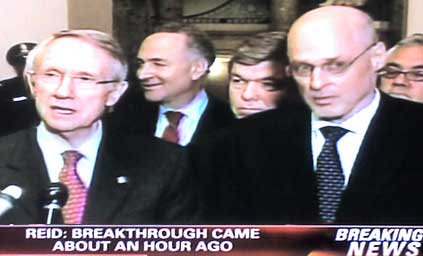
As I watch a bit of news before bed early Sunday morning, congress negotiators look to have come up with a ‘bailout’ plan. The whole group of leaders are walking out smiling at 12:28 AM and Nancy Pelosi announced that they have a “package to stabilize markets” and “protect citizens and taxpayer.” They still need to commit it to paper, but they in discussion have reached an agreement. Harry Reid spoke next and mentioned the “breakthrough” came at about 11:30PM. He was complimentary of all participates and will make a more detailed announcement Sunday, but in handing off to Treasury Secretary Paulsen, he indicated that he was positive that “we are there and so far so good.”
So as they turn in tonight and their staff work though the night, the should have a final announcement tomorrow. Minority Whip of the House, Roy Blunt, said that he believes they will have something tomorrow that will work when he presents to his colleagues tomorrow.
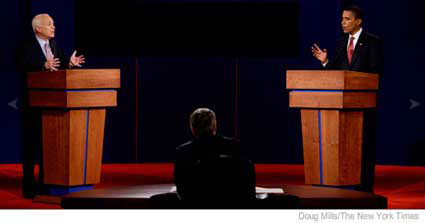
No real winner, no real loser … that’s the conclusion in my unscientific reading of the newspapers and websites garnered this morning. I thought both candidates handled themselves well considering the heavy focus on Capital Hill over the economic crisis. Both candidate are in support of government coming to the aid of our nations’ banks. As for the foreign policy part, Iraq, the War on Terror, Russian aggression, our national security and nuclear advancements in Iran and North Korea — neither candidate is all that different on the need for American involvement, although they are somewhat different on their approach. Obviously each will try to suggest that they have the “right read” and the “best approach,” but I’ve concluded that at least both agree the world’s problems do impact U.S. security. Each candidate concludes that our nation must address world problems and the next President will need to be involved in foreign policies more than their citizens would like.
As for domestic issues, there is a larger difference: Senator Obama see a need for a bigger government and has shared his plan to expand it and the programs designed to help Americans. Senator McCain, in keeping with Republican philosophy, prefers less government and believes we need to cut our spending, reduce the tax burden on all. He pointed out a sharp different between himself and others currently serving not just in talk, but in their actions such as “congressional earmarking” or tagging on pet projects on bills heading for approval. He has had long record of not seeking earmarks and has made it a promise that he intends to veto these kinds of bills when President. Obama sells his ‘bigger government ideas’ by raising additional taxes on the wealthy and reducing taxes for the rest; McCain points out that these kinds of selective tax increases eventually end up costing all Americans by triggering slower business growth, less investment in U.S. companies and a loss of tax revenues due to a weaker economy. He used the 35% corporate tax rate as an example to stress the difficulty American companies face when competing with companies overseas taxed at lower rates.
Although I support Senator John McCain’s approach to government and taxes, and have a deep respect for his service to country and experience in foreign affairs, I was impressed with Senator Barack Obama and his understanding of international politics. He is bright and smart, and although I disagree with his willingness to talk without conditions with some radical leaders and view that we should leave Iraq on a pre-determined timetable, I do believe he would in the end make the right decisions to secure our nation — I may be naive?
Since I recorded the debate on CSPAN2 while watching it in High-Def (very cool) on another channel, I’ll include the full 1-1/2 hour debate encoded from my Tivo box below ..
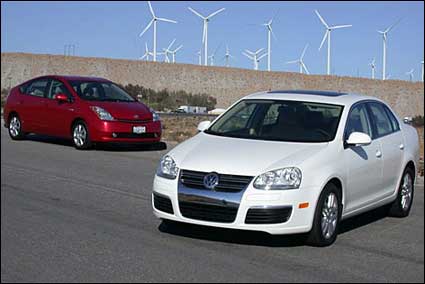
It’s always great to see these headlines … New VW Jetta Diesel Tops Prius in Fuel-Economy Marathon Test … although its a bit misleading. The Prius still tops the 2009 VW Jetta TDI with DSG in the city, but the clean diesel surpasses the Toyota Hybrid on the highway (Jetta: 45.4 MPG | Prius: 44.8 MPG) — even if as the author says, “the Jetta’s drivetrain almost encourages you to burn fuel that is, it’s actually fun to drive. And the same cannot be said for the Prius.” Check out Ben Stewart’s September 24, 2008 Popular Mechanic’s article.
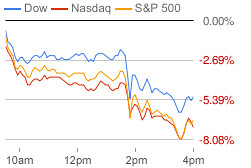 It was a rough day on Wall Street, but nothing like it will be if they aren’t able to pass a bill to keep money flowing in the U.S. When paychecks are no long being cashed and layoffs start occurring in full force, their will be blood. For most, the losses are currently just on paper as the DJIA closes at 10,365.45, down 777.68 points 7% drop. The Nasdaq and S&P 500 were even worse, down about 9% at the close … big numbers for those of us funding, or planning to fund, our children’s education and trying to be responsible about retirement.
 Money lending … this wouldn’t be the first time society gets carried away with borrowing more than realistically we can pay back under the terms of a contract — what started it and is there a solution? Was it the Fannie and Freddie backed loans to those without the incomes to borrow during the 1990s? Was it the ‘market driven’ unrealistic price increases for homes and property seen over the past 10+ years? What about the excessive borrowing encouraged by lenders, either with or without enough collateral leveraging the value of a home. Some see much of the blame can be tied to these creative

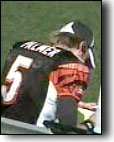 Not that it matters, but the Cincinnati starting quarterback Carson Palmer is just sitting on the sideline today as he watches his 0-3 Bengals take on the equally struggling Cleveland Browns. According to reports, he is capable of playing, but his elbow is sore after receiving beatings in the first three game. The franchise quarterback has been durable since the 2005 playoff injury against Pittsburgh, but one can take only so many sacks and remain healthy. So far in today’s game (2nd quarter), the Bengals haven’t missed their veteran as back up