Bad news for Sprint Everything Data customers in 2011

Posted By on January 19, 2011

Add one more thing to the “inflation” worries (on top of energy and food) … especially if you are a Sprint wireless data smartphone user. It looks as if one might be wise to shop wireless phone carriers a little closer come renewal time. According to yesterday’s press release, Sprint has decided to “apply a $10/month Premium Data add-on charge to activation of smartphones beginning January 30, 2011.” Ouch, my bill is already too high.

18 January 2011

Sprint (NYSE: S) is committed to providing its customers a great wireless experience now and in the future. From its packed portfolio of innovative phones and devices to its leadership in introducing 4G services, to its consumer-friendly Everything Data plans, featuring unlimited text, Web and calling to any mobile phone, Sprint offers the best value in wireless.

Sprint will increase its postpaid rates by applying a $10 per month Premium Data add-on charge to activations of smartphones beginning Jan. 30. The charge will assist Sprint in offering simple and affordable unlimited plans for its customers while maintaining a wireless network able to meet the growing appetite for a richer mobile experience. Subscribers with smartphones will still receive the best value in wireless, including the Any Mobile, Anytime feature offered nationwide only by Sprint.

Sprint also offers a full range of traditional feature phones, including popular eco-friendly or touch-screen handsets that do not require the Premium Data add-on charge but still have a great range of capabilities with voice, text and data access. Existing Sprint smartphone customers are not affected unless they upgrade to or activate another smartphone.

“Sprint wants its customers to experience the range of entertainment and productivity possibilities available with today’s wireless technology,” said Bob H. Johnson, president of Sprint’s consumer business. “While some of our competitors impose overage charges and complex plans, Sprint continues to provide a worry-free, unlimited data experience while on the Sprint network. This is responsible, sustainable and reflects our commitment to simplicity and value.”

“Sprint’s decision to apply the Premium Data add-on charge to activations of smartphones going forward recognizes the enhanced user experience that today’s smartphones deliver, which, in turn, drives substantially higher data usage and cost,” said Roger Entner, analyst and founder of Recon Analytics.

“Building, maintaining and expanding wireless data networks isn’t free – there are real costs involved. In effect, Sprint has chosen to increase the price of its unlimited Everything Data plans, which is still below that of its major competitors, for the segment of customers – smartphone users – who are using wireless data the most and are driving up costs. Consumers have many choices. They can choose unlimited, worry-free data plans on the Sprint network or they can have tiered, metered plans and overage charges with other wireless carriers.”

Smartphone customers use, on average, 10 times more data than users of traditional feature phones. Smartphone users have access to more data capabilities, applications and other functionality than traditional feature phones. Examples include access to thousands of applications and games through online marketplaces and full HTML Web browsing with Adobe Flash technology that allows users to browse the Internet on their devices just like they can at home or in the office.

Sprint defines smartphones as devices with robust operating systems that deliver a rich wireless experience by bringing the full function of mobile applications and programs to life, including Blackberry, Android, Windows Mobile, Palm, and the Instinct family of devices. The Premium Data add-on charge previously applied to HTC EVO 4G, HTC EVO Shift 4G and Samsung Epic 4G devices.

“Sprint continues to be the carrier for people who want to do more than just talk with their wireless devices,” said Johnson. “Customer growth on our 3G and 4G networks, exponential increases in the use of mobile data applications, and the growing use of smartphones is proof that consumers are getting the message.

“Sprint’s unlimited data plans, with or without the $10 charge, continue to beat the offerings of our top national competitors, who cap users’ data, charge data overages, and do not offer the unique functionality of Any Mobile, Anytime, which gives subscribers on the Sprint network unlimited calling to any other wireless user in America regardless of carrier.”


How-to: Shattered — but that is not the point

Posted By on January 18, 2011

shatterglass_modifieddepthoffield

I dropped one of our juice glasses on the hardwood floors this morning and it really shattered into small shards of glass … hopefully I’ve swept up them all. I was surprised at how small the pieces were, but then that’s really not the point of this post.

Really it was just an opportunity to “Photoshop” a couple of images in order to correct a low-light/existing-light depth-of-field photography issue. On the surface, most non-photographers may not have realized or notice that the above image has been tweaked. Those who understand depth-of-field focus issues realize that close focus and low light create problems for photographers wanting to keep everything in focus, although the “selective focus” technique is often used intentionally as well. (the longer the lens – telephoto, the more selective the focus)

In the case above though, I used two images to keep both a glass and the broken glass in focus. The simple technique is to use two points of focus and then sandwich (layer) the images together in order to create an image with both close and distant in-focus photos. Give it a try.

IMG_4694 IMG_4695

Flix on Stix kiosk for movie rentals

Posted By on January 17, 2011

flixonstixThe WSJ This Morning podcast mentioned Flix on Stix, a new kiosk similar to Redbox, as yet another way to rent movies. The self-service kiosk delivers a movie to a USB flash drive which eliminates the need to return the movie. At first look it sounds like a great idea, as after selecting a movie and paying by credit card, it is downloaded to the flash drive and you’re hopefully on your way.

Some issues that I’m visualizing will be the frustration of waiting in line to select and download a movie, only to have technical issues with downloading to the memory stick. I can also imagine the many possible format and quality problems when attempting to play the movie on one of many new devices. Having recently had to stand outside when it was 20 degrees waiting in line behind ‘movie browsers’ to pick up a reserved movie (‘Salt’ on Blu-Ray) using Reboxed for the Palm Pre, I’m starting to think twice about kiosk delivery methods. (perhaps ‘reserved’ only pick-up boxes would be helpful?)

Is Flix on Stix an investment idea bound to fail? There aren’t any in my area yet, but I’ll keep my eyes open – let me know if you’ve tried it.

Reviving an older Canon i70 portable inkjet printer

Posted By on January 16, 2011

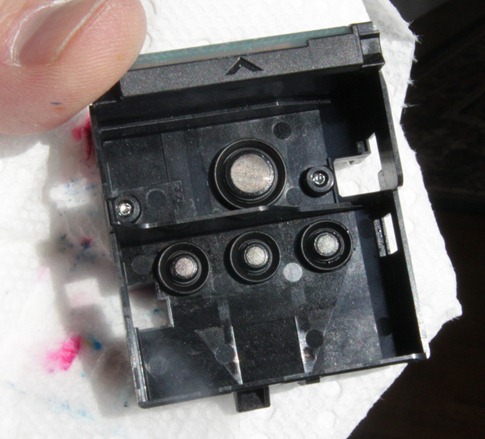
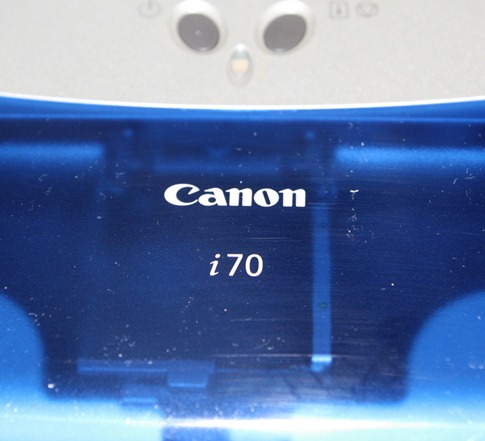
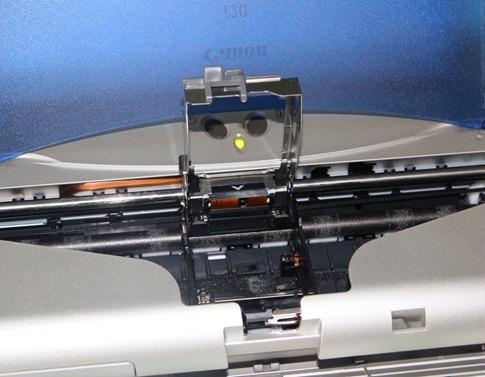
IMG_4683Once upon a time, I packed a small portable printer — Canon i70 — in my car when I traveled, but found it to be a hassle to keep it working. Fast forward to 2011 and I have found a possible use for a small lightweight printer – on the boat. Who knows if it is worth trying to keep a printer working onboard, but since it has been just sitting around collecting dust, it is worth giving it a try. IMG_4688

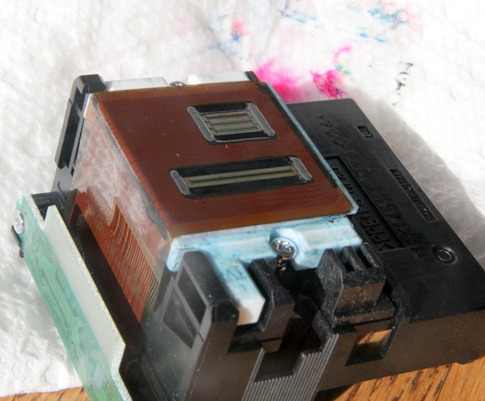
The first of a couple of problems were the dried up ink cartridges: easy to correct, pitch the old and buy two new semi-expensive name brand replacements at one of the big box office stores (I didn’t want to wait around or could have shopped online). Problem number two, the printheads (particularly the Magenta) were plugged with ink causing spotty or no ink coverage. Often running the maintenance cycle or deep cleaning cycle will repair this, but many times it will not. Seeing that new printheads can nearly run the cost of a new printer, an attempted cleaning was in order.

IMG_4690 IMG_4685

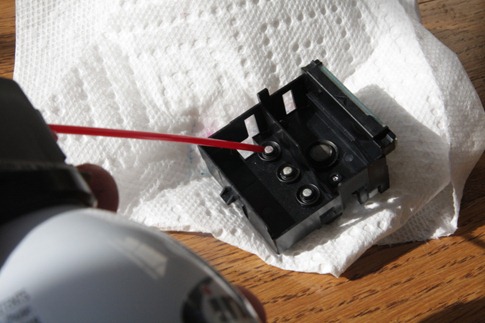
I used isopropyl alcohol dabbed on the small screen area with a swab and a saturated paper towel on the bottom. Once the alcohol has cleaned most of the ink, try a little compressed air on each of the printheads. This will force the solvent (alcohol) and liquid inks through the printhead; it may also take several cleaning attempts to get all of the ink cleaned out. After a quick reassemble and both and alignment check my Canon i70 is working again.

IMG_4692 IMG_4691

Oriental, NC dock with a little snow

Posted By on January 15, 2011

Should left turns be illegal? (an Autoblog repost)

Posted By on January 14, 2011

I’ve posted regarding the superstreet intersections being constructed in Ohio and have wondered just how many more accidents are happening? According to the research, not having to turn left (and making a planned U-Turn instead) “reduce” accidents by 63%. Hmm … perhaps once we adjust to them, I’ll fell like they are an improvement, but currently approaching one on a dark, rainy and glary night can be confusing.

If you sit down and think about it, the notion of making a left turn across oncoming traffic at a stoplight is pretty absurd. All that stands between you and certain oblivion is the hope that other drivers headed your direction are obeying the speed limit and paying enough attention to notice when the light turns red.

Traffic engineers have known for years that hanging a left increases the likelihood of an accident and wastes fuel. The minds at UPS have even gone so far as to design their delivery routes with fewer left turns, and transportation departments all over the country have adopted so-called “superstreets” that force drivers to make a right and then a U-turn in order to go left or straight.

Sound absurd? Think again. According to Smithsonian Magazine, researchers at North Carolina State University have found that the superstreet design is more efficient and safer than allowing drivers to turn across traffic. After examining data from 13 superstreet intersections and comparing them to their traditional counterparts, researchers found that, on average, the superstreets delivered a 20-percent decrease in travel time and caused 46 percent fewer reported traffic collisions. More importantly, the superstreet design caused 63-percent fewer accidents that resulted in personal injury.

There’s some food for thought the next time you’re hanging a left.

[Source: Smithsonian Magazine | Image: North Carolina Department of Transportation]

Posted via email from RichC’s posterous

Gary Sinise & The Lt. Dan Band to return to EAA Airventure 2011

Posted By on January 14, 2011

Good news for those who enjoyed the music of the Lt. Dan Band last year at Airventure. The EAA Warbirds of America and Disabled American Veterans who sponsored the band in 2010 have decided to do it again in 2011.

EAA AVIATION CENTER, OSHKOSH, Wis. — (Jan. 6, 2011) — Back by popular demand, actor and veterans advocate Gary Sinise and the Lt. Dan Band will return to EAA AirVenture in 2011 as the grand finale of a day-long salute to veterans on Friday, July 29. The 59th annual edition of "The World’s Greatest Aviation Celebration" will be held July 25-31 at Wittman Regional Airport in Oshkosh.

Performing at AirVenture for the second consecutive year and third time since 2008, the band will take to the Theater in the Woods stage for an evening concert hosted by EAA Warbirds of America and Disabled American Veterans. Last year’s concert drew more than 6,000 attendees and again will be the highlight of a veteran-focused day. Further details will be announced as they are finalized.

Sinise, who is best known for his role as Vietnam veteran Lt. Dan Taylor in the classic film "Forrest Gump" and as star of the hit TV series "CSI: New York," plays bass in the Lt. Dan Band and is a well-known supporter of veterans as well as active-duty military.

"We are thrilled to welcome back Gary Sinise and the Lt. Dan Band to AirVenture," said Tom Poberezny, EAA and AirVenture chairman. "Gary Sinise has been a tremendous supporter of our veterans and active duty military personnel and we’re proud to have the opportunity to join Gary in thanking our veterans for their service to our nation."

"The genuine interest Gary Sinise shows for our veterans fits perfectly with our objectives to pay tribute to our veterans at EAA AirVenture on July 29," said Rick Siegfried, EAA Warbirds of America president.

The Lt. Dan Band covers everything from Bruce Springsteen to Linkin Park, Aretha Franklin to Jimi Hendrix. Following the band’s first hit concert at Theater in the Woods in 2008, EAA Warbirds of America and Disabled American Veterans teamed up to sponsor the band’s return in 2010 and again this year.

"Gary Sinise is a longtime advocate for Disabled American Veterans and continues to shine the light on our mission to build better lives for America’s disabled veterans," said Wallace E. Tyson, DAV National Commander. "As a patriotic and family friendly venue, EAA AirVenture is an ideal setting to feature the Lt. Dan Band."

The 1.2 million-member Disabled American Veterans, a non-profit organization founded in 1920 and chartered by the U.S. Congress in 1932, represents this nation’s disabled veterans. It is dedicated to a single purpose: building better lives for our nation’s disabled veterans and their families.

EAA Warbirds of America is a non-profit organization and division of EAA that is dedicated to the preservation of former military aircraft, better known as "warbirds." Since 1964, EAA Warbirds of America has worked to "Keep ’em Flying."

AirVenture 2011 has been classified a Tier 1 event by the U.S. Navy as it celebrates the Centennial of Naval Aviation throughout next year. Several top-level attractions will commemorate this notable anniversary as well as 100th anniversary of air mail service. Special themed days planned are "Tribute to Bob Hoover" Day on Tuesday, July 26, Navy Day on Wednesday, July 27, and "Tribute to Burt Rutan" Day on Thursday, July 28.

Advance purchase admission tickets and camping for AirVenture 2011 are now available at a discounted rate at www.airventure.org/tickets.

More on the 2012 Volkswagen Passat TDI

Posted By on January 13, 2011

passat2012

As mentioned the other day, the 2012 Volkswagen Passat will be built on a new platform in Chattanooga, Tennessee and be available with the very efficient and desirable TDI diesel engine. According to what I’ve read on other blogs, the published fuel economy will be 43 mpg on the highway and will be offered with the DSG transmission as an option – hinting that we might get a manual stock [or maybe not, see EDIT below]?

passatinterior

Additionally, VW notes that the DSG transmission is optional, which suggests to us that the 2012 Passat TDI would be available with the same 6-speed manual transmission available on the Jetta.  If the Passat TDI does return with a manual transmission option it will be the first time in 14 years since a diesel and a stick were available together in the US market – 1997 was the last year of the B4 Passat TDI.

A Quick Review of the 2.0 Passat TDI Specs as they currently stand:

  • Common Rail, Direct Injection
  • 236 lbs/ft torque
  • 140 horsepower
  • 43 Highway MPG
  • 18.1 Gallon Fuel Tank

LINK

EDIT: Saw this on Friday 1/14/2011 and began rethinking … maybe Passat will not be offered with a diesel here in the US right away?

Drivetrain: 170-hp, 2.5-liter five-cylinder with five-speed manual or six-speed automatic; 140-hp, 2.0-liter turbo-diesel four-cylinder with six-speed DSG making 236 lbs.-ft. of torque; 280-hp, 3.6-liter V-6 with six-speed DSG

Whoops … FedEx missed the driveway. Now what?

Posted By on January 12, 2011

fedex_spinning

It will be interesting to see if the FedEx driver delivering to our home on Tuesday will voluntarily make note of this “error in judgment” … or if the little off-roading incident will go unmentioned? I’ll need to check on things when the snow melts, but perhaps someone reading this knows how it is best handled?

Fedx_offdrive_4671 Fedx_offdrive_4678

I think I’ll archive a couple security photos to my blog just in case there is an issues with the lawn repair … of course they may say I should have put in driveway markers?

Fedx_offdrive_4679 Fedx_offdriveway_4680

Learning a bit more about the “4G” network hype

Posted By on January 11, 2011

While staying on the smartphone subject trend, I’ve been curious as to where the market is going besides the phone’s hardware and operating system – yesterday’s grumbling about HP/Palm and webOS. The devices is only 3g4gcomparisonhalf the picture and far less of the investment – the carrier may be the game changer.

In reading a bit about the confusing hype around “4G” networks, Popular Science points out that it “can mean many different things,” depending on the network and carrier. Here’s a good breakdown, although one is probably best to analyze coverage and the total commitment and price in the area where you intend to use your phone or data card.

Essentially there are three types of networks the carriers are currently calling 4G: HSPA+ (High Speed Packet Access Plus), LTE (Long Term Evolution) and Wi-Max. And each carrier uses a different one (or a combination of two or more). You’re probably already familiar with the GSM/CDMA divide, with Verizon and Sprint on CDMA and AT&T and T-Mobile on GSM. The difference between the 4G networks works in a similar same way.

Verizon: As you’ve probably seen via their recent marketing blitz, Verizon’s moving fast with their next-generation LTE network, which is actually based on GSM technology (an interesting change, because Verizon’s 3G network is CDMA/EV-DO). The network is largely deployed already (Verizon’s current count is 38 major cities and 60 airports). LTE’s capacity is huge: Verizon boasts download speeds of 5-12 Mbps, which is on par with a standard home broadband connection. Another benefit of LTE is that it’s an entirely different network than VZW’s CDMA 3G, which means the chances of overcrowding are lower.

AT&T: AT&T is also rolling out LTE, but not yet: today they dropped a cagey "mid-2011" date for an initial LTE rollout (in a limited selection of cities, to be sure). They hope to be done with their LTE rollout "by the end of 2013." In the meantime, AT&T is calling their enhanced HSPA+ network "4G." HSPA+ is at its core the same protocol used by their current 3G network, just with added capacity. HSPA+ is the slowest of the three main 4G options. Today’s AT&T phone announcements are the first hardware devices to take advantage of the HSPA+ network, and AT&T is still fairly cagey about their 4G coverage map. Basically, AT&T is playing catch-up.

T-Mobile: T-Mo is further along with their HSPA+ than AT&T, currently claiming "over 100 major metropolitan areas" with coverage. So while their enhanced 3G network is fairly beefy and you can use it today on a variety of phones and laptop cards, they currently have no solid LTE or Wi-Max plans for the United States.

Sprint: Sprint is the only major player that stuck with Wi-Max, another GSM-based protocol that was an early contender for a 4G wireless broadband standard. Generally speaking it’s faster than HSPA+ but not as fast as LTE. Sprint has had 4G hardware available for several months to take advantage of this network, including the HTC Evo 4G smartphone and a variety of modems and dongles.

Phew! As you can see, the 4G landscape is pretty crazy. Another interesting thing to consider: moving from 3G to 4G connectivity is more of a hassle when the two networks’ protocols are different. If you drop out of a 4G zone on Sprint, for instance, your device has to switch to a different type of radio band to re-connect to the CDMA/EV-DO 3G network. On T-Mobile’s (and presumably AT&T’s) HSPA+ networks, this is less of an issue.

Desultory - des-uhl-tawr-ee, -tohr-ee

  1. lacking in consistency, constancy, or visible order, disconnected; fitful: desultory conversation.
  2. digressing from or unconnected with the main subject; random: a desultory remark.
My Desultory Blog