PacMen of the Galaxy
Posted By RichC on January 9, 2006
In attempts to stay in sync with my daughter’s astronomy study, I’ve been doing some reading and learning. I’m barely scratching the surface in understanding this field, but find it very interesting. Our Milky Way is a phenomial site whether looked at in photos, viewed from a home telescope, or explored with the the extrodinary images returned by the Hubble Space Telescope.

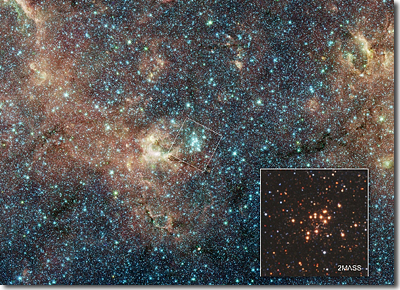
The above is just a tiny section of the galaxy in an area sometimes referred to as the ‘Bermuda Triangle’ that was taken as a 2 Micron All Sky Survey (2MASS) in a project called GLIMPSE (Galactic Legacy Infrared Mid-Plane Survey Extraordinaire).
A team of astronomers at the Space Telescope Science Institute in Baltimore, Md. believe they now closer to solving the intriging mystery know as the ‘warping of a galaxy’ with images such as these. At first they believed that Magellanic Clouds caused the warping but the mass was determined to be too small to be creating the large ‘bend.’ Although the mass is small, the Magellanic Clouds pass through the dark matter and create a cosmic wake powerful enough to make our galaxy bend and flap.
They have also idenified a massive star clusters in the galaxy that they believe may provide evidence that large clusterings of stars can ‘pull in’ the galaxy. In the above photo, a cluster of stars, each about 20 times more massive than sun, pull in on a galaxy. This cluster in particular is home to 14 red supergiants which are stars that are nearing the end of their lives. As they near the end, they begin to enlarge in size, ‘voraciously’ pulling in the galaxy before eventually exploding as a supernova.
Although this ‘warping of galaxies’ is not new, as scientists have known about the Milky Way’s warped nature for half a century, they have had difficulty confirming the cause.
The cluster of stars above lies 18,900 light-years away (a light year is about 6 trillion miles) in the direction of the constellation Scutum. It is the first in a survey of 130 potentially massive star clusters in the Milky Way that astronomers will study over the next five years using a variety of telescopes, including the Spitzer and Hubble space telescopes.
The Spitzer image was taken April 4, 2004; the 2MASS image (above) on July 4, 1999. (click here for a printable 8-1/2 x 11 view of the Massive Star Cluster) image below.




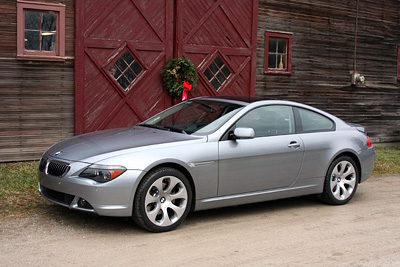
 First, it is a luxury car. The power mega-way leather seats adjust quickly to a perfect drivers position for me and I immediately felt comfortable behind the wheel. Controls are not overdone and look very appealing. The “
 What doesn’t take getting use to is the powerful 4.8 liter Double-VANOS steplessly variable valve timed V-8; it is a engine that belongs in this Bengal tiger! It accellerates quickly and kept the 18 inch alloy wheels and 245/45R-18 all-season run-flat tires stuck to the pavement … with a little assist from the Dynamic Traction Control. I wasn’t watching the speedo, but the seat of the pant feel confirms the 6-speed SMG transmission rocketed this luxury car to 60 in its stated 5.3 seconds, I think. What stood out most was just how quiet the car was even while accelerating hard as the cabin is best defined as ‘hushed.’ I was shocked several times when I glanced at the tach to see rpm’s up around 5 and 6000 … you couldn’t tell from inside the car. I could continue to rave about all the features that ease the driver’s load, but just check out the

 First my apologies for my lack of Christmas blogging for those who might occasionally read my desultory posts … although I can’t imagine why one would miss them.