Christopher Hitchens dies at 62

Posted By on December 16, 2011

Christopher Hitchens, the author, essayist and polemicist who waged verbal and occasional physical battle on behalf of causes left and right and wrote the provocative best-seller “God is Not Great,” died Thursday night after a long battle with cancer. He was 62.

more at WSJ.com.

Mitt Romney for President is just fine with me

Posted By on December 15, 2011

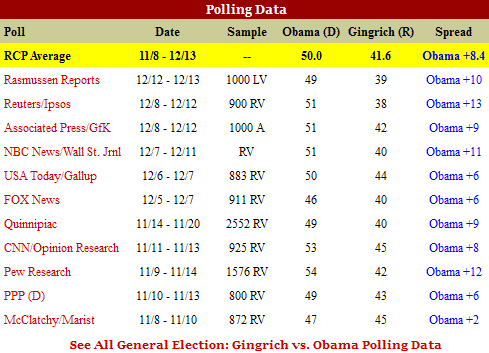
Well I was going to wait until closer to the Republican primary in Ohio (3/6/2012) to decide which candidate was best to run against the president, but after seeing recent polling, the candidate is obvious. When polls pitting Newt Gingrich against the sitting President Obama, the numbers indicate the President may have an easy re-election, in that case the only real option for the GOP is Mitt Romney … and personally, that’s fine with me (my reasons below).

polls_obamagingrich111214

First, Mitt Romney’s character is about as solid as they come for politicians. It wouldn’t be appropriate to say that his integrity is on the level of a Washington or Lincoln, but his moral compass is intact. No one has characterized him as corrupt or questioned his devotion to family, faith or country … therefore in my eyes he is way ahead of most others seeking office.

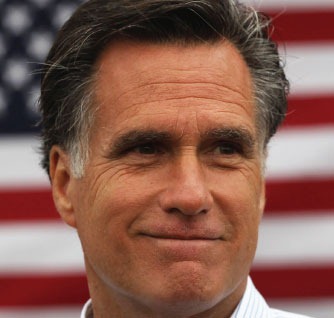
mittromneyheadshotHe also has demonstrated that he understands both the economy and American business … and government’s place in a free society. Besides growing up in a business family, he has managed businesses as well as asked to help salvage the 2002 Olympics. He has also functioned at a Republican governor of the liberal state of Massachusetts. This executive branch position required far more tact and negotiation with an opposing party than governing in a one party controlled state. His ability to function and get work done may be useful in Washington DC considering what we’ve seen in the past two administrations.

How does Mitt Romney propose dealing with our #1 issue, the economy? According to what I absorbed from his 59 point plan, he would start by making the U.S. business friendly. His sharp criticism of China for currency manipulation may not gain traction since no one wants a trade war, but his push to lower the corporate tax rate from 35 percent to 25 percent would put the United States in a more competitive position. Romney want to streamline much of the business red tape which will not only help corporations, but small businesses which have become the growth energycomparison1engine of our nation. Speaking of red tape, he also proposes to dismantle much of Dodd-Franks, something that will make business more competitive and make more capital available. U.S. jobs here is better than companies sending them overseas.

Energy continues to dog our country as well. Although I’m anxious for day we are less reliant on fossil fuel, there is no denying that we suffer economically if our energy cost is artificially higher because of unrealistic policies. The rotation from oil and coal in the U.S. is a great goal, but not at the expense of our citizens and businesses. We need to continue to use all sources of energy and let them compete with each other without picking winners and losers from Washington DC. Romney position is to allow oil drilling “wherever it can be done safely.” His plan is to “fast-track the process for approving energy permits, and streamline the approval of new nuclear reactors.”

Romney has also pledged to keep taxes where they are today by making the Bush-era/Obama temporary renewal rates permanent. As a way to address retirement saving shortfalls, spendmorethanwetakeinhe also plans to eliminate double taxation policy of the estate tax and zero out the capital gains taxes for those with incomes below $200,000 (Millionaires need not apply). His eventually goal … probably a pipe dream … is to eventually reform the tax code by simplification and flattening the rates – fairer.

A touchy subject is of course is how to best deal with Medicare and Social Security. Although I haven’t figured out where he comes in on Medicare (his Obamacare problem, perhaps?), he has suggested that he would be considering raising the retirement age and reducing benefits to wealthier retirees in order to preserve the current Social Security program. The shared pain approach is realistically the only way forward since everyone knows we can’t continue without change.

cutthespending

As for the Tea Party movements hot button issue of Obama’s sweeping healthcare reform, Romney said he would repeal it. One can only go on his word that he believe states have that right, but not the federal government. If change needs to be implemented in order to control cost and assure all Americans get care, a state based solution may be the right step? One of the areas of healthcare he want to address (left out of even the all encompassing Obamacare) is medical malpractice lawsuits. Romney wants to rein in medical malpractice lawsuits and other types of litigation that cost companies billions of dollars and often drive up prices, but he many not have much impact since his position is that these decisions should be at the state levels.

Foreign policy may be Romney’s Achilles heel in that he has yet to be exposed to decisions that can all consume a president. Personally the security of our country was my biggest fear with President Obama, but thankfully he rose to the occasion. On the other hand, having bright advisors and good judgment may be more important than having a little bit of personal experience? In reading Mitt Romney’s white paper makes me realize the depth of planning he already has in place and that he has already shown the kind of executive level of leadership required to put together a Whitehouse. America could (and has these past 3+ years) have a less qualified leader serving as our president.

polls_obamaromney111214
RealClearPolitics Polls 12/12/2011

NTSB recommends banning cellphone use while driving

Posted By on December 14, 2011

womanoncellA real hot button topic is being discussed after the National Transportation Safety Board (NTSB) recommended banning portable electronic devices such as cellphones from being used by drivers of automobiles. Distracted driving is fast becoming the seatbelt or drunk driving issue of the day. As someone who spends a significant amount of time on the road and has owned and used a mobile phone since before they were call “cellular,” I can say that the convenience of using a phone while driving would be missed. Admittedly I recognized that anything that distracts a motorist from the task of driving the car increases the risk of an accident, but I’m still against an out and out ban.

…the National Transportation Safety Board (NTSB) called for the first-ever nationwide ban on driver use of personal electronic devices (PEDs) while operating a motor vehicle.

The safety recommendation specifically calls for the 50 states and the District of Columbia to ban the nonemergency use of portable electronic devices (other than those designed to support the driving task) for all drivers. The safety recommendation also urges use of the NHTSA model of high-visibility enforcement to support these bans and implementation of targeted communication campaigns to inform motorists of the new law and heightened enforcement.

One of the more difficult problems in enforcing the “no distracted driving” push is how to enforce drivers from using cellphones. Restricting the use of cellphones through technological means seems a bit draconian since the “non-driver” shouldn’t be restricted in my opinion – of course our big government movement could be adopting the aviation industry’s no portable electronic devices position. Having a traffic stop based on a cellphone electronic signature is equally storm trooper-ish … although after an accident I can see that punitive damages may be an option? Just as fines go up in construction zones, perhaps fines and penalties raised for those using electronic communication devices may be the answer, although if we “must” go this route how about encouraging the private industry route. What I mean is let the consumers choose an auto insurance company that discounts based on those drivers who don’t use a phone while they drive … sort of the Gecko characters position on radar detectors.

I assume this ban would impact the entire mobile radio business for trucks, constructions, and for the use of law enforcement “non-emergency” radio while driving?  From the sounds of it, it will also have to include amateur and CB radio as well? As the trend toward embedded iPad-like dashboards continue, perhaps these devices will be the next target.

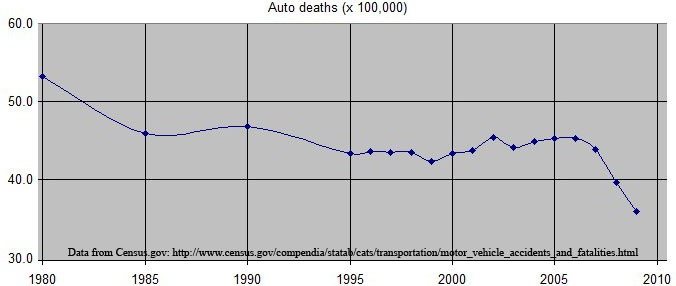
autodeaths19802010

Besides embedding a CBNC video below, I thought it interesting to look, even with the increased use of cellphones and connected devices, how much safer we are on the roads today than in the past. (Census Info) Food for thought before we legislate more of our personal freedoms away.

Video: A feel good story for Humpback Whale lovers

Posted By on December 14, 2011

Microsoft Co-Founder to Build Massive Jet for Space Launches

Posted By on December 13, 2011

Without NASA, the private sector has a bigger incentive to step up …

Space Jet

Microsoft Corp. co-founder Paul Allen says he will use his wealth to build the world’s largest airplane as a mobile platform for launching satellites at low cost, which he believes could transform the space industry.

Slated to be announced Tuesday, the novel, high-risk project conceived by renowned aerospace designer Burt Rutan seeks to combine engines, landing gears and other parts removed from old Boeing 747 jets with a newly created composite craft and a powerful rocket to be built by a company run by Internet billionaire and commercial-space pioneer Elon Musk.

Dubbed Stratolaunch and funded by one of Mr. Allen’s closely held entities, the venture seeks to meld decades-old airplane technology with cutting-edge booster-rocket designs in an unprecedented way to assemble a hybrid that would offer the first totally privately funded space transportation system.

Posted via email from RichC’s posterous

Apple looking to make a $400 million buy?

Posted By on December 13, 2011

With the “in the news” section of Anorbit a bit quiet, the rumor that Apple may be buying the company makes the story a bit more interesting. There might be a good reason for cash rich Apple to begin acquiring a few more of the parts they need to assure production continues for their hot selling MacBook Airs, iPhones and iPads … owning a solid state storage company makes sense.

Anobit’s MSP™-powered MSP20xx embedded flash controllers are the industry’s highest performance embedded flash controllers for Smartphones and Tablet computers, supporting sub-20nm MLC (two bits-per-cell) and TLC (three bits-per-cell) NAND flash.

Key Features

  • 666 MB/s data transfer rate

  • Ultra low power consumption

  • Supports up to 256 GB / 16 dies of NAND flash

  • Supports 20nm and sub-20nm NAND flash

  • Dual host interface

Boeing nabs big Southwest order for 737 jets

Posted By on December 13, 2011

Boeing ($BA) just confirmed their largest firm order to date from Southwest ($LUV) with an order for 150 Boeing 737 Max jets (just announced). The deliveries slated to start in 2017 will secure Southwest Airlines as the largest 737 carrier.

U.S. discount carrier Southwest Airlines Co. is in talks with Boeing to order 100 to 150 of the 737 Max and might announce the deal in the coming weeks, people familiar with the matter said last week.Boeing has said it is expecting its first firm order for the new plane before the end of this year. The aerospace company on Monday revealed the first list prices for the 737 Max. Prices, on average, range from $77.7 million for the smallest planned version of the jet to $101.7 million for the largest. Customers, however, typically negotiate discounts off list prices when placing orders.

via Boeing Cites More Interest in Updated 737 – WSJ.com.

Video: Australian Cattle Dogs

Posted By on December 12, 2011

CattleDogsVideo_lookslikeToDuring a little channel surfing this weekend spotted an interesting and educational segment on Australian Cattle Dogs. It interested me because our 14 year old Tootsie is Blue Heeler and the comments were very characteristic of her breed. She is a good pet, but I can attest to the warning regarding “need for exercise” and tendency to “herd” everything – in our case everything from a large yoga ball to small children … often by “nipping at their heels!”

Still, she is my kind of breed and does a good job of patrolling our property, hunting for odds and end scraps including birds, rabbits, foxes, “old” coyotes and mink … AND she does a good job of protecting her family.

WebOS survives as open source; HP phone hardware? Doubtful.

Posted By on December 11, 2011

The big news from HP’s CEO Meg Whitman this past week is that the operating system they acquired when purchasing Palm last year will remain alive … hpdesertroadjust in a different form than originally intended. WebOS will soon beopen source to its Linux core.” Some see that as a good thing in hopes that there will be a community who will rally around such a thing. Others see it as too late; consumers, programmers and equipment manufacturers have already embraced a mobile and tablet OS platforms and will find it hard pressed to switch unless there is a good reason.

I’d like to remain optimistic but a few remarks from Ms. Whitman have left me decidedly lukewarm. I applaud the fact that webOS will survive, but with support from HP on the backburner … Android and Apple’s iOS leap to an even a bigger lead. She also commented that any hardware support would most likely be in the tablet form and stated, “I do not believe we will be in the smartphone business again.” As an early adopter and happy Palm Pre webOS smartphone user … that’s disappointing.

Still … take a victory when it comes — webOS remains alive! The future over the next couple years will likely see limited growth until someone decides there is enough of a market to make a buck.

How Doctors Die

Posted By on December 10, 2011

What treatments do doctors seek when they get sick? That’s the basis of an article my daughter read to me this week while we were heading out to dinner … it is sobering.

Ken Murray’s article in Zócalo Public Square is something I found thought provoking when considering just how far “we” want doctors and hospitals to go in their attempts to “save” us. It is worth reading and thinking about before having to make those difficult decisions (I’m archiving the article below unless requested to remove … just in case the link disappear).

How Doctors Die

Years ago, Charlie, a highly respected orthopedist and a mentor of mine, found a lump in his stomach. He had a surgeon explore the area, and the diagnosis was pancreatic cancer. This surgeon was one of the best in the country. He had even invented a new procedure for this exact cancer that could triple a patient’s five-year-survival odds—from 5 percent to 15 percent—albeit with a poor quality of life. Charlie was uninterested. He went home the next day, closed his practice, and never set foot in a hospital again. He focused on spending time with family and feeling as good as possible. Several months later, he died at home. He got no chemotherapy, radiation, or surgical treatment. Medicare didn’t spend much on him.

It’s not a frequent topic of discussion, but doctors die, too. And they don’t die like the rest of us. What’s unusual about them is not how much treatment they get compared to most Americans, but how little. For all the time they spend fending off the deaths of others, they tend to be fairly serene when faced with death themselves. They know exactly what is going to happen, they know the choices, and they generally have access to any sort of medical care they could want. But they go gently.

Of course, doctors don’t want to die; they want to live. But they know enough about modern medicine to know its limits. And they know enough about death to know what all people fear most: dying in pain, and dying alone. They’ve talked about this with their families. They want to be sure, when the time comes, that no heroic measures will happen—that they will never experience, during their last moments on earth, someone breaking their ribs in an attempt to resuscitate them with CPR (that’s what happens if CPR is done right).

Almost all medical professionals have seen what we call “futile care” being performed on people. That’s when doctors bring the cutting edge of technology to bear on a grievously ill person near the end of life. The patient will get cut open, perforated with tubes, hooked up to machines, and assaulted with drugs. All of this occurs in the Intensive Care Unit at a cost of tens of thousands of dollars a day. What it buys is misery we would not inflict on a terrorist. I cannot count the number of times fellow physicians have told me, in words that vary only slightly, “Promise me if you find me like this that you’ll kill me.” They mean it. Some medical personnel wear medallions stamped “NO CODE” to tell physicians not to perform CPR on them. I have even seen it as a tattoo.

To administer medical care that makes people suffer is anguishing. Physicians are trained to gather information without revealing any of their own feelings, but in private, among fellow doctors, they’ll vent. “How can anyone do that to their family members?” they’ll ask. I suspect it’s one reason physicians have higher rates of alcohol abuse and depression than professionals in most other fields. I know it’s one reason I stopped participating in hospital care for the last 10 years of my practice.

How has it come to this—that doctors administer so much care that they wouldn’t want for themselves? The simple, or not-so-simple, answer is this: patients, doctors, and the system.

To see how patients play a role, imagine a scenario in which someone has lost consciousness and been admitted to an emergency room. As is so often the case, no one has made a plan for this situation, and shocked and scared family members find themselves caught up in a maze of choices. They’re overwhelmed. When doctors ask if they want “everything” done, they answer yes. Then the nightmare begins. Sometimes, a family really means “do everything,” but often they just mean “do everything that’s reasonable.” The problem is that they may not know what’s reasonable, nor, in their confusion and sorrow, will they ask about it or hear what a physician may be telling them. For their part, doctors told to do “everything” will do it, whether it is reasonable or not.

The above scenario is a common one. Feeding into the problem are unrealistic expectations of what doctors can accomplish. Many people think of CPR as a reliable lifesaver when, in fact, the results are usually poor. I’ve had hundreds of people brought to me in the emergency room after getting CPR. Exactly one, a healthy man who’d had no heart troubles (for those who want specifics, he had a “tension pneumothorax”), walked out of the hospital. If a patient suffers from severe illness, old age, or a terminal disease, the odds of a good outcome from CPR are infinitesimal, while the odds of suffering are overwhelming. Poor knowledge and misguided expectations lead to a lot of bad decisions.

But of course it’s not just patients making these things happen. Doctors play an enabling role, too. The trouble is that even doctors who hate to administer futile care must find a way to address the wishes of patients and families. Imagine, once again, the emergency room with those grieving, possibly hysterical, family members. They do not know the doctor. Establishing trust and confidence under such circumstances is a very delicate thing. People are prepared to think the doctor is acting out of base motives, trying to save time, or money, or effort, especially if the doctor is advising against further treatment.

Some doctors are stronger communicators than others, and some doctors are more adamant, but the pressures they all face are similar. When I faced circumstances involving end-of-life choices, I adopted the approach of laying out only the options that I thought were reasonable (as I would in any situation) as early in the process as possible. When patients or families brought up unreasonable choices, I would discuss the issue in layman’s terms that portrayed the downsides clearly. If patients or families still insisted on treatments I considered pointless or harmful, I would offer to transfer their care to another doctor or hospital.

Should I have been more forceful at times? I know that some of those transfers still haunt me. One of the patients of whom I was most fond was an attorney from a famous political family. She had severe diabetes and terrible circulation, and, at one point, she developed a painful sore on her foot. Knowing the hazards of hospitals, I did everything I could to keep her from resorting to surgery. Still, she sought out outside experts with whom I had no relationship. Not knowing as much about her as I did, they decided to perform bypass surgery on her chronically clogged blood vessels in both legs. This didn’t restore her circulation, and the surgical wounds wouldn’t heal. Her feet became gangrenous, and she endured bilateral leg amputations. Two weeks later, in the famous medical center in which all this had occurred, she died.

It’s easy to find fault with both doctors and patients in such stories, but in many ways all the parties are simply victims of a larger system that encourages excessive treatment. In some unfortunate cases, doctors use the fee-for-service model to do everything they can, no matter how pointless, to make money. More commonly, though, doctors are fearful of litigation and do whatever they’re asked, with little feedback, to avoid getting in trouble.

Even when the right preparations have been made, the system can still swallow people up. One of my patients was a man named Jack, a 78-year-old who had been ill for years and undergone about 15 major surgical procedures. He explained to me that he never, under any circumstances, wanted to be placed on life support machines again. One Saturday, however, Jack suffered a massive stroke and got admitted to the emergency room unconscious, without his wife. Doctors did everything possible to resuscitate him and put him on life support in the ICU. This was Jack’s worst nightmare. When I arrived at the hospital and took over Jack’s care, I spoke to his wife and to hospital staff, bringing in my office notes with his care preferences. Then I turned off the life support machines and sat with him. He died two hours later.

Even with all his wishes documented, Jack hadn’t died as he’d hoped. The system had intervened. One of the nurses, I later found out, even reported my unplugging of Jack to the authorities as a possible homicide. Nothing came of it, of course; Jack’s wishes had been spelled out explicitly, and he’d left the paperwork to prove it. But the prospect of a police investigation is terrifying for any physician. I could far more easily have left Jack on life support against his stated wishes, prolonging his life, and his suffering, a few more weeks. I would even have made a little more money, and Medicare would have ended up with an additional $500,000 bill. It’s no wonder many doctors err on the side of overtreatment.

But doctors still don’t over-treat themselves. They see the consequences of this constantly. Almost anyone can find a way to die in peace at home, and pain can be managed better than ever. Hospice care, which focuses on providing terminally ill patients with comfort and dignity rather than on futile cures, provides most people with much better final days. Amazingly, studies have found that people placed in hospice care often live longer than people with the same disease who are seeking active cures. I was struck to hear on the radio recently that the famous reporter Tom Wicker had “died peacefully at home, surrounded by his family.” Such stories are, thankfully, increasingly common.

Several years ago, my older cousin Torch (born at home by the light of a flashlight—or torch) had a seizure that turned out to be the result of lung cancer that had gone to his brain. I arranged for him to see various specialists, and we learned that with aggressive treatment of his condition, including three to five hospital visits a week for chemotherapy, he would live perhaps four months. Ultimately, Torch decided against any treatment and simply took pills for brain swelling. He moved in with me.

We spent the next eight months doing a bunch of things that he enjoyed, having fun together like we hadn’t had in decades. We went to Disneyland, his first time. We’d hang out at home. Torch was a sports nut, and he was very happy to watch sports and eat my cooking. He even gained a bit of weight, eating his favorite foods rather than hospital foods. He had no serious pain, and he remained high-spirited. One day, he didn’t wake up. He spent the next three days in a coma-like sleep and then died. The cost of his medical care for those eight months, for the one drug he was taking, was about $20.

Torch was no doctor, but he knew he wanted a life of quality, not just quantity. Don’t most of us? If there is a state of the art of end-of-life care, it is this: death with dignity. As for me, my physician has my choices. They were easy to make, as they are for most physicians. There will be no heroics, and I will go gentle into that good night. Like my mentor Charlie. Like my cousin Torch. Like my fellow doctors.

Ken Murray, MD, is Clinical Assistant Professor of Family Medicine at USC.
Desultory - des-uhl-tawr-ee, -tohr-ee

  1. lacking in consistency, constancy, or visible order, disconnected; fitful: desultory conversation.
  2. digressing from or unconnected with the main subject; random: a desultory remark.
My Desultory Blog