Look for Palm webOS 1.4 on February 25th

Posted By on February 24, 2010

Palm Pre and Pixi users have known about and seen many of the new feature in webOS 1.4 demos (flash, video recording) for some time; most of us have been waiting patientlyUpdate App for the announced February 2010 rollout.

According to most blogs and newsy Internet sites, the webOS devices on both Sprint and Verizon networks should look for updates this week. The earlier Sprint rumored February 15th date has passed and the new date being bantered around is February 25th. I’ll be watching the Official Palm Blog, my Update App and for Palm oriented ‘tweets’ for the release.

Nearly One in Four Borrowers Underwater on Mortgage

Posted By on February 23, 2010

Looks like a serious problem for homeowners, mortgage companies and banks alike. It certainly isn’t promising for the new home market either.

Nearly one in four U.S. homeowners with a mortgage owed more than their homes were worth at the end of 2009, underscoring the challenges facing any sustained recovery in consumer spending and housing. Some 11.3 million households had negative equity at the end of the fourth quarter, according to First American CoreLogic, a real-estate information company based in Santa Ana, Calif., up from 10.7 million at the end of the third quarter

Problems are concentrated in the states that have had the biggest home price declines. In Nevada, seven in 10 borrowers were underwater at the end of December, up from 65% three months earlier. Nearly half of all borrowers in Arizona and Florida and one third of borrowers in California owe more than their properties are worth.

“Negative equity is a long-term problem for us,” says Mark Fleming, chief economist at First American CoreLogic. “Some of these markets have lost from their peak 50% of their value. How many years at 5% growth would it take to bring it back?”

High rates of negative equity also raise the specter that more borrowers who can afford their mortgages will choose to walk away from their homes and rent. More than half of all borrowers in Nevada owe at least 25% more than their homes are worth. “People who are vastly underwater will look at what they’re paying compared to what they can rent, and those people are throwing their keys back,” says Daniel Alpert, managing director at Westwood Capital.

A separate study last year by researchers at Experian Information Solutions Inc., a credit-reporting company, and consultants Oliver Wyman Group estimates that 588,000 U.S. mortgage borrowers defaulted strategically in 2008, more than double the year-earlier total. The researchers identified strategically defaulting borrowers as those with perfect payment histories who suddenly stopped making mortgage payments and made no attempt to become current, even as they paid other bills.

Posted via web from richc’s posterous

Second push for near trillion dollar Health Care proposal

Posted By on February 23, 2010

After American citizens were heard ‘loud and clear’ during the Obama administration’s attempt last year to ram though health care reform, the President and a ‘agenda-driven’ liberal congress are planning to give it another go. StethIn a feeble attempt  to cloak the “retooled $950 billion health care plan” and continual expansion of government as “bi-partisan,” President Obama has extended an invitation to Republicans to consult over his plan on Thursday. Personally I think it is just a rouse to find a couple votes, since if this were truly a bi-partisan approach, it would include ideas from both parties. From a cursory reading of the President’s proposal, I would have thought the administration would have shown that they heard the citizens …  and might have included some fiscal restraint, or at minimum offered up convincing and palatable numbers of how they plan to pay for the massive changes. The plan does little to keep government small, accountable and out of an individual’s life; instead of being strictly in the oversight role and empowering competition through free markets for best prices/best quality, they regulate with bureaucrats, expand governments power over private industry and reduce a citizen’s liberty — along with increase taxes selectively based on their philosophy of social and economic justice.

Unfortunately, the President’s current proposal is just a redraft of what already caused so much uproar. The slick marketing and misleading answers to questions does little to instill confidence that “choice” will really be much of an option when a business providing better health care plans are “Cadillac taxed” and have to compete will companies providing the minimums — why pay those 40% taxes to buy a better plan … and when they don’t, who’ll pick up that 40% that was calculated into the cost of the new legislation?

If we’re talking real reform and bi-partisan reform, the where is the tort reform, the competition from insurance plans across the country or between states? Where is the evidence that government control over health care will save money and improve care for Americans?

I knew my friend Steve Moore would be on TV this morning, so I set up the Tivo to record his appearance (above). As a respected economist and WSJ reporter,  I appreciate his insight on these matters. Although h  has a fiscally-conservative bias and isn’t confident government has proven it can spend wisely, he understands the economic  side of the health care equation better than most and is worth listening to when it comes to fiscal sense.

My fear is that if Washington forces through the current proposal which is frighteningly similar to the 2000+ page bills we’ve already seen, Americans in the long run will pay dearly for socialization of health care in both dollars and quality of care.

How upset with the bank and the IRS does one have to be?

Posted By on February 23, 2010

I don’t pretend to understand how a man concludes that crashing plane crash austin1an airplane into an IRS building is justified, but I know that stress can push reasonably sane people into saying and doing some pretty radical things. I get pretty worked up over government waste and irresponsible spending, but can’t imagine striking back at innocent people, destroying my own property (below) or taking my own life.

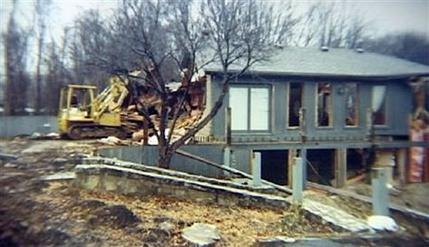
In another case where some believes government (and bankers) have gone too far, Terry Hoskins, east of Cincinnati Ohio, took drastic measures and bulldozed his home to prevent foreclosure.

homemoscowohMOSCOW, Ohio (AP) — An Ohio man says he bulldozed his $350,000 home to keep a bank from foreclosing on it. Terry Hoskins says he has struggled with the RiverHills Bank over his home in Moscow for years and had problems with the Internal Revenue Service. He says the IRS placed liens on his carpet store and commercial property and the bank claimed his house as collateral.

Hoskins says he owes $160,000 on the house. He says he spent a lot of money on attorneys and finally had enough. About two weeks ago he bulldozed the home 25 miles southeast of Cincinnati.

Messages were left for the bank and its attorney.

IRS spokeswoman Jodie Reynolds said individual taxpayer information is private and federal law prevents her from commenting.

Consumers beware: Plastic Money regulations will impact you

Posted By on February 22, 2010

If you are like me, you like having a regular routine to start the day; for me it’s the newspaper, the Gordon Deal podcast, a large cup of coffee and review of my email inbox, although I won’t encourage the large cup of coffee. Today, one of the lead stories in the news pertains to the new rules impacting credit card companies which changes the business of “plastic money.”   creditcards4Personally, I’ve not been all that enthusiastic about ‘change’ since I’ve figured out how to best use credit cards and haven’t been impacted by extreme charges we’ve all heard about … but according to some financial gurus, the new regulation make create unseen consequences for even the most disciplined card users.

Last year prior to our trip to Europe, I researched the significant charges that most credit cards had adopted for Americans traveling overseas. We opted to use the Capital One card at that time since others were adding fees (about 3%) to purchases, and depending on how much one spends, this can make an already costly trip really costly. With the new restrictions in place by congress in order to project consumers from digging their holes too deep, banks and card companies are finding new ways to make up the shortfall. Just as liberal politicians look for new ways to tax, credit card companies are looking for new ways to make a buck – so consumers be weary, there will be new changes coming even for (and particularly for) those of us who pay off balances every month and avoid paying finance charges. I looks as if  new or higher annual fees, reduced perks such as cash back bonuses or points, elimination of teaser rates and overall higher rates will become routine policy. Gone may be the days when those exercising care will be able to use “someone else’s money “ for a month.

One shrewd example I’ve already noticed is an update coming from Chase. The company is automatically “upgrading” our current  PerfectCard Rewards card which chase-sapphire-cardhas traditionally offered a cash back bonus to what their marketing wants you to believe is something better. You bee the judge …  Our Chase PerfectCard Rewards card has been offering us a 5% rebate on gasoline purchases (1% on other items) and has been our our primary card for fuel purchases. The Chase Sapphire card returns to the points structure rather than my preferred “cash” back or rebate. Instead of 5 cents on the dollar for fuel and 1 cent for everything else, 1 point is awarded for every dollar spent. As the marketing clarifies:

Credits begin at 2,500 points for $25.

The “lessor” Sapphire card (in my opinion) is not really an option and will automatically replace our current PerfectCard Rewards card. It almost seems to be marketed (I should have saved the letter) as an elite card similar to the “gold, platinum, diamond, etc” of years past and even leads one to believe that the Sapphire Preferred card might even rival the Coutts, Centurion, Ultima, Chairman, Merrill+, Accolades or Stratus cards offered to the wealthy. One look at what we “had” (below) to what is being force on us with the new Sapphire tells me that new government regulation is going to cost responsible credit card users.

Your Chase PerfectCard™ is just that — Perfect. You earn rebates on all brands of gasoline — not just one brand.

With your Chase PerfectCard, you earn a 5% rebate on all eligible gas purchases at any gas station and a 1% rebate on all other purchases. Your rebate is automatically credited to your monthly statement – no forms to fill out, no keeping track of points.

Earn rebates on all your eligible gasoline purchases and everything else you buy. The more you use your Chase PerfectCard, the more rebates you’ll earn and the payoff is fast and easy.

Digitally reminiscing with Google Maps and Streetview

Posted By on February 21, 2010

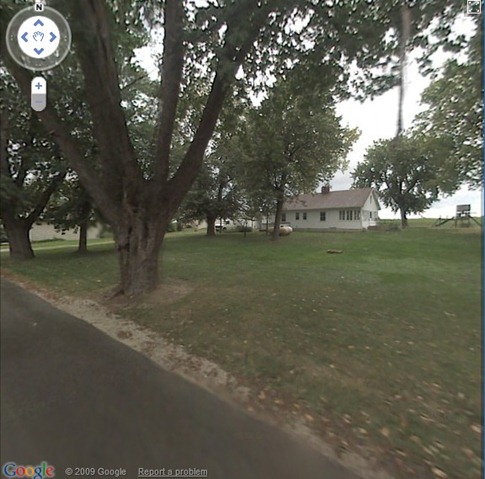
lagoondrivegoogleviewAfter reading an article by Kathleen Hughes in this weekend’s WSJ, I just couldn’t help myself in reminiscing about where I grew up … they were wonderful memories for me – I couldn’t have asked for a better childhood.

Nevertheless, noting the comment about digitally visiting home, I “re-experienced” memories from my childhood taking the Internet journey with Google Maps and Streetview – well the home I remember most, since I moved while in high school. Sadly, the “Streetview” drive was disappointing. The old oil-sprayed gravel road is ‘now paved’ and looks very little like I remember. Several cottages and homes have been torn down as well as the old garage and several trees. I can certainly relate to the “mixed emotions” paragraph of the article, but feel tremendously fortunate to have grown up an lived on the lake in the 1960s and 70s – thanks mom and dad.

Finding Our Way Home

Technology is helping more of us return to the places where we grew up. But when you arrive, will it measure up to your memories?

By KATHLEEN A. HUGHES

‘You can’t go home again,” Thomas Wolfe concluded in his novel of the same name.

But what if you insist on trying?

Visiting a childhood home is something that almost everybody thinks about, and many people eventually do. In fact, in more than a hundred interviews, I found that all but one of the people I talked with had gone back to visit their childhood home. At the very least, many people drive by; some stand outside and stare. Still others write letters to the current owners or are brave enough to knock on the door, requesting a few moments inside.

“It’s a way to re-experience all the feelings of childhood just by being in that space,” says Esther Sternberg, a rheumatologist and author of a new book, “Healing Spaces: The Science of Place and Well-Being.” “There’s a kind of memory that focuses on place.”

Today, the Internet may be inspiring more people to return. Google Maps allows people to see a street view of their old home. Bloggers are posting photos of childhood homes and lengthy stories on sites such as Apartment Therapy (apartmenttherapy.com). And on YouTube, some people are posting videos chronicling the search for their childhood home. One takes the viewer through a forest in Germany, and another travels along a desolate road in Pittsburgh.

While most people say they want to return simply out of curiosity, psychologists say the visits reflect a subconscious desire to bring childhood into perspective as an adult. For baby boomers stressed by aging parents and teenagers, the visits may offer a quick route back to memories of a better time—an era when parents were healthy, families were still intact, children felt loved and the world at least seemed safer than it does now.

Mixed Emotions

Yet when adults finally arrive at their childhood homes, pleasant memories are often mixed with surprising disappointments.

Most homes don’t measure up to the memory. For one thing, childhood homes are usually owned by strangers who have remodeled. But the memory of the original childhood home, just the way it was, never seems to lose ground in the psyche. Discovering that the house has been altered—or worse, torn down—can trigger much greater feelings of loss.

About five years after her mother died, Dr. Sternberg, who lives in Washington, D.C., went back to see her mother’s home in Montreal. She had wanted to go back for a long time and finally had the courage to drive up and ask the owner for a tour. The house had been remodeled, but the front rooms were almost identical to the way they had looked in her childhood. That gave her “a good feeling,” she says, “a warm, happy feeling.”

Visceral Reaction

But as she walked to the back of the house, she discovered the owners had ripped out the old kitchen. That was where she had made Russian pastries with her mother, using sour cherries she picked in the backyard. The space was now a mudroom for the dog. Dr. Sternberg says she had a very powerful reaction to the missing kitchen. “It was a visceral feeling of revulsion,” she says. “It was something I couldn’t control.”

When John Beebe, a Jungian analyst in San Francisco, was invited to speak at a conference in China, he decided he would try to find the house he had lived in there as a child. His father had been a military attaché in the 1940s, and Dr. Beebe remembers living in a “rather grand” house before the family was evacuated and before his parents divorced.

But when he finally found the spot, the house was gone. It had been replaced, in his words, by “drab communist housing.” That visit—and watching “Empire of the Sun,” a World War II movie about a boy separated from, and then reunited with, his parents—triggered overwhelming feelings of grief, Dr. Beebe recalls. “Twenty-seven years of Jungian analysis, and I didn’t mourn my childhood until then,” he says.

There can be an upside to such disappointments. “A lot of people haven’t fully left home,” Dr. Beebe says. “Some people need to go back [in order] to move on.”

Others, while claiming to be “just curious” about seeing their childhood home, may have a deeper motive, he suggests: a desire to reconnect to the way they felt as a child before life—school, careers and families—required so many compromises. “In adapting to the world, we all lose some of our soul,” Dr. Beebe says. “When we make the journey back, we find some of our soul again.”

Oh, That Color

The memories of a happy childhood can prompt some people to try to buy back the past. Or at least re-create it. Walt Disney, for instance, in designing his first theme park, made no secret of his desire to replicate the look and feel of his boyhood home. Thus, Marceline, Mo., became the model for Disneyland’s (and, later, Walt Disney World’s) Main Street.

Memories of Home

But again, such efforts don’t always have predictable endings.

Allen Hammer, a management consultant, was driving through Pennsylvania on a business trip when he suddenly decided he wanted to find the family farm his grandparents had sold several years earlier—and make an offer for the property on the spot. He and his siblings had spent most of their summers there as children, and they used to run around the fields, sneak up on deer, throw stones at groundhogs and steal eggs from the chicken coop.

“It was a total paradise,” says Mr. Hammer. His grandparents had been forced to sell the 100-acre farm for financial reasons, and he didn’t even know how to find it. So he called his father from the car on his cellphone, and his father guided him through the unnamed dirt roads until he lost the connection.

He finally found the property. “I just sat there, looking at it, thinking, ‘This is nothing at all like I remember it,’ ” recalls Mr. Hammer. “It was like a slap in the face.” The dark brown wood of the home had been painted a bright blue-green. The barn looked so small that he wondered how three kids had ever been able to get lost hiding in it.

“I was so deflated, I didn’t even want to see inside,” says Mr. Hammer. He drove away and dropped the idea of buying it back. Instead, he and his siblings are looking for land in Virginia with the idea of building three houses together for retirement.

“We want to recapture that experience in our old age. We’ll be kids again,” he says with a laugh.

A Thrill for Everyone

Of course, driving up to a former home, as Mr. Hammer did, is one thing; knocking on the front door is another—a line many people hesitate to cross.

Jody Akeson, a therapist in Rockville Centre, N.Y., says she drives past the house she lived in 40 years ago every time she visits her mother in Newton, Mass. She always has the same thought: “It’s beautiful. Why did I ever leave?”

But she never even considers knocking on the door. “It’s a boundary issue,” she says. “It’s not my house anymore.”

Homeowners, not surprisingly, find it unsettling to see someone staring at their house from the sidewalk. One day last spring, Betsy Styron, president of a Gainesville, Fla., nonprofit, noticed a man in a baseball cap outside her home taking pictures with a cellphone. He walked a little farther down the street and circled back. Concerned, she called her husband, who went outside and said, “Hi, I’m Bob. Can I help you?”

“I think I lived in this house for a year when I was little, but it has changed a lot,” the man replied. The couple invited him in, and he introduced himself as Benmont Tench.

Ms. Styron, a huge fan of Tom Petty and the Heartbreakers, recognized him as the band’s keyboard player. “Would you mind showing me the room where I first learned to play the piano?” Mr. Tench asked. Ms. Styron was thrilled.

Mr. Tench, who now lives in Los Angeles, explains that he was “too shy to knock on the door.” Whenever he visited his parents’ home in Gainesville, he searched for the house because he had such vivid memories of falling in love with the piano there. The visit, he says, “was a wonderful, great big wow.”

Last summer, a neighbor of mine in Rolling Hills, Calif., called and asked if a friend, whose family had built our house in the 1950s, could come over. I agreed, and Janet McCaman, a medical sales representative, soon arrived with her mother. The two women politely complimented me on our remodeling. Standing in our backyard, Ms. McCaman related a long string of memories: Her father, an airline pilot, built a small racing plane in our garage. She used to watch her mother put on makeup at the vanity table we had ripped out.

After an hour, she thanked me and headed for the door, but her eyes filled with tears. When I called a few weeks later, she explained her feeling of loss.

“Other families have moved, but a lot of them have passed their homes down to their kids,” she said. “It was so emotional to go back there. It just leaves me wondering, how would my life have been different if we hadn’t moved?”

Ms. Hughes is a writer in Rolling Hills, Calif. She can be reached at encore@wsj.com.

Snow beautified picturesque Glendale Cemetery in Akron Ohio

Posted By on February 20, 2010

gendalecemetery1

While traveling to NE Ohio this week, and waiting to meet with my daughter for lunch in Akron Ohio, I drove through the gates of snow crusted Glendale Cemetery founded gendaletower1as Akron Rural Cemetery in 1839.  While steering through the snow-covered drives in serene park-like setting, I took the opportunity to capture the snow surrounding a couple of historic building with my Palm Pre.

If you enjoy historic cemeteries, this one offers both an honorable burial place for Civil War veterans and stately mausoleums for turn of the century industrialists and notables from the Akron Ohio area. Two of the many building that caught my attention were the 1876 Civil War Memorial Chapel (above) and the 1883 Bell Tower (left), but there is much more.

Glendale Cemetery
150 Glendale Ave.
Akron, Ohio
Phone: 330-253-2317
Added to Register of Historic Places 9-27-1980

A Profile of Glendale Cemetery in Akron Ohio

By Cindy Orley

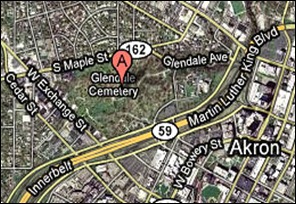
Glendale Cemetery is Akron’s oldest cemetery, dating back to 1839. It is entered as a historic landscape by the National Register of Historic Places. Takronglendalecemeterymaphe picturesque landscape, monuments and burial sites tell the diverse history of “The Rubber City.”

History:

Historic Glendale Cemetery was charted in 1839. It was registered in the National Register of Historic Places in 2002 for the Historic Landscape and bear the tag line of “The Guardian of Akron’s Heritage Since 1839.” Within the cemetery, the story of Akron unfolds. Past citizens of Akron’s are all buried here from the prominent figures to all social, ethnic, and economic groups. Located right outside of Downtown Akron, the cemetery was originally located in a rural setting. However, the city has grown around it. The preservation of the cemetery is a continuing effort.

The Cemetery Grounds:

Glendale’s 150 acres are hilly with mature trees shading the landscapes and curving roads winding throughout. The "great meadow" is a grassy open space that once held Swan Lake. During summer months, people are often found picnicking in this area. There are also many statues scattered throughout, including angels, grieving poses, life-size statues of the deceased, and symbolic forms such as a draped urn and little lamb. There are memorials, headstones and mausoleums from the past and the present. Four thousand sites are still available today, including locations near Simon Perkins, son of Akron’s founder.

Buildings and Structures:

Glendale’s Civil War Memorial Chapel is one of the country’s most prominent Civil War memorials, and was built to honor the Akron natives who served in that war. This 18,000 square foot historic Gothic chapel has exterior walls of broken ashlar stone and a porch supported by six columns of polished granite. The European rolled cathedral glass windows were imported from Scotland. Tours and rental of this recently renovated chapel are available by calling 330-668-2205.The Bell Tower was built in 1883 of rusticated stone and exposed timber and holds a 700 pound bell. A must-see are the numerous mausoleums located throughout the cemetery, and which are designed to look like Egyptian, Greek and Roman temples, or Gothic churches.

Glendale Cemetery Residents:

A tour of the Glendale Cemetery is filled with stories of the notables, veterans, and politicians buried there. Many important residents of Akron are buried here, including the founder of Goodyear Rubber, Frank A. Seiberling, and the inventor of Quaker Rolled Oats. At least one person from the Spanish American War, World War I, World War II, and the Korean and Vietnam conflicts are represented and buried at Glendale Cemetery. Politicians buried here include Elsworth Raymond Bathrick, George Washington Crouse, Charles William Fredrick Dick, and William Hanford Upson.

Public Use :

People can be found driving, jogging, painting, bird watching, picnicking, and walking the historic grounds of the cemetery daily. Glendale Cemetery also hosts public events throughout the year. Each summer, the West Hill Neighborhood holds a Jazz festival in the great meadow. On Memorial Day, the local VFW and American Legion host a service with 21-gun salute and raising of the flag at the chapel.

Hours:

Glendale Cemetery is open daily from 8:30am to 4:30pm, weather permitting. Office hours are Monday through Friday from 8am to 4pm.

About.com: Cleveland

CinciTDI Volkswagen diesel GTG tomorrow in Cincinnati

Posted By on February 19, 2010

Slipped my mind, but wanted to make a note on my blog to be sure all Cincinnati area VW TDI people knew about the CinciTDI.com / TDIClub.com GTG tomorrow — 8am February 20th.

Feb 20th GTG @Dubwerx


Its official, Dubwerx is hosting our GTG on Feb 20th, at 8:00 to whenever we get kicked out.Dubwerks is being extremely gracious allowing us to use their space and associated tools and equipment (and heat!).

Start at 8am, CinciTDI will provide lunch (pizza) around noonish and coolers with water. Bring any additional non alcoholic drinks you want and we will keep them cold.

Small jobs are welcome, especially topside work, we want to get as many people in and done as possible. All work is done with your hands and guru assistance as necessary. This is not drop off your car for service day

Bigger jobs will need both Dubwerx approval and guru approval if you require assistance.

If you require parts you must bring them or work can not be performed.

Posted via email from richc’s posterous

Adding some “light” reading to my weekend: Windows 7 Secrets

Posted By on February 19, 2010

Windows 7 SecretsI’ve added  a little light reading to my weekend plans from Paul Thurrot and Rafael Rivera’s book, Windows 7 Secrets … it’s only 1080 pages. I’m hoping the book will help enhance an already satisfied Windows 7 user by teaching me a few tricks in using Microsoft’s newest OS. As regular readers know, I’ve been using the beta and release candidate of Win7 for over a year now and have found Windows 7 a ten fold improvement over Vista  … and yes it is better then Win 2000 and XP … although I doubt diehards will make the upgrade without grumbling.

As comparisons go, it now rivals the Apple Macintosh for ease of use and is ‘almost’ as reliable from the standpoint of crashes and freezes — of course this depends on the computer hardware and what other programs have been installed. I still prefer the Mac for most video and graphics work, but for software and corporate compatibility having Window 7 on my notebook is a great option. If you have a newer computer with Vista the upgrade is worth it … Windows 7 Secretsif you have XP on a slightly older computer, its a more difficult call, as you might just want to wait and purchase it pre-installed on your next computer.

According to the Amazon Windows 7 Secrets book description,Thurrott and Rivera’s book “tells you what you need to know to go from Windows user to Windows expert and doesn’t waste time with basic computer topics.” If Paul Thurrot’s weekly TWIT podcast and winsupersite are to be the judge, I’m looking forward to Thurrot’s advice in helping me to gain in proficiently with Windows 7. Generally I modify the system to my liking anyway and it will be good to know a few of the hidden functions and features. Maybe I’ll add a few of my own tips here in the coming weeks?

Cleaning out my closet, although I should do it again

Posted By on February 19, 2010

In a belated personal post, after reviewing a few photos from earlier in the week on my Palm Pre, I’m archiving a post of what was part of my Valentine’s Day gift to my wife. She has been threatening reminding me for the better part of a year to clean out my half of the closet — “either throw away or donate those old clothes.” My motto has been so long as there is room I’ll keep it – a bad motto.

closetcleaning clothestodonate

With cabin fever taking hold due recent snows, I begrudgingly decided that I should start the project on V-Day and finally went to work. Reality set in, and something told me to give up on ever fitting into waist size 33” and 34” jeans. I don’t need yellowed and ragged tee-shirts no matter what was printed on them and realized the couple dozen old shirts I haven’t worn in years (nor ever will) are better given to someone who might wear them. It is embarrassing to admit, but I found a few shirts dating back to college and several from our first decade of marriage – what was I thinking? It’s not as if I haven’t gone through them before, but the pack-rat in me has never been able to give them up until now. So finally the mood was right to just close my eyes and get rid of them before I start to contemplate their antique historical value!  
  😀

Desultory - des-uhl-tawr-ee, -tohr-ee

  1. lacking in consistency, constancy, or visible order, disconnected; fitful: desultory conversation.
  2. digressing from or unconnected with the main subject; random: a desultory remark.
My Desultory Blog