Technical problems … restart test post
Posted By RichC on January 28, 2008

Once again I’m having technical problems with my blog and have lost the last couple posts to server/host issues. Stay tuned …
Posted By RichC on January 28, 2008
Once again I’m having technical problems with my blog and have lost the last couple posts to server/host issues. Stay tuned …
Posted By RichC on January 25, 2008
 While I was out feeding the dog before sunrise and creaking over the light snow on the sidewalk, I thought “it feels really cold today?” Brrr … it is! Thankfully the sun is out and should warm things up a little bit.
Maybe this is a good time to point out that during the 1970s we were talking “Global Cooling” in the way we talk about “Global Warming” today. Here’s the 1975 Newsweek article (PDF file here) that has been widely circulated.
There are ominous signs that the Earth’s weather patterns have begun to change dramatically and that these changes may portend a drastic decline in food production with serious political implications for just about every nation on Earth. The drop in food output could begin quite soon, perhaps only 10 years from now. The regions destined to feel its impact are the great wheat-producing lands of Canada and the U.S.S.R. in the North, along with a number of marginally self-sufficient tropical areas—parts of India, Pakistan, Bangladesh, Indochina and Indonesia—where the growing season is dependent upon the rains brought by the monsoon.
The evidence in support of these predictions has now begun to accumulate so massively that meteorologists are hard-pressed to keep up with it. In England, farmers have seen their growing season decline by about two weeks since 1950, with a resultant overall loss in grain production estimated at up to 100,000 tons annually.
During the same time, the average temperature around the equator has risen by a fraction of a degree a fraction that in some areas can mean drought and desolation. Last April, in the most devastating outbreak of tornadoes ever recorded, 148 twisters killed more than 300 people and caused half a billion dollars worth of damage in 13 U.S. states.
To scientists, these seemingly disparate incidents represent the advance signs of fundamental changes in the world’s weather. Meteorologists disagree about the cause and extent of the trend, as well as over its specific impact on local weather conditions. But they are almost unanimous in the view that the trend will reduce agricultural productivity for the rest of the century. If the climatic change is as profound as some of the pessimists fear, the resulting famines could be catastrophic.
A major climatic change would force economic and social adjustments on a worldwide scale, warns a recent report by the National Academy of Sciences, because the global patterns of food production and population that have evolved are implicitly dependent on the climate of the present century.
A survey completed last year by Dr. Murray Mitchell of the National Oceanic and Atmospheric Administration reveals a drop of half a degree in average ground temperatures in the Northern Hemisphere between 1945 and 1968. According to George Kukla of Columbia University, satellite photos indicated a sudden, large increase in Northern Hemisphere snow cover in the winter of 1971-72. And a study released last month by two NOAA scientists notes that the amount of sunshine reaching the ground in the continental U.S. diminished by 1.3% between 1964 and 1972.
To the layman, the relatively small changes in temperature and sunshine can be highly misleading. Reid Bryson of the University of Wisconsin points out that the Earth’s average temperature during the great Ice Ages was only about seven degrees lower than during its warmest eras and that the present decline has taken the planet about a sixth of the way toward the Ice Age average.
Others regard the cooling as a reversion to the little ice age conditions that brought bitter winters to much of Europe and northern America between 1600 and 1900 years when the Thames used to freeze so solidly that Londoners roasted oxen on the ice and when iceboats sailed the Hudson River almost as far south as New York City.
Just what causes the onset of major and minor ice ages remains a mystery. Our knowledge of the mechanisms of climatic change is at least as fragmentary as our data, concedes the National Academy of Sciences report. Not only are the basic scientific questions largely unanswered, but in many cases we do not yet know enough to pose the key questions.
Meteorologists think that they can forecast the short-term results of the return to the norm of the last century. They begin by noting the slight drop in overall temperature that produces large numbers of pressure centers in the upper atmosphere. These break up the smooth flow of westerly winds over temperate areas. The stagnant air produced in this way causes an increase in extremes of local weather such as droughts, floods, extended dry spells, long freezes, delayed monsoons and even local temperature increases all of which have a direct impact on food supplies.
The world’s food-producing system, warns Dr. James D. McQuigg of NOAA’s Center for Climatic and Environmental Assessment, is much more sensitive to the weather variable than it was even five years ago.
Furthermore, the growth of world population and creation of new national boundaries make it impossible for starving peoples to migrate from their devastated fields, as they did during past famines.
Climatologists are pessimistic that political leaders will take any positive action to compensate for the climatic change, or even to allay its effects. They concede that some of the more spectacular solutions proposed, such as melting the Arctic ice cap by covering it with black soot or diverting arctic rivers, might create problems far greater than those they solve. But the scientists see few signs that government leaders anywhere are even prepared to take the simple measures of stockpiling food or of introducing the variables of climatic uncertainty into economic projections of future food supplies. The longer the planners delay, the more difficult will they find it to cope with climatic change once the results become grim reality.
Posted By RichC on January 25, 2008

How about an Exhaust Burger? I’ve cooked a meal under the hood before, but never heard of cooking with a grilling device like this using exhaust gas! Well the exhaust gas never hits the meat, but its probably hot enough to barbecue a hamburger — I wonder if I could fix a meal for two if these were installed on a car with dual exhaust?
🙂
[adinserter name=”Block 2″]
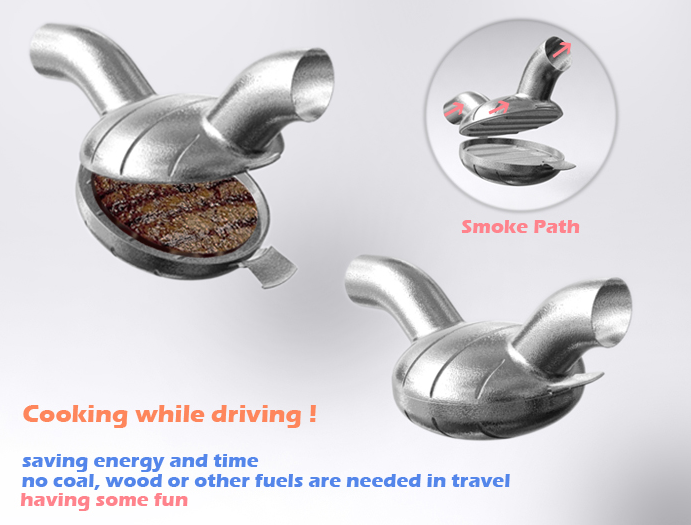
This post was spotted over on Autoblog, where they had this to say: “We’d sure like to try it out, though, especially if fitted to the back of a bio-diesel running on used grease from McDonald’s. Instead of asthma-inducing fumes, we’d be spewing the hunger-inspiring smells of french fries and hamburgers. Yum.”
Posted By RichC on January 24, 2008

SpaceShipOne (see post for photos) provided the X-Prize momentum that will give the adventurous, and wealthy, traveler an opportunity to fly into space … at least that’s Sir Richard Branson’s plan. The final design launch vehicle, White Knight Two was announced yesterday in New York and will be built by Scaled Composites in California under the direction of designer Burt Rutan. The current ‘space’ module, SpaceShipTwo is already 60% complete and according to news reports will be ready for testing at the end of this year. SpaceShipTwo is designed to carry eight people on a sub-orbital trip starting in 2010 and will cost each passenger an estimated $200,000. Virgin Galactic has already booked over 200 individuals and has registered 85,000 interested passengers.

According to Branson, the launch system being used to send SpaceShipTwo into space may also be used to launch small payloads and satellites at a far lower cost “As far as science is concerned, this system offers tremendous potential to researchers who will be able to fly experiments much more often than before, helping to answer key questions about Earth’s climate and the mysteries of the Universe.”

Posted By RichC on January 23, 2008
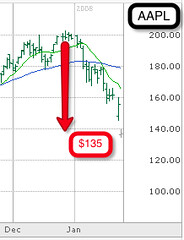 Apple Inc. reported that their holiday quarter was strong showing profits were up 57% during the three months that ended December 29th. Unfortunately investors who are concerned that the slowing economy will ding Apple in 2008. Forecasts from Apple, which are usually conservative, were for a 94 cents per share this second fiscal quarter, far short of the $1.09 per share analysts were expecting. Traders and investors took this news negatively and sold shares at the opening bell; this drove AAPL down $18 per share, nearly a 13% drop today. There has been a significant decline from last month as shares of AAPL were as high as $202. Today shares are selling for less than $135.
Pre-market news this morning highlighted Apple, and the clip below includes a comical line by Steve Jobs while discussing the iPod threat from Microsoft’s Zune music player. Do you know someone with a Zune?
Posted By RichC on January 23, 2008
 The diesel news from Subaru continues to trickle out of the auto shows this month after announcing they were developing a diesel boxer engine last year. (post) The first models to go on sale will be the Outback and the Legacy Sports Tourer in the UK in February 2008, with a much slower planned launch in the U.S. The 2.0L horizontally opposed four cylinder diesel produces 150 HP and 258 lb-ft of torque and will deliver over 40 U.S. miles per gallon … and still zip to 60mpg in about 8.5 seconds. With all-wheel drive, and one of the best resale values around, the Subaru Outback diesel will make a great vehicle WHEN it comes to the U.S. For the time being, I’m looking forward to reading the reviews even if they will be from the UK … and will anxiously looking forward to seeing this “smaller than the gasser” engine (2″ shorter) here in North America. (don’t expect to see the Subaru diesel in the U.S before 2010, unless something changes … but likely in a Forester and Imprezza too)
Posted By RichC on January 22, 2008
Don’t look at your 401-K or IRAs if you are squeamish. Will this be an opportunity long term or a big time recession?

After overseas markets headed down on worries about a U.S. recession, the FED makes an emergency cut this morning which hasn’t helped the panic (and necessary cash raising selling) on Wall Street pre-market. DOW futures were down as much as 500 points pre-market and the world bites their fingernails in fear of ‘too little – too late’ in response to the Federal Reserve cuts. Only time will tell. FED statement below.
The Federal Open Market Committee has decided to lower its target for the federal funds rate 75 basis points to 3-1/2 percent.
The Committee took this action in view of a weakening of the economic outlook and increasing downside risks to growth. While strains in short-term funding markets have eased somewhat, broader financial market conditions have continued to deteriorate and credit has tightened further for some businesses and households.
Moreover, incoming information indicates a deepening of the housing contraction as well as some softening in labor markets.
The Committee expects inflation to moderate in coming quarters, but it will be necessary to continue to monitor inflation developments carefully.
Appreciable downside risks to growth remain. The Committee will continue to assess the effects of financial and other developments on economic prospects and will act in a timely manner as needed to address those risks.
Voting for the FOMC monetary policy action were: Ben S. Bernanke, Chairman; Timothy F. Geithner, Vice Chairman; Charles L. Evans; Thomas M. Hoenig; Donald L. Kohn; Randall S. Kroszner; Eric S. Rosengren; and Kevin M. Warsh.
Voting against was William Poole, who did not believe that current conditions justified policy action before the regularly scheduled meeting next week.
Absent and not voting was Frederic S. Mishkin.
In a related action, the Board of Governors approved a 75-basis-point decrease in the discount rate to 4 percent. In taking this action, the Board approved the requests submitted by the Boards of Directors of the Federal Reserve Banks of Chicago and Minneapolis.
Posted By RichC on January 22, 2008
 Many diesel advocates are anxiously waiting to see just what new clean diesels will be arriving in the U.S. over the next few years. Hardly a week goes by now without some new announcement. For many of us, the Honda Accord 2.2L i-DTEC stands out in the hopes it will be an affordable and dependable diesel for the masses. According to reports from overseas and press reports, the Honda diesel is capable of over 60mpg). In keeping with that theme, their upscale Acura line is being redesigned and they have announced at the Detroit Auto show that they will have the diesel too.

Several automotive blogs have mention that the TSX would be the Acura vehicle of choice in receiving the Honda 2.2L i-DTEC diesel.
The TSX seemed like a likely candidate for diesel power as it is basically the Euro-spec Honda Accord — a vehicle that will hit European showrooms this summer with a diesel option. Honda’s new 2.2L i-DETC four-cylinder will power both vehicles. Honda will also launch a V6 clean diesel in 2010, which will likely see duty in the Acura TL and MDX. The Honda Pilot could also use a version of the engine. “All along, we’ve said there would be a diesel in Acura,” Dick Colliver, executive vice president of American Honda Motor told Automotive News.
Posted By RichC on January 21, 2008

As Alan Greenspan would say … “irrational exuberance!“ 🙂 Ebay link.
EDIT 1/21 9:30 PM: The mug has been sold ($1025.00) thanks to some outrageously generous bidders (congratulations ‘dorky54‘). They must have realized that this is a highly prized collectible … or at least appreciate the work of RHM. Thanks to all who placed a bid and participated in the fun.
Posted By RichC on January 21, 2008
 A bit of Google code from cute web application below the break. Pretend the box below is a fishbowl/box and use your mouse to ‘click/drop’ a bit of food. Watch the fish swim toward your mouse expecting a treat.