An anticipatory “pre” release Palm Pre video
Posted By RichC on May 15, 2009
Note to self — don’t get excited just yet as the Palm Pre is NOT in the Sprint inventory. But seeing it being unboxed doesn’t help the anticipation factor.
Posted By RichC on May 15, 2009
Note to self — don’t get excited just yet as the Palm Pre is NOT in the Sprint inventory. But seeing it being unboxed doesn’t help the anticipation factor.
Posted By RichC on May 14, 2009
 After billions of American taxpayer dollars, concessions from labor and retirees, thousands of job losses, threats of bankruptcy and government nationalization of the company … management has the audacity to plan on importing Chinese-built vehicles in 2011 order “to save on manufacturing costs.” How can Americans who through all this considered supporting GM swallow this?
The way I see it, this is the icing on the cake. My raw response is to instead buy a Ford (or transplant for that matter) if in order to support a U.S. carmaker that is at least trying to act halfway responsible.
General Motors plans to start importing Chinese-built vehicles into the U.S. in 2011, according to an outline the auto maker has submitted to members of the U.S. Congress.
GM currently manufacturers vehicles in China for sale in Asia. But the company plans for the first time to ship some of those vehicles to the U.S. to save on manufacturing costs.
Posted By RichC on May 14, 2009
 I was disappointed last week to have missed seeing Rhett and Link in Fairfield Ohio while out of town on Thursday, but since then I’ve noticed them on several network news shows talking about a controversial Red House Furniture video (my previous post). I didn’t find the video all that offensive or really all that intriguing even though it is closing in on 1 million views.
My current favorite is their Fast Food ad below since it had some great candid content from a ‘real’ Taco Bell worker — but the video and song that put them on the scene was the Facebook song that came out 2 years ago and now has 2.5 million views! These guys are pretty talented (and funny); it is interesting to see how they have leveraged their interests and talents in order to make a living online. Here’s Rhett and Link’s YouTube Channel. (be sure to check out their live Ohio appearance here)
Posted By RichC on May 13, 2009
I’ve been happily running the Windows 7 Beta (post 1 & post 2) and see it as Microsoft’s best OS release since XP. Although the Release Candidate is now available for all to install, I’ve been slow to update my 7000 Beta build because I’d like a clean install requiring solid backups, my install CDs, de-authorization of certain licenses (Paul Thurrott‘s comments) and a few hours of time. I’m hoping to get into it this weekend.
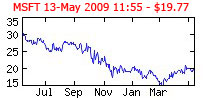 The good news for investors is that MSFT announced that Windows 7 will go on sale in time for the 2009 holiday season. According to a WSJ article, Microsoft is making “a public commintment” that it “expects to be able to get the software into stores in time for the key retail season.” Bill Veghte, senior vice president for Windows, said “We’re tracking well to deliver Windows 7 in time for holiday availability based on the groundswell of feedback we received from the partner ecosystem, customers and through our own internal testing from pre-Beta to now.” He added, however, that Microsoft “will not ship the product…until it meets our quality bar.”
According to the article, “windows generates approximately one-third of Microsoft’s $60 billion in annual sales and is on more than 90% of the world’s personal computers, is the company’s most important product. Delivering a smooth launch of Windows 7 in time for the 2009 holiday season will go some way toward persuading both consumers and corporate customers Microsoft has learned the lessons of Vista.”
_
Posted By RichC on May 12, 2009
Although some in the Obama administration have proposed that raising taxes on fuel is one way to encourage driving less and buying smaller more fuel efficient vehicles, Americans surveyed by Rasmussen don’t like it. A short FoxNews interview with Scott Rasmussen highlights that 81% oppose additional fuel taxes, although they seem to be a bit more positive with the “Cash for Clunkers” proposal.

Monday, May 11, 2009Given last year’s record-high gasoline prices and the still-fluctuating price at the pump, most Americans aren’t interested in the government tacking on any more, even in the name of fuel efficiency.
Just 10% of adults think the federal government
should increase the tax on gasoline by a large amount as a way of encouraging people to buy more fuel-efficient cars, according to a new Rasmussen Reports national telephone survey.
Eighty-one percent (81%) oppose a large tax hike for that purpose, and eight percent (8%) are undecided.
These sentiments remain largely unchanged from nearly two years when 86% said they opposed the idea of raising gas taxes by 50 cents a gallon as a result of congressional legislation that would encourage the development of more fuel-efficient cars.
In April of last year, 60% of Americans favored suspending the federal gas tax completely for the summer to offset soaring gas prices.
(Want a free daily e-mail update? If it’s in the news, it’s in our polls.) Rasmussen Reports updates are also available on Twitter.
Younger Americans are slightly more supportive of raising the gas tax to encourage the purchase of more fuel-efficient cars than their elders, but even among those ages 18 to 29, 79% are opposed.
Fifteen percent (15%) of men support a big tax increase on gasoline to push sales of fuel-efficient cars, compared to six percent (6%) of women.
Thirteen percent (13%) of both Democrats and adults not affiliated with either major party like the gas tax proposal versus just four percent (4%) of Republicans. Eighteen percent (18%) of government employees agree, compared to seven percent (7%) who work in the private sector.
But again in all categories, the vast majority oppose a gas tax hike as a way to push more fuel-efficient cars.
Americans give mixed reviews to the “Cash for Clunkers” plan now moving through Congress
Only 22% of Americans are willing to spend more to buy an energy-efficient hybrid car to help the environment. Even last October, after record high prices at the pump, just 37% said they were more likely to buy a hybrid car than they were a year earlier.
Americans took a dim view of another car-focused tax when it was proposed earlier this year. Seventy-three percent (73%) rejected the idea of taxing drivers based on how many miles they drive to help fund the building and repair of roads and bridges. Only 18% supported a mileage tax.
The findings are not surprising since Americans consistently favor tax cuts
Most U.S. voters believe they already pay more than their fair share of taxes.
Please sign up for the Rasmussen Reports daily e-mail update (it’s free)… let us keep you up to date with the latest public opinion news.
See survey questions and toplines. Crosstabs available for Premium Members only.
Posted By RichC on May 11, 2009
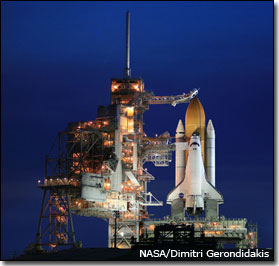 The shuttle Shuttle Atlantis sits on launch pad 39A (photo right) as the crew of STS-125 rests for an ambitious mission to service NASA’s Hubble Space Telescope this week. The launch is scheduled for 2:00PM EST Monday afternoon and will be manned by retired Navy Capt. Gregory C. Johnson, pilot, mission specialists and veteran spacewalkers John Grunsfeld and Mike Massimino along with Andrew Feustel, Michael Good and Megan McArthur. The 11-day mission will include five scheduled spacewalks to install two new instruments and repair two inactive ones. The plan is to keep the Hubble Space Telescope active until 2014.
Along with the actual tasks to be accomplished, a less critical but still interesting part of the mission, will that Mike Massimino (aka: Twitter @Astro_Mike) who intends to ‘tweet’ from space. I might be interesting to follow him?
STS-125 Additional Resources
› Mission Summary (407KB PDF)
› Press Kit (4.8MB PDF)
› Meet the Crew
› Learn About the Mission
Posted By RichC on May 10, 2009

Short ‘text to blog’ post to wish all the mothers in my life a Happy Mother’s Day.
Posted By RichC on May 8, 2009

The MyPre website posted comments about a possible June 7th release of the Palm Pre. They pointed to an alleged leaked internal meeting agenda that will be taking place from June 3rd through June 5th. Historically June 7th has been a Sprint launch day for new products.
Also, according to the buzz in Palm Pre forums, a couple YouTube videos hint that training my soon be started for Sprint employees. Above is a video detailing how email works on the Pre with Synergy and below highlighting contact management.
_
Posted By RichC on May 8, 2009
 In my second sailing entry for the day, the razor sharp photo to the left is of Thomas Johanson (click photo for larger) the helmsman for Team Ericsson 3 in the Volvo Ocean Race. This Oskar Kihlborg was one of the featured photos in an excellent Boston.com The Big Picture page. The Volvo Ocean Race (formerly called the Whitbread) is a high performance around the world sailing race that started in Europe and travels nearly 40,000 miles stopping in 9 to 10 cities. The heavily sponsored race pushes man and technology to its limits making the famous America’s Cup sailing race seem as if it is for lightweights. Although the coverage in the U.S. is rather sparse, worldwide about 2 billion people will see television coverage of the race. At minimum, check out the outstanding photos on the Boston.com site … Boston is the 6th and current sixth port city for the eight teams competing in this around the world race.
The yachts racing in the Volvo Ocean Race are 21.5 meters and manned my a fit crew of 11. The will remain in Boston Harbor until May 16th heading ‘across the pond’ to Galway, Ireland and concluding in St. Petersburg, Russia at the end of June.

ABN AMRO ONE heads out of Port Phillip Bay and round The Heads in the Volvo Ocean Race restart Melbourne to Wellington (1,450Nm) (© Oskar Kihlborg)
_
Posted By RichC on May 8, 2009
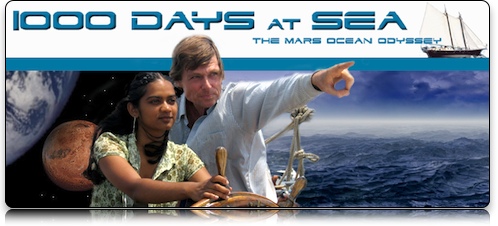
I regularly read the updates from Reid Stowe and his 1000 Days at Sea Mars Ocean Odyssey and wanted to archive an AP story from earlier in the week. The AP article written by Verena Dobnik was published a couple days ago and portrayed Soanya and Reid’s story as “quirky” — at least the beginning. It offers an outside look into the couple’s meeting and eventual sailing together and unusual relationship with Reid on his schooner and Soanya raising their son back in NYC.
Voyage of the heart: Sailing quest tests couple’s skills and bondNEW YORK — A thousand days at sea – that was the couple’s dreamy plan. They’d crisscross oceans aboard their 21-metre sailboat, the Anne, never making landfall, never resupplying.
It would be an inspired adventure, which they viewed in different ways.
The voyage “is an experiment in the psychology of what it takes for humans to live in a dangerous situation, isolated and self-sufficient,” Reid Stowe told The Associated Press, speaking from the Anne in the rugged South Atlantic, with the satellite telephone line dropping several times.
His crewmate Soanya Ahmad, now back on dry land in Queens, N.Y., where she’s raising the baby son conceived on board, sums up the trip in a phrase: “A voyage of the heart.” That’s the title of a book she’s writing.
It’s quite a story, with an ending that’s still to be written, and a middle full of thrills, perils and even a quest for a world record.
The story’s beginning has a quirky, almost Hollywood quality.
Ahmad was a 20-year-old college student when she first met Stowe a half-dozen years ago. She was photographing Manhattan’s West Side waterfront where he had docked his homemade schooner.
“He invited me aboard. It was my first time on a sailboat,” says the daughter of ethnic Indian immigrants from Guyana, who raised her and her two brothers in Queens.
“Reid was looking for someone to go with him,” says Ahmad, “And at first, I said no. But then …”
She says she was fascinated by this man with “transparent grey eyes that seem to have seen distances far greater than I could ever imagine.”
Within several months, the delicate, 5-foot-tall young woman boarded the boat and put her life into the hands of the 6-foot-1 sailor, 32 years her senior, whose face is weathered by decades of adventures to every continent.
Stowe had set out on his first sea journey as a teenager, dropping out of college in Arizona and sailing from Hawaii to the South Pacific with another young man.
For years after that, he found work at boatyards and as a skipper in the Caribbean, while selling some of his own sculptures and paintings. In 1999, he and his then-wife made it through 197 days together at sea.
He had fallen in love with the water as a boy on vacation with his grandfather, who owned a beach house on the North Carolina coast. That’s as grounded as Stowe ever was, the oldest of six siblings whose father was a U.S. air force officer who kept the family on the move around the United States, Germany and the Philippines.
By the 1970s, in North Carolina, Stowe and his relatives had built the Anne, naming it after his mother. The masts were hewn from pine trees that Stowe chopped himself, and his wood carving decorates the interior.
In the past few years, the Anne has been tested to the extreme.
Before they pushed off on April 21, 2007, from Hoboken, N.J., on the Hudson River, the couple crammed the boat with supplies.
The food ranged from rice and beans to tomato sauce, pasta, pesto, olives, chocolate, spices – plus one luxury: about 90 kilograms of Parmesan cheese. Ahmad also brought along Indian spices.
Provisions included coal and firewood for the heating stove and fuel for limited motoring, with solar panels powering the electronics on board. Water would be collected from rainfall and the sea, using a desalinator.
With small funds from friends and family, plus donated equipment and food supplies, the schooner disappeared into the sunset “on a warm spring day with a light breeze,” Ahmad wrote on their online log.
They alternated watches, vigilant for other vessels and braced for the fierce wind she called “our capricious master.”
Within days, heading south in the Atlantic, they hit stormy weather.
In their bunk, pitching around on the violent ocean, she wrote, “I clung to Reid and hoped he didn’t notice me clinging… I was more scared of losing Reid than of the storm.”
However “unlikely” their relationship is, she said, “from the inside, it is a perfect love.”
She and Stowe balanced one another as a crew at sea, she observed recently in her journal: “Where Reid might overreact, I was calm. Where I lacked the energy or manual skill to complete a task, Reid more than made up for it. We complemented each other’s strengths and weaknesses.”
Stowe had proposed a trip of 1,000 days at sea without resupplying or stops. But it nearly ended in disaster soon after it began.
Fifteen days from Hoboken, the couple collided with a freighter in the Atlantic, smashing the Anne’s bowsprit and mast.
“It looked like everything was over,” Stowe says now by sat phone. “I got all stressed out, but Soanya was very calm. She steadied me and said, ‘Yes, we can go on.”‘
The repairs took a month “and we drifted until we could sail normally again,” Ahmad remembers.
After crossing the Equator on the 90th day, she wrote excitedly: “We’ve been picking up enough flying fish off the deck every morning to have fish with every meal.”
There were also romantic interludes.
“Full moon nights on the ocean are magnificent,” she wrote on the 186th day. “The sky is suffused with a soft luminosity as if dawn were arriving at any moment. The waves are mesmerizing.”
But on the 230th day, her tone was changed as conditions worsened, with strong winds that rocked the boat in the Indian Ocean. She wrote: “I’m not sure it’s healthy to take seasick pills every day … I spend a good deal of my day curled up on the pilothouse bunk…”
By Day 289, on Feb. 6, 2008, she knew pregnancy was causing this seasickness – and her fluctuating mood: “It’s not easy to be loving all of the time. It takes as much work to remember to be loving as it does to act out frustration or negative feeling.”
Still, it was wrenching for both to decide she had to leave.
“Together we have made memories we will never forget,” she wrote on her last day aboard.
The two had sailed together for 305 straight days when, near Australia, Ahmad was helped off the Anne by a fellow long-distance sailor. From Perth, Australia, she flew home to New York, where on July 16, she gave birth to their son Darshen. His name is Sanskrit for a glimpse of something divine.
Stowe is still sailing. He’s been alone at sea for a year, though he keeps in touch with a log posted on a website by satellite phone.
To reach his 1,000-day goal, Stowe faces another eight months of solitude and, at times, terrors.
Gale-force winds have blown huge holes in his sails, which he’s always mending.
“I am sending an extra update today,” Stowe wrote in his web journal, “to take a little time off since my hands are so sore from constantly working, sewing sails and pulling ropes. But I am always ready if something comes up.”
One day in the middle of the South Atlantic, roaring seas capsized the Anne, submerging the sails and knocking Stowe into the cabin wall. The waves crashed over the schooner, “and had me hanging on with my heart beating,” he wrote. “I am a little gun-shy now, after capsizing, losing my staysail and blowing out my old red foresail.”
Ahmad, no longer there to help, supports him in spirit, writing daily emails, calling when possible, and sending digital photos of Darshen.
Also monitoring Stowe’s travels is Charles Doane, editor-at-large of Sail magazine. “I check his positions every day,” he says.
Already, Stowe “has set the record of the longest non-stop, unsupplied voyage at sea,” says Doane, adding that proof the schooner has not touched land comes from a GPS satellite system tracking the voyage, along with regular photos and videos posted on the web.
Stowe has his detractors: authors of Internet posts who paint him as a fraudulent, Svengali-like figure who seduces women and spirits them into danger. One blogger pointed out that Stowe had been convicted of drug dealing.
He acknowledges having served nine months in prison for conspiracy to deal drugs in the Caribbean – helping transfer marijuana from a Colombian vessel to some yachts in 1987.
“But what I’m doing now is an honourable thing – working hard and keeping love in the forefront to guide my actions,” he says.
Doane likens Stowe to French sailor Bernard Moitessier, who in the 1960s completed the first non-stop round-the-world race. “He was a very spiritual person on a spiritual enterprise,” says Doane, and Stowe “is in that tradition.”
More than 700 days into the voyage as of April, Stowe’s many repairs are holding, sprouts for salads grow in boxes on the Anne’s deck, and he catches fish daily.
“I have an excellent diet,” he says. “And I feel very close to a universal god.”
He still wants to break the record of 657 days alone at sea set in 1988 by Australian Jon Sanders. Stowe aims to return in January 2010 after 1,000 days.
And after that? “We do plan to be together when he returns,” Ahmad wrote on the website.
“I’m her man,” he confirmed from close to 10,000 kilometres away at sea.
Marriage, perhaps?
“I have no idea,” she says brightly.
Stowe says he’ll return to land “to be the best man and father I can. We probably will get married.”
Ahmad has no regrets about taking the trip, or about the separation. “When it comes to making certain life decisions, there’s a feeling, when you’re doing the right thing, that it’s the right thing – something solid inside.”