The Legend of Tokyo Rose
Posted By RichC on December 21, 2013
Archiving a bit of text (Chapter 5 in Miss Your Lovin by Ann Elizabeth Pfau) in researching some WWII Pacific history. See the Gutenberg link above but text saved below.
 American veterans of the Pacific war still remember Tokyo Rose. She was the most dangerous and seductive of the enemy radio announcers who broadcast propaganda to American troops. During the war, she attracted avid listeners who passed the time in the tropics by circulating stories about what she said and speculating about who she really was. After the Japanese defeat, former servicemen reminisced about Tokyo Rose, and when the U.S. Department of Justice (DoJ) called for witnesses able to recognize her voice and to remember her words, many veterans eagerly volunteered their memories. In interviews conducted by FBI agents and in their own sworn statements, these men claimed to remember the peculiarities of her voice and delivery; they were certain that they could identify Tokyo Rose were they to hear her again. Many characterized her voice as “soft,” “smooth,” “sultry,” or “sexy”; she spoke with a slight accent, or they were amazed by its lack. When asked to describe the content of Tokyo Rose’s radio show, some former servicemen recounted taunting tales of unfaithful wives who were dating draft-dodgers. Others remembered more ominous broadcasts. They claimed that Tokyo Rose “welcomed” American troops to the Pacific by predicting their movements and warning of impending attacks.
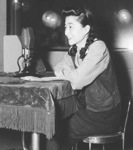
Iva Toguri photographed before the microphone at Radio Tokyo in September 1945. Between December 1945 and June 1949, FBI agents collected former servicemen’s stories about Tokyo Rose with the goal of building a treason case against Iva Toguri. Toguri was an American Nisei who had been visiting a sick aunt in Japan at the time of the Japanese attack on Pearl Harbor in December 1941. Despite her efforts to return home to the United States, Toguri was trapped as an enemy alien in Japan for the duration of the war. During that time, she supported herself by working as a typist and, after November 1943, as a popular announcer for the Japan Broadcasting Corporation. On the air, Toguri called herself “Orphan Ann,” but her American listeners often referred to her (as well as to other female announcers) as Tokyo Rose. Toguri became known as “the one and original ‘Tokyo Rose’ who broadcasted from Radio Tokyo” only after she agreed to an interview with two American journalists on 1 September 1945.3
3The news that reporters had discovered the real Tokyo Rose reached the United States just weeks after the U.S. government had announced that no such woman existed. The Foreign Broadcast Intelligence Service (FBIS), the government agency responsible for monitoring enemy broadcasts, was the source of this announcement. FBIS reported that no one in its employ had ever heard the name Tokyo Rose broadcast over Japanese frequencies. Furthermore, FBIS operatives were unable to identify a probable candidate to fit the widely varying descriptions. The report singled out Toguri’s “Orphan Ann” as the woman “most servicemen seem to refer to when they speak of Tokyo Rose” but characterized the “legends” that “piled up about ‘Tokyo Rose'” as “apocryphal.”4
Hello there Enemies . . . how’s tricks? This is Ann of Radio Tokyo, and we’re just going to begin our regular programme of music..news and the zero hour for our Friends . . . I mean, our enemies! . . . in Australia and the South Pacific . . . so be on your guard, and mind the children don’t hear! . . . All set? . . . O.K. here’s the first blow at your morale . . . the Boston Pops . . . playing “Strike Up the Band.”5
4With these words, Iva Toguri opened her segment of the popular Japanese radio program, “The Zero Hour,” on 22 February 1944. This was a typical broadcast. As the announcer “Orphan Ann,” Toguri welcomed her American listeners (whom she also called orphans) to the program by telling them to expect a “subtle attack” on their morale. She urged servicemen to sing along to sentimental songs like “The Love Parade,” and then, pretending her “Orphan Choir” had declined the offer, she comically affected pique: “You won’t alright you thankless wretches, I’ll entertain myself and you go play with the mosquitoes.” Later broadcasts followed the same format. Preparing her “honourable boneheads” for a “vicious assault on your morale,” Toguri made humorous references to Pacific island discomforts (too many mosquitoes, not enough beer) and played “sweet” music by performers such as Rudy Vallee and His Connecticut Yankees, Victor Herbert, and Bing Crosby.6
5In one broadcast, “Orphan Ann” informed her listeners that she was preparing to “creep up and annihilate them with my nail file” while she “lull[ed] their senses” with a Victor Herbert waltz, “Kiss Me Again.” But Toguri’s scripts and FBIS transcripts show no sign that she ever broadcast Japanese intelligence or threatened American soldiers.7 Yet American servicemen have long asserted they heard words that Japanese documents and American radio monitoring equipment did not record. Their memories, memoirs, letters, and diaries are the only evidence we have of such broadcasts.
6The issue, then, is how to assess the historical value of this evidence. One option is to treat servicemen’s stories as factual accounts of they actually heard. Taking that approach, Iva Toguri is the most likely candidate for the role of Tokyo Rose. Even before Toguri became the topic of sensational news stories, American soldiers and war correspondents identified Tokyo Rose as the female announcer on “The Zero Hour,” and many accounts of Rose’s broadcasts were partly modeled on Toguri’s,8 but whereas “Ann” invited servicemen to “sit back, close your eyes, and relax” while they listened to music, Rose urged her listeners to “go back to your homes before it is too late.”9 Yet treating soldiers’ Tokyo Rose stories as evidence of actual broadcasts would mean overlooking too many important facts (among them, that stories about Tokyo Rose predated “Orphan Ann’s” November 1943 debut).10 Even the contention that some other woman might have broadcast the words soldiers remembered and wrongly attributed to Iva Toguri (as Toguri’s defense lawyers, and later her biographers, tried to do)11 requires a stretch of the historical imagination. To make this argument, one would have to disregard both FBIS’s failure to identify a real Tokyo Rose and Toguri’s long-standing identification with the moniker.
7Lack of sufficient evidence to convict or absolve has always been the difficulty of assessing the case against Iva Toguri. Radio Tokyo officials burned agency records before American troops arrived in Japan. Iva Toguri retained several scripts in her possession and distributed others to American soldiers as souvenirs, but these documents do not cover her entire broadcast history. Furthermore, for all the agency’s monitoring, FBIS representatives were able to provide government lawyers with only a few clear recordings; most broadcasts were recorded on wax cylinders that were later shaved and reused.12
8All available documentary and recorded evidence supports the conclusion that FBIS officials were correct more than fifty years ago when they characterized Tokyo Rose as an American “invention.”13 Like all legends, Tokyo Rose has basis in historical fact. Toguri’s “Orphan Ann” segments were sandwiched between propaganda-tinged news, skits, and commentary. However, the bare facts of Japanese broadcasts do not account for the radio personality so many servicemen talked about, wrote about, and still remember. Rather, this legend was born of emotions, like anger, alienation, and anxiety—feelings about the war, the military, and American civilians that soldiers were otherwise unable or unwilling to acknowledge.14 The emotions that gave rise to Tokyo Rose later fueled the drive to punish Iva Toguri when she became entangled in the legend.
1American veterans of the Pacific war still remember Tokyo Rose.2 She was the most dangerous and seductive of the enemy radio announcers who broadcast propaganda to American troops. During the war, she attracted avid listeners who passed the time in the tropics by circulating stories about what she said and speculating about who she really was. After the Japanese defeat, former servicemen reminisced about Tokyo Rose, and when the U.S. Department of Justice (DoJ) called for witnesses able to recognize her voice and to remember her words, many veterans eagerly volunteered their memories. In interviews conducted by FBI agents and in their own sworn statements, these men claimed to remember the peculiarities of her voice and delivery; they were certain that they could identify Tokyo Rose were they to hear her again. Many characterized her voice as “soft,” “smooth,” “sultry,” or “sexy”; she spoke with a slight accent, or they were amazed by its lack. When asked to describe the content of Tokyo Rose’s radio show, some former servicemen recounted taunting tales of unfaithful wives who were dating draft-dodgers. Others remembered more ominous broadcasts. They claimed that Tokyo Rose “welcomed” American troops to the Pacific by predicting their movements and warning of impending attacks.
2Iva Toguri photographed before the microphone at Radio Tokyo in September 1945. Between December 1945 and June 1949, FBI agents collected former servicemen’s stories about Tokyo Rose with the goal of building a treason case against Iva Toguri. Toguri was an American Nisei who had been visiting a sick aunt in Japan at the time of the Japanese attack on Pearl Harbor in December 1941. Despite her efforts to return home to the United States, Toguri was trapped as an enemy alien in Japan for the duration of the war. During that time, she supported herself by working as a typist and, after November 1943, as a popular announcer for the Japan Broadcasting Corporation. On the air, Toguri called herself “Orphan Ann,” but her American listeners often referred to her (as well as to other female announcers) as Tokyo Rose. Toguri became known as “the one and original ‘Tokyo Rose’ who broadcasted from Radio Tokyo” only after she agreed to an interview with two American journalists on 1 September 1945.3
3The news that reporters had discovered the real Tokyo Rose reached the United States just weeks after the U.S. government had announced that no such woman existed. The Foreign Broadcast Intelligence Service (FBIS), the government agency responsible for monitoring enemy broadcasts, was the source of this announcement. FBIS reported that no one in its employ had ever heard the name Tokyo Rose broadcast over Japanese frequencies. Furthermore, FBIS operatives were unable to identify a probable candidate to fit the widely varying descriptions. The report singled out Toguri’s “Orphan Ann” as the woman “most servicemen seem to refer to when they speak of Tokyo Rose” but characterized the “legends” that “piled up about ‘Tokyo Rose'” as “apocryphal.”4
Hello there Enemies . . . how’s tricks? This is Ann of Radio Tokyo, and we’re just going to begin our regular programme of music..news and the zero hour for our Friends . . . I mean, our enemies! . . . in Australia and the South Pacific . . . so be on your guard, and mind the children don’t hear! . . . All set? . . . O.K. here’s the first blow at your morale . . . the Boston Pops . . . playing “Strike Up the Band.”5
4With these words, Iva Toguri opened her segment of the popular Japanese radio program, “The Zero Hour,” on 22 February 1944. This was a typical broadcast. As the announcer “Orphan Ann,” Toguri welcomed her American listeners (whom she also called orphans) to the program by telling them to expect a “subtle attack” on their morale. She urged servicemen to sing along to sentimental songs like “The Love Parade,” and then, pretending her “Orphan Choir” had declined the offer, she comically affected pique: “You won’t alright you thankless wretches, I’ll entertain myself and you go play with the mosquitoes.” Later broadcasts followed the same format. Preparing her “honourable boneheads” for a “vicious assault on your morale,” Toguri made humorous references to Pacific island discomforts (too many mosquitoes, not enough beer) and played “sweet” music by performers such as Rudy Vallee and His Connecticut Yankees, Victor Herbert, and Bing Crosby.6
5In one broadcast, “Orphan Ann” informed her listeners that she was preparing to “creep up and annihilate them with my nail file” while she “lull[ed] their senses” with a Victor Herbert waltz, “Kiss Me Again.” But Toguri’s scripts and FBIS transcripts show no sign that she ever broadcast Japanese intelligence or threatened American soldiers.7 Yet American servicemen have long asserted they heard words that Japanese documents and American radio monitoring equipment did not record. Their memories, memoirs, letters, and diaries are the only evidence we have of such broadcasts.
6The issue, then, is how to assess the historical value of this evidence. One option is to treat servicemen’s stories as factual accounts of they actually heard. Taking that approach, Iva Toguri is the most likely candidate for the role of Tokyo Rose. Even before Toguri became the topic of sensational news stories, American soldiers and war correspondents identified Tokyo Rose as the female announcer on “The Zero Hour,” and many accounts of Rose’s broadcasts were partly modeled on Toguri’s,8 but whereas “Ann” invited servicemen to “sit back, close your eyes, and relax” while they listened to music, Rose urged her listeners to “go back to your homes before it is too late.”9 Yet treating soldiers’ Tokyo Rose stories as evidence of actual broadcasts would mean overlooking too many important facts (among them, that stories about Tokyo Rose predated “Orphan Ann’s” November 1943 debut).10 Even the contention that some other woman might have broadcast the words soldiers remembered and wrongly attributed to Iva Toguri (as Toguri’s defense lawyers, and later her biographers, tried to do)11 requires a stretch of the historical imagination. To make this argument, one would have to disregard both FBIS’s failure to identify a real Tokyo Rose and Toguri’s long-standing identification with the moniker.
7Lack of sufficient evidence to convict or absolve has always been the difficulty of assessing the case against Iva Toguri. Radio Tokyo officials burned agency records before American troops arrived in Japan. Iva Toguri retained several scripts in her possession and distributed others to American soldiers as souvenirs, but these documents do not cover her entire broadcast history. Furthermore, for all the agency’s monitoring, FBIS representatives were able to provide government lawyers with only a few clear recordings; most broadcasts were recorded on wax cylinders that were later shaved and reused.12
8All available documentary and recorded evidence supports the conclusion that FBIS officials were correct more than fifty years ago when they characterized Tokyo Rose as an American “invention.”13 Like all legends, Tokyo Rose has basis in historical fact. Toguri’s “Orphan Ann” segments were sandwiched between propaganda-tinged news, skits, and commentary. However, the bare facts of Japanese broadcasts do not account for the radio personality so many servicemen talked about, wrote about, and still remember. Rather, this legend was born of emotions, like anger, alienation, and anxiety—feelings about the war, the military, and American civilians that soldiers were otherwise unable or unwilling to acknowledge.14 The emotions that gave rise to Tokyo Rose later fueled the drive to punish Iva Toguri when she became entangled in the legend.
Iva Toguri’s 14 August 1944 “Orphan Ann” broadcast. | Read transcript The most striking aspect of Iva Toguri’s 1949 treason trial was the discrepancy between what she actually broadcast and what former soldiers remembered hearing. One of the recordings presented by the prosecution as evidence of treason contained this example of propaganda, described by journalist Francis O’Gara as “sometimes insolent, sometimes almost affectionate”:
Hello you fighting orphans of the Pacific. How’s tricks? This is after her weekend Annie back on the air strictly under union hours. Reception O.K.? Why, it better be because this is all request night and I’ve got a pretty nice program for my favorite little family—the wandering boneheads of the Pacific islands. The first request is made by none other than the boss and guess what. He wants Bonnie Baker in “My Resistance is Low.” My, what taste you have sir, she said. (music)
By contrast, the veterans who served as ear-witnesses for the prosecution remembered far more sensational and damaging broadcasts. The day after the jury listened to the government’s recordings, former Army lieutenant Jules Sutter Jr. testified that in early September 1944 (about two weeks after the broadcast above), he heard Toguri tell Americans on Saipan that the island was “mined with high explosive[s]” and would be “blown sky high” unless U.S. forces evacuated the area within 48 hours.15
10On the following day, Marshall Hoot, who had commanded a rescue and patrol boat assigned to the area of the Gilbert Islands, provided the prosecution with even more damaging testimony, reportedly moving some of the women in the courtroom “close to tears.”16 Under cross-examination by defense attorney Wayne Collins, a lawyer well known for his defense of Japanese American detainees, Hoot produced an intimate and affecting letter he had written to his wife in the first week of January 1944. Although the letter did not record the words Hoot would later attribute to Iva Toguri, it did characterize such broadcasts as demoralizing:
We have a radio now and we get Tokyo best. They have an American Jap girl who has turned down the United States for Japan. They call her Tokyo Rose and does she razz us fellows out here in the Pacific, telling how well Japan is getting along and to hear her start out you would think she was broadcasting from the U.S. and sorry we were loosing so many men and ships. It sure makes the fellows sore.
Prosecution lawyer John B. Hogan read the entire letter, including Hoot’s sentimental closing, “Honeybabies, I must lay off for today, hope I dream of you tonight as I think of you all day,” into the court record in order to establish the date on which Hoot claimed to have heard Toguri “congratulate” the commander of a naval bomber squadron “on his safe landing” in the Gilbert Islands. To this welcome, she added this warning: “you will be sorry if you don’t leave soon or now.” According to Hoot, this broadcast alerted him and his comrades to expect an attack, for in his experience, these predictions generally proved true. Hoot testified that a few days after the broadcast, the Japanese conducted a bombing raid on Abamama, killing two of his men.18
11To combat such damaging testimony, Toguri’s lawyers produced ear-witnesses of their own, former listeners who had served in the American armed forces and who characterized the “Orphan Ann” broadcasts as friendly and entertaining rather than vicious and demoralizing. Defense attorneys also attacked the credibility of the prosecution’s ear-witnesses, but in the case of Marshall Hoot, this strategy backfired. Wayne Collins charged that Hoot had altered his testimony from an earlier version of the story confided to journalist Payne Knickerbocker. Furthermore, Collins insisted that there were no casualties in the air raid Hoot described, but the Navy veteran had the last word, responding with indignation: “I beg your pardon, I ought to know. I helped bury them.”19
12Marshall Hoot proved an effective prosecution witness, but FBI records reveal that Hoot’s story changed dramatically over the course of a year. In June 1948, special agent Chester Orton reported that Hoot was “of the opinion that the woman he heard signed off the radio as Tokyo Rose.” When prompted, however, Hoot did recall a Christmas Eve broadcast by an announcer who called herself “Annie,” but he denied that Toguri’s was Annie’s voice. Months later in March 1949 Hoot swore that Toguri’s was the voice he had heard over Radio Tokyo, asserting, “This woman always referred to herself as Ann, Orphan Ann, or Little Orphan Annie, and I never heard her call herself Tokyo Rose.”20 Despite this change, Hoot’s testimony cannot be dismissed as an outright fabrication. As demonstrated by the letter Hoot exhibited in court, it had some basis in fact. But the details of his testimony derived less from actual Radio Tokyo broadcasts than from the collective experience and shared culture of American military personnel who served in the Pacific theaters of World War II.
13Tokyo Rose was an American creation, a female villain who articulated emotions the servicemen were unable or unwilling to acknowledge. Her reputed threats catalogued their fears. Her legendary prescience reflected their feelings of powerlessness. Her taunting words articulated their sexual anxieties. Her accusations against American civilians, especially women, were their own. Sexual and racial difference, however, concealed that American servicemen were the source of Rose’s pronouncements and allowed the men to evade responsibility for their own words. The medium of radio itself facilitated the masquerade by unleashing listeners’ imaginations and by fostering, in Susan Douglas’s words, a “strong collective sensibility.”21
14To understand the emergence of Tokyo Rose, we must return to her birthplace in the Pacific theaters of World War II, where leisure facilities were inadequate, time weighed heavily, and many American servicemen listened to Radio Tokyo’s English language program of propaganda, news, and American music. These radio shows, which were sometimes broadcast over public address systems, were a major source of amusement for soldiers, sailors, airmen, and marines who listened to them while literally “sweating out” the time between missions or the next Japanese move.22 This in-between time was a period of anxious anticipation, characterized by hard work and boredom and punctuated by small-scale enemy attacks. Combined with demands for military secrecy, it was fertile ground for speculative rumors about future movements and impending operations.23 The omniscient radio announcer who knew when and where the men would be going while they still awaited orders, Tokyo Rose was an outgrowth of these rumors.
15Daily life in the Pacific was full of uncertainty; soldiers lived in constant anticipation of danger. Japanese airplanes might attack at any time of day or night. Warnings attributed to Tokyo Rose provided the illusion of predictability. The rumor that Rose had announced an attack gave men time to prepare for the eventuality. These stories were also emotional outlets; they enabled servicemen to articulate their fears, if only indirectly. Such warnings, however, provided no escape from anxiety; some men imagined dangers far more dreadful than the ones they actually experienced.
16Tokyo Rose’s imagined warnings were often ominous; she voiced the servicemen’s worst fears. In February 1948, James G, a former lieutenant who had been attached to the 500th Bombardment Group on Saipan told FBI agents that at first members of his group had “regarded [Tokyo Rose’s] program and predictions as humor”; her threats gave them an “occasion to laugh and joke.” According to Lt. G, Rose’s predictions of Japanese air raids proved so accurate that the Americans did not laugh for long; they soon became “very serious and on edge relative to forthcoming attacks which she predicted.” When she warned them one evening to prepare for poison gas, he remembered that the men became extremely agitated, wondering whether it would be best to await the attack in their foxholes or nearby caves.24 A similar rumor made the rounds of the 6th Infantry Division in August 1944. It triggered a run on gas masks among the anxious servicemen who prepared themselves for the attack and by their actions gave further credence to the warning.25 The men must have imagined the “horrible death” that would have resulted from such an attack.26
17Counterintelligence officers attempted to discourage circulation of the many rumors attributed to Tokyo Rose. These threats, however, were American in origin. In regard to the Saipan rumor, FBI case files reveal that some of Lt. G’s comrades recalled similar rumors, but none substantiated his story. Furthermore, the lieutenant’s former commanding officer admitted that had he learned of the threat from Lt. G, he would probably have ignored it, for he regarded the young man as overly “excitable.” He described Lt. G as “the type of soldier who sat around in full combat equipment when Japanese troops were not within 1500 miles of the island . . . and most Army personnel . . . considered the danger negligible.”27 Army counterintelligence officers publicized American responsibility for the latter threat by printing an article in the 6th Infantry newspaper on the day that the attack was supposed to occur; the piece playfully chided the men for their gullibility and reminded them that it was their “duty to expose all rumors and rumor mongers.”28 Other than rumors like these, there is no evidence that Radio Tokyo broadcasts ever warned American soldiers to prepare for such an attack, and the Japanese military never used chemical weapons against American troops.
18Rumors of impending poison gas attacks, sometimes attributed to Radio Tokyo or Tokyo Rose, proliferated throughout the Pacific and were especially prevalent in censorship reports from the summer and fall of 1944, as American troops prepared to invade the Philippine Islands. This period produced rumors reflecting servicemen’s fears; the men did not know precisely where they would be going, but they knew they would soon move into a new round of combat. Furthermore, American servicemen probably understood that poison gas was a weapon of last resort, and they certainly knew that the situation of the Japanese military was becoming more desperate.29 Rumors about Japanese use of poison gas floated around Pacific army bases throughout the war, but by the end of 1944 after the successful invasion of the Philippine Islands, many servicemen were better able to dismiss them. In December 1944, for example, one man advised a friend to disregard stories about Japanese chemical or German biological weapons: “Almost invariably there is no truth in them,” he wrote. “So don’t worry, whatever terrible weapons the Nazis and Japs are saving for us, you may be sure that we have something twice as terrible as they do.”30 Indeed, as this man wrote, American weapons and tactics were becoming more terrible. The Army Air Forces had already commenced bombing raids on the Japanese mainland, and American ground forces had increased their use of flame-throwers. In March 1945, fire and airpower were combined when B-29 bombers began dropping incendiaries on Tokyo and other densely populated areas of Japan. A photo reconnaissance plane named Tokyo Rose and decorated with a comic portrait of its namesake led the way. It was the first American warplane to fly over Tokyo since the Doolittle raid of 1942, and its crew’s photographs of the Japanese mainland provided the Twentieth Air Force with a map for future attacks.
19As the American victory drew closer, threats attributed to Tokyo Rose began to seem more amusing than frightening. Unable to recall the poison gas threat (recounted earlier by another member of the 500th Bombardment Group), one senior officer told FBI agents that rumored gas attacks and Tokyo Rose broadcasts were “treated as joke[s].” His diary from late fall 1944 included sardonic commentary on American victories vociferously denied by Tokyo Rose.32 American servicemen delighted in stories of attacks that never happened and ships that remained afloat even after Rose announced that they would be or had been sunk. These tales were funny because the expansive claims and explosive threats were so obviously empty:
Tokyo Rose sure is a laugh. We get a big kick out of listening to her. If we would believe all she tells us over the radio we never would win this war. But that program sure is the laughing thing of our army. I wonder what she will say when we walk right into Tokyo?33
On 7 August 1945, the day after an American B-29 dropped the first atom bomb on Hiroshima, Navy officials got in on the joke, issuing a mock citation that commended Tokyo Rose for “bring[ing] laughter and entertainment to” American troops in the Pacific.34
20A peculiar affection animated many servicemen’s accounts of Tokyo Rose. Her purported pronouncements were, according to one former Army counterintelligence officer, “an unending source of satisfaction” to American soldiers who served in the Pacific. “Thousands of letters went home from the troops telling of the girl’s all-knowing, all-seeing powers,” Gen. Elliot Thorpe wrote in his memoir, “and no matter how small a unit each soldier would stoutly maintain his unit had been specifically mentioned on Radio Tokyo.”35 Servicemen who feared that they had been “forgotten” relished stories of the time when Tokyo Rose singled out their unit for special attention. By welcoming American units to the area and informing them of Japanese interest in their plans, she gave them a sense of importance, compensating for the seeming indifference of American civilians.
21Servicemen took pride in the reputed recognition of Tokyo Rose. During the war, they wrote home about it and marked the occasion with notations in their diaries. Years later, many former servicemen recalled the time when Tokyo Rose talked about their unit. In December 1947, one former Seabee contacted the FBI with the story of how Tokyo Rose welcomed the 100th Naval Construction Battalion to the Pacific on 10 February 1944, nine days after the battalion landed in the Marshall Islands and eight days before that landing was made public. In between musical selections, she had introduced herself to the men: “This is Tokyo Rose calling the 100th Seabee Unit in the Majuro Islands,” and asked, “How do you boys like our coc[o]nuts?” She told the men that their wives were unfaithful and promised a Japanese air raid in the very near future. Despite the imaginary threat, the Seabees were not attacked at this time, although two Japanese planes were spotted flying over the island while an airstrip was under construction.36 In this case, Tokyo Rose’s alleged broadcast was probably more comforting than threatening, assuring the Seabees that they made a noticeable contribution to the American war effort—an important assurance for the many men who felt their work to be invisible and their suffering futile.
22Stories of Tokyo Rose provided American servicemen with the opportunity to boast of their military prowess. Adopting her imagined insult as a badge of honor, members of the 41st Infantry Division proclaimed themselves “the Butchers,” and a medical officer noted, “The favorite broadcast heard by our troops comes from Tokyo. The Division had more publicity from Tokyo than the United States. The Japs called us the ’41st Division Butchers’ and we were proud of that name.” According to George S. Andrew Jr. who served with the 41st Division, Rose was quick to recognize the division’s fighting prowess. She “indirectly conceded” their success by calling them “the Butchers” early in the war, while American civilians did not seem to notice their abilities or sacrifices until late February 1945 when “the Butchers” were dubbed the “Jungleers” by the American press.38 Other units also claimed the “Butchers,” and years later many veterans recalled and took pride in the epithet.
23Tales of Tokyo Rose provided soldiers with the opportunity to valorize themselves and to criticize American civilians. In the course of their narratives, servicemen often attested to a renewed sense of commitment. Her words, designed to frighten and demoralize, could have the opposite effect. Yet the martial enthusiasm inspired by Tokyo Rose was marked by traces of doubt. Although servicemen could embrace her insults and discount her threats, they were unable to ignore her intimations that American civilians had betrayed them, because her words were their own. The distrust she was accused of having fostered between soldier and civilian had in fact originated with American servicemen and found outlet in their stories of Tokyo Rose.
24Along with insults, threats, and predictions, Tokyo Rose taunted American servicemen with news from home. According to soldiers, she told them that while they were stuck out in the jungle with only the mosquitoes for company, civilians were living well and having fun without a thought for the soldiers. Civilian men were on strike (thus depriving the soldiers of necessary war materiel), and women (particularly soldiers’ wives and girlfriends) were enjoying newfound sexual freedom by dating wealthy, malingering war workers. One serviceman wrote that he had heard Tokyo Rose announce: “But that girl back home isn’t waiting for you. She’s out drinking and dancing with some 4F who’s rolling in easy money. They are probably eating some nice thick steaks in some air conditioned café. But you won’t get any steaks for a long time out here.” She voiced servicemen’s complaints about the heat and the food as well as the strong feeling that American civilians did not “know or . . . care that a war is going on.”
25Tokyo Rose became the sultry, insinuating voice of civilian conscience in a 1945 war bond film that depicted American marines listening to the radio just before heading off to invade the island of Iwo Jima. The Treasury Department’s Tokyo Rose made the sort of accusations often leveled against civilians by soldiers: that they were selfishly striking or frivolously spending their money instead of investing in the war effort. Civilian indifference to the war created the shortages that were ultimately responsible for deprivation and death in the Pacific.
26The Treasury Department’s Tokyo Rose called herself the “voice of truth,”43 and in this, she resembled the soldiers’ Rose who told “mostly lies” but also some important and unpleasant truths.44 In the words of one paratrooper:
I’ve heard several of these propaganda stories from the Japs and Germans. They broadcast over the radio that our girls and wives back home are unfaithful. Most of its true too, but when soldiers hear it they go all to pieces. The war, as far as they are concerned is over for them.
45Although there is no evidence that Iva Toguri made broadcasts of this sort, female infidelity was certainly a popular Japanese propaganda theme. The colorful leaflets air-dropped on Allied servicemen during the war often featured lurid pictures of partially dressed women leaning against well-dressed men; the text printed beside these images indicated that the wives and girlfriends of Allied soldiers were frolicking with slackers “behind your back.”46 However, this theme’s resonance with and elaboration by servicemen cannot be explained away as the result of a successful marketing strategy. Japanese propaganda was less a source of concern than a vehicle through which soldiers, like this infantryman, could voice their doubts:
I get a kick out of the broadcast from Japan. Every day they feed us a lot of bull but a lot of it is the truth. At Hollandia they told us to clear out in twenty four hours or they would bomb us out. Then at Biak they said no one would get out alive. They just about spoke the truth. Then they always play some good jive tunes to cheer us up and end up by saying, “Wonder who is out with your wife about this time?” It sort of gets a guy to wondering.
27According to legend, Tokyo Rose’s sexual taunts could drive men to insanity, illness, and even death. One former soldier contacted the DoJ in 1949 with an offer to testify against Toguri. He claimed that she had singled out his buddy and killed him with her words. She told the young man that his wife was unfaithful, and as a result, this soldier lost his nerve, “jumped out of his foxhole,” and “was immediately mowed down by Japanese gunfire.”48 But American servicemen did not need Japanese propagandists to remind them of these fears.
28In 1943, real or imagined “unfaithfulness of wife” rated high on the list of cases commonly seen by Red Cross social workers in Fiji. A medical department report for the same island in 1944 noted that by contrast to Tokyo Rose, whose broadcasts were consistently amusing, mail from home was often “depressive, especially when the men learn that their girl friends were running around or their wives stepping out.”49 Soldiers’ letters communicate their anger and despair:
When most of us return home we won’t have our girl friends or wives there to greet us. You probably see what’s going on with the women running around. It’s very cheap on their part. God almighty don’t they have any respect for us? We are fighting for freedom so we can live a happy life with our families. Can’t anything be done about what’s going on back home?50
Some servicemen blamed unfaithful wives and sweethearts for the high rate of suicide and mental disorders among troops in the Pacific. Particularly during the later stages of the war, their letters contained many violent expressions of hostility toward civilians, much of it directed at wives suspected of infidelity, usually in the company of 4-F boyfriends.51 Worries about unfaithful wives and predatory 4-Fs were common to soldiers in all theaters of operations, but in the Pacific, many blamed Tokyo Rose for fostering this anxiety.52
29Rose’s reputation for wrongly accusing American women of infidelity became more pronounced in the postwar period. During the war, she was best known for predicting movements and attacks. But when the fighting was over and the difficult process of veterans’ readjustment had begun,53 hindsight made her slander of American women more strident. The accusation that Tokyo Rose preyed on soldiers’ fears of marital infidelity appeared more regularly in FBI interviews and postwar news features than they had in earlier accounts. These later stories allowed their tellers to repudiate, sometimes violently, earlier suspicions by attributing them to Tokyo Rose. When the members of an Ohio American Legion post requested clemency for Iva Toguri in 1956, a Massachusetts post quickly and unanimously denounced the plea, demanding revocation of the other post’s charter. The Massachusetts veterans claimed that forgiving Toguri and reinstating her citizenship would equate her with (or even elevate her above) those American women who had (despite doubts fostered by the treacherous Tokyo Rose) remained faithful to the soldiers:
[Tokyo Rose] made an effort, unsuccessful though it was, . . . to destroy in the still formative minds of these young men, not only the faith they had in the principles of their country, in their leaders and in their way of life, but she attempted to destroy the faith and love they felt so deeply for their loved ones at home, their wives, sweethearts, sisters, and mothers. Yes comrades, . . . turn to your wife and tell her that you recommend heroine-worship for the famous Tokyo Rose, the same wartime “Rose” who, in her broadcasts, quite often in your hearing, accused her and all the wives and sweethearts like her, of unfaithfulness and moral laxity at home. These same wives and sweethearts who were spending all their spare time in prayer for your safety, or in efforts to make your lot an easier one if possible.
54By insisting on the difference between American women and Tokyo Rose (and by ensuring that Iva Toguri would not regain her American citizenship), former servicemen could disavow their own distrust. But during the war, the notorious announcer was not so different from other women.
30Taunting, female, and unreal, Tokyo Rose resembled the women soldiers left behind, for wartime separation bred suspicion and estrangement between the sexes.55 During the war, Tokyo Rose was defined by femininity more than race and nationality. Although Americans often pictured her as a seductively oriental woman, the very white Amelia Earhart was also a prime candidate for the role.56 Most Japanese radio announcers were male, but “Tokyo Tony” lacked the resonance of Tokyo Rose, Madame Tojo, or Miss Tokio.57 Like the alluring and horrifying images of women that have historically embodied men’s fear of castration, a seductive female voice best articulated servicemen’s anxieties.58 Representing both sexual danger and difference, Tokyo Rose enabled men to acknowledge, displace, and later repudiate wartime fears of emasculation.
31Transferring this fear onto Tokyo Rose, American servicemen blamed her for the widespread rumor that Atabrine, the antimalarial drug used by the American armed forces in the Pacific, would make men sterile or impotent. According to her accusers, Tokyo Rose urged the men to refuse to take their daily dose of the drug, thus convincing them to disobey orders, ruin their health, and endanger the American war effort. In 1948, Walter Winchell published an elaborate version of this story in the form of an angry letter to Toguri (addressed as “Rosie”) from newspaper columnist Frank Farrell. Farrell, who had served as an officer with the First Marine Division, purported to quote a broadcast to marines on Guadalcanal (months before Toguri began her Radio Tokyo broadcasts in November 1943):
You poor little Marines, I wish you could spend the night with me. I am a little Japanese pin-up girl. But it wouldn’t be any use. Your officers won’t tell you because they want you to take these atabrine pills every day. . . .
Your officers don’t dare tell you—but I will—that when you swallow those bitter little pills, they will not only turn you yellow for the rest of your life, but they will also prevent you from ever being able to make love again.
Farrell attributed to Tokyo Rose the high incidence of self-inflicted casualties as well as the “shameful” necessity of imposing an Atabrine discipline among the marines on Guadalcanal. Medical and intelligence officers likewise blamed Tokyo Rose for this misinformation, but even assigning the blame to an enemy agent did not check the spread rumors about Atabrine. They circulated among the troops throughout the war despite regular malaria education lectures.59
32Soldiers feared they had been sexually impaired and would remain so even after the war’s end. One lieutenant, who was later reprimanded for his letter, confided his anxieties in a letter to friends: “[T]hey claim [Atabrine pills] make you sterile for about 9 to 12 mos. after you stop taking them. And if a woman does catch it may disform the child. So now I [know] I won’t have any children for quite a spell after I get home.”60 This lieutenant, like many of his comrades, foresaw a future of sterility, impotence, and possible internment, purportedly proposed and publicly denied by First Lady Eleanor Roosevelt. Roosevelt was rumored to advocate the temporary internment of all men who had served in the Pacific on their return to the States. Depending on the teller, the purpose of internment was to cure the men of tropical diseases or wartime brutality and to protect civilians from the same.61 The men who circulated these rumors feared that military service had rendered them physically and psychologically unfit to return to their homes and families. Despite vigorous efforts to assure servicemen that Atabrine was harmless, medical and intelligence officers were unable to calm servicemen’s fears.
33A drug that turned white skin yellow and whose other side effects were unknown,62 Atabrine heightened servicemen’s sense of exile from “civilization” and their estrangement from national goals. White men feared loss of status as much as the loss of their health; their yellow skin underscored the lack of difference between them and the island natives who lived in villages nearby most military bases. African American servicemen were even more likely than their white counterparts to believe that Atabrine endangered their reproductive health; institutional racism had cemented their distrust of the Army orders.63 Both black and white soldiers thought that their personal well-being was of little concern to the American military.
34As months and years passed by with little hope of rotation, many servicemen came to see the Army as their enemy. Among American soldiers, the “general consensus” was that instead of fighting for their country, men were “fighting to get out of the Army and to get back home.” Both widespread resistance to the administration of Atabrine and the resulting epidemic of malaria demonstrated a strong shared desire to evade military service. Some men tried to catch malaria, because they hoped for a discharge or transfer. Once hospitalized, patients often prolonged their stay by secretly spitting out the Atabrine pills they were required to swallow.64 Men commonly feared the effects of malaria as much as they did Atabrine,65 but many sought (consciously or not) to catch the disease, because they could see no other way out of the military. Atabrine discipline and policies prohibiting medical discharge for malaria would later block this avenue of escape. Under this discipline, each soldier’s canteen cup would be filled with no more than half an inch of water by an enlisted man assigned to that duty. Carrying the cup in his left hand, the soldier would proceed to the Atabrine table, careful to keep three feet between himself and the next man. Another enlisted man would place the Atabrine pill in the open palm of the soldier’s right hand, and without closing his hand, the soldier was required to face the supervising officer who would watch him put the pill in his mouth, finish the cup of water, and place the cup face down on the table.66
35As the difficulties of administering Atabrine demonstrated, many American soldiers in the Pacific shared a lack of faith in officers, training, and national ideology. These feelings of alienation found an outlet in the creation of Tokyo Rose, the radio broadcaster who articulated the emotions servicemen did not wish to acknowledge. In the guise of reporting her words, soldiers accused civilians of indifference; they charged women with betrayal; and they aired the suspicion that Army superiors had emasculated them. This act of wartime ventriloquism served to externalize the breaches between American soldiers and civilians, officers and enlisted men, and men and women, but it depended on the belief that Tokyo Rose was a real woman and that she was responsible for the statements attributed to her.
36Once the war ended, this fiction became difficult to maintain. American journalists quickly identified Iva Toguri as Tokyo Rose, and, initially at least, she proved willing to play the part. For the promised fee of $2,000, she agreed to an exclusive interview with reporters Clark Lee and Harry Brundidge, signing their 1 September 1945 contract “Iva Ikuko Toguri (Tokyo Rose).” Lee and Brundidge got their interview, but Toguri never received her pay; Brundidge’s editor refused to cover the high cost of the exclusive. Learning of the interview, Sgt. Dale Kramer, a reporter for Yank magazine, convinced Toguri to call a press conference, and on 4 September 1945, she shared her story with journalists gathered at a Yokohama hotel. Toguri informed her audience that she was only one of several English-language female broadcasters employed by Radio Tokyo, and she denied accusing soldiers’ sweethearts of infidelity and taunting the men with their “forgotten” status. “I didn’t think I was doing anything disloyal to America,” Toguri told reporters, but her professions of innocence were unconvincing to those in attendance. Already there was talk of a treason trial,67 but in September 1945, Toguri’s fate was unclear. Detained and interrogated by Army counterintelligence officers after her press conference, she was quickly released and became a minor celebrity in occupied Japan. The 15 September issue of the Marine Corps newspaper The Chevron hailed Toguri as “the best morale builder we had” and claimed that Pacific war veterans were forming a “Tokyo Rose Club.”68 Toguri was slated to star in Army and Navy newsreels and dogged by Army autograph hounds. She obliged her fans by signing her name Iva Toguri and “Tokyo Rose”; these autographs would later serve as evidence against her.69
37A month later in mid-October, Toguri was arrested. She remained in prison for more than a year, although no charges were filed. During that time Army intelligence officers in Japan investigated Toguri’s activities as an employee of Radio Tokyo. They interviewed her former colleagues and examined all available radio scripts. The investigating officers found that while American soldiers applied the name Tokyo Rose to Toguri (among others), “there is no evidence that she ever broadcast greetings to units by name and location, or predicted military movements or attacks indicating access to secret military information and plans, etc, [as] the Tokyo Rose of legend and rumor is reported to have done.” Toguri’s broadcasts “had little, if any, of the [demoralizing] effect intended” by her Japanese employers and did not violate any military law. Nevertheless, if civilian officials chose to pursue a case against Toguri, her broadcasts for Radio Tokyo could be construed as treasonous or as violations of the Espionage Act of 1917.70
38Meanwhile in the United States, DoJ officials conducted their own investigation of Toguri’s wartime activities. From fall 1945 through summer 1946, FBI special agents interviewed FBIS officials, journalists, Toguri’s friends and acquaintances, and a wide range of military personnel.71 Based on these interviews and an analysis of available scripts and recordings, Nathan T. Elliff, chief of the DoJ’s Internal Security Section, concluded that prosecution for treason was unwarranted. Toguri’s broadcasts, he reported, “contained nothing whatever of propaganda, troop movements or any apparent attempts to break down the morale of the American forces.” Months later he reiterated this assessment. Although employed by Japanese propagandists, Toguri’s broadcasts were “innocuous and could not be considered giving aid and comfort to the enemy.” Assistant Attorney General Theron Caudle concurred with Elliff’s assessment of the case; he recommended to the attorney general that the case be closed, “subject, of course, to being reopened in the event more information is received at a later date.”72 Toguri was finally freed from prison on 25 October 1946, but she would soon be jailed again.
39Army officials feared that Toguri’s release might result in a flood negative publicity,73 but the response bordered on indifferent. The story merited only a bland wire service story buried on a back page of the New York Times.74 It did not even merit a mention in Time or Newsweek. Toguri’s attempt to reestablish American citizenship in 1947, however, was big news. It provoked angry protests from former servicemen and civilians intent on preventing her, and the troubling associations attached to her, from ever returning home.
40The day Assistant Attorney General T. Vincent Quinn informed state department officials that the DoJ had “no objection” to issuing Toguri a U.S. passport,75 her situation changed. That same day, 24 October 1947, James F. O’Neil, National Commander of the American Legion, publicly called on the U.S. government not simply to prevent Toguri’s return to the United States but to charge her with treason. “By her treasonable attempts to discomfort and demoralize American fighting forces, this woman renounced her citizenship in spirit if not in fact,” he declared. “It is unthinkable that she should be accorded a haven by the government whose extinction she sought during the war.” A treason conviction, he argued, would prevent this outcome.76 Others, most notably news columnist and radio broadcaster Walter Winchell, joined O’Neil’s call. In his November 12 column, Winchell took aim at the soft treatment of “Hitler’s American-made radio hucksters of hate,” including Ezra Pound, Constance Drexel, Donald Day, and Mildred Gillars (a.k.a. Axis Sally). He also railed against the treatment of “Japanazis,” like “‘Tokyo Rose’ Toguri,” who “radiorated for the Japanese in Tokyo” but faced no punishment for their treachery. A few weeks later, Winchell broadcast a letter from Gold Star mother Mrs. H. W. Copeland protesting Toguri’s plans to return home.77
41These pleas provoked concerned citizens and members of Congress to contact DoJ officials in order to communicate their displeasure. One message written on a newspaper photograph of Toguri simply read: “No! This worse than poisonous snake cannot claim U.S. as her home.” Another indignant citizen insisted that allowing Toguri to return to the United States would be tantamount to “selling out the brave boys who gave their lives in the late wars.” Many others agreed, charging Toguri with responsibility for servicemen’s sufferings and even their deaths. Veterans’ groups and California nativists added their voices to the protest, petitioning government officials to prevent Toguri’s return.78
42Bowing to public pressure and hoping to appease Walter Winchell, the DoJ publicly reopened the case against Iva Toguri on December 3, less than a week after Winchell broadcast Mrs. Copeland’s letter. The following day, James Carter, the United States Attorney for the Southern District of California, met with Winchell, who, according to Carter, was pleased with the news but was disappointed that he was not publicly credited with spurring the DoJ to act. Carter, who was accompanied by his predecessor Charles Carr, tried to convince Winchell to tone down his attack on Toguri, explaining that the case against her was weak. Carr told Winchell that as United States Attorney he had received letters from “GIs all over the world, criticizing [him] for his announced intention of prosecuting ‘Tokyo Rose’ and claiming that the ‘Tokyo Rose’ broadcast[s] . . . were morale builders.” Winchell replied that Carr’s correspondents were “probably communists” but conceded that many of Toguri’s broadcasts were “innocuous.” He agreed with Carter that “prosecution without a proper case” would be worse than letting the matter drop.79 Nevertheless, Winchell continued his attacks on Tokyo Rose, goading the government to gather more evidence against Toguri and other traitors. He would later compare Toguri’s purported broadcasts to statements by Paul Robeson, better known to Winchell fans for his communist beliefs than for his musical and theatrical accomplishments.80
43In preparing a case against Toguri, FBI special agents interviewed veterans from across the nation, despite concerns that ear-witness accounts were of limited evidentiary value.81 The problem was that few of the men were previously acquainted with Toguri, and none told the same story. Most of the veterans’ Tokyo Rose stories also failed to conform to the realities of Radio Tokyo broadcasts.82 Furthermore, many of those interviewed would not admit to having been demoralized. Some even claimed that Tokyo Rose was an inadvertent morale builder; her show was entertaining and the propaganda ineffective. When pressed one ear-witness admitted that “weaker soldiers” might have been affected but insisted that most servicemen “got a big kick out of the broadcasts and thought they were a big joke.”83 Yet veteran ear-witnesses contributed a great deal to the government’s credibility. Without the testimony of former soldiers, the prosecution would have depended on the statements of Toguri’s former colleagues, both Japanese military officials and Nisei collaborators, who, unlike Toguri, abandoned their American citizenship. By contrast, the most important witnesses for the defense were three former Allied prisoners of war who testified that they had been forced to assist Japanese propaganda efforts at Radio Tokyo. These men insisted that Toguri was a loyal American who, like themselves, broadcast for the enemy only under duress and without the intent of betraying her country.
44Although the case against Toguri was weak, the government won an indictment in October 1948. Special Assistant Attorney General Tom DeWolfe, a veteran of radio treason prosecutions, reported that some of the grand jurors were skeptical of the government’s case. Complaining “it was necessary for me to practically make a fourth of July speech in order to obtain an indictment,” DeWolfe urged the DoJ to shore up the case by conducting further investigation in “the Orient.”84 But the DoJ’s detective work in Japan created new problems for DeWolfe. Soon after the government won its indictment, witness Hirom Yagi admitted that his grand jury testimony was perjured. Harry Brundidge, who with Clark Lee had broken the Tokyo Rose story in 1945, had approached Yagi in the spring of 1948, promising him a free trip to the United States. All Yagi had to do was testify that while visiting Radio Tokyo, he had witnessed Iva Toguri broadcast demoralizing statements, such as “Soldiers, your wives are out with the war workers.” Because a treason conviction requires two witnesses to the same overt act, Brundidge urged Yagi tried to recruit a friend to corroborate the story. Toshikatsu Kodaira, however, refused to give false testimony and later exposed the scheme. When confronted with the evidence, Brundidge denied the allegations, but Assistant Attorney General Alexander Campbell was unconvinced. However, Campbell advised against charging Brundidge with “subornation of perjury,” because it would “completely destroy any chance of a conviction in [Toguri’s] case.” Brundidge continued to assist the DoJ but would be disappointed when he was not called as a witness against Toguri.85
45Ultimately the government’s case depended on perjured testimony. Kenkichi Oki and George Mitsushio, two of Toguri’s former Radio Tokyo superiors, both swore they had seen and heard her broadcast this statement during the Battle of Leyte Gulf: “Now you fellows have lost all your ships. You really are orphans of the Pacific. How do you think you will get home?” The two men later recanted their testimony, claiming they had been compelled to make false statements.86
46For several days in September 1949, it looked as though even the perjured evidence was insufficient to convict. On the second day of deliberations, jury foreman John Mann attempted to call a hung jury. The jurors were divided nine to convict and three to acquit until day four, when the three holdouts came to the conclusion that Judge Michael Roche’s instructions left them no alternative but to vote with the majority. Iva Toguri was found guilty of one of the eight overt acts of treason with which she was charged—that of broadcasting from Tokyo “concerning the loss of ships.”87 After he delivered the verdict, Mann stated to reporters that he would have preferred to acquit. Others on the jury shared Mann’s concern that the “prosecution did not prove guilt beyond a reasonable doubt” and would later agree to meet with Toguri’s attorneys in an effort to overturn the verdict.88
47Despite jurors’ ambivalence, their decision to convict dispelled any doubts about the veracity of soldiers’ stories that the trial might have raised. Banner headlines reading “Tokyo Rose Guilty”89 made it easy for Americans to believe that a real woman had broadcast the taunts and threats routinely attributed to Tokyo Rose—in other words, that Pacific area disaffection had been fomented by Japanese propagandists rather than generated by American soldiers. The verdict at once affirmed wartime suspicions of Japanese-American loyalty and fulfilled the Cold War imperative to identify and punish homegrown traitors.90 Fined $10,000, sentenced to ten years confinement, and deprived of her citizenship, Toguri was threatened with deportation upon release from prison in 1956.91 Although allowed to continue living in the United States, she remained a stateless person until pardoned by President Gerald Ford in 1977.
48By the mid-1970s, excesses had discredited the search for internal subversion, and many Americans had come to view the internment and relocation Japanese Americans as a blot on the nation’s honor. In 1974, the Japanese American Citizens League (JACL) took up Iva Toguri’s case as part of a campaign to rectify wartime injustices that included the rescission of Executive Order 9066 and reparations for detainees. Asserting that Toguri was the “victim of a legend” and wartime racism, the JACL urged President Ford to pardon her and restore her citizenship. The pardon campaign drew a great deal of support from the popular press, political office holders (particularly from California), and civic and veterans’ organizations. The national board of the American Veterans Committee came out in support of Toguri, along with three VFW posts and the 41st Infantry Division Association.92
49To the chagrin of Toguri’s JACL supporters, the American news media failed to distinguish between legend and reality when reporting her story. Even sympathetic stories tended to reinforce the Tokyo Rose legend. Although he later quoted from actual scripts, English professor and World War II veteran John Leggett opened his article on Iva Toguri with a description of entertaining and wholly imaginary broadcasts about lost ships and unfaithful wives. One member of the 41st Infantry Division put a positive spin on Rose’s legendary threats in a letter to the Jungleer: “I can remember how on two different occasions Tokyo Rose warned us of an air attack at Oro Bay. . . . I could be one of the lives she saved.” Another 41ster insisted that Tokyo Rose’s broadcasts improved division morale and cohesion when she referred to them as “a mighty enemy,” probably referring to the proudly remembered rumor that she called them “the Butchers.”93
50More than sixty years after the end of World War II and thirty years since Toguri’s pardon, the Tokyo Rose legend remains intact. World War II veterans still believe they heard words and voices never broadcast by Radio Tokyo, and their memories have become our history. John Costello’s Pacific War, published in 1981, four years after the pardon, featured a “sinister” and “taunting” Tokyo Rose whom he identified as Iva Toguri. More recently, Eric Bergerud, while admitting that some of the stories might have been “exaggerated,” nevertheless insisted that “[Tokyo] Rose did personalize many messages to specific units, which both amused and unsettled the soldiers involved.”94 Many other historians have perpetuated this distortion.95
51The persistence of the Tokyo Rose legend is a symptom of a widespread desire to believe in a “greatest generation.” By disguising unpatriotic impulses, this legend enables the construction of a heroic narrative of suffering, sacrifice, and unswerving commitment. But Rose’s reputed pronouncements also betray what they were designed to conceal, alerting careful listeners to the emotional conflicts that characterized military service in the Pacific.