Veterans Day – 100 year anniversary of the Armistice ending WWI
Posted By RichC on November 11, 2018
The "Bells of Peace" will ring out nationwide from smartphones on
the "11th hour of the 11th day of the 11th month" to mark the centennial
of the end of World War I in November 1918 – click for app
On the 11th hour of the 11th day in the 11th month … one hundred years ago … in 1918, the guns of World War I fell silent as the Armistice ending WWI was signed … it unfortunately was not to be the war to end all wars.
Today, Veterans Day, the citizens of our nation honors ALL of our veterans … and we thank them for their service. Although the last living veteran who fought in World War I died in 2012, we appreciate those veterans who followed in their footsteps serving in the military and  protecting us from the tyrannical evil in the World War to follow, as well as when our nation called and calls them, again and again. Thank you veterans for answering that call and for your service to our country.
Veteran’s Day (formerly Armistice Day) is celebrated on November 11th each year. This is a day for us to honor our nation’s veterans, and in particular on this centennial year, remember those who served in the First World War.
Origin
During August 1914, immediately after the outbreak of the war, British author and social commentator H. G. Wells published a number of articles in London newspapers that subsequently appeared as a book entitled The War That Will End War. Wells blamed the Central Powers for the coming of the war and argued that only the defeat of German militarism could bring about an end to war. Wells used the shorter form of the phrase, "the war to end war", in In the Fourth Year (1918), in which he noted that the phrase had "got into circulation" in the second half of 1914. In fact, it had become one of the most common catchphrases of the First World War.
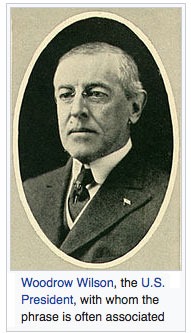
In later years, the term became associated with Woodrow Wilson, despite the fact that Wilson used the phrase only once. Along with the phrase "make the world safe for democracy", it embodied Wilson’s conviction that U.S. entry into the war was necessary to preserve human freedom.