Posted By RichC on April 14, 2016
Although Fatty Goodlander’s book "Creative Anchoring: Everything About Anchors and Anchoring" is a more in-depth guide to anchoring your small boat, a 2014 AllAtSea.net article by the same author is shorter and very good advice. I’ve read it before, but it is worth archiving on my personal blog just in case the link disappears.
Anchoring a Boat: The Ultimate Guide
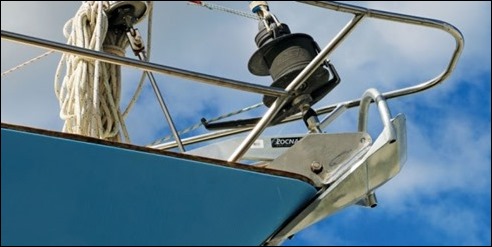
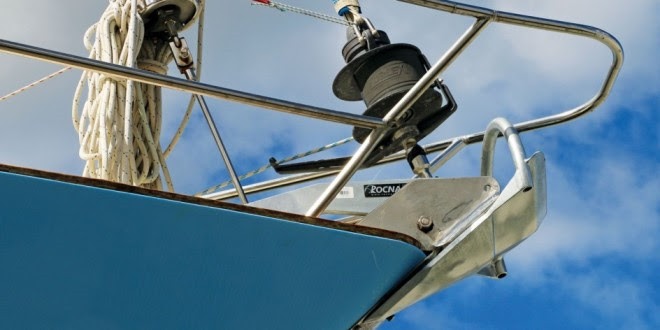
Ganesh’s Rocna anchor fits like a glove
If you don’t know how to safely anchor your vessel for the conditions expected, you should not leave the dock. Anchoring is the bedrock skill of the cruising sailor.
Anchoring is, at its core, extremely simple. However, perfecting your technique and adapting your gear to the conditions experienced can take a lifetime. I’m on my 54th year of living aboard; the vast majority of that time has been spent sitting on my own hook.
During the course of 2+ circumnavigations and over 100,000 ocean miles sailed, I’ve experienced a wide variety of anchoring situations. I’ve never damaged my vessel—or another vessel—by dragging.
Here’s a brief primer on Anchoring a Boat, to get you started.
First off, let’s consider the anchor—especially the anchor which has pride-of-place on your bow roller.
You can’t effectively and safely anchor with a poorly made, poorly designed ‘no name’ anchor. I’m a frugal guy who watches his pennies—but your ground tackle is no place to economize. Quality costs.
Different anchors do different things well
Some are lightweight. Some are meant to stow in a hawse hole. Others are designed for rock.
Which anchor is best for general use?
Well, that’s the subject of vast controversy and much emotion. But I want to honestly and effectively help my readers to enjoy their boats, and the best way I can do that is just to be honest with my own opinion and experience.
For instance, I believe that, ounce for ounce, the Danforth style anchors are the best in terms of holding. I always carry one. And I’ve been continually amazed at how well they hold in sand or mud if deployed properly with sufficient scope.
But I do NOT carry one on my bow. They don’t always reset when the wind changes. They often become entangled when the current opposes the wind and your vessel circles while tide-bound. Occasionally, a rock or piece of coral jams the flukes up, and they skate across the bottom like it was ice.
Bottom line: almost no cruising boat has a Danforth in its bow roller.
The majority of offshore cruising vessels and circumnavigating sailboats used to have CQR anchors. It was a big advancement. Authorities like Eric Hiscock used and advocated them in the 1950s. They still hold well when properly set in sand. But I believe that new designs are better for a number of reasons.
The Bruce is extremely popular. There are no moving parts. It is strong. However, it doesn’t penetrate grass well. It takes a while to dig in. Soupy conditions aren’t its forte.
The Delta is a very good anchor—with all the advantages of the Bruce and the CQR. It penetrates grass much better. This is the preferred choice in the Med. Super strong!
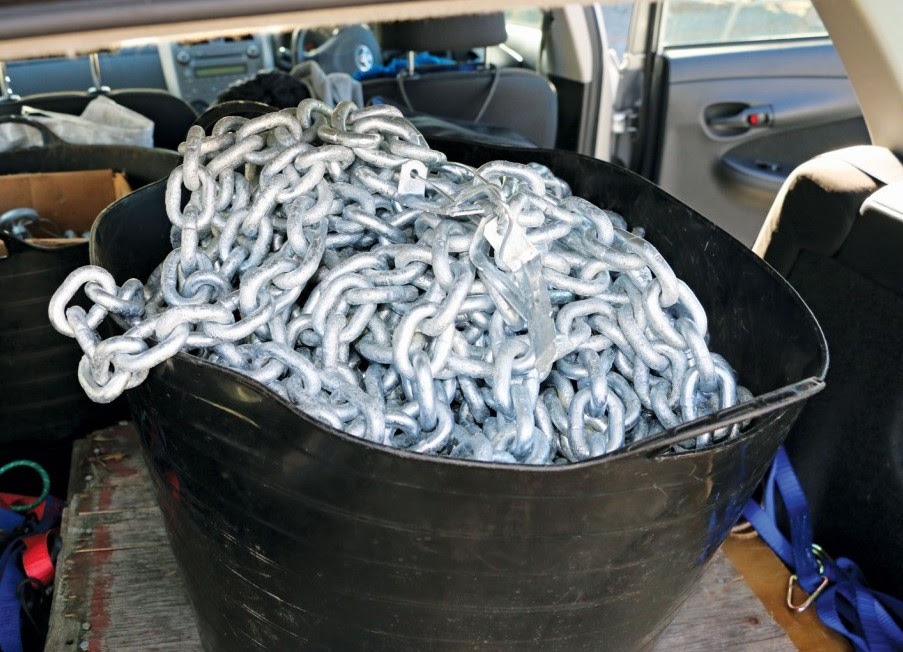
But I carry a Rocna (Editor’s Note: He is referring to the Rocna 25KG which is 55 lbs) with 240 feet of 10mm chain on the bow of my 43-foot, 30,000 pound ketch Ganesh.
- It holds extremely well.
- It works in a wide variety of bottom types.
- It stows in most bow rollers well.
- It sets the fastest of any anchor I have ever had—so quickly it can surprise you (and your gear can be dangerously shock-loaded if your snubber is not in place).
No anchor should be short-scoped. However, if you have to ride to a short scope, a Rocna is a good choice.
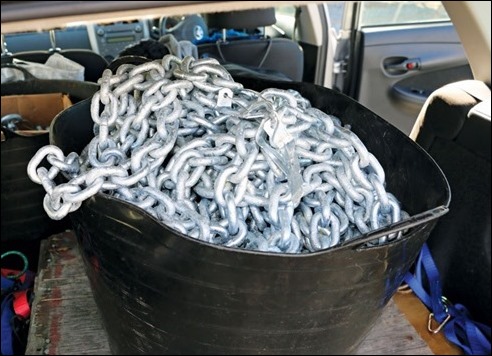
Cap’n Fatty has his chain regalvanized every two years, when possible.
The better the anchor holds—the more it needs to be firmly attached to the vessel.
Most cruising boats use a chain rode. This offers several advantages; chafe is not an issue. The weight, especially in deep water, acts to effectively increase your apparent scope in moderate weather. (Note: this is NOT true in strong conditions.)
Perhaps most importantly, chain can be easily and conveniently handled by most modern deck windlasses—allowing a cruising sailboat to deploy its best gear in a very easy, safe, effective manner. This means you have more protection, more often.
Nylon rope can be used, as well. It is light in weight and offers superior stretch. Alas, it can chafe through on coral or any underwater obstruction at any time—thus, making chain far preferable. (To save weight on a small vessel, I once sailed around the world without chain—Lord, what a hassle!)
Two more notes, seldom considered:
- Galvanized steel is the preferred choice for an anchor and its chain. Steel is extremely predictable, and never fails without warning. If your chain is not rusty, it will hold as advertised—not so, stainless steel.
- Do NOT use ss shackles between a galvy chain and a galvy anchor. Beware of ss anchor swivels, too. Never use an ‘off brand’ or no brand one—and even the best can fail catastrophically without warning.
I do NOT use a ss swivel.
So… The best, most common way to anchor a cruising sailboat in a wide variety of conditions is to use a CQR, Bruce, Delta, or Rocna anchor on galvy chain.
To lessen the shock of the non-stretching chain, I use a 20-foot nylon snubber with a chain claw—which totally insulates the anchor from shock loading and the boat from any bottom noise.
Which leads us to the subject of scope.
What is anchor scope? Why? How much do you need?
Okay, scope is the amount of rode (chain or nylon or combo) you deploy between boat and anchor. How to determine how much scope?
- Take the depth of the water
- add the height of the bow roller above water—and
- times it by five to get the correct scope in light to moderate winds.
Let’s say that you anchor in 15 feet of water, and your bow roller height is five feet. You need 100 feet of rode to anchor. No less.
Nearly all anchor dragging is because of too little scope. 5 to 1 is minimum. 7 or 8 to 1 is recommended in a blow. I deploy 10 to 1 during hurricanes (dozens of which I’ve ridden out successfully, two of which I haven’t).
Why not always put out all your chain? You could. I often do in deserted anchorages. But when other boats are present, it is best to share the resource and limit your scope—or you will limit your friends within the anchorage.
Another factor is bottom type
- sand and mud are good.
- Clay is great.
- Rocks are erratic, and some anchors (Danforth types, for example) are not suited for rocks; this is where Yachtsman and various other small fluke ‘pick’ anchors shine.
It used to be, when I grew up aboard the schooner Elizabeth in the 1950s, that every boat had an armed sounding lead.
Most people are confused by the ‘armed’ part. Simple, each lead weight used for sounding was hollow at the bottom. You’d ‘arm’ it by squishing in a little beeswax—and tossing it overboard to the bottom. The wax would bring up the bottom-sample embedded in it, hopefully sand or mud.
Today I use an inexpensive fish finder. It indicates the hardness of the bottom (after you get used to reading its graphic display) and shows if there are any coral heads or other obstructions on the bottom.
Tips!
- One should, of course, avoid anchoring on a lee shore—where the wind is pushing you onto the beach and the seas can build without hampering.
- It is best to anchor in an enclosed harbour with the wind blowing off the beach. It will be flat calm in terms of seas (waves). If the harbour is truly snug and landlocked, it won’t matter if the wind veers or clocks.
- Another factor is reaction time. Let’s say you go into a landlocked harbour to sit out an easterly blow. You should anchor on the eastern side of the harbour, so you have minimal waves and maximum reaction should you begin to drag.
- Thus, you should never anchor too close directly behind someone—it is poor seamanship and bad manners.
- The time honored rule in relationship to other vessels is dead simple; the first vessel to anchor has rights. If you anchor anywhere around it, it is up to YOU to not hit IT.
Ideally, all vessels anchored in a harbour should have 5 to 1 scope. This is seldom the case. Usually, our precious natural resources are shared; some boats are at a dock, others on moorings, some stern to, and the rest swing to their hooks.
You can not come in and anchor unless you can do so safely—without damaging the other vessels REGARDLESS of what happens in terms of wind, tide, and current.
You also need to pay attention to how the other boats are maintaining their positions. Boats on mooring generally swing in a lot tighter circle than boats on anchors.
In the Bahamas, two anchors deployed off the boat are almost mandatory. In Hiva Oa in the Pacific, two anchors are required—one off the stern and one off the bow. In Turkey, a stern line is taken ashore in most places after the bow anchor is deployed.
The point is: when in Rome, do as the Romans do. If everyone has an anchor ball deployed (as they do in the Med), deploy yours. Forget it in the Great Lakes; they wouldn’t even know what a black ball is. (It means ‘anchor down’ and is mandatory under international law most places.)
If you don’t have a black ball up, someone can hit you and claim you were maneuvering—or that they didn’t know you were anchored, etc.
Here’s how to deploy for precise anchor placement
Let’s say you want to anchor in twenty feet of water in a crowded harbor.
- Slowly cruise around until you find your preferred spot. Place your vessel exactly where you want it to be, the place at which you want it to end up anchored.
- Check to see if there’s a current, AND if other nearby vessels are also anchored with chain rodes. If the answers are no and yes, proceed directly upwind while letting out 15 feet of chain.
- When you are 120 feet upwind, stop, and put your engine in reverse. The moment you start to gather stern way (within 10 feet) drop your anchor on the bottom. Slowly pay out rode, occasionally ‘almost’ snubbing off.
- Now deploy your nylon snubber around 90 feet or so. If you backed up 10 feet before dropping and it took ten feet for your anchor to set–and you desire 5 to 1 scope, you should be exactly where you were (and want to be) when 100 feet of rode is out.
- Slowly increase throttle astern until your anchor chain is taut, then run up to half RPM. Carefully check your shore bears to confirm you are holding. Maintain this position for one full minute, then throttle down. You are done.
Your vessel will move forward a bit, from the weight of the chain. You should stay there if the wind remains constant, and change safely in relationship to the other vessels if it does not. If the holding ground is good and your gear ample, you should be fine up to 50 knots in smooth water.
My policy on vessel proximity is simple
I attempt to anchor as prudently as far away from another vessel as possible. If for any reason the other fellow thinks I’m too close—I am! I either don’t anchor or move immediately.
If I inform a vessel’s skipper that he’s anchoring too close and, in the middle of the night, there’s contact—I expect him to pay all my damages and certainly will not be liable for his.
I don’t like involving the law, but once a guy did a lot of damage to my vessel after being told repeatedly that he was too close and repeatedly politely asked to leave—and when the judge heard this, the trial was effectively over.
Anchoring a Boat in a hurricane
Anchoring in a hurricane incorporates all of the above—with an emphasis on chafe.
I pre-rig three snubbers to my chain—and swath my nylon with canvas or hose. Sometimes I put a short piece of Dacron® where my gear comes aboard—Dacron® doesn’t melt as easily as nylon from the intense friction.
I also slather it with grease if the line is showing signs of rapid wear—and have plywood and crowbars standing by to deal with chains or rodes sawing through their hawse holes and cutting a straight line down through the hull and deck! (Faster Horses had exactly this happen to them in 1989 during Hurricane Hugo.)
The bottom line on staying connected to the bottom—it is usually possible in moderate conditions with the proper gear properly deployed.
If you know how to anchor your vessel, you have my respect. If you do not—whether you are on an 8’ Opti or a 124’ Oyster—you do not.
Publisher’s note: Fatty and Carolyn are currently in the Western Pacific, practicing what they preach.
http://www.allatsea.net/anchoring-a-boat-the-ultimate-guide/
Category: Archive, Sailing |
No Comments »
Tags: anchor, anchoring, archive, fatty, fatty goodlander, goodlander, sailboat
 What a mess of "tiny snakes" as my daughter call the the organized harnesses of wires connected to my cars ECU.