Will President Obama win back public trust?

Posted By on December 20, 2013

I listened to the president answer questions in today’s long news conference and it was interesting to hear reporters finally drill down on the Obama administrations’ blunders and shortcomings. For the past five years most network reporters in the Whitehouse press corps  have been pretty gentle with questions and all but a few seemed to avoid difficult the questions. I’m sure what finally gave journalists a backbone, maybe it was the spying issues or the blood in the water associated with Obamacare, but the overly gentle tone is gone. He deflected and used humor when responding and avoided blaming Bush, the Tea Party, Republicans in congress and FoxNews as is his custom.

While listening I read an article on the conservative website by The Heritage Foundation. Alyene Senger listed a ten of the broken promises which give most of us pause when it comes to believing what President Obama “says” … and then what ends up being true (highlighted by me). Trust is a hard thing to earn back Mr. President, even from those who really liked and agreed with your policies.

Ten Broken Promises – 12/18/2013

Since the passage of Obamacare in 2010, many of the President’s famous promises have been routinely broken. As he so ironically threatened in 2009, “If you misrepresent what’s in this plan, we will call you out.”[1] To that end, here are 10 promises of Obamacare that have already proved to be broken.

Promise #1:If you like your health care plan, you’ll be able to keep your health care plan, period.”[2]

Reality: Millions of Americans have lost and will lose their coverage due to Obamacare.

Obamacare has significantly disrupted the market for those who buy coverage on their own by imposing new coverage and benefit mandates, causing a reported 4.7 million health insurance cancelations of an existing policy in 32 states.[3]

For those with employer-sponsored insurance in the group market, the Congressional Budget Office (CBO) projects that 7 million fewer people will have employment-based insurance by 2018.[4]

Moreover, the Administration itself has admitted that employers would not keep their existing health plans. Federal regulations written in 2010 estimated that 51 percent of small and large employers would lose their “grandfathered status” by 2013—meaning a majority of employers would not keep their existing health plans.[5]

Promise #2: “[T]hat means that no matter how we reform health care, we will keep this promise to the American people: If you like your doctor, you will be able to keep your doctor, period.”[6]

Reality: Many Americans might not be able to keep their current doctor without paying extra.

Many plans offered on Obamacare’s exchanges have very limited provider networks, decreasing the chances consumers will be able to keep their current doctor without paying more money.[7] Furthermore, many Americans who purchase coverage on their own have had their existing health plans changed or canceled due to Obamacare, resulting in some people being unable to keep their current doctors without paying additional money to do so.

Due to the significant payment reductions included in Obamacare, seniors with Medicare Advantage plans may be forced to find new doctors. The largest provider of these plans, UnitedHealth, has recently reduced its provider networks in several states.[8]

Promise #3: “In an Obama administration, we’ll lower premiums by up to $2,500 for a typical family per year.”[9]

Reality: Premiums for people purchasing coverage in the individual market have significantly increased in a majority of states.

A Heritage analysis shows that, on average, consumers in 42 states will see their premiums in the exchanges increase, many by over 100 percent.[10]

For people with employer-sponsored coverage, costs also continue to increase. For families, premiums from 2009 to 2013 have increased by an average of $2,976.[11]

Promise #4: “[F]or the 85 and 90 percent of Americans who already have health insurance, this thing’s already happened. And their only impact is that their insurance is stronger, better and more secure than it was before. Full stop. That’s it. They don’t have to worry about anything else.”[12]

Reality: Obamacare imposes certain new benefit mandates on those with employer-sponsored coverage—a majority of Americans.

These mandates increase the cost of coverage. In fact, federal regulations written in 2010 assumed “that the increases in insurance benefits will be directly passed on to the consumer in the form of higher premiums. These assumptions bias the estimates of premium changes upward.”[13]

But higher premiums not only cost people more money; they have other impacts on coverage as well. For instance, as a response to the direct cost increases associated with Obamacare, UPS dropped coverage for spouses of employees if they are offered coverage through their own employers.[14]

Promise #5: Under my plan, no family making less than $250,000 a year will see any form of tax increase.”[15]

Reality: Obamacare contains 18 separate tax hikes, fees, and penalties, many of which heavily impact the middle class.

Altogether, Obamacare’s taxes and penalties will accumulate over $770 billion in new revenue over a 10-year period.[16] Among the taxes that will hit the middle class are the individual mandate tax, the medical device tax, and new penalties and limits on health savings accounts and flexible spending accounts.[17]

Promise #6: I will not sign a plan that adds one dime to our deficits—either now or in the future.”[18]

Reality: Obamacare’s new spending is unsustainable.

Obamacare was passed into law relying on a wide variety of unrealistic budget projections. A more realistic assessment reveals that it will be a multi-trillion-dollar budget buster. The Government Accountability Office (GAO) estimated the cost of Obamacare over the long term if certain cost-containment measures were overridden. Under that alternative scenario, which assumes that “historical trends and policy preferences continue,” the GAO found that Obamacare would increase the primary deficit by 0.7 percent of gross domestic product (GDP).[19]

Senator Jeff Sessions (R–AL) and the Senate Budget Committee staff, who commissioned the GAO report, translated the 75-year percentage estimate into today’s dollar amount, which would be $6.2 trillion over the next 75 years.[20]

Promise #7: “[W]hatever ideas exist in terms of bending the cost curve and starting to reduce costs for families, businesses, and government, those elements are in this bill.”[21]

Reality: Health spending is still rising and is projected to grow at an average rate of 5.8 percent from 2012 to 2022.[22]

While growth in health spending has been slower recently compared to the past, that is largely due to the sluggish economic recovery. Indeed, Obamacare’s new entitlements will help drive greater health spending in 2014 and beyond.[23]

Promise #8: I will protect Medicare.”[24]

Reality: Obamacare cuts Medicare spending.

Obamacare makes unprecedented and unrealistic payment reductions to Medicare providers and Medicare Advantage plans in order to finance the new spending in the law. The cuts amount to over $700 billion from 2013 to 2022.[25] If Congress allows these draconian reductions to take place, it will significantly impact seniors’ ability to access care.[26]

Promise #9: “I will sign a universal health care bill into law by the end of my first term as president that will cover every American.”[27]

Reality: Millions of Americans will remain uninsured.

Despite spending nearly $1.8 trillion in new spending from 2014 to 2023, the law falls far short of universal coverage. Indeed, Obamacare is projected by the CBO to leave 31 million uninsured after a decade of full implementation.[28]

Promise #10: “So this law means more choice, more competition, lower costs for millions of Americans.”[29]

Reality: Obamacare has not increased insurer competition or consumer choice.

In the vast majority of states, the number of insurers competing in the state’s exchange is actually less than the number of carriers that previously sold individual market policies in the state.[30] And at the local level, for 35 percent of the nation’s counties, exchange enrollees will have a choice of plans from only two insurers—a duopoly. In 17 percent of counties, consumers will have no choice—a monopoly—as only one carrier is offering coverage in the exchange.[31]
Gold bugs take another hit closing below $1200 an ounce

Posted By on December 19, 2013

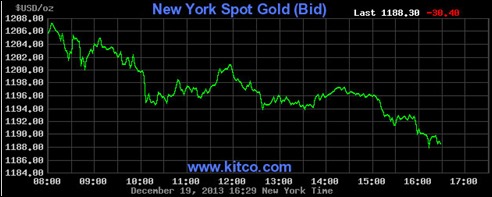
goldkitco131219

Gold dropped to a six-month low on Thursday selling off as the Federal Reserve’s pulled back in the U.S. monetary stimulus.  It closed down 2% to $1,196.31/ounce which is the lowest since June 2013. Give credit or blame the Fed which took its first step in winding down the easy money policies which helped to drive gold to record highs in the past few years.

Realistically the Fed’s move on Wednesday to trimmed the pace of its monthly asset purchases was modest. They inched back by $10 billion to $75 billion. With the U.S. central bank also lowering its expectations for both inflation and unemployment over the next few years, concern eased and gold lost value. "A lot of gold investors are anticipating deflation not inflation as a result of the Fed announcement, taking advantage of the downside momentum and shorting gold at least temporarily," said Jeffrey Sica, chief investment officer of New Jersey-based Sica Wealth with over $1 billion in client assets.

Woodworking: The best material for a table saw throat plate

Posted By on December 18, 2013

StarboardInsertIMG_2393

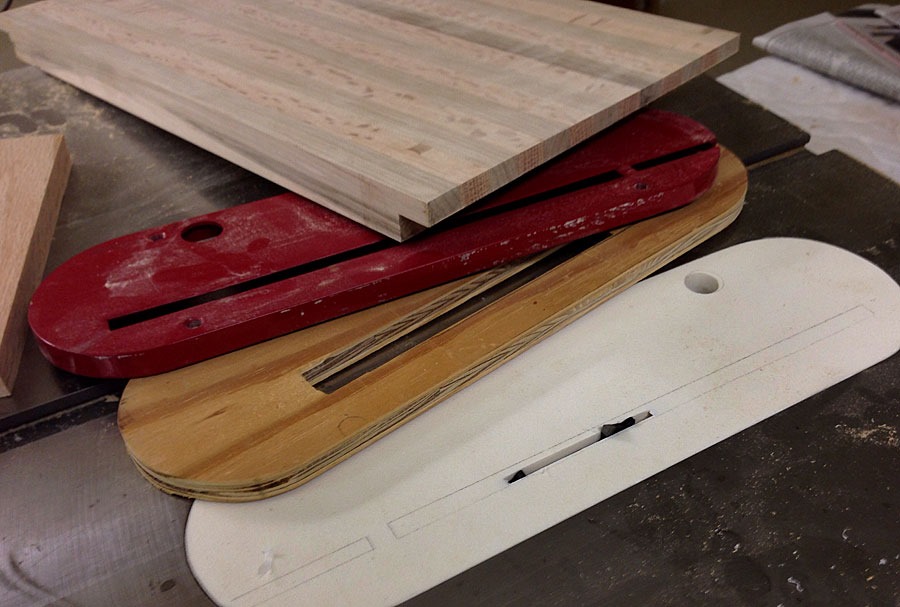
When needing to make precise cuts or dadoes on the table saw, I have found that making them from the marine material Starboard is the best (shop around for price). Most likely the experts in woodworking have found other stock that would just as well, like the self-healing cutting board material, but since I had a few extra cut-off from boating projects this worked great for me. I just outline with a pencil from a previous throat plate, rough cut on the bandsaw an finish to fit with a sander … just be careful not to overheat or load up the sanding disk. The material that I used is just thick enough to permit four screws that can be tweaked to offer a perfectly flushed table top surface and the plastic material is both stiff and slick enough for wood to slip nicely, whether using a fence or slide.

Updating WordPress to release 3.8 known as “Parker”

Posted By on December 17, 2013

It feels better to get WordPress updated to the current 3.8 version, as well as updating all the plug ins. This latest version is named “Parker” in honor of Charlie Parker, but don’t ask me what bebop has to do with blogging? 

Along with getting WP updated, a database optimization and backup was in order as well. Whew, it is nice when it all goes smooth. 

One year ago today my mom passed away

Posted By on December 17, 2013

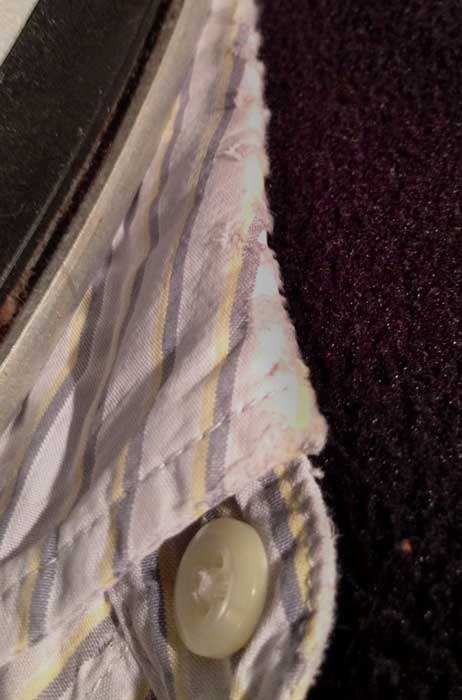
shirtcollar_momc_131217sIt has been a busy year with weddings, graduations and new jobs  … and they would have been enjoyed A LOT by my mom, especially if she had better health. Unfortunately her last year of life was difficult — with constant pain, reliance on mind numbing pain medication and the inability to do even relatively simple things. Who wants to live like that? Not me … or in the later months, not mom. Thankfully, she does not have to suffer anymore(12/17/2012).

I miss my mom and remember the simple things she did that demonstrated her love for me. An example was  how she turned my shirt collars. “Huh,” you ask? Well, even though my mom gave up on “darning socks” in the 60s, she continued fixing my shirts and turned the worn collars by re-stitching them “new side up” allowing me to get double the wear out of my shirts. As it is often said,it is the simple things in life that mean the most.” I love and miss you mom.

momc100102_palmpre
Mom (Jeanine Corbett) at home in Sidney Ohio — October in 2010

Corbett Christmas Letter number thirty-one — 2013

Posted By on December 16, 2013

CorbettChristmasLetter2013tMerry Christmas to those who regularly read my “desultory” daily posts or may have just stumbled onto my blog. It has been a busy year and although my Google Analytics stats are no longer growing (they are actually down), the AdSense revenue is up? That aside, I am including more archival information “for me” than being focused on being newsworthy. I attribute the decline in views to more content being read on phones, privacy and cookie blocking in browsers and an overwhelming amount of content available on the Internet … along with my opting to post more “personal content” rather than sharing news about technology and gadgets or information on biodiesel, aviation and Volkswagen TDIs.

As has been my habit in the last few years, I am again including our personal annual Christmas letter as a PDF for those who might be closer friends or family. Not to worry if you are on our Christmas card list though, as Brenda refuses to give up on personal snail mail cards and letters. Either way, you’ll get the message that we want to wish you all a very Merry Christmas and a and healthy and Happy New Year …  and Brenda would want me to include a “carpe diem” to all.

Its beginning to look a lot like Christmas

Posted By on December 15, 2013

Christmastree2013We’re closing in on Christmas and it is beginning to look a little more festive around our house. I still have a few things to do, but at least the tree is up and decorated. It is a bit smaller this year but I didn’t have someone twisting my arm!

This is the first year that Taylor hasn’t been around for the annual Corbett Christmas tree “battle” over choosing the right tree. We have always done this together and secretly I think we have both enjoyed the “feisty debate” over the size and price of a tree, and essential father-son Mexican lunch. I’ll let you guess who wanted the tree bigger, and who wanted it cheaper.
Winking smile
I have to admit I miss having Taylor around … maybe about as much as he misses being around … at least that’s how I read his Facebook post“Starting the countdown till when I’ll be back in Cincy! 11 days — never thought I would be this excited.”

A few amateur radio updates including my new call: K4RDC

Posted By on December 14, 2013

FirstPactorHFExchange131213My older SCS PTC-IIe Pactor modem came back from Farallon Electronics after being updated with a new electronic serial number and Pactor III update – faster speeds using the HF radio (still very slow by modern Internet standards). A Winlink account is now active and seems to be working over Telnet, so the step is to find a station and tune it in manually with my Icom IC-718 (no auto tuning from computer). Currently the temporary 20-meter dipole antenna is not tuned but plans are to improve both the antenna and add an Icom AT-130 tuner. It is a little limiting since I’m not transmitting and receiving the strongest of signals, but after a little experimenting I was able to exchange data with a couple east coast stations and one in Florida, the Sarasota Power and Sail Squadron, using the RMS Express email client on my six year old Win7 Gateway notebook.

1stPactorHFEmail131213

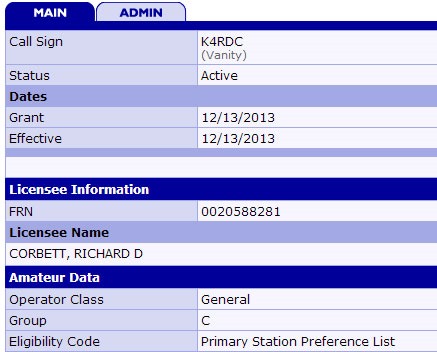
About the time everything was set up and working using my old KD8VSB call sign, I received notice from the FCC that my call sign request has been canceled and updated with the new shorter personalized “vanity” call – K4RDC. Time to set it all up again with the new call and email address.

newcallK4RDC

Tech Friday: Annoying Microsoft Windows Automatic updates

Posted By on December 13, 2013

googlecomputer   mswindowsicon bingbaricon

As the big tech companies look for ways to push the use of their products, some of us are looking for ways to keep them from taking over our computers. I welcome having the option (easy option) to disregard the intrusions, but often spend too much time ignoring, opting out or disabling something that should be an “opt in” choice.

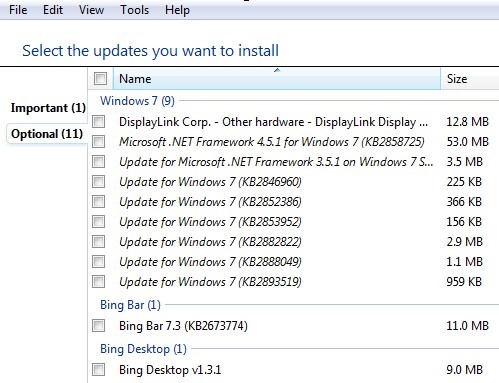
A perfect example is in using Microsoft’s Windows Update. It is relatively easy to turn the entire service off, but that’s not necessarily prudent or something I wanted to do. So I set the service to “pop-up” and let me know when “important updates” are available and then choose to install on my time. Unfortunately the nag seem to be way too often and requires regular reboots even on Windows 7 (something I thought was improved?) msupdates131209BUT more than that, I am frustrated in seeing the same couple of “updates available” for features I don’t want. ie. Bing bar and Bing Desktop.

If you choose not to download and install an update, it frustratingly remains “available for you the next time you visit Windows Updateand the next time, and the time after that as well.” I my mind, there’s no reason to see this over and over again in list of available updates. Of course, there isn’t an obvious way to remove the item from the list barring installing it (no thank you). Thankfully there is a less than obvious way to hide the update from appearing … and it is somewhat hidden and is easy to overlooked.

In the list of available updates, right-click any update that you don’t want to see again, and choose Hide Update. If you later change your mind—or if you just want to see a list of the updates you’ve chosen to hide—on the main Windows Update page, click Restore Hidden Updates.

bingrtclickhide

Can’t imagine airline seats getting much narrower …

Posted By on December 12, 2013

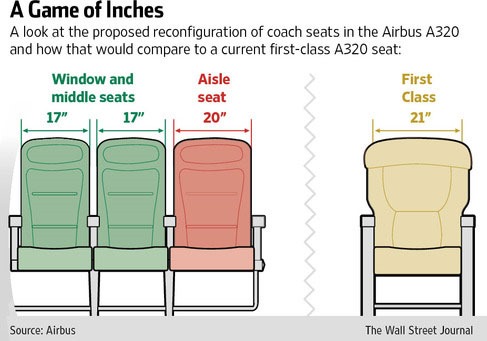
The more delays and longer the flight, the more cranky passengers are bound to get. Now imagine sitting in the middle seat of modified Airbus A320 as the scrunched seats get smaller and give up 3 more inches to the aisle seats? Oh, I’m sure those fortunate enough to book the wider seats, will be happy, but at the expense of your two seat mates?

gameofinches

A “Middle Seat” travel article in the WSJ today mentioned that Airbus is offering a wider seat to airlines “thinking” they could squeeze a few more dollars from travelers willing to buy “more square inches of space” (I’m thinking about the Michael Douglas character talking to Kathleen Turner in “War of the Roses” – see YouTube trailer about the 1:50 mark). 

According to Scott McCartney, Airlines are surprisingly reluctant to price their wider seats higher as they do for those with more legroom — we’ll see how long that lasts. For now, it looks like keeping a close eye on the aircraft model (A320)when I book tickets … although suspect most of us over 6 foot are already vying for the aisle seats?

Snippet below … pertaining to our “growing girth.”

The growing girth of people has led to wider seating areas in many public situations where space is limited and packing in seats can lead to more revenue. In 1990, the average seat in performing-arts theaters was 21 inches. By 2010 that grew to 22 inches, according to a study by Theatre Projects Consultants Inc. The new Yankee Stadium opened in New York in 2009 with seats ranging from 19 to 24 inches wide, compared with 18 to 22 inches in the old Yankee Stadium, according to the baseball team. The basic seats on Amtrak’s Acela trains are 21 inches wide. (Older trains have coach seat cushions 20 inches wide.)

But airlines have been making coach seats skinnier, not wider. On widebody jets, airlines have more flexibility to determine how many seats they want in each row. On American Airlines’ existing Boeing 777-200s, for example, the airline has nine seats in a row. On its new 777-300s just being put into service, coach cabins have 10 seats in each row. The width of the fuselage didn’t change—it’s a longer airplane—so the seats shrank from more than 18 inches to about 17 inches. Other airlines are making similar moves with widebody cabins.

Desultory - des-uhl-tawr-ee, -tohr-ee

  1. lacking in consistency, constancy, or visible order, disconnected; fitful: desultory conversation.
  2. digressing from or unconnected with the main subject; random: a desultory remark.
My Desultory Blog